
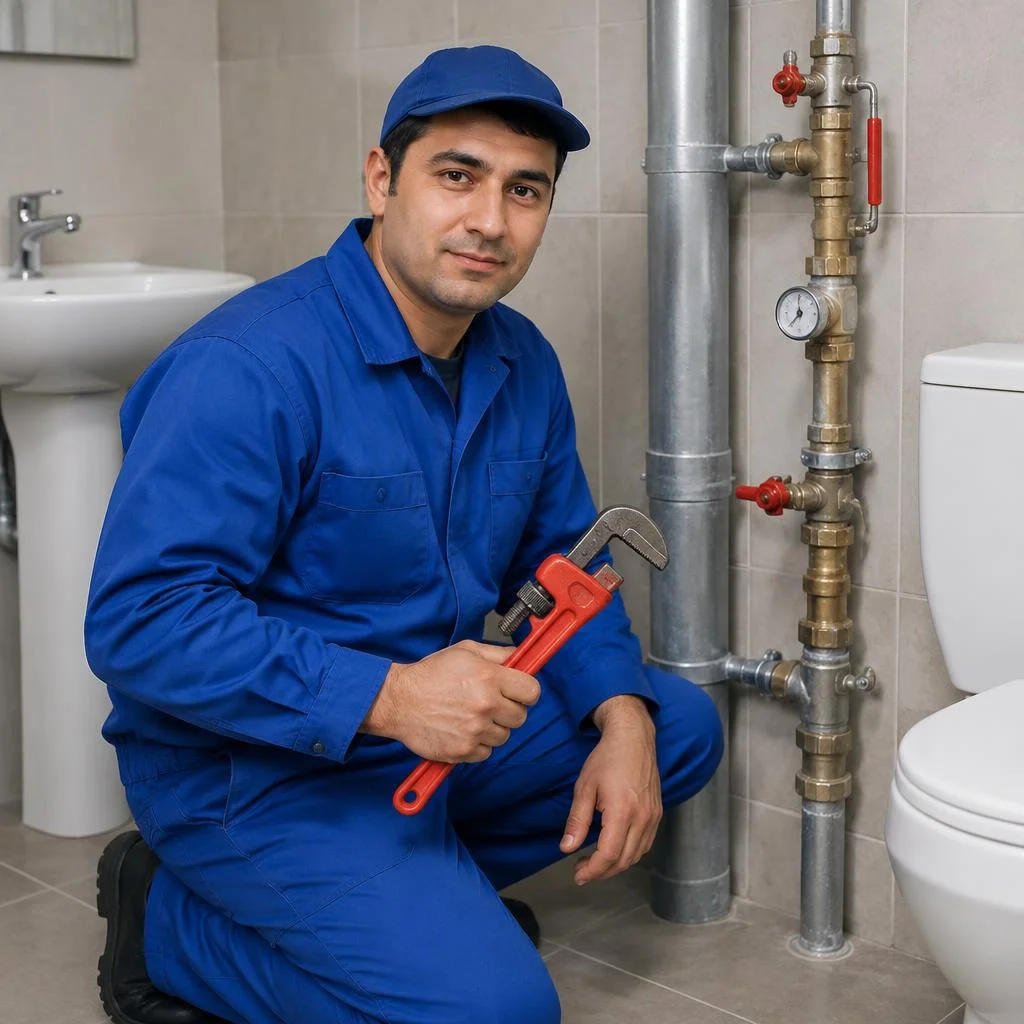
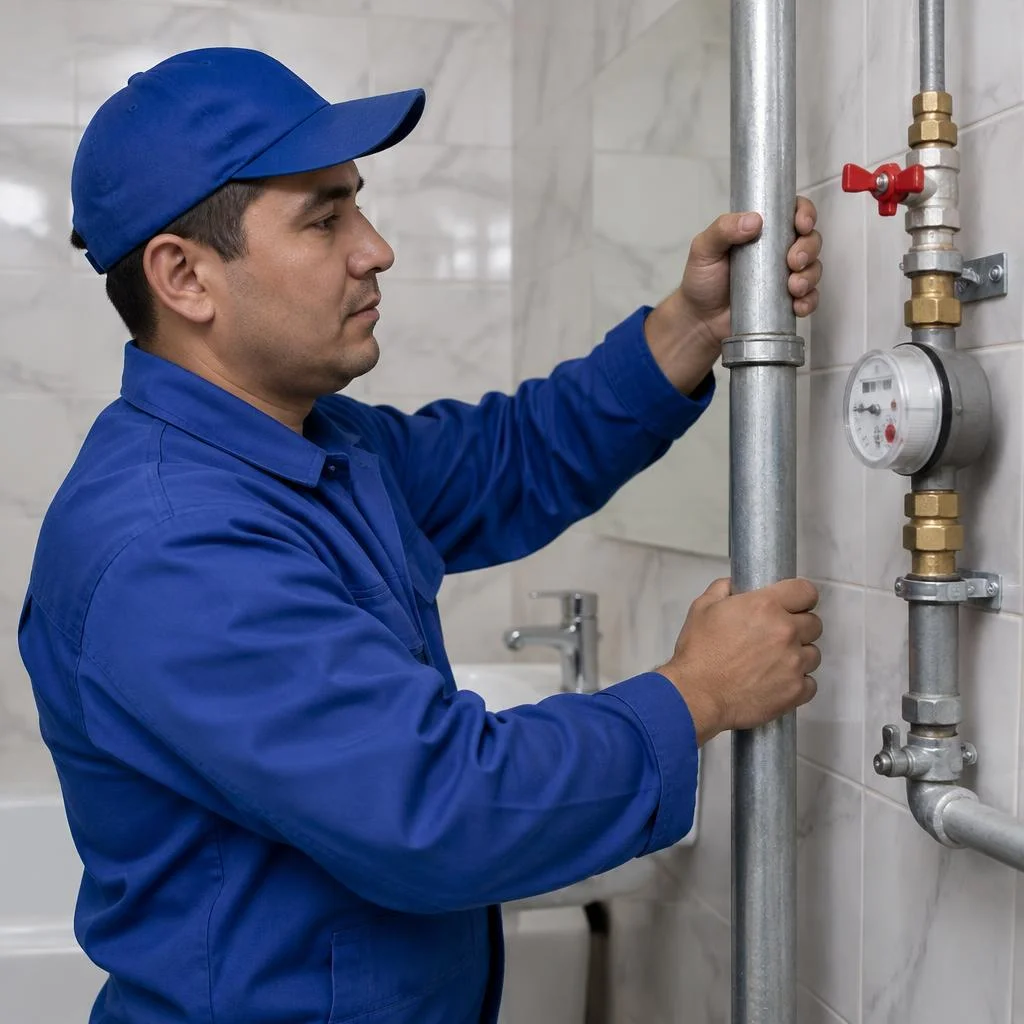
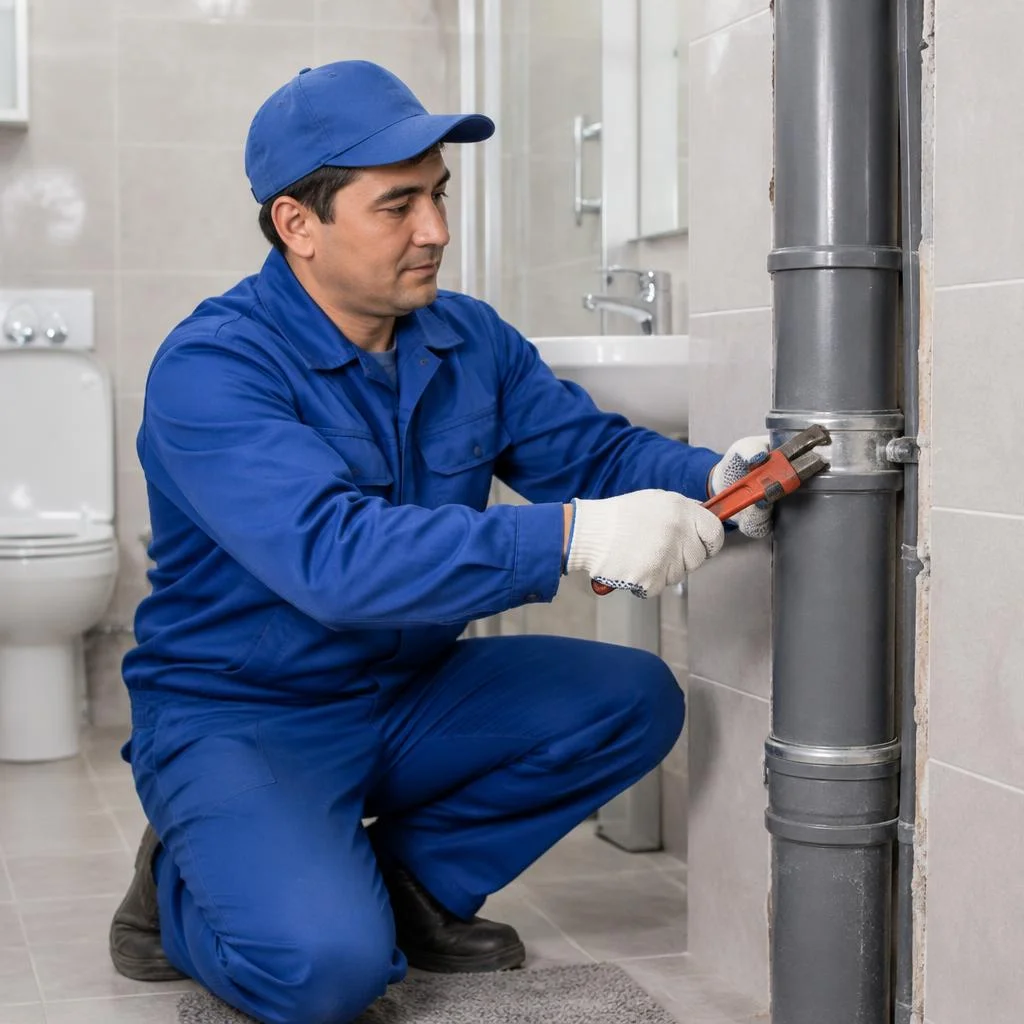
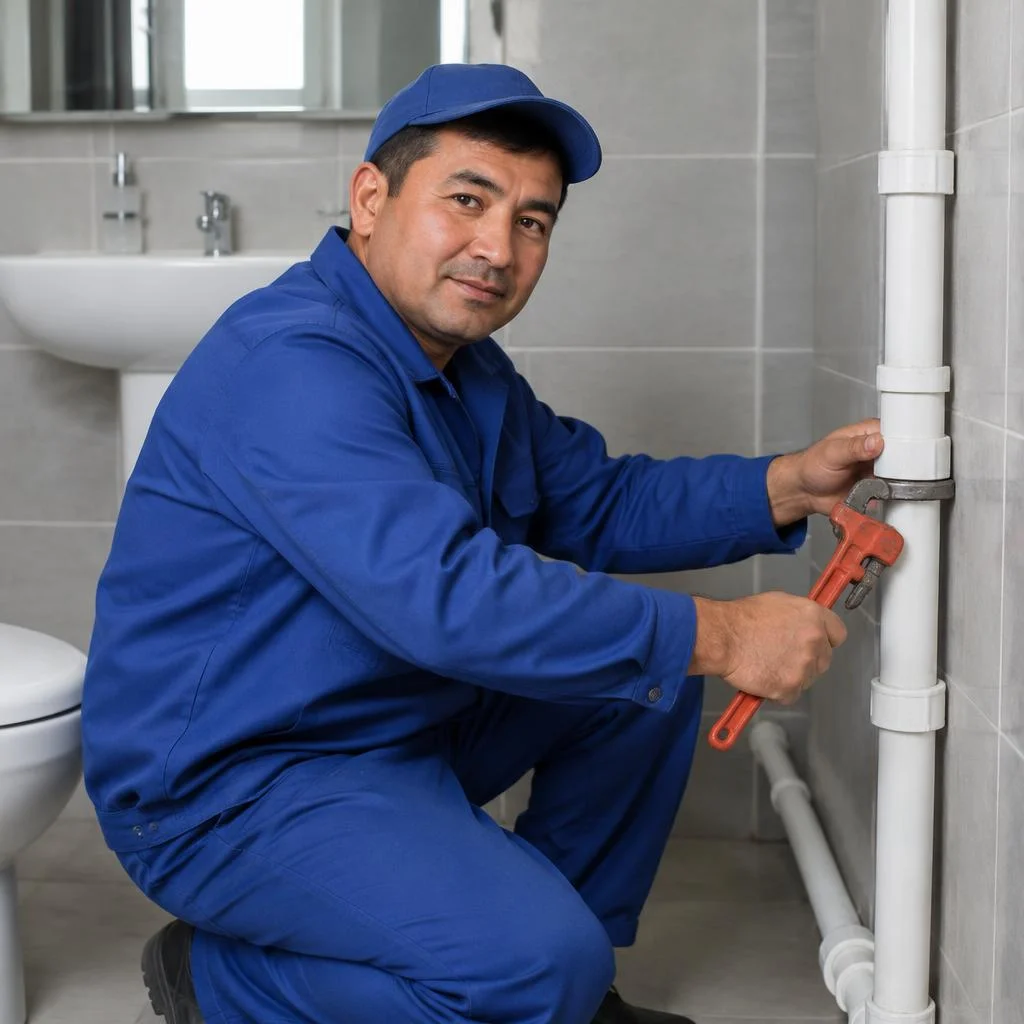








When it's time to replace the riser: signs of wear and risks for the apartment
A riser is a shared pipe for an entire building entrance, and wear in it shows up before the first leak. Let's break down the signs by which a technician recommends replacement, and the risks for the apartment if you delay.
Signs that a cold or hot water riser needs replacement
- Rusty water: after the tap has been idle, the water runs brown or reddish — the inner walls of the pipe are already flaking.
- Pinholes and seepage: brown spots, droplets or wet streaks appear on the visible part of the riser at the joints.
- Weak pressure: a thin stream with the tap fully open indicates the bore has become overgrown from the inside.
- Noise in the pipe: humming, knocking or "singing" when neighbors use water is a sign of corrosion and a narrowed passage.
- Cold water from the hot tap: if cold water comes out of the hot tap, the hot water riser is partially clogged or shut off.
- Age of the building: cast iron and steel older than 30 years have exhausted their service life even without visible defects.
Why a worn-out sewer riser in a panel building is dangerous
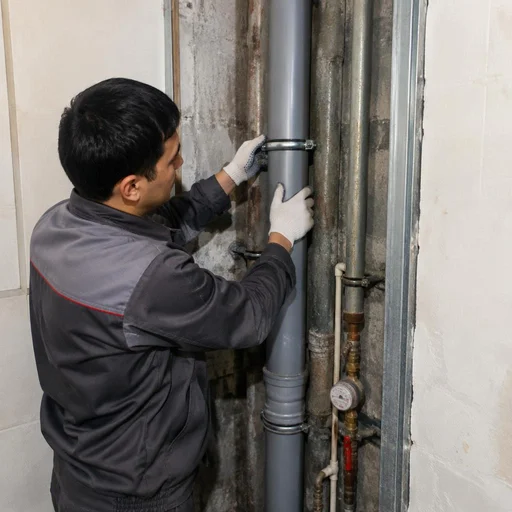
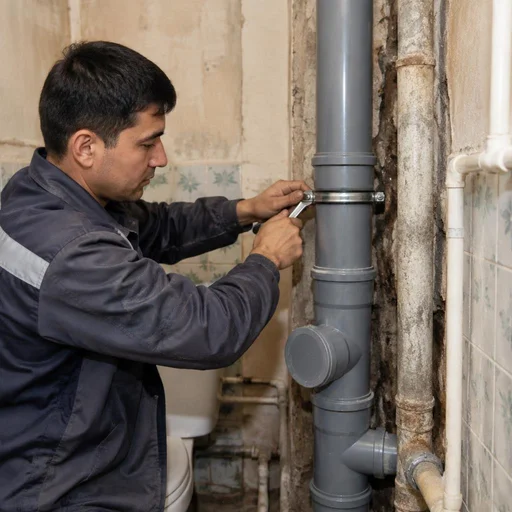
In panel buildings, cast iron sewer risers from the 1970s–1990s have exhausted their standard service life: cracks along the sockets and odors in the bathroom are a typical picture for entrances with such piping. Cast iron is brittle in bending, and panel joints settle over time — the pipe cracks precisely at the sockets, where the metal is thinner. Odors in the bathroom appear before a leak: sewer gases penetrate into the apartment through microcracks, and when there's a blockage, water flows down to the lower floors. Steel sewer risers in Khrushchyovka buildings corrode on the outside — condensation on a cold pipe eats through the metal in 15–20 years, long before the internal service life is used up. A sewer leak on the upper floors shows up at the lower neighbors' — it has to be fixed by the entire entrance at once, otherwise replacing just one section yields no result.
How risers differ in an apartment, a bathroom and a private house
| Object | Work specifics | What to coordinate |
|---|---|---|
| Apartment | Shared riser with neighbors in the entrance | Shutoff with the management company and access to apartments |
| Bathroom | Local section with piping and inspection port | Only in-apartment work |
| Private house | Autonomous system, its own inlet | Nothing except inspecting the inlet |
Eco-Service divides work into three categories by object: a riser in an apartment (shared with neighbors), a riser in a bathroom (a local section with piping) and a riser in a private house (an autonomous system with no coordination required). Installing risers in an apartment in a panel building takes longer due to coordinating access, while in the private sector the technician works without pausing for neighbors. Clients often search for "bathroom riser replacement price" — and land on our page, because the query reflects a real task: renewing a pipe section in the bathroom. A separate category of requests is heating: people search for "heating riser replacement cost," and from that query the technician immediately understands that it's about the heating circuit, not water supply. The cost of water supply work depends on the scope: in a private house, renewing the riser doesn't require shutting off the entrance, but it does require inspecting the inlet — otherwise the new pipe butts against the old inlet and leaks at the joint.
Types of risers and materials: what to install instead of cast iron
The service life, installation method and labor intensity of the work depend on the riser material. We break down what we install by default instead of cast iron and steel pipes, and when alternatives are appropriate.
Polypropylene PN20 and PN25 — Eco-Service's base material
Eco-Service installs risers made of polypropylene PN20 for cold water supply and PN25 for hot water supply: the reinforced layer withstands temperatures up to 95 °C and pressure up to 25 bar, with a service life of 50 years. For the cold circuit we use pipe with a nominal pressure of 20 bar and a wall thickness of 3.4 mm at a diameter of 25 mm; for the hot circuit — with internal reinforcement with aluminum or fiberglass to compensate for linear expansion. Welding of polypropylene pipes is done with a socket fusion iron at 260 °C; fusing fittings takes 6-10 seconds per joint, and the joint must cool for another 2 minutes before reaching working pressure. For hot water supply you must not use PN20 without reinforcement — the pipe warps when heated, and after a season the joint with the fitting leaks at the weld.
Cross-linked polyethylene and metal-plastic: when they are appropriate
Eco-Service uses cross-linked polyethylene and metal-plastic selectively — on sections with bends and in cramped bathrooms where polypropylene welding is impossible due to the bend radius. PEX-a with a slip-on sleeve withstands 95 °C and a working pressure of 10 bar, bends along an arc with a radius of five diameters or more, and does not require compensators on short branches. Metal-plastic with an aluminum layer holds its shape more rigidly, but every connection is a press fitting or a threaded riser connection with a seal that requires tightening over time. In requests, clients often write briefly — "replacement of the sewer riser in an apartment price" — and based on such a request the technician immediately clarifies the floor, the material of the existing pipe and the number of bathrooms. Metal-plastic requires press fittings and inspection hatches at every connection — on a riser these are extra access points, so as a primary material it loses out.
Comparison of riser materials by service life and installation conditions
| Material | Service life | Working temperature | Installation specifics |
|---|---|---|---|
| Polypropylene PN20 | 50 years | up to 60 °C | welding with a socket fusion iron |
| Polypropylene PN25 | 50 years | up to 95 °C | reinforcement, compensator on the riser |
| Cross-linked polyethylene PEX-a | 30-50 years | up to 95 °C | slip-on sleeves, bending along a radius |
| Metal-plastic | 25-30 years | up to 95 °C | press fittings, inspection hatches |
| Cast iron | 40-60 years | up to 100 °C | weight of the section, fastening to the wall |
| Galvanized steel | 20-25 years | up to 90 °C | threading, tendency to corrosion |
The cost of the work consists of the material, the number of fittings and the scope of dismantling. Cast iron lasts longer than steel, but dismantling is more difficult: the weight of the section requires two installers and fastening to the wall — this affects the duration of the work, not the choice of material.
Replacement of water supply and sewer risers: turnkey work stages
Installation of water supply and sewer risers follows a fixed procedure — from diagnostics to pressure testing. We break down each stage: what is done during preparation, how the assembly is put together, and how tightness is checked.
Dismantling the old riser and wall chasing: how preparation proceeds
- Assembly diagnostics: the technician opens the box, assesses the condition of the cast iron, marks out the route of the new pipe and the attachment points for the clamps.
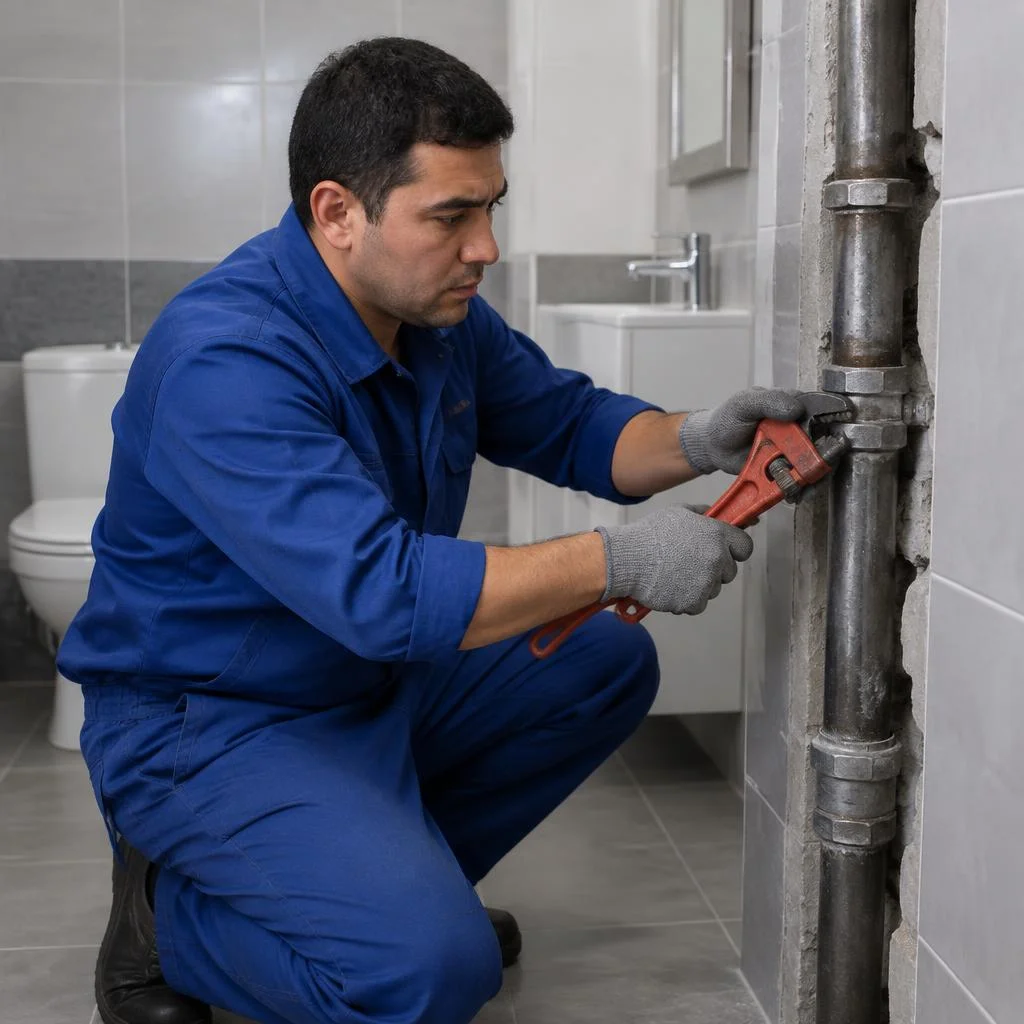
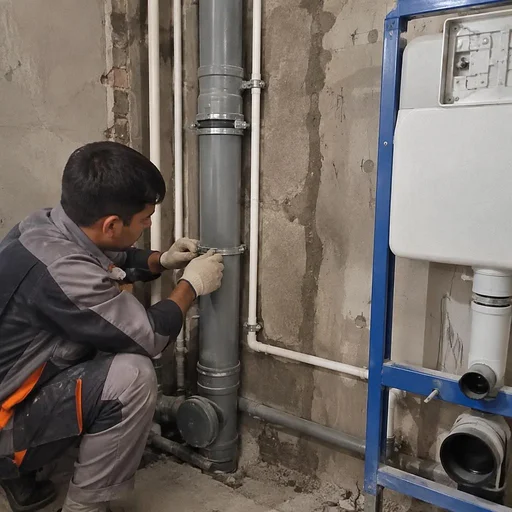
- Dismantling the old riser: the cast iron is cut with an angle grinder into sections of 40-60 cm, each carried out separately — the pipe will not fit through the doorway in one piece.
- Dismantling with removal: ordered when the riser runs through a living room — the debris is loaded and taken away immediately so as not to scratch the finishes and parquet.
- Wall chasing for the riser: a rotary hammer with an industrial vacuum cleaner cuts a channel for the pipe and compensator, depth and width — according to the diameter with allowance for insulation.
- Sealing the old riser: the vacated channel is filled with mortar and reinforcing mesh so that the wall does not sag under the tiles.
- Checking adjacent inlets: before chasing, the branches on the floor are inspected — cracks in the cast iron next to the working riser will narrow the choice of route.
Fitting soldering, welding and threaded connections: how the riser is assembled
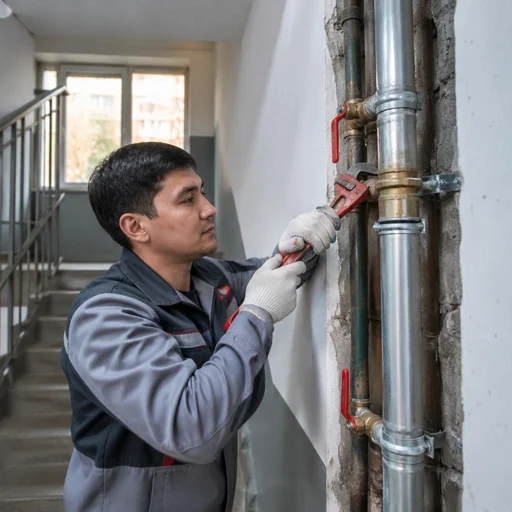
Fitting soldering is carried out at 260 °C: tees and bends are installed at branches, and threaded connections are used only at the tie-in to the meter and shut-off valves. Welding of polypropylene pipes is done according to diameter — for risers this is PN20 and PN25, fiberglass-reinforced, with a soldering depth of 16-20 mm for the size type. The riser tee is installed on each floor for the bathroom, the riser bend — at the turn of the route, where the flow changes direction and the risk of water hammer increases. Overheating the soldering iron produces internal flash: it narrows the bore and creates noise in the pipe during draining. The technician controls the soldering depth by the mark on the fitting, not "by eye," and after cooling checks the seam against the light. Clients often phrase the request as the cost of riser replacement — and from this phrase the technician immediately understands that a calculation is needed based on the route length and number of floors.
Pressure testing and hydraulic tests: how tightness is checked
Pressure testing completes the installation: the riser is filled with water at 1.5 times the working pressure and held for 30 minutes — a pressure drop is not allowed. Hydraulic tests are carried out in accordance with SNiP and GOST: the pressure in the cold and hot water supply system is raised to the test pressure, each joint, tee and threaded connection is inspected, and the manometer readings are recorded before and after the holding period. On a riser with a cleanout, the cleanout hatch is checked separately — it must open without effort and hold pressure. Pressure testing is done before sealing the chase: if a leak is found after plastering, it will have to be opened up again, and this means repeated dismantling and loss of finishes. In our practice, it is precisely this stage that filters out 90% of hidden soldering defects.
Riser replacement with piping and with cleanout: extended scope
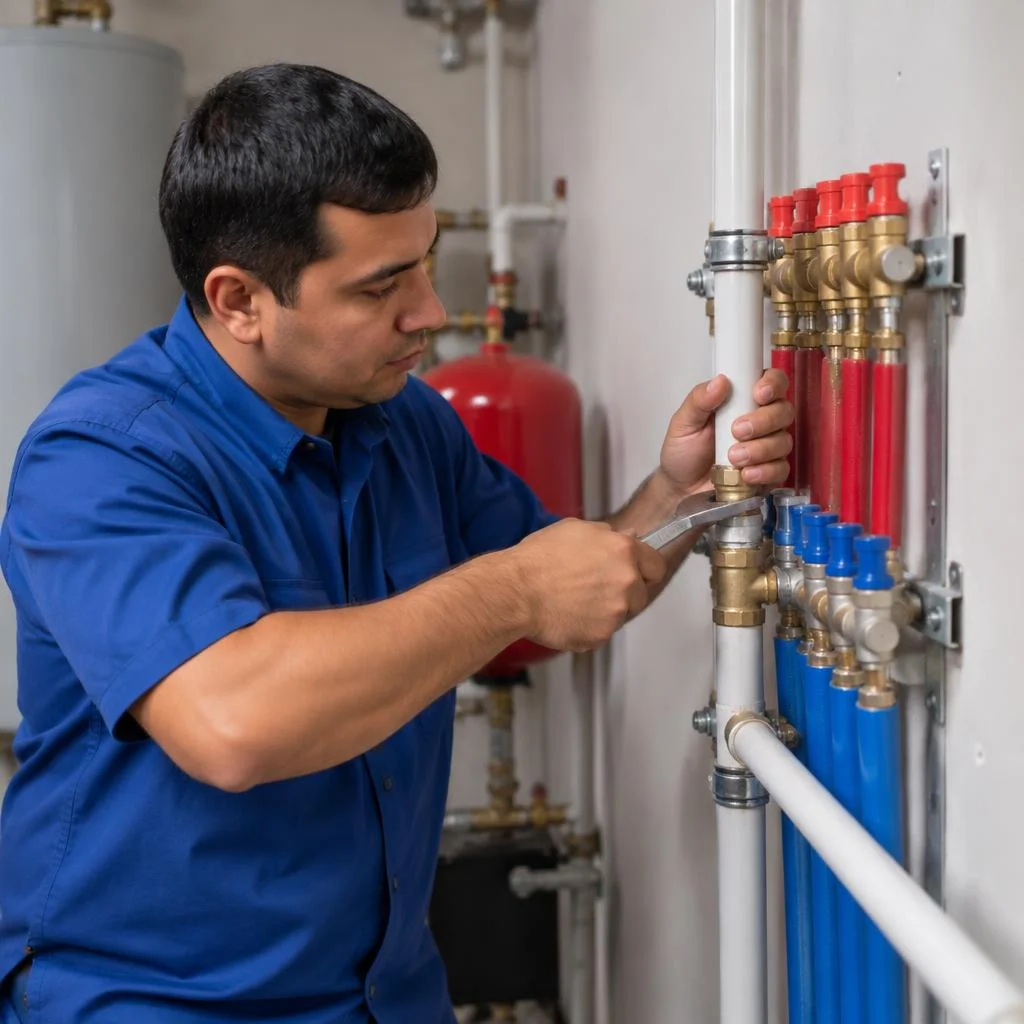
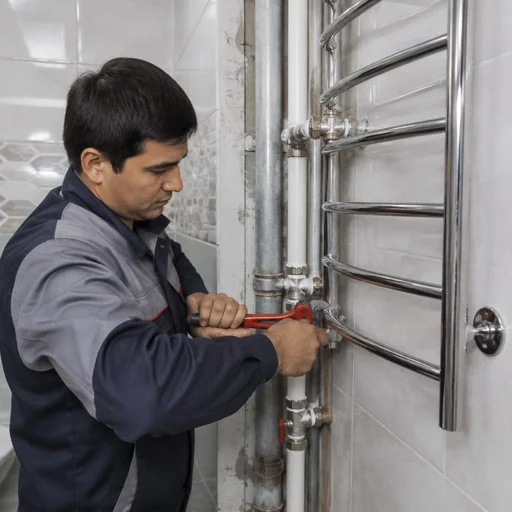
- Riser with piping: a complete assembly with shut-off valves, filter, meter and flexible connections — the apartment gets a ready connection point for plumbing fixtures.
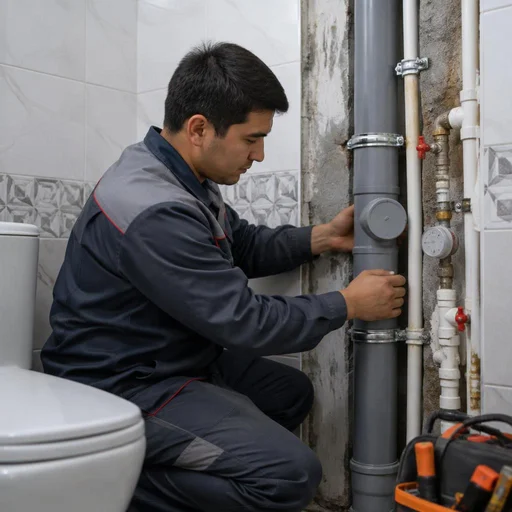
- Riser with cleanout: a hatch for cleaning on each floor, installed on the sewer riser at turns and on long straight sections.
- Riser relocation: the route is moved out of the living area into the bathroom or a box — agreed with the neighbors on the floor in advance.
- Turnkey installation: the entire cycle from dismantling to pressure testing and sealing, including removal of the old cast iron and cleanup after the work.
- Apartment sewer riser price: depends on the route length, number of cleanouts and number of floors — the exact estimate is calculated after diagnostics of the assembly.
- Riser replacement Tashkent: the extended format covers several floors at once, when both inlets and the sewer are replaced by one crew on a single shutdown schedule.
Coordination with the Management Company, Homeowners' Association and Neighbors: How Not to Disrupt the Work
The riser is common property of the building, so replacing risers in a Tashkent apartment begins not with demolition, but with paperwork and agreements. Let's break down who is responsible for what, how to coordinate water shutoff, and which documents protect residents.
Who is responsible for the riser: the Management Company, the Homeowners' Association or the Owner
Up to the first branch to a plumbing fixture, the riser belongs to the common property and is maintained by the management company or the homeowners' association, while the section after the branch is the responsibility of the apartment owner. The boundary runs at the valve or tee on the branch: everything above and below along the vertical, including the cold water, hot water and sewer risers, is the building's responsibility. In practice, Tashkent management companies rarely replace cast-iron risers at their own expense — more often they issue technical specifications, while the residents themselves choose the contractor and pay for the work from collected funds. If you want to understand how much the section for your particular apartment will cost, search for "riser replacement in an apartment price" — it depends on the material, the number of floors and the amount of wall chasing. Demand a written act delineating the zones from the management company before starting work: without it, a dispute over a leak after installation will not be resolved in the resident's favor.
How to coordinate riser shutoff with neighbors
- Visiting neighbors: 2-3 days in advance, the technician or the building entrance elder goes around the apartments on the riser and records a convenient shutoff time.
- Request to the Management Company: the date and shutoff interval are agreed in writing, usually a weekday morning from 9:00 to 13:00, while residents are at work.
- Notice at the building entrance: a day in advance, a sheet is posted with the date, hours and the crew's phone number for emergency contact.
- Water reserve: residents are advised to store up a day's supply — in case soldering or pressure testing runs long.
- Turning the water back on: after pressure testing, water is supplied gradually and the pressure is checked on every floor down to the last; in the Tashkent riser replacement schedule this takes no more than an hour.
What documents Eco-Service prepares before starting work
- Contract agreement: records the scope of work, deadlines, liability of the parties and a 2-year warranty on riser replacement.
- Estimate: an itemized list — dismantling the old riser, wall chasing, soldering fittings, sealing and debris removal as separate line items.
- Act of delineation with the Management Company: confirms that the management company has been notified and has no objections to the scope of intervention.
- Acceptance and pressure testing act: records the test pressure, the absence of leaks and the start date of the warranty period.
- Warranty card: kept by the owner; it is used to file a claim in case of a leak or blockage within 2 years.
Timelines, Warranty and Payment: What the Eco-Service Client Gets
Timelines and warranty are what distinguish a direct service provider from a private crew: we break down how long installation takes, what the two-year warranty covers, and how payment works after acceptance of the work.
How long it takes to replace a riser in an apartment
- Diagnostics and marking: 1 hour — the technician inspects the old cast iron or steel, determines the tie-in points and agrees on the route with the residents.
- Dismantling: 2–3 hours — removal of cast-iron segments, hauling away the cut-offs, preparing the niche for the new riser.
- Chasing for the riser: 1–2 hours — no chasing is done in load-bearing walls; the route is run around through a box.
- Installation and pressure testing: 4–5 hours — soldering fittings, assembling connections, hydraulic pressure tests.
- Acceptance: 30 minutes — checking for leaks, signing the acceptance report, payment after inspection.
2-year warranty: what it covers and how to file a claim
Eco-Service provides a 2-year warranty on riser replacement: it covers the tightness of connections, the soldering of fittings and the operation of the shut-off valves installed by the technician. The warranty period is recorded in the contract and the estimate — which also list the pipe brands, diameter, number of bends and tees, so when a claim is filed the technician pulls up the acceptance report and sees the original configuration. A claim is filed using the receipt and the acceptance report: it is enough to call or write on Telegram; a visit for a warranty case is free of charge. The warranty does not apply in the event of mechanical damage to the pipe after installation — for example, if a neighbor drilled into the riser while installing a shelf; such cases are recorded in a separate inspection report. The timeline stretches if the riser passes through a load-bearing wall: chasing in it is prohibited, and the pipe is run around through a box.
Payment methods: Click, Payme, Uzcard, Humo
- Click: transfer from a Uzcard or Humo card, the receipt arrives in the app, payment after signing the acceptance report.
- Payme: payment from a card of any bank in Uzbekistan, the commission is on the payment system's side.
- Uzcard: card payment via a terminal at the site or at the office, no prepayment.
- Humo: cash or card after acceptance, if it is more convenient for the client to pay on site.
- Cold water riser replacement price: the final amount is calculated after diagnostics — it depends on the material, the number of floors and the scope of dismantling.
What affects the final estimate
Clients most often type the query "water supply riser replacement price" when they want to understand the order of magnitude before the technician's visit — and that is how they end up here. The final estimate is made up of the number of bends, tees and compensators: the more connection points to radiators and heated towel rails, the higher the consumption of fittings and the longer the installation day. The second factor is the material: reinforced polypropylene costs less than cross-linked polyethylene, but requires more compensators on long runs. The third is the number of floors and access: on upper floors, work with a winch and protection of neighboring risers is added. Payment after pressure testing protects the client — if the pressure does not hold, the work is not accepted and is not paid for until the defect is eliminated. Payment is accepted via Click, Payme, Uzcard and Humo after acceptance; no prepayment is required. Before signing the estimate, request a list of materials with pipe brands and diameters: this rules out surcharges for items that the technician did not agree on in advance.
Why replacing risers in Tashkent through Eco-Service is more advantageous than a private crew
In the Tashkent market, risers are replaced by private craftsmen, seasonal crews, and service companies. We break down how a direct supplier differs from an intermediary in terms of process, documents, and responsibility for the result.
Direct supplier versus intermediary: where responsibility gets lost
Eco-Service operates as a direct supplier: the plumber is on staff, materials are purchased directly, and the contract and estimate are concluded with its own service center rather than with a dispatcher-intermediary. A private craftsman arrives with his own tools and often without an official contract — the arrangement rests on a verbal agreement, and the scope of work in the estimate is not documented. A crew with a foreman takes the project as a subcontractor but brings in welders and installers from outside: in buildings in the Mirzo-Ulugbek or Yashnabad districts, the crew changes from floor to floor. With an intermediary, the warranty rests on his promise rather than on a contract — if the contractor changes, there is no one to file a claim with. Therefore, before work begins, request a written estimate listing the stages: dismantling, wall chasing, soldering, pressure testing — and sign it before tools are brought into the apartment.
Customer reviews on Google Maps and Yandex.Maps
Reviews of Eco-Service's work are collected on Google Maps and Yandex.Maps: clients note adherence to deadlines, cleanliness after dismantling, and pressure testing performed without repeat visits. Private craftsmen promote themselves through Telegram channels and Instagram, where reviews are not tied to a specific project and can be deleted at the author's discretion, while crews use OLX.uz without a history of completed orders. On map listings, you can see the area of work — Chilanzar, Yunusabad, Sergeli — and the date of the review, which allows you to assess how long the contractor has been working with multi-story buildings. When reading reviews, look at the "before/after" photos: they show whether the craftsman chased the wall for the riser and sealed the old riser or left the pipe exposed in the wall.
What is included in turnkey riser replacement at Eco-Service
- Diagnostics: inspection of the cold water, hot water, and sewer risers, diameter measurement, checking the condition of tees and branches before work begins.
- Dismantling: removal of cast-iron or steel sections, hauling away cut-offs, protecting tiles and plumbing fixtures with film during the work.
- Wall chasing: preparing the channel for the new pipe, taking into account the slope of the sewer riser and expansion gaps.
- Installation: assembly of PN20 and PN25 polypropylene, soldering of fittings, installation of the riser tee and branch, threaded connections at the connection points.
- Pressure testing: hydraulic tests at pressure above the working pressure, checking the tightness of all joints before closing the chase.
- Sealing: filling the chase with mortar, restoring the wall surface for subsequent finishing by the client.
How the estimate is calculated and what affects the final total
Many ask how much sewer riser replacement costs and how the riser replacement price is formed — the final total depends on the number of floors, the material, and the scope of piping; the calculation is made after diagnostics. The cost is affected by the length of the section, the number of tees and branches, the need for wall chasing for the riser and sealing of the old riser, as well as the floor: on upper floors, work with expansion compensators is added. "Turnkey" does not mean "everything we find": the scope is fixed in the estimate before work begins, and hidden defects in the inlet are documented through a separate approval. In our practice, the estimate for a multi-story building in Sergeli changed after opening up only once — when a rotted section of a cast-iron branch was discovered under the tile.
Conclusion
Installing risers in a multi-story building means working within a limited window of access to neighbors, staged pressure testing, and mandatory acceptance by report. Below are brief conclusions that will help you plan the work without downtime or rework.
Key conclusions
- Diagnostics first: thread leaks, rusty water, and humming in the pipe are grounds to inspect the riser before an emergency, not after flooding your neighbors.
- Material for the task: polypropylene PN20 and PN25 cover most water supply tasks; cross-linked polyethylene is appropriate for hot water supply with high temperatures.
- Estimate without surprises: a request for "sewer riser replacement price" is clarified after inspection — the scope depends on the number of floors, tees, and branches.
- Approval in advance: shutting off the riser for 4-8 hours is coordinated with neighbors and the management organization at least 2-3 days ahead.
- Verification upon completion: "how much does riser replacement cost" can only be correctly compared taking into account pressure testing, inspection, and a 2-year warranty on the installed section.