
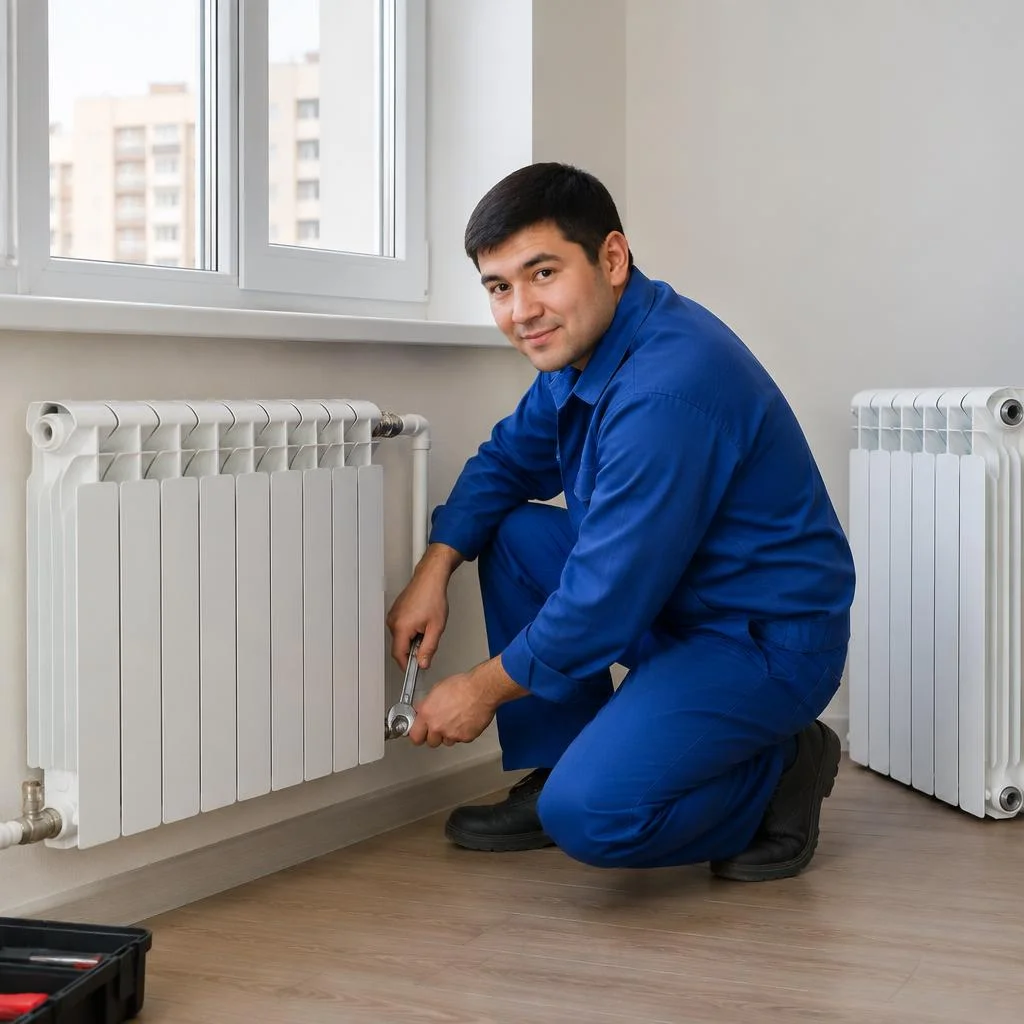
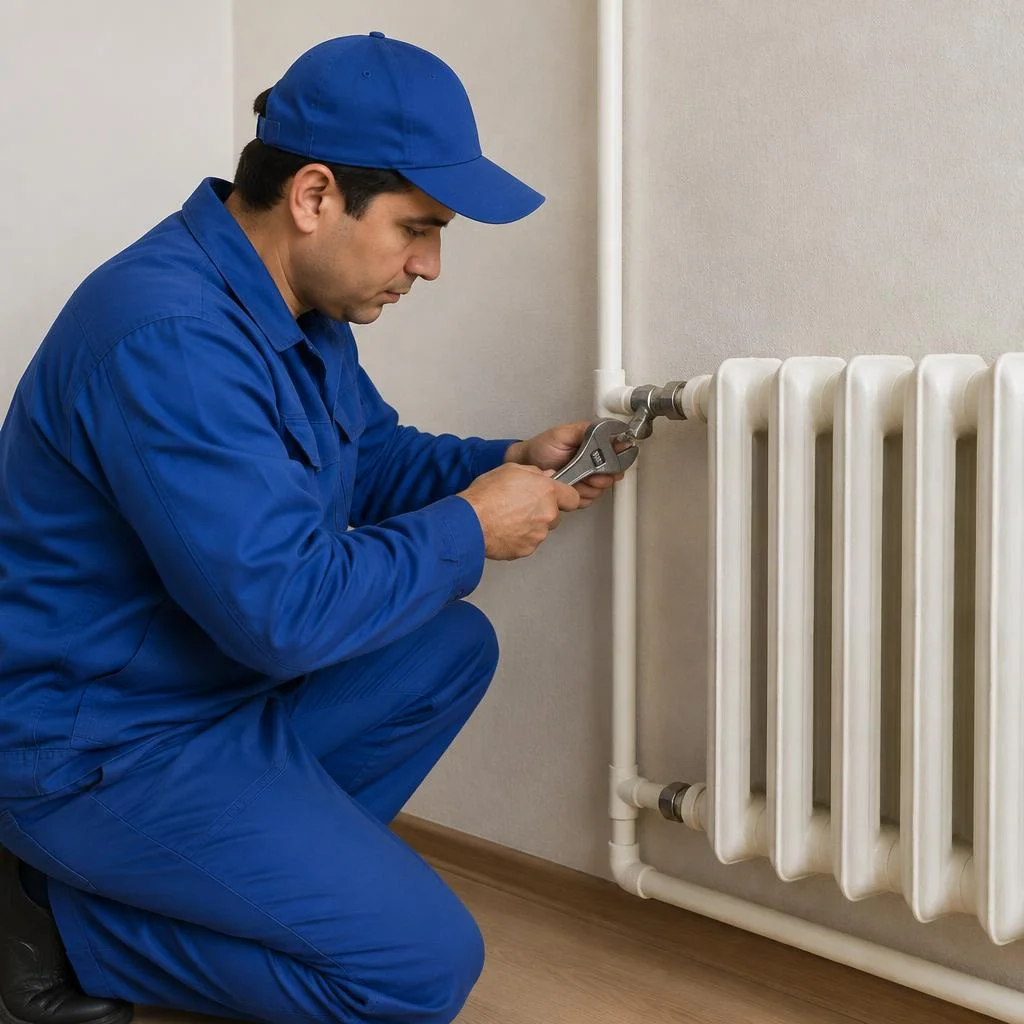
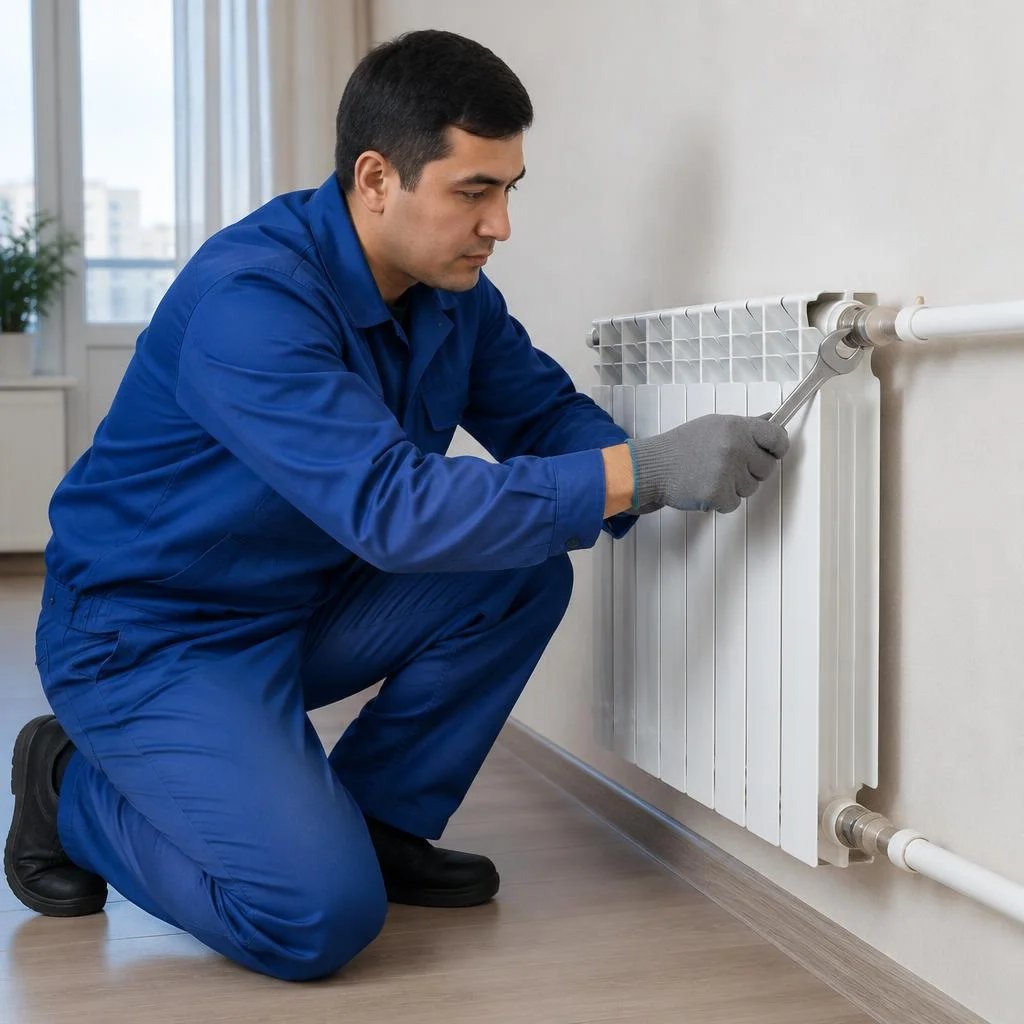








When It's Time to Replace Batteries and Radiators: Signs of Wear and Emergency Situations
In Tashkent multi-story buildings with central heating, batteries fail before their rated service life — hard water, seasonal water hammer and pressure surges take their toll. Let's look at how to spot wear before an accident happens.
Signs That a Battery Needs Replacing, Not Repairing
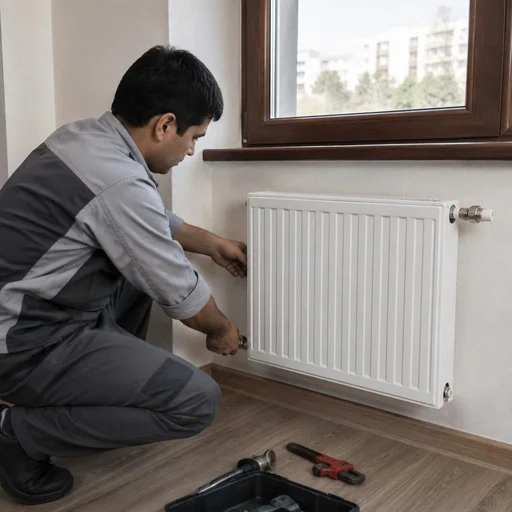
Clients in Tashkent often describe the problem with the words "radiator replacement Tashkent" — and by this request the technician immediately understands that the unit needs replacing, not patching. Fistulas and wet marks on sections, cold outer sections when the supply pipe is hot, rusty water from the Mayevsky valve for more than two weeks after the season starts, paint blistering and pressure drops — five signs where repair no longer helps. Eco-Service technicians during inspection check the section wall thickness with ultrasound: when more than 30% of the metal is lost, repairing heating batteries in an apartment becomes pointless. If rusty water flows from the Mayevsky valve for more than two weeks after the season starts, flushing will only give a temporary effect. With two or more signs at the same time, plan the replacement before the heating season starts — postponement turns into an accident in the middle of the cold. In requests this most often sounds brief: battery replacement cost — and the technician comes out for diagnostics.
Emergency Leak: What to Do Before the Technician Arrives
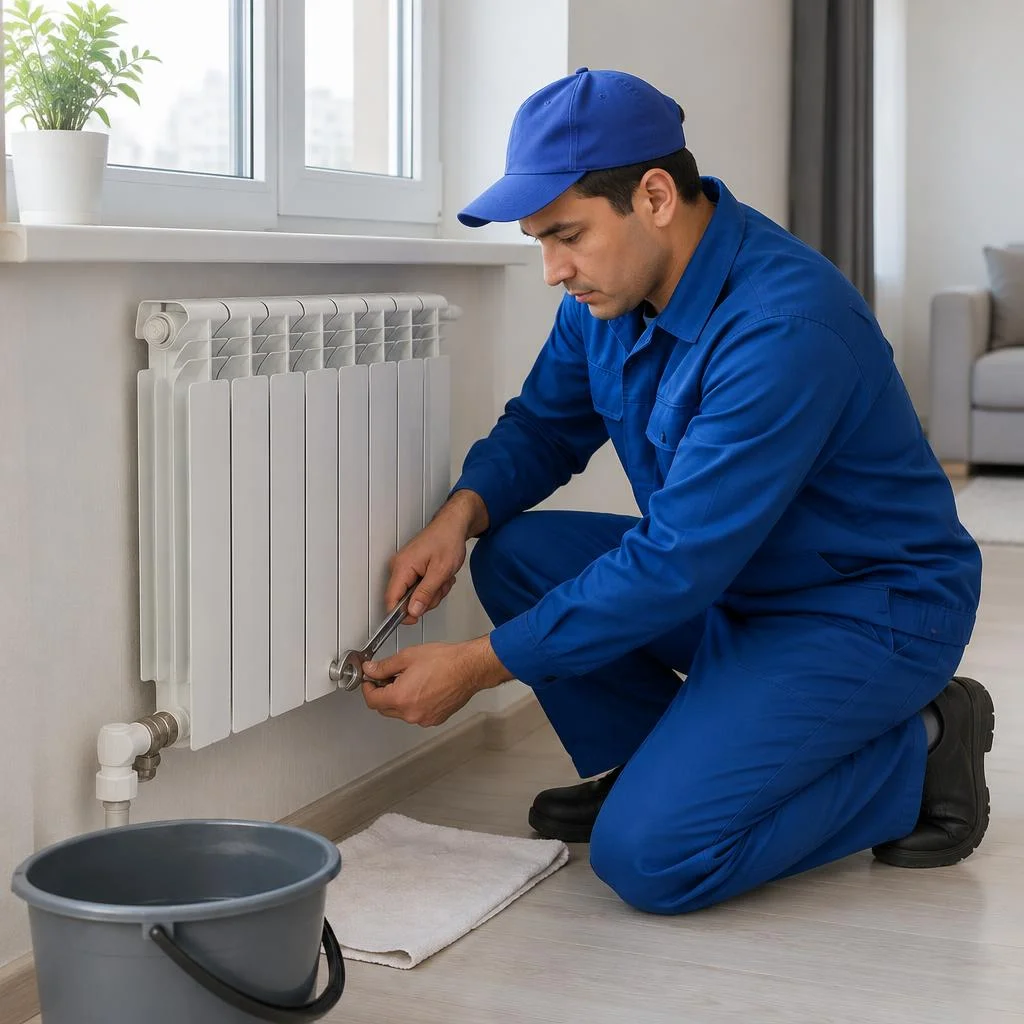
You must not shut off the riser yourself — it's enough to close the valve on the supply to the specific unit. If the valve is stuck and won't budge, wrap it in a cloth and wait for the specialist: applying force breaks the stem and turns a local leak into an accident on the entire riser. Place a basin or bucket under the leak, lay out cloths around the perimeter — this will protect the floor and walls from water. Release the pressure through the Mayevsky valve: carefully bleed the air and the remaining coolant from the section to reduce the pressure at the leak point. Eco-Service works throughout Tashkent with same-day visits. Clients in such cases search for "battery replacement Tashkent" — and get a technician within the day. If the leak doesn't stop after closing the supply, call the management company's emergency service and simultaneously call a specialist. In a hurry the request is phrased as battery replacement price, but the priority here is to shut off the supply.
Why Replacing Heating Batteries in Winter Is Dangerous
Replacing heating batteries in winter in Tashkent multi-story buildings is possible without shutting off the riser — technicians use the pipe freezing method and work with one unit at a time. Freezing allows replacement without draining the riser: an ice plug is frozen in the supply pipe, the section is cut off, and the new unit is installed without stopping heating for the neighbors. When replacing an old battery with a new one during the heating season, agree on the work window with the neighbors on the riser in advance: even with freezing, a 2–3 hour interruption in supply affects the entire entrance. If the riser hasn't been replaced in more than fifteen years, plan the heating battery replacement with extra time — the old piping often requires re-soldering a section, and the work window stretches to a full day. Clients formulate the task briefly: heating battery replacement — and the technician selects the method for the specific riser. In winter requests, bimetallic radiator replacement often appears — the freezing method works for them too.
Repair or Replacement: Comparison by Service Life and Reliability
Repair is justified for a local leak at a threaded connection; for corrosion of the housing or clogged sections, replacement is cheaper per year of service. A welded cast-iron radiator after two repairs loses its seal at new points — each subsequent repair shortens the interval between repairs. Clients often ask about heating battery radiator replacement when they see rusty water from several units in the apartment at once. If corrosion has affected one section, local re-soldering gives a one-season reprieve, but doesn't solve the housing problem as a whole. When sections are clogged, pressure flushing restores heating for 2–3 seasons, after which deposits return. A practical rule: with two or more signs of wear at the same time, repair makes no sense — plan the unit replacement before the season starts. An estimate in the request usually sounds like heating radiator replacement price, and the technician calculates both scenarios.
When to Replace Radiators Along the Entire Riser and Building-Wide
Replacing old heating radiators along an entire riser is required when corrosion has affected not just one unit but the entire distribution system: rusty water comes out of the Mayevsky valve in several apartments at once, and the system's makeup water consumption grows month after month. In such cases, replacing heating batteries is done comprehensively — from the basement to the top floor, with re-soldering of polypropylene pipes, replacement of shut-off valves on each supply line, and pressure testing of the section under operating pressure. Replacing heating batteries along an entire riser is cheaper as a single operation than calling a technician repeatedly to each apartment: one pressure test checks the entire branch at once. Replacing a heating battery in one apartment without replacing the riser only makes sense for localized wear — if rusty water is coming from the neighbors, the new unit will quickly clog with deposits from the shared pipe. Clients describe such a task as replace radiators in apartment price — and receive an estimate for the entire riser at once. In comprehensive work, a separate line item covers the replacement of pipes and batteries in the apartment — re-soldering of supply lines along the entire branch.
Prevention: how to extend battery service life
- Flushing before the season: annual pressure flushing of the radiator removes scale and sludge before the heating season starts.
- Bleeding air through the Mayevsky valve: regular air release after system startup evens out section heating and reduces stress on the housing.
- Checking shut-off valves: test the valves on the supply line once a year — a seized valve won't shut off the coolant in an emergency.
- Monitoring system pressure: keep an eye on the pressure gauge readings and promptly report surges to the management company — water hammer destroys connections.
- Inspecting connections: check threaded joints for leaks once a season — early seal replacement is cheaper than an emergency call-out.
Repair or replacement: which is more cost-effective per season
Replacing a heating battery in an apartment costs less than prevention only until the first emergency: regular inspection and flushing postpone replacing an old battery with a new one by several seasons. Prevention doesn't help with through corrosion — here only battery replacement helps, and the intermediate option of repair gives a one-season delay. Clients often ask about heating battery replacement in apartment price when the technician suggests first flushing the unit and replacing it a month later — this is a sign that corrosion has already penetrated the housing: in such a scenario, battery replacement will cost more due to the repeat visit and draining of coolant. A practical rule: with two or more signs of wear at the same time, plan to replace the old battery with a new one before the heating season starts. Comprehensive replacement of radiator batteries along a riser and Replacement of batteries/radiators in a single apartment differ in their estimates: in the first case, pipe re-soldering and pressure testing of the entire branch are added, in the second — the work is done on a targeted basis. Replacing old batteries with new ones with preliminary pressure testing provides a 2-year warranty on all connections. Cast-iron battery replacement price is calculated separately — the difference in section weight changes the scope of work.
Types of radiators and batteries: what to install in an apartment and a private house
We break down the four types of devices that we install in Tashkent apartments and private houses, and explain which system and property each one suits.
Bimetallic radiator: why it is most often chosen in Tashkent
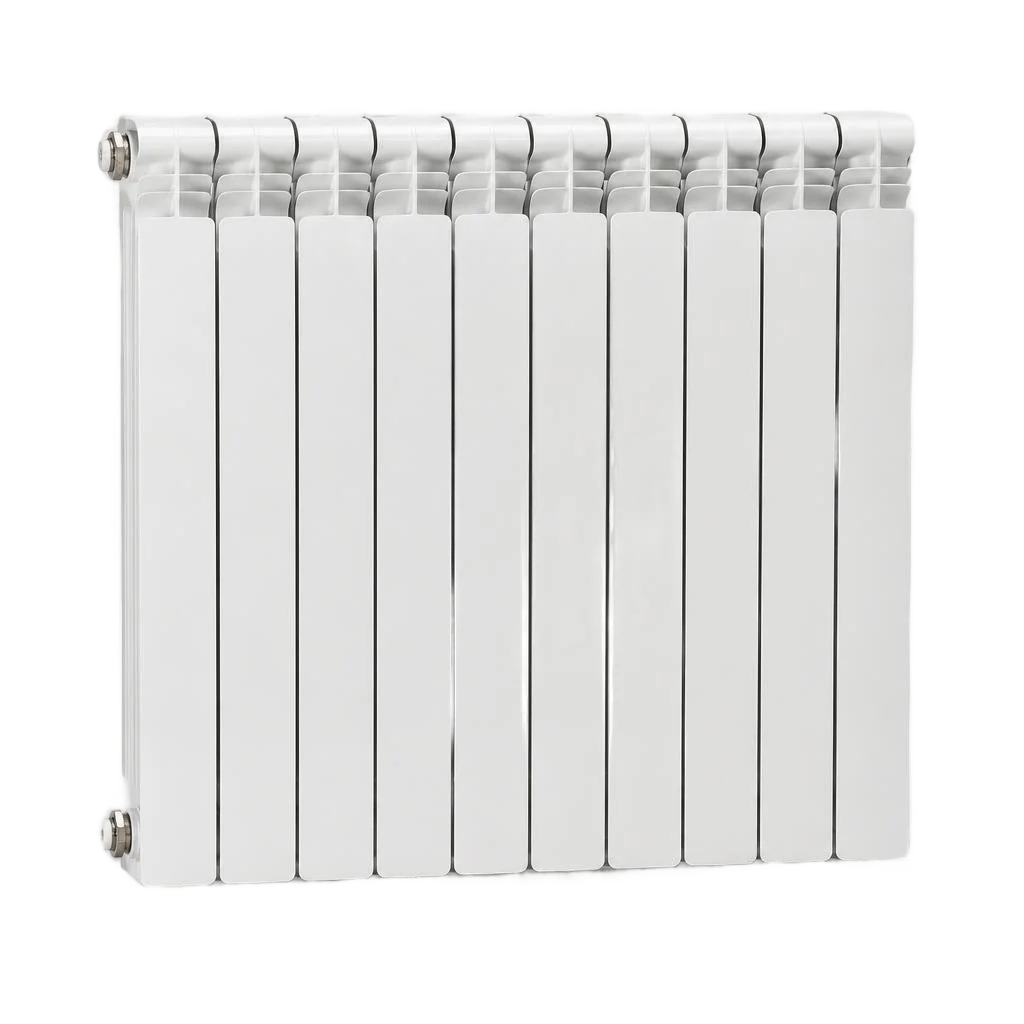
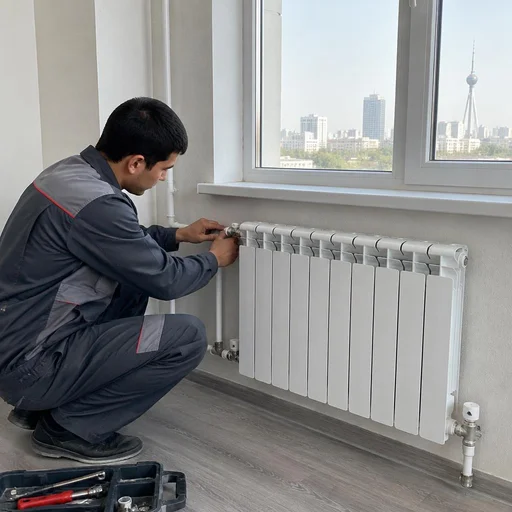
Replacing batteries with bimetallic ones is the most common solution in the capital's apartments with central heating: the steel core withstands the system pressure, while the aluminum fins provide high heat output. Inside the section runs a steel tube, outside is an aluminum body with developed fins; this design withstands working pressure up to 35 bar and short-term water hammer during the start of the season. The heat output of one section is 170-200 W with a center-to-center distance of 500 mm, which is almost twice that of cast-iron equivalents. A Mayevsky valve is mandatory on every device: without it, an air lock reduces heat output by 20-30%, and the far room heats unevenly. Clients often phrase the request as replacement of a heating radiator — and from that phrase we immediately understand that it is about modernizing the riser in an apartment. In our practice, the installation of bimetallic radiators comes both as planned modernization and as a forced measure after the riser has frozen — in both cases the device survives more than one season of water hammer. In search, people type replacement of a heating radiator — and land on our page with the calculation. They separately ask about the cost of radiator replacement — we answer after measurement and diagnostics of the riser. Most often the request says heating replacement price — that is how the client indicates that they want to understand the order of the amounts even before the technician's visit.
Replacing cast-iron batteries with bimetallic ones: what to take into account
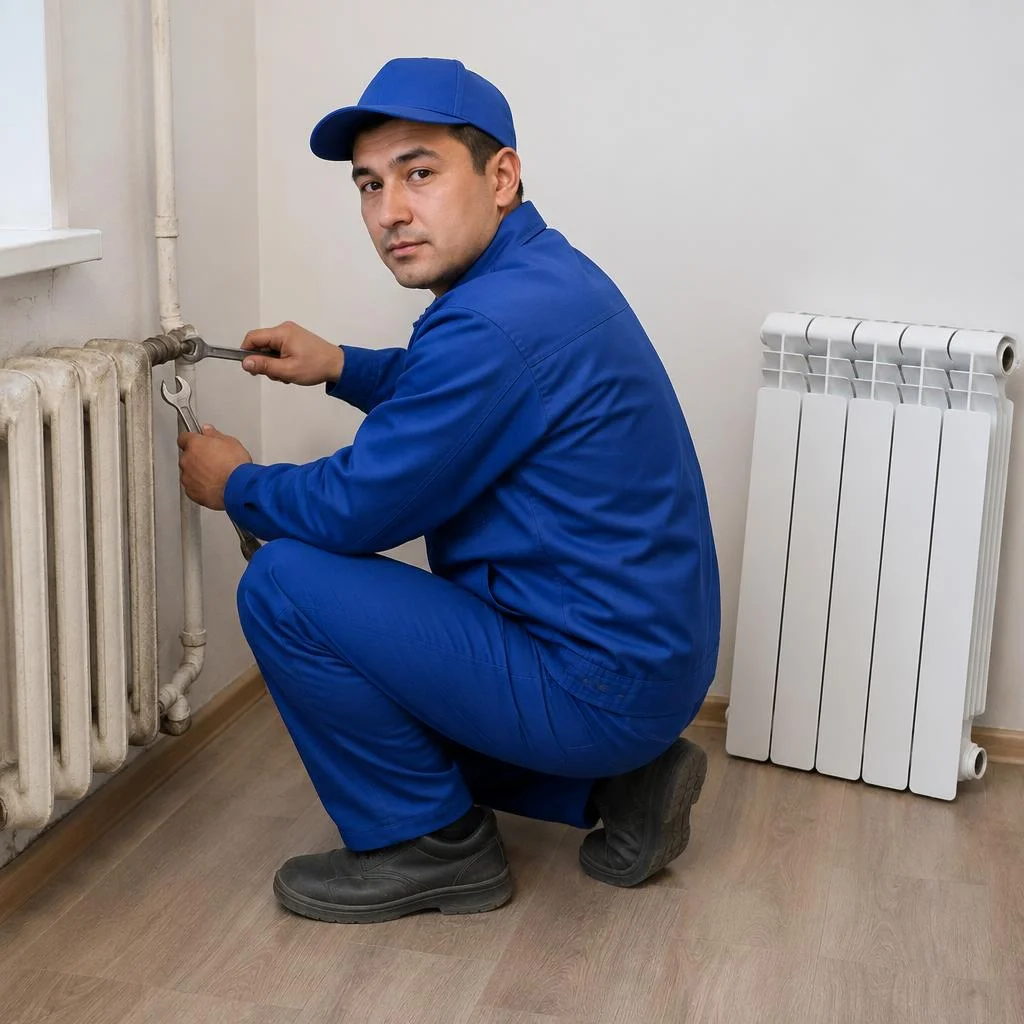
Installing cast-iron batteries with a bimetallic calculation requires recalculating the number of sections: cast iron gives off heat more slowly and, due to thermal inertia, retains it longer, so for an equal area, bimetallic is installed with fewer sections. A cast-iron MS-140 section has a heat output of 150-160 W, while a bimetallic one has 170-200 W, meaning that for a room of 18 m², five to six bimetallic sections are enough instead of seven cast-iron sections. The center-to-center distance of 500 mm is the same for most cast-iron and bimetallic models, but the supply pipe diameter is not: cast iron was connected to 32-40 mm pipes, while modern bimetallic is designed for 20-25 mm. Replacing a cast-iron radiator with a bimetallic one therefore includes adapters, new supply piping and shut-off valves — without this, the threaded connection leaks in the very first season. In a private house with an autonomous system, replacing a cast-iron battery with a bimetallic one is easier: the pressure is lower, but a filter at the boiler inlet is required. In the request this usually sounds like replacement of a heating radiator in an apartment, and the technician already sees during the measurement that adapters are needed. Often clients write briefly — change the radiator — and we clarify the details on site. If it is a complete replacement of heating batteries in an apartment, we immediately calculate both the number of sections and the scope of work on the supply piping. In the price list, such requests go under the line cast-iron battery replacement price, and from it you can see that the client is comparing options by budget.
Aluminum, steel and cast iron: who each type suits
| Type | Where we install it | Feature | Service life |
|---|---|---|---|
| Aluminum | Autonomous heating of a private house | High heat output, sensitive to coolant quality | 10-15 years |
| Steel panel | Apartments with a central system, fast heating | Low thermal inertia, cannot be repaired section by section | 15-20 years |
| Cast iron | Houses with an autonomous boiler | Retains heat for a long time, heavy, requires reinforced brackets | 25-30 years |
| Bimetallic | Apartments with central heating | Steel core and aluminum fins | 20-25 years |
Replacing cast-iron radiators with steel ones is less common than bimetallic: a panel unit heats up in 15-20 minutes versus 40-60 for cast iron, but it also cools down just as quickly. An aluminum radiator in a central heating system lasts less than its stated service life due to hard water: scale on the inner walls reduces heat output by 10-15% over three to four seasons. When it comes to a complete replacement of radiators in an apartment, we first look at the type of system and the quality of the coolant, and only then suggest the material of the unit. In requests for replacing heating pipes and radiators, we always clarify whether only the unit is being replaced or the entire riser as a whole. Clients often ask about the cost of replacing radiators for the entire apartment at once — in that case we calculate the items for each room separately. The wording "replacing a radiator in an apartment price" appears in requests almost as often, and from it we understand that a calculation for all rooms at once is needed.
How to calculate the number of sections for a room's area
- Basic formula: 100 W per 1 m² with a ceiling height of up to 2.7 m — for a room of 18 m² the calculated power is 1800 W.
- Adjustment for windows: each window adds 100-150 W, a balcony door adds another 200 W to the calculated power of the unit.
- Corner rooms: two exterior walls require plus 20% to the power, an end apartment — plus 30% due to greater heat gain from outside.
- Ceiling height: at 3 m and above we multiply the basic power by a coefficient of 1.1-1.15 for each additional 0.5 m.
- Number of sections: we divide the total power by the heat output of one section — for bimetallic this is 170-200 W, for cast iron 150-160 W, for aluminum 180-210 W.
Towel warmer, convector, in-floor convector: separate replacement items
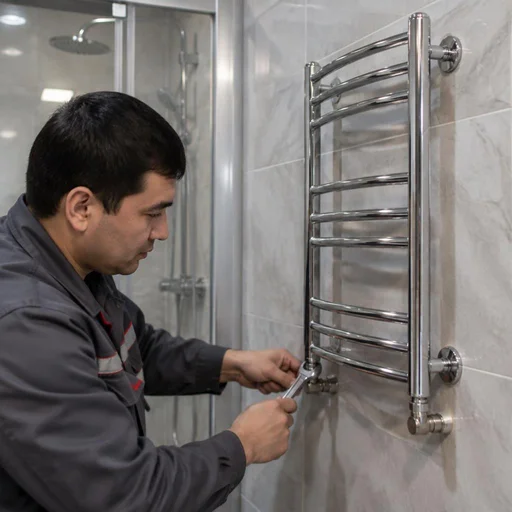
- Towel warmer: we replace it in the bathroom with a water or electric one — a water one is cut into the hot water supply riser, an electric one requires a separate line with a 10 mA RCD.
- Heating convector: a wall-mounted or floor-standing unit with natural or forced convection, used in private homes and offices instead of radiators.
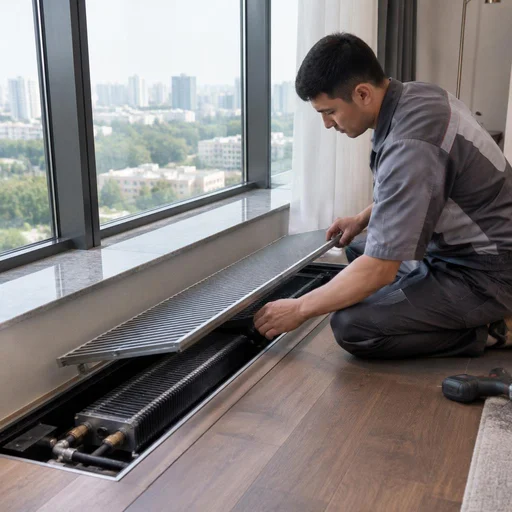
- In-floor convector: installed in the floor screed near panoramic windows, requires drainage to remove condensate and a niche 90-120 mm deep.
- Coolant and connection: convectors operate at 70-90 °C, in-floor models are more often connected to low-temperature circuits with underfloor heating.
- Who does the replacement: the Eco-Service company performs the replacement of a towel warmer, convector and in-floor convector as separate items with their own installation technology.
- Drainage is mandatory: without a drainage tube in the screed, condensate accumulates in the duct and causes corrosion of parts within just two to three seasons.
How a radiator replacement proceeds: stages of work from dismantling to startup
We show the full cycle of work on a single unit — from shutting off the riser and draining the coolant to pressure testing and balancing. At each step we explain what the technician does and why the order of actions cannot be changed.
Dismantling the old battery and draining the coolant
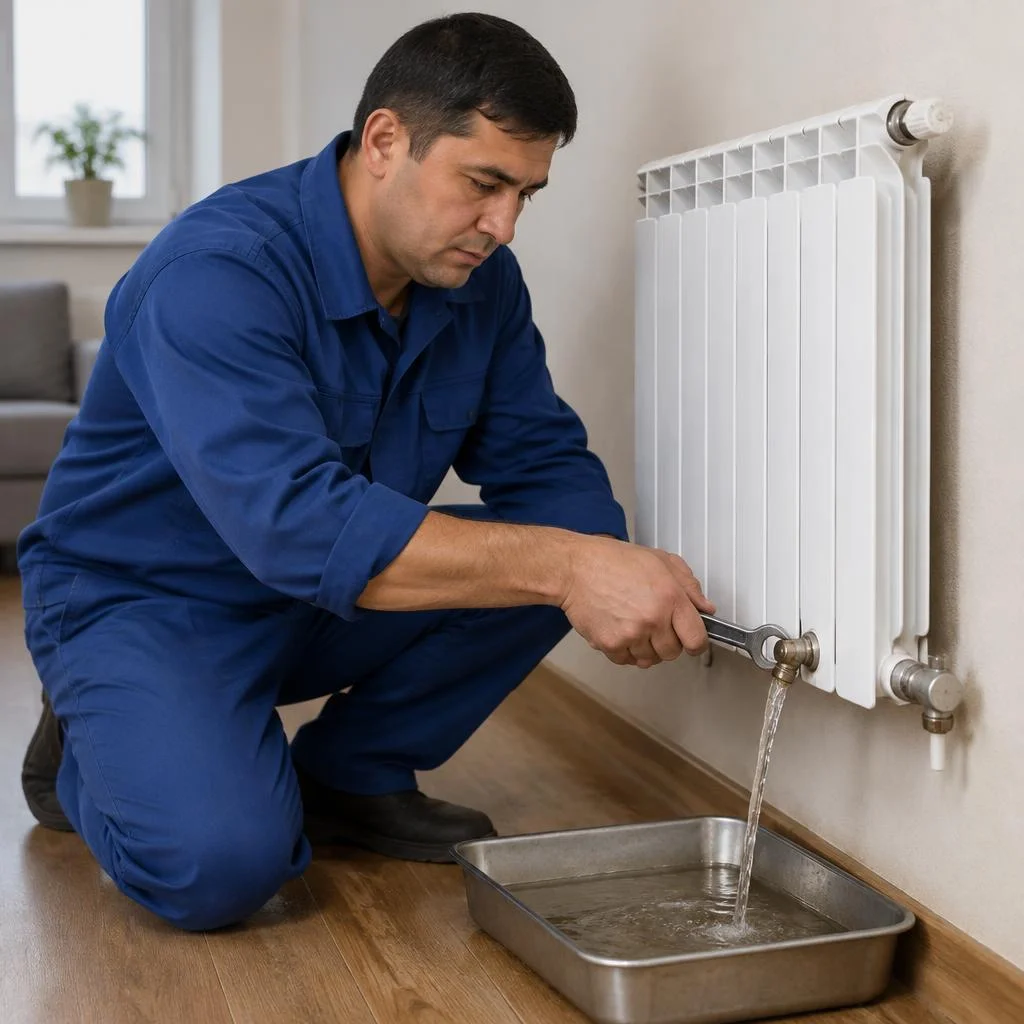
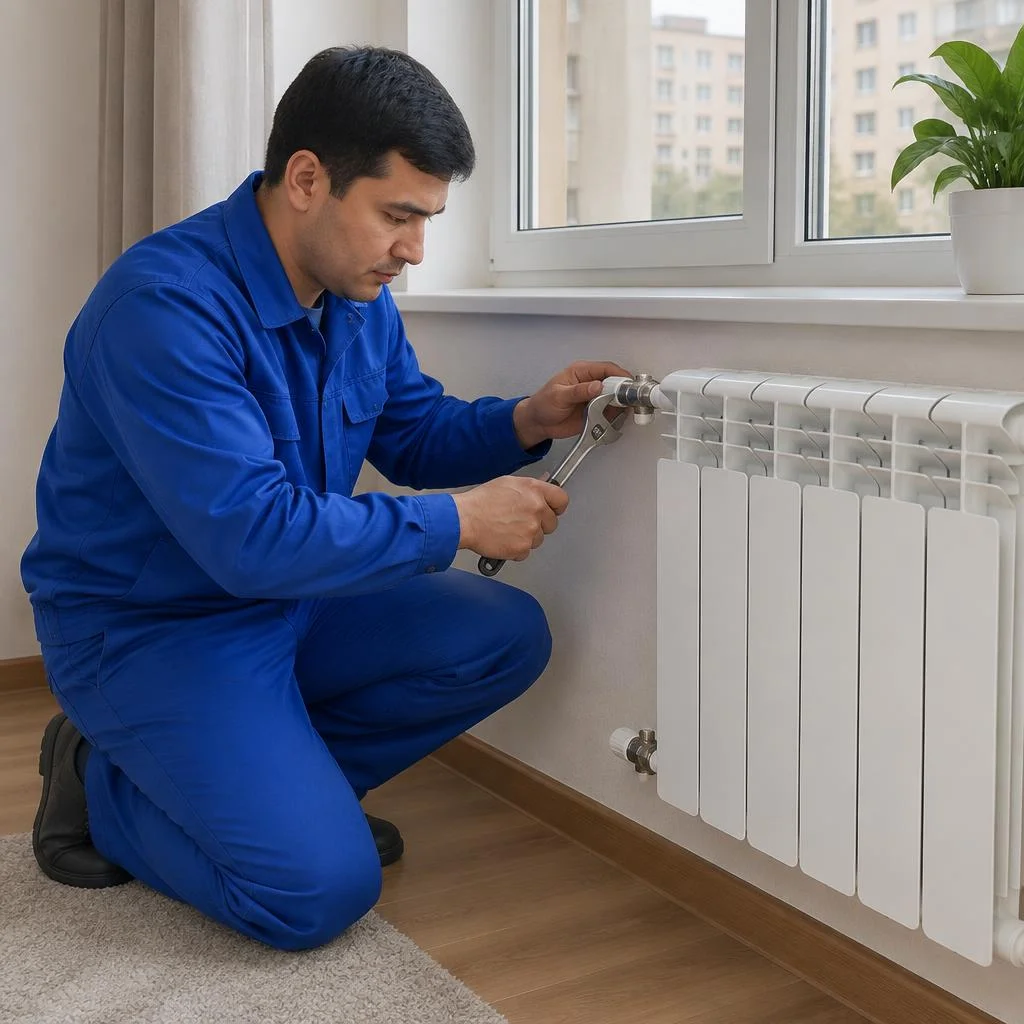
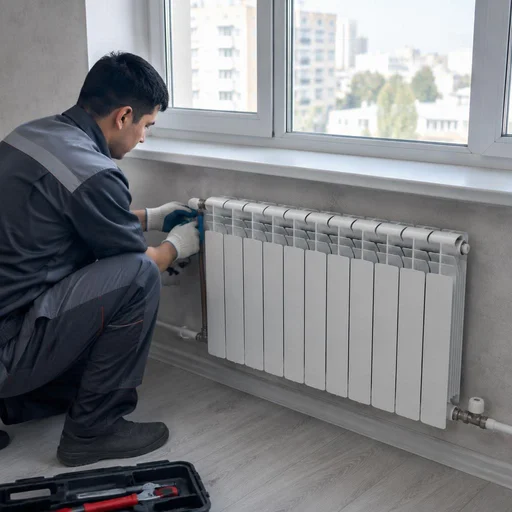
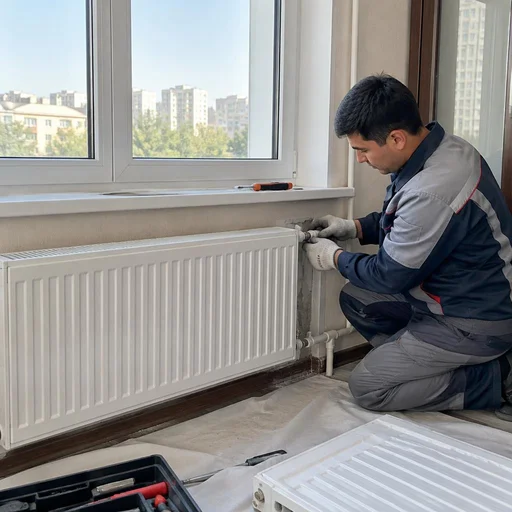
The work begins with dismantling the old battery and draining the coolant: the technician shuts off the heating riser, drains the water into a prepared container and removes the unit. Through Eco-Service, at sites in Tashkent most often these are cast-iron sections from Soviet-era piping and aluminum units that have served 10-12 seasons. Dismantling takes from 40 minutes to an hour and a half — the time depends on the number of sections and the condition of the threaded connections: we heat a seized fitting with a gas torch, otherwise there is a risk of stripping the thread on the supply line. When dismantling a cast-iron battery, it is important to support its weight: an assembled section weighs up to 80 kg, and a fall to the floor can damage the screed and the neighbors' supply lines below. We drain the coolant only after checking that the shut-off valves on the riser hold pressure — otherwise we postpone the work until it is coordinated with the management company.
Marking, preparing the place and mounting the brackets
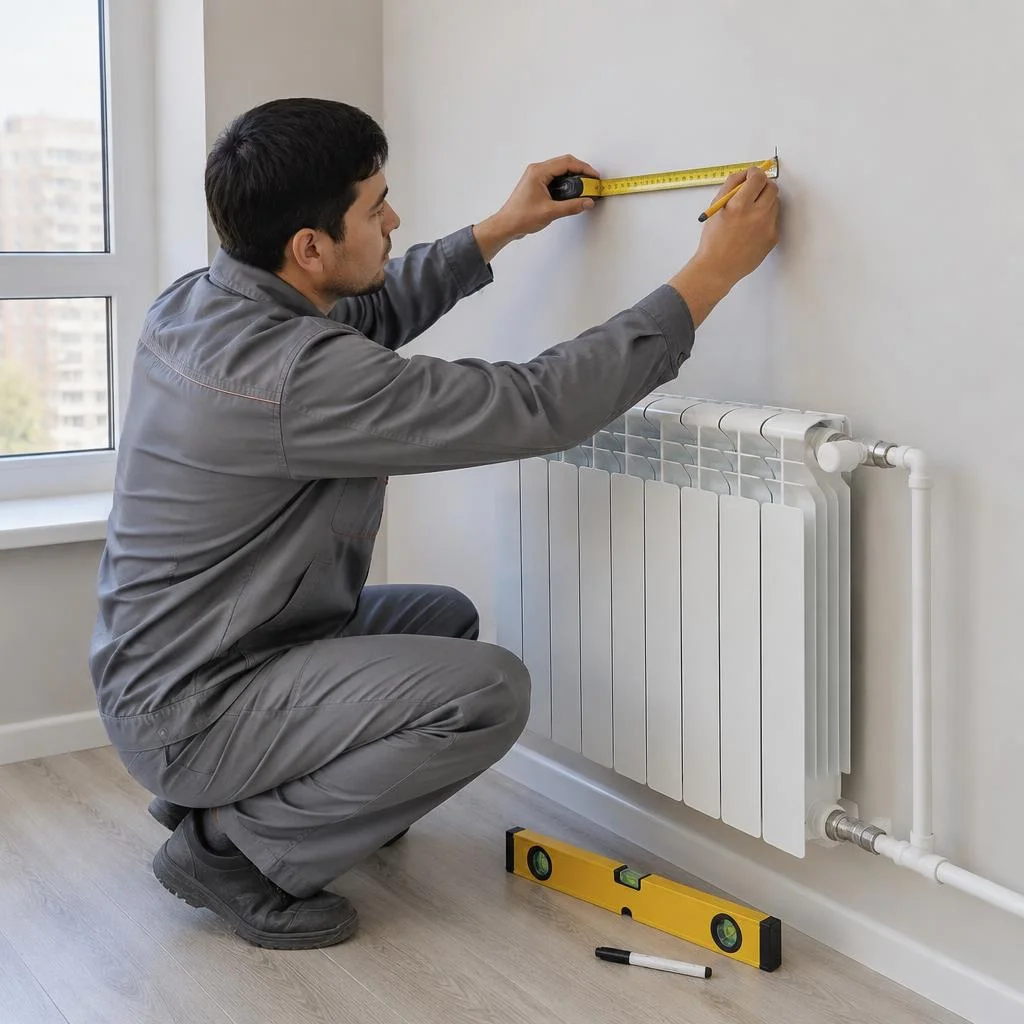
- Center-to-center distance: we measure with a tape measure between the axes of the supply lines and select a model with the same parameter — 500, 350 or 300 mm, otherwise the pipes will not match the valves.
- Supply line slope: we set 1-2 mm per linear meter toward the riser so that air escapes through the Mayevsky valve instead of accumulating in the upper sections.
- Marking for the brackets: we mark the horizontal and vertical with a laser level, the offset from the windowsill is at least 100 mm, from the floor — 120-150 mm for convection.
- Fasteners: in a load-bearing wall we install a 10×80 mm anchor, in drywall — a backing block or floor support; fastening into plaster is not allowed.
- Load check: after installation we check each bracket for pull-out with a force of 40-50 kg — this margin is enough for the weight of a unit filled with water.
Connecting the supply lines and shut-off valves
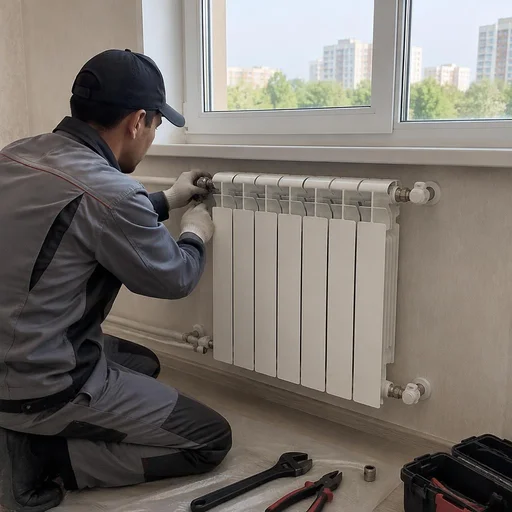
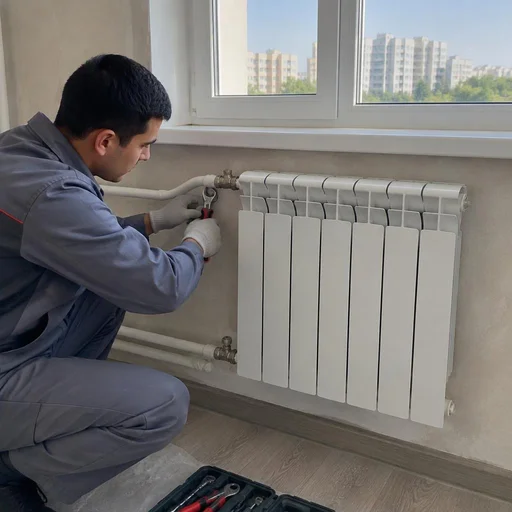
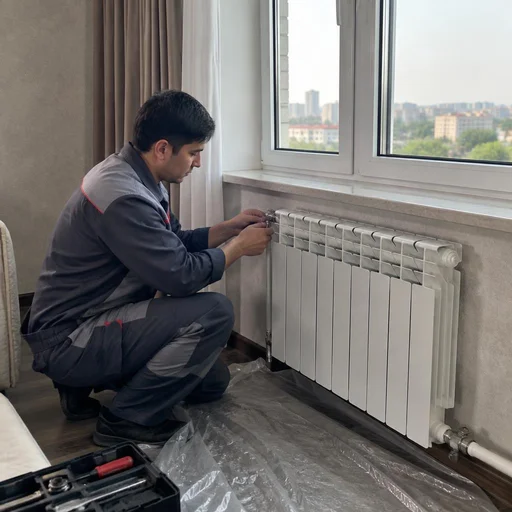
We replace the supply lines to the radiator and the shut-off valves together with the unit: old threaded connections do not withstand re-installation and leak in the first season. For the supply lines we use ½ or ¾ inch pipe — the diameter is selected for the pipe of the new unit, not for the old piping, otherwise pressure is lost and the last radiator in the apartment heats poorly. Installing a heating battery includes a ball valve and a thermostat on each supply line — this allows removing the unit without stopping the riser and regulating heat output room by room. Installing the shut-off valves takes us 30-40 minutes per unit, including wrapping flax with sealant or an anaerobic compound on the thread. We check the Mayevsky valve separately: if it is corroded, we replace it with a new one — the old one will not open at the moment when an air lock appears in the system.
Re-soldering polypropylene pipes and replacing the riser
If the piping is made of polypropylene, we re-solder the pipes for the new unit; if the riser is worn, we replace its section with coordination with the management company. Updating pipes and heating radiators with polypropylene piping is a separate work item: the soldering iron heats up to 260 °C, the sleeve is inserted for 5-7 seconds, and an error of a couple of seconds causes a narrowing of the bore or incomplete heating of the joint. Polypropylene loses strength at temperatures above 95 °C — in Tashkent's central system with water hammer this is critical, so on risers we recommend reinforced pipes. Replacing a heating riser requires written coordination with the management company and shutting down the circuit for 4-6 hours — we carry out the work in the non-heating season or according to the management company's schedule.
Pressure testing the system after replacement
After installation, we pressure-test the system — we apply pressure above the working pressure and hold it to identify hidden leaks before starting the heating. Pressure testing of the system after replacement is performed with a manual or electric pump: for apartment wiring, we raise the pressure to 6-8 bar and hold it for 30 minutes; a drop of the needle by more than 0.5 bar means a leaking joint. We check all connections — threaded ones on the supply line, soldered ones on polypropylene, bushings on the sections — and go around the unit along the circuit with a paper napkin: a micro-leak leaves a wet spot sooner than it can be seen by eye. We perform the pressure test before installing decorative screens: under a screen a leak is not visible, and it is detected only by a wet spot on the neighbors' wall.
Starting the heating and balancing
- Opening the valves: we smoothly open the ball valves on the supply and return, then release air through the Mayevsky valve until a steady stream of coolant appears.
- Checking the warm-up: 15-20 minutes after startup, we check the temperature of each section with a thermal imager or by touch — the variation across the unit should not exceed 5-7 °C.
- Setting the thermostatic head: we set the head to the desired temperature, while keeping full flow on the supply and regulating the return — this way the unit does not hum or click.
- Balancing across the apartment: we throttle the first unit on the riser by 1-1.5 turns of the valve so that the coolant reaches the last unit.
- Follow-up inspection: a day after startup, we check the joints for seepage and bleed the air again if it has collected in the upper sections.
Replacing radiators without shutting off the riser and in winter: technologies and limitations
We replace radiators in the middle of the heating season without leaving the building without heat: we break down the pipe freezing method, the limits of its application, and the cases when waiting for a scheduled shutdown is mandatory.
Pipe freezing method: how it works
Replacing radiators without shutting off the riser is done using the freezing method: we freeze ice inside the pipe at the work area, and the coolant does not reach the unit being dismantled. Refrigerant is supplied to the evaporator sleeve, the metal temperature in the local area drops to minus 25–30 °C, and the column of water turns into an ice plug 15–20 cm long, which holds pressure up to 2.5 atm. Freezing work takes 2–3 hours per unit: freezing 20–30 minutes, dismantling, installing the new section, thawing. Freezing works only on metal and reinforced pipes — on thin-walled polypropylene, ice expands the wall and the pipe bursts. Requests also contain this wording: replacement of heating pipes and radiators — usually behind it is the desire to overhaul the entire circuit as a whole, rather than one unit. Another frequent request is radiator replacement in an apartment: from it the technician immediately sees that the person is replacing one unit without re-soldering the distribution. And the third variant, which we hear almost every day: replacement of heating radiators in an apartment price — that is how those who are still only putting together an estimate and want to understand the scope of work phrase the task.
Replacing radiators during the heating season: what can and cannot be done
- Can be done without shutting off: replacing a radiator section, replacing the supply line to the radiator, replacing shut-off valves, replacing a heated towel rail if there are valves on the supply line.
- Can be done with freezing: replacing a bimetallic or aluminum radiator entirely, replacing a convector, relocating the unit to a new place.
- Cannot be done until the off-season: replacing the heating riser, replacing radiators in the entire apartment with re-soldering of the distribution, work on polypropylene pipes without shut-off valves.
- Replacing radiators during the heating season in a private house can be done without freezing: the autonomous circuit is shut off with a single valve on the boiler, and work proceeds in any weather.
- Coordination with the management company: replacing a radiator during the heating season in an apartment requires written notification to the management company if the common riser is affected.
Replacing radiators in winter without shutting off risers: step-by-step scenario
Replacing radiators in winter without shutting off risers proceeds in four steps, and each step fits within the overall work window of 2–3 hours. Step one — freezing: the technician attaches the evaporator sleeve to the supply line 10–15 cm from the radiator and freezes the plug for 20–30 minutes. Step two — dismantling: draining the remaining coolant into a prepared container, disconnecting the supply line, removing the old unit from the brackets. Step three — installation: mounting the new radiator according to the markings, connecting the supply line and shut-off valves, tightening threaded connections with a torque wrench. Step four — thawing and checking: natural warming of the pipe for 15–25 minutes, pressure testing of the system, monitoring pressure and dryness of threaded joints. Radiator replacement in winter through Eco-Service includes mandatory pressure testing after installation — without it, a micro-leak on the thread will only show up by the next season. Clients often write "heating replacement in an apartment" — and from that phrase the technician immediately understands that it is about a complete overhaul of the circuit. Requests also contain this wording: change the radiator in an apartment — usually behind it is the desire to replace one unit without re-soldering the entire distribution. And some type right away "cost of heating radiator replacement" — and that is also a clear signal: the person has already chosen the method and wants to estimate the budget before the technician's visit.
When winter replacement is impossible: limitations of the method
- Emergency riser: pinholes, corrosion along the threads, traces of repairs with clamps — freezing will not hold the pressure, a full replacement of the riser is needed between heating seasons.
- Thin-walled polypropylene: ice expands the wall from the inside and bursts the pipe, so replacing a radiator in winter on such piping is postponed until summer.
- No shut-off valves: without a valve on the supply line, the technician physically cannot isolate the unit from the riser, and installing a valve becomes a separate task.
- Single-pipe system without a bypass: shutting off the unit stops circulation throughout the entire riser, leaving neighbors without heat until the work is finished.
- Emergency work by the management company: if an emergency repair is already underway in the building, freezing on an adjacent riser is prohibited until the pressure stabilizes. Replacing radiators in winter in such a situation is postponed to the nearest scheduled shutdown.
Replacing radiators in an apartment and a private house: specifics of the properties
An apartment building and a private house dictate a different procedure for the work: in some cases approvals from the management company are needed, in others — recalculating the capacity of the devices for the boiler. We break down the scenarios by type of property and premises.
Installing batteries in an apartment: approval from the management company and neighbors
Installing batteries in an apartment with central heating requires written approval from the management company if the riser or common property is affected — we carry out the installation of a separate device without permission. When residents decide to update the heating radiators in an apartment and change only the sections under the window, it is enough to notify the management company one day before the crew's visit. It is a different matter when installing a heating riser: here the management company approves the work, and in some building series access to common property is required. Installing a battery in an apartment building with full piping also affects the basement, so the application is submitted in two copies — the second one with an incoming number stays with the owner. A verbal "okay" from the management company's plumber does not protect against claims if the neighbors file a complaint after the riser is replaced. Clients often phrase the request as replacing a battery in an apartment building — and in this case we immediately clarify whether the riser is affected, because the entire approval procedure depends on it. If, however, it is a matter of replacing the heating system in an apartment as a whole, the approval is issued for the entire scope of work at once, and not for individual devices. In requests for partial repairs, people often write replacing batteries in an apartment — and we clarify how many devices are to be updated and whether the riser needs to be touched.
Installing a battery in a house: autonomous system and boiler
In a private house, installing a battery in the house proceeds without approvals: the system is autonomous, and we work with the boiler, the piping and the devices as a single circuit. If a complete update of the heating system of a private house is planned, we first calculate the heat losses by room and select the capacity of each device — in houses with a Navien or Baxi gas boiler this is critical, because the capacity margin of household models is limited. For a partial replacement, when only replacing batteries in a house in two or three rooms, it is important to recalculate the total heat output: if it exceeds the boiler's capacity, the house will not warm up even with a hot supply. Installing batteries in a house with old-style cast-iron devices often also requires flushing the circuit of scale — otherwise the new section clogs up in a single season. In requests this usually sounds like replacing a battery in a house or replacing a battery at home — both options mean the same crew visit with pressure testing of the circuit. But replacing the heating system in the private sector is already a full cycle: boiler, piping, devices and pressure testing of the entire circuit in one visit. When it comes to a complete update of the circuit in the private sector, clients type replacing batteries at home — and the technician goes to the property with a calculation of heat losses for all rooms.
Installing radiators throughout the entire apartment: an integrated approach
Installing radiators throughout the entire apartment is carried out in a single visit: we replace all devices, supply lines and shut-off valves, then balance the system as a whole. When a client asks to replace the radiators in an apartment completely, the work follows a single plan: dismantling all devices, marking, mounting the brackets, connecting the supply line to the radiator and the shut-off valves, then pressure testing the system under pressure. Owners who decide to change the heating batteries in an apartment in stages — one room per season — run into the fact that each visit requires a separate shutdown of the riser and a separate pressure test. A comprehensive replacement reduces the number of riser shutdowns: one cycle instead of three or four, and balancing is done once for the entire apartment. This is noticeable in the evenness of the heating — rooms far from the riser stop lagging behind in temperature. Our clients most often describe this work with the words replacing heating batteries in an apartment — and this is the exact name of what we do in a single visit. If, however, the client asks to change the radiators in the entire apartment at once, we offer a comprehensive scenario with a single estimate for all devices. Clients call a complete update of the circuit on the scale of the entire apartment replacing the heating system in an apartment — and in this case we plan a single visit with balancing of all devices.
Moving a radiator to a new location: when it is needed
Relocating a radiator is needed during redevelopment, furniture installation, or combining rooms — we run new supply lines to the radiator and move the unit while maintaining the slope. A common reason in Tashkent apartments is moving the battery from the wall under the window to an interior wall for the sake of a wardrobe or kitchen unit. When relocating, we use the same pipe diameters as in the existing distribution, otherwise the radiator's heat output suffers: a narrow supply line chokes the flow. Moving it from under the window to another place reduces heating efficiency — a radiator under the window creates a thermal curtain, while one moved to an interior wall does not, and the window starts to "weep" from condensation. If relocation is unavoidable, we place the unit closer to the source of heat loss — by an exterior wall or under a ventilation duct. Sometimes relocation is combined with a complete replacement of the heating radiator, if the old unit no longer holds pressure. When relocation is done in one room, in the request it often sounds like replacing the battery in the room — and the technician immediately understands that a new supply line outlet is needed. If the unit is replaced in the kitchen together with the supply line, clients write replacing the battery in the kitchen — and we take into account the proximity of the sink and ventilation when marking out the new location.
Installing a battery in the bathroom and kitchen: specifics of the premises
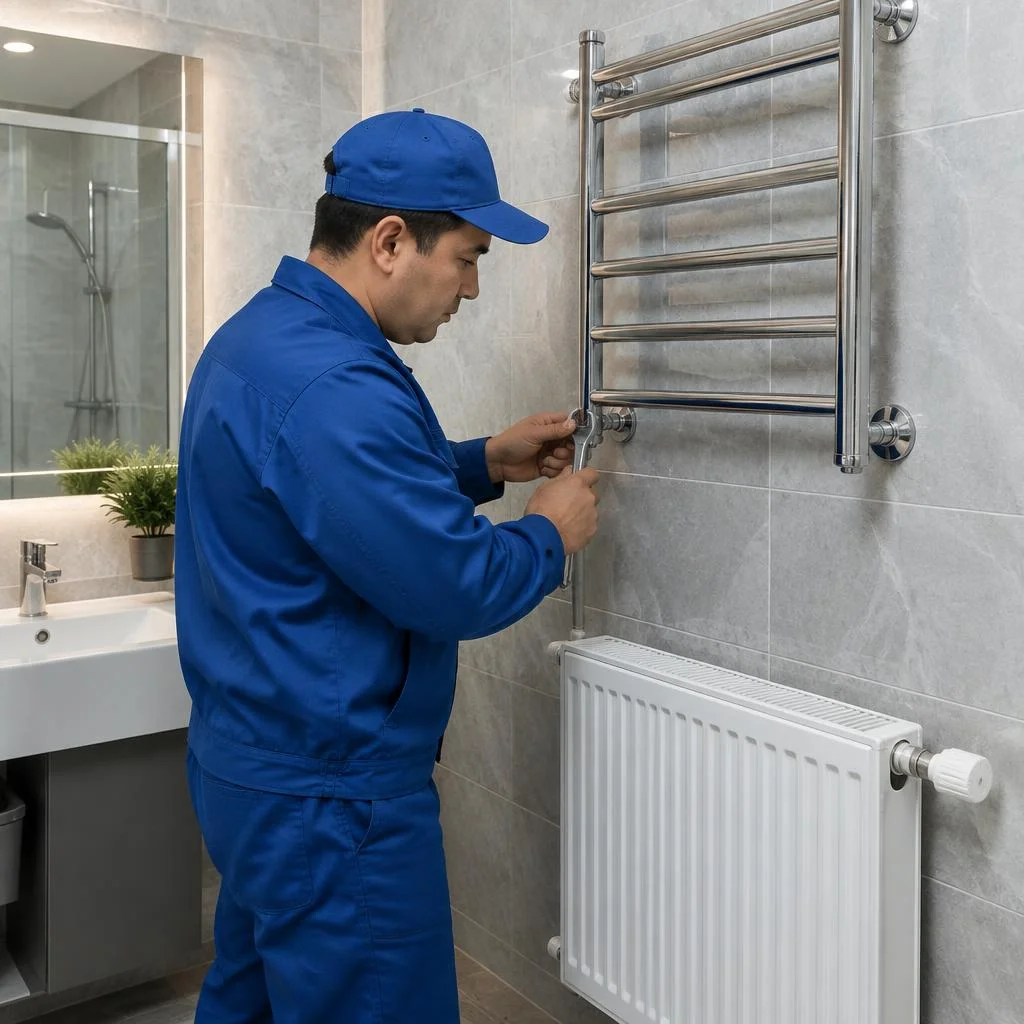
- Bathroom: installing a battery in the bathroom most often concerns a towel warmer — we replace it with a moisture-resistant model made of stainless steel or bimetal; an ordinary steel panel radiator without corrosion protection fails here within 3–4 seasons.
- Kitchen: installing a battery in the kitchen requires taking into account the proximity of the sink and ventilation — we place the unit so that splashes do not hit the sections and the flow from the window does not blow the heat toward the extractor hood.
- Room: installing a battery in a room is standard installation under the window with section calculation based on area and ceiling height, with no special requirements for the premises.
- Adjacent zones: updating the heating in an apartment with several wet zones (bathroom, kitchen) is done in one visit, so as not to send the crew twice and not to shut off the riser again.
- Approval: installing batteries in an apartment in the bathroom and kitchen does not require separate permission from the management company, if the riser or a towel warmer connected to the shared hot water circuit is not affected.
Installing batteries in an apartment: scenarios by number of units
| Scenario | What we replace | Specifics |
|---|---|---|
| One unit | Radiator in one room | Without shutting off the riser if shut-off valves are present |
| Two or three units | Bedroom, living room, kitchen | One pressure-testing cycle, the riser is shut off once |
| Whole apartment | All units, supply lines, valves | Full system balancing is required |
| Wet zones | Bathroom, kitchen | Moisture-resistant models, separate ventilation considerations |
| With relocation | Radiator to a new location | New supply line, maintaining the slope |
When a client asks to replace the heating radiators in an apartment entirely, the estimate is made up of dismantling, installation, and pressure testing — each item is calculated separately, not as a single sum. If, however, they decide to replace the batteries in the apartment one unit at a time over the season, the total cost of work turns out higher due to repeated visits and riser shutdowns. In such requests, clients often write replace batteries in apartment price — and we immediately calculate the full cycle based on the number of units, not per single item. Many ask about the cost of replacing a heating battery in advance — and we state the calculation procedure based on the number of units, without fixing the sum until inspection.
Installation of radiators and batteries: Tashkent and the private sector
Installing a battery in Tashkent most often concerns the panel buildings of Chilanzar and Yunusabad, where heating risers are laid out in a riser scheme — here, installing a radiator in Tashkent requires shutting off the riser for the entire entrance. Installing batteries in the new buildings of Sergeli and Mirzo-Ulugbek district is easier: in the new series, each device has shut-off valves, and installing batteries in Tashkent is done without stopping the circuit. Installing radiators in the private sector means working with an autonomous boiler and polypropylene piping, where installing a radiator takes one visit without approvals. Installing heating radiators in an apartment in the old housing stock also requires checking the condition of the riser: if the pipe is clogged, a new section will not provide the required heat output. Installing heating batteries in an apartment with Soviet-style cast-iron devices is the most frequent request during the cold season. In search, such work is entered as battery replacement Tashkent or battery replacement in Tashkent — both queries mean the same visit by a crew with shutting off the riser. A separate line is radiator replacement in Tashkent: this is how owners of apartments in the old housing stock phrase the request, where one device is replaced without full piping.
Installing heating batteries in an apartment: choosing the type of device
Installing heating batteries in an apartment begins with choosing the type of device for a specific system: bimetallic for central heating with high pressure, aluminum for an autonomous circuit. Upgrading the heating system in an apartment as a whole means replacing not only the devices, but also the connections, shut-off valves and, if necessary, the riser. You can also change the batteries in an apartment in stages, but upgrading the heating system in an apartment in one visit gives a more predictable result: balancing is done once and for all devices at once. Before replacing radiators in an apartment, it is worth requesting the pressure parameters in the circuit from the management company — this determines whether an aluminum section can withstand water hammer. Installing radiators in an apartment taking into account pressure and coolant quality extends the service life of the devices by several seasons. When choosing between cast iron and bimetallic, clients ask about replacing a cast-iron battery with a bimetallic one price — and we explain what makes up the calculation based on the number of sections and the type of connection.
Eco-Service Warranty, Timelines and Terms of Work
The warranty on work, actual timelines and the boundaries of the basic service — three questions most often asked before a technician's visit. Below we break down each one: what the two-year warranty covers, how long it takes to install one unit and an entire apartment, and which items are considered separate work.
2-year warranty on work: what it covers
- 2-year warranty on installation: covers leaks at connection points, failure of shut-off valves and errors made during unit installation.
- Supply line to the radiator: if a connection leaks during the warranty period, the technician's visit and defect elimination are performed at no additional charge.
- Shut-off valves: valves installed during installation are replaced under warranty if the body fails or the stem jams.
- What is not covered: damage from water hammer in the central system, mechanical impacts on the unit and independent re-sealing of connections after the technician's visit.
- Recording the case: each incident is inspected on site, the cause is described in a report, and the decision is made based on the inspection, not over the phone.
Timelines: how long one radiator and an entire apartment take
- One unit: installation takes 2–3 hours, including draining the coolant, removing the old battery and connecting the new one.
- Entire apartment: replacing radiators throughout the entire apartment — one working day for 4–6 points with existing supply lines.
- Heating riser: work on the riser stretches to two days: part of the time goes to coordinating the shutdown with the management organization.
- Impact of supply lines: if the threaded connections are seized or the pipe is damaged by corrosion, removal is delayed by 1–2 hours, which we warn about before starting work.
- Seasonal factor: during the heating season, time for shutting down the riser is added to the timeline — on average half a working day.
What is included in the service and what is considered separate work
- Included in the basic service: removal of the old battery, marking the location, mounting the brackets, connecting the supply lines and pressure-testing the system after installation.
- Separate item: re-soldering polypropylene pipes, renewing the supply line to the radiator and installing shut-off valves if the old valves have become unusable.
- Separate item: relocating the radiator to a new place with modification of the pipeline route and re-soldering the line.
- Separate item: work on the heating riser, renewing the towel warmer and heating convector — each is agreed in advance.
- Approval procedure: the list of works is recorded in the request before the visit; if the technician on site discovers the need for re-soldering, he coordinates the addition and does not start work without confirmation.
Own service center in Tashkent: what it provides
Eco-Service has its own service center in Tashkent — a direct provider of the service, without intermediaries or subcontractor crews; requests are accepted directly and passed to a specific technician with a heating profile. On staff are specialists in the installation of bimetallic and aluminum sections, polypropylene soldering, and system balancing: the same crew can be called again if warranty follow-up work is needed. A direct provider is responsible for the result as a whole — if a problem arises, you contact the same center rather than looking for a crew that the contractor hired for a one-off job. Clients search for radiator replacement Tashkent — and reach us directly, bypassing intermediaries. In our practice, there was a case when, after updating the radiators in an entire apartment, rebalancing was required two months later — the technician came under warranty, because the request and work history remained in the center's system. Clients search for heating radiator replacement services — and get one crew for the entire scope, not a chain of contractors. When asked about the cost of battery replacement, we explain: the price is made up of the scope of work, not the number of intermediaries in the chain, and this is the main difference between a direct service center and one-off crews. Often the request says plumber battery replacement — and the technician arrives with a full set of tools for heating installation. The wording battery replacement at home price also appears in requests, and from it we immediately understand the scope: one point or the entire distribution throughout the apartment. Another frequent request is replace radiator in apartment price, and we answer it the same way: the calculation is made after inspecting the supply line and the riser. Separately, we break down what makes up the heating battery replacement price: dismantling the old unit, installing brackets, connecting the supply line, and pressure-testing the system. We calculate the cost of heating replacement by the number of points and the condition of the distribution, not by a price list per section. When a client clarifies heating radiator replacement in apartment price, the technician asks for a photo of the supply line before the visit — this makes the calculation more accurate. We break down the request battery replacement in kitchen price separately: in the kitchen, furniture most often gets in the way and the supply line runs into the wall, which adds to the scope of work. The topic cast iron battery replacement with bimetallic price comes up in requests for old housing stock: cast iron is heavier, dismantling takes longer, but bimetallic is installed on the same brackets. And the wording cast iron battery replacement with bimetallic price describes exactly the same process, only in the singular. Another frequent request is heating battery replacement price, and here we answer the same way: the total depends on the scope, not on how the request is worded.
Reviews and reputation: where to look
Reviews of heating work are published on Google Maps and Yandex.Maps, as well as in the service center's Telegram channel — there we post photos of completed work with a description of the site: type of unit, condition of the supply line, distribution specifics. From the reviews, you can see how the technician behaves when faced with a non-standard task: seized threads, old cast iron distribution, the need to re-solder on the spot. When choosing a contractor, look not at the average rating, but at reviews with photos and a description of a specific situation — they show the real level of work, whereas the overall score is made up in part of how quickly calls are answered. If a review mentions a specific address or type of building, that is already a signal: the technician has worked with a similar distribution and knows what to expect. Clients often write battery replacement in bathroom — and from the photos in the reviews you can see how such work was performed at similar sites. Different requests such as cost of heating battery replacement work or replace batteries price lead to the same page, so focus on the description of the process, not on the wording of the request. In search, people type heating battery replacement price and heating battery replacement price — both wordings lead to this page, which describes the entire process from dismantling to pressure testing. There are also radiator replacement cost and replace heating radiator price: behind different words is one service, and it is assessed by the scope of work at the site. The request cost of battery replacement and replace heating batteries price is also frequent, so look at the description of the process and the photos, not at the wording.
Conclusion
Replacing batteries and radiators is a task that is tackled once every 15-25 years, so the cost of a mistake in choosing the type, number of sections, and connection is higher than it seems at the moment of dismantling.
Key takeaways
- Type matters more than brand: bimetallic sections withstand pressure up to 35 atmospheres and are suitable for central heating, while aluminum ones are cheaper but sensitive to water hammer in old risers.
- Calculate by area, not by eye: one bimetallic section covers 1.8-2 m² with a ceiling height of up to 2.7 m; a shortage of sections cannot be compensated for by boiler temperature.
- Season is not a death sentence: freezing the pipe with nitrogen allows you to replace a radiator without shutting off the riser, but with worn polypropylene supply lines the method is not used.
- Comprehensive replacement is cheaper than phased: changing all radiators in an apartment in one visit saves on repeated draining, pressure testing, and balancing.
- Warranty and documents: keep the work completion certificate and receipt — without them, a warranty case for connections and fittings cannot be processed.