








When a pump station needs repair: signs and causes
A station rarely breaks "suddenly" — usually it signals in advance: pressure drops, humming grows, the motor won't shut off. Let's break down the symptoms by which the owner understands that repair is needed, not just pumping air into the tank.
The pump station won't shut off or won't build pressure
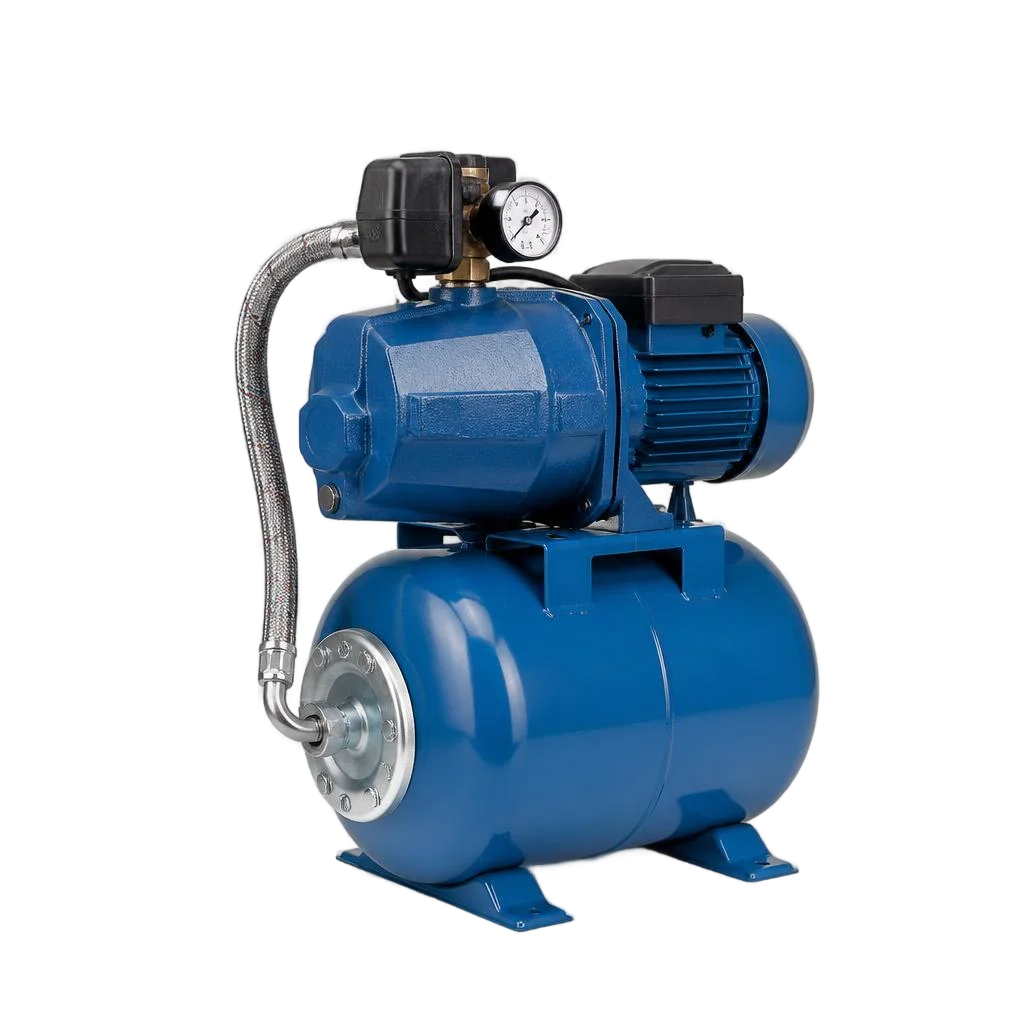
Most often the cause is a loss of tightness in the diaphragm of the hydraulic accumulator or misadjusted pressure switch thresholds, because of which the unit doesn't reach the set pressure and runs non-stop. An EPDM diaphragm loses its elasticity over 3–5 years, air from the air chamber escapes into the water, and the tank stops damping water hammer; the pressure switch clicks, but the contacts are already burnt and "stuck." The second scenario is the check valve on the suction line not holding the column, water flows back, and the pump circulates it in a loop. It's easy to check: if with the motor off the pressure gauge needle drops within 10–15 minutes — look for a leak in the diaphragm or check valve, don't go adjusting the switch. Such a pump station requires repair already after the first week of continuous operation — the winding overheats and goes into an interturn short circuit.
Noise, vibration and humming during station operation
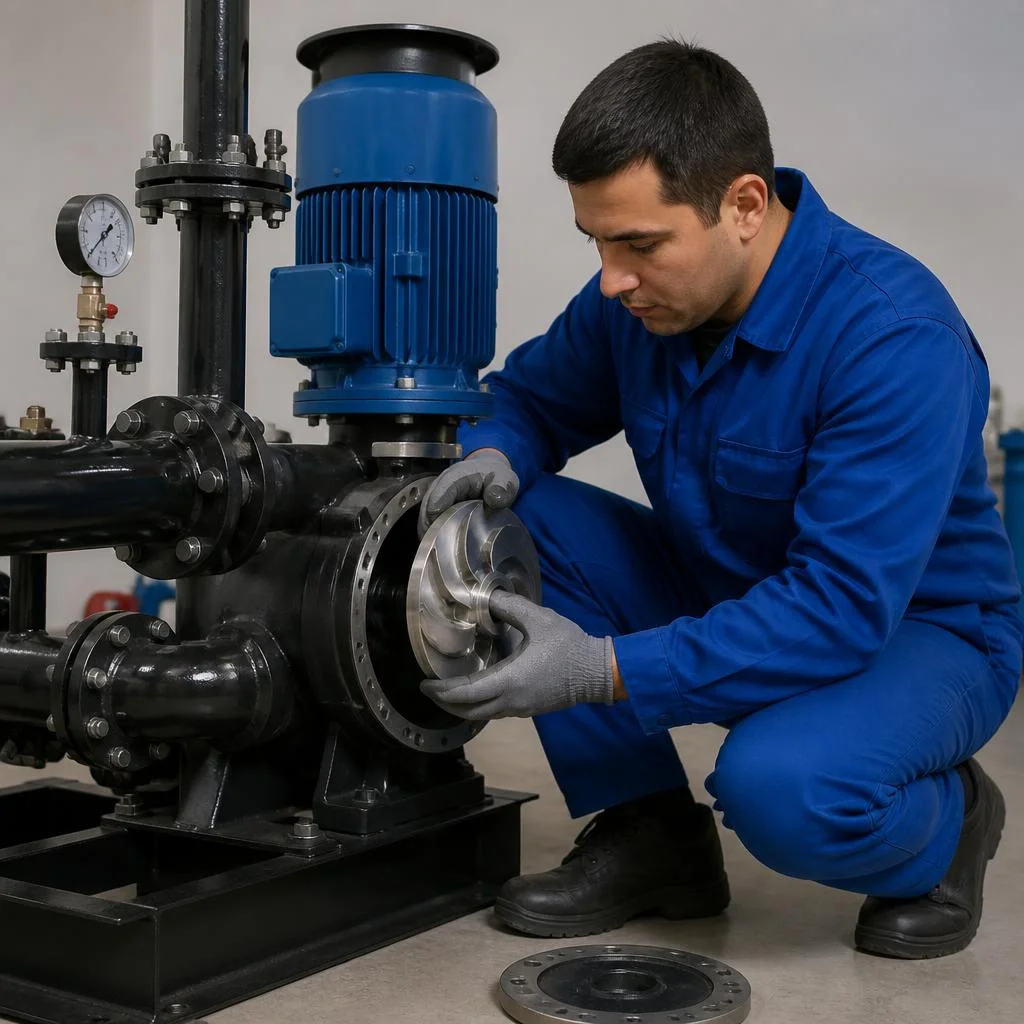
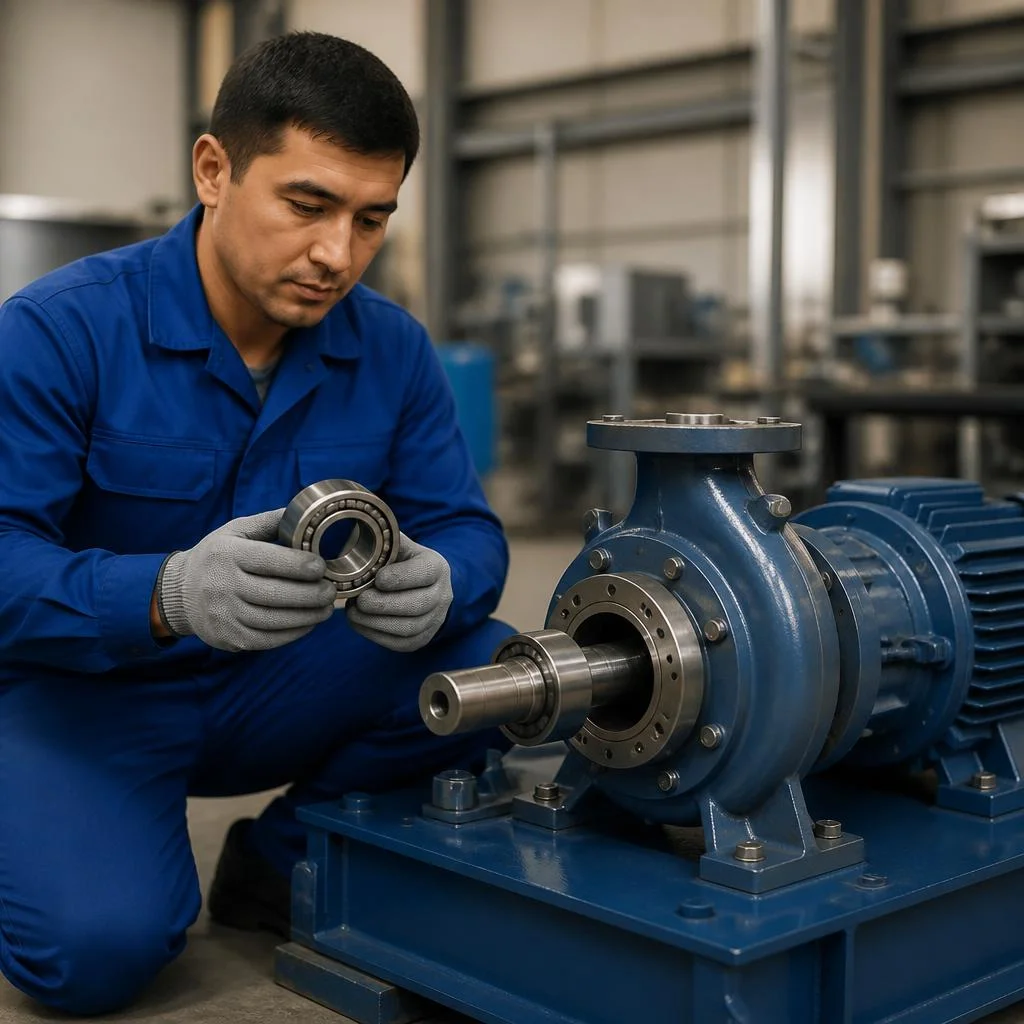
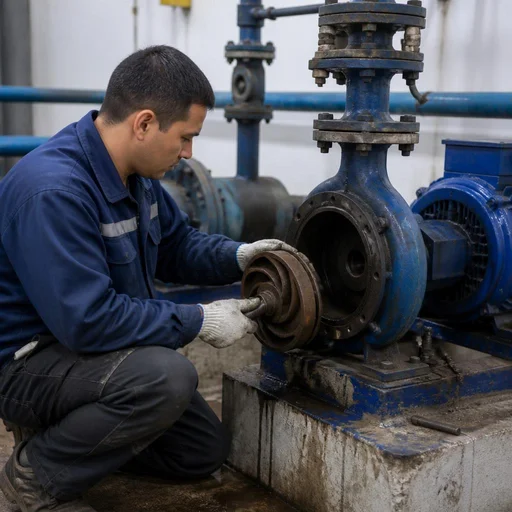
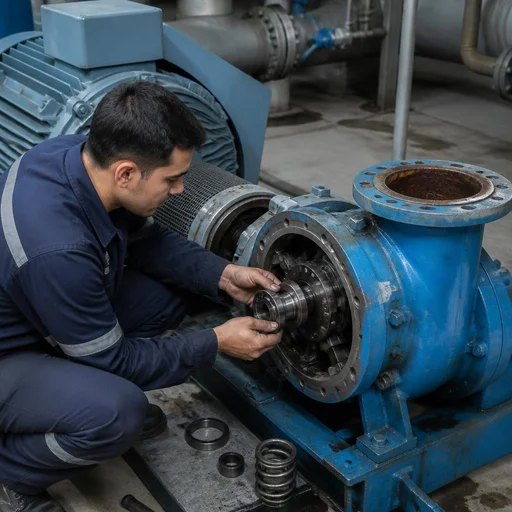
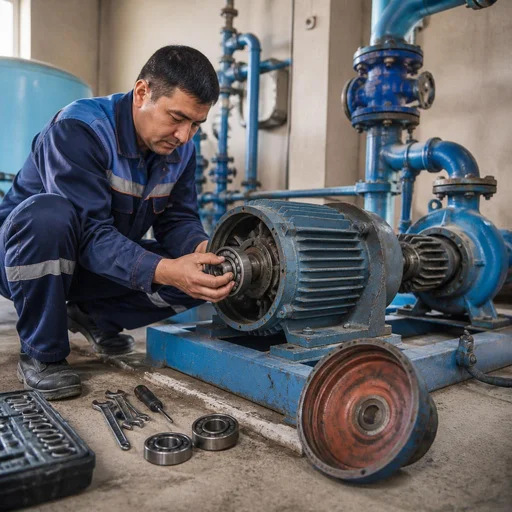
Growing humming and vibration almost always indicate wear of the motor bearings or destruction of the impeller — parts that are replaced at a service center, not "cured" with lubricant. Bearing 6203 or 6204, when worn, produces a characteristic low hum, and the shaft begins to strike the housing; a glass-filled polyamide impeller, when sand gets in, gets chipped along the edges and loses its balance. If vibration appeared abruptly after winter downtime — first check whether the impeller has spun on the shaft: this is a common cause that is confused with a "dead" motor. Owners often describe the problem in their own words — they search for water station repair using exactly this query when the unit hums but still pumps. Diagnostics begin with measuring vibration on the housing and checking shaft play: the bearing is replaced together with the seal, otherwise a leak along the shaft will return within a month.
The station runs, but no water comes
If the motor hums but no water is supplied, the cause is usually a loss of the water column in the well, airlocking, or a jammed impeller — this requires on-site diagnostics. The suction pipe becomes exposed when the dynamic level in the well drops below the design level — the pump grabs air and stops pumping, and during dry running the winding heats up and can burn out within minutes. The second option is a jammed impeller after scale or sand gets in. Before calling a technician, check the water level in the well: if it has dropped below the suction pipe, pump repair for the well won't help — the pump needs to be reinstalled deeper.
Typical pump station faults and their causes
| Symptom | Probable cause | What is replaced |
|---|---|---|
| Won't shut off, pressure doesn't rise | Hydraulic accumulator diaphragm is torn | Diaphragm or tank |
| Frequent switching on | Pressure switch thresholds are misadjusted | Pressure switch |
| Humming, housing vibration | Wear of motor bearings | Bearings |
| Pumps weakly, pressure has dropped | Impeller is destroyed | Impeller |
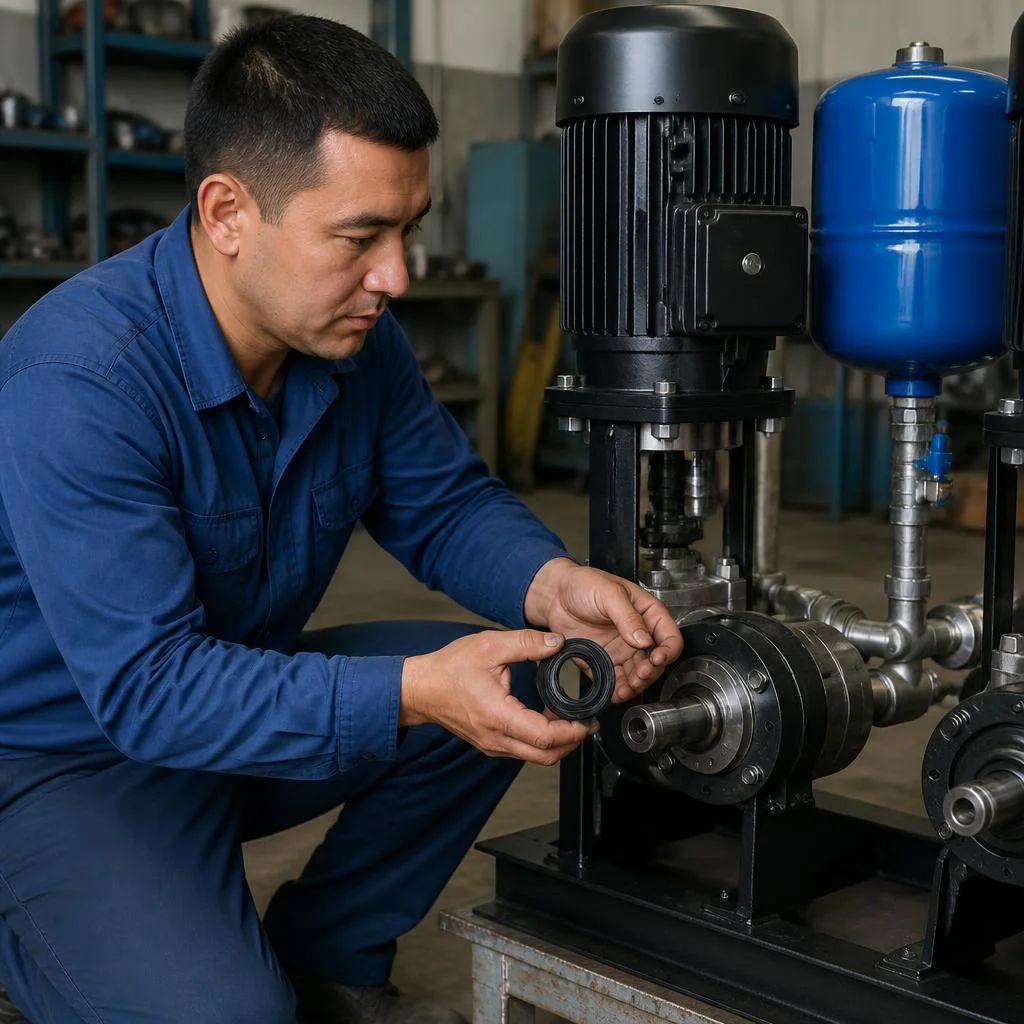
| Leak along the shaft | Wear of the mechanical seal | Mechanical seal |
| Hums, no water comes | Dry running, loss of column | Dry-run sensor |
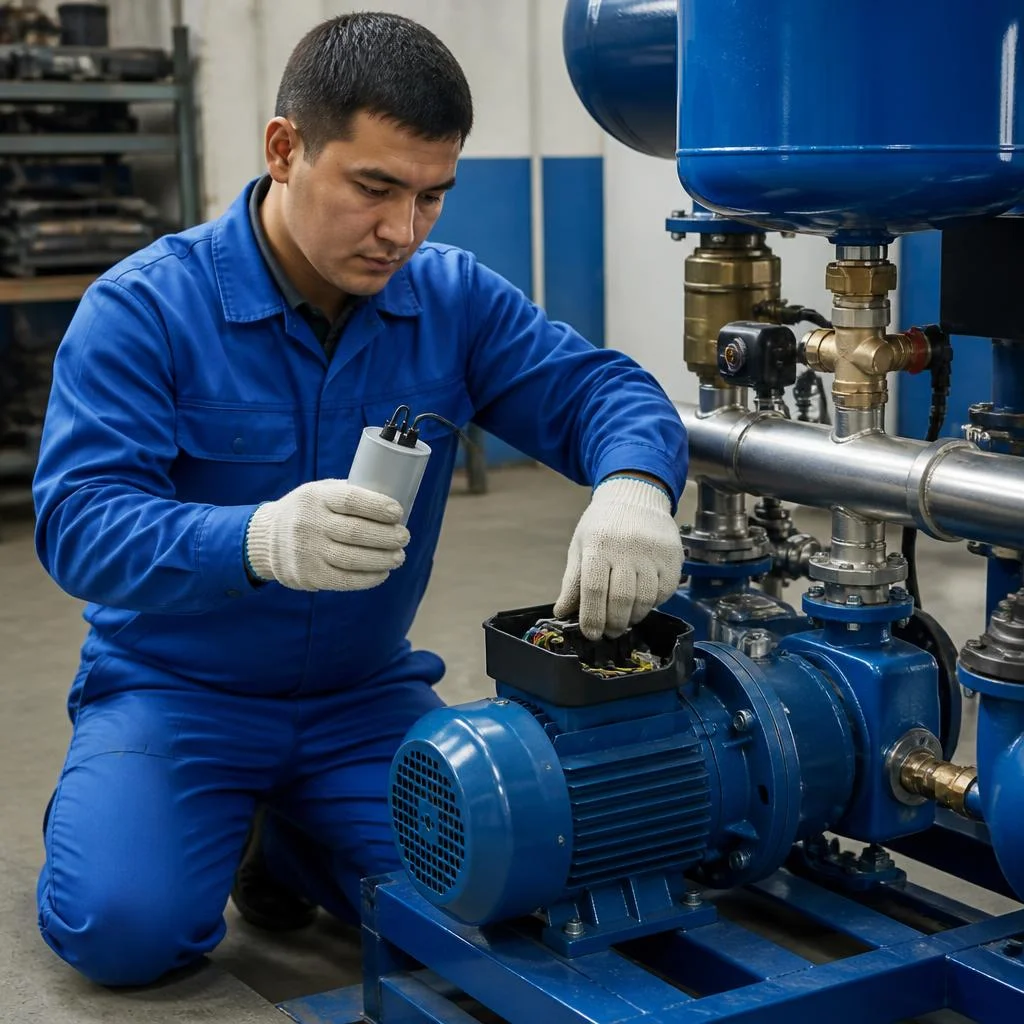
| Won't start | Capacitor is blown | Capacitor |
| Water comes in bursts | Airlocking, air suction | Seal, gaskets |
One symptom can have 2–3 causes — don't replace a unit at random, diagnostics are cheaper than a repeat replacement. Pump station repair begins precisely with the map "symptom → cause → unit," not with disassembling the motor.
Repair of pumping stations at home and at the Eco-Service service center
Restoration is possible in two ways — with a visit to the client or at the service center. The choice depends on the faulty unit, the conditions at the site, and whether the motor needs to be disassembled on a test bench.
Repair of pumping stations at home: how a technician's visit works
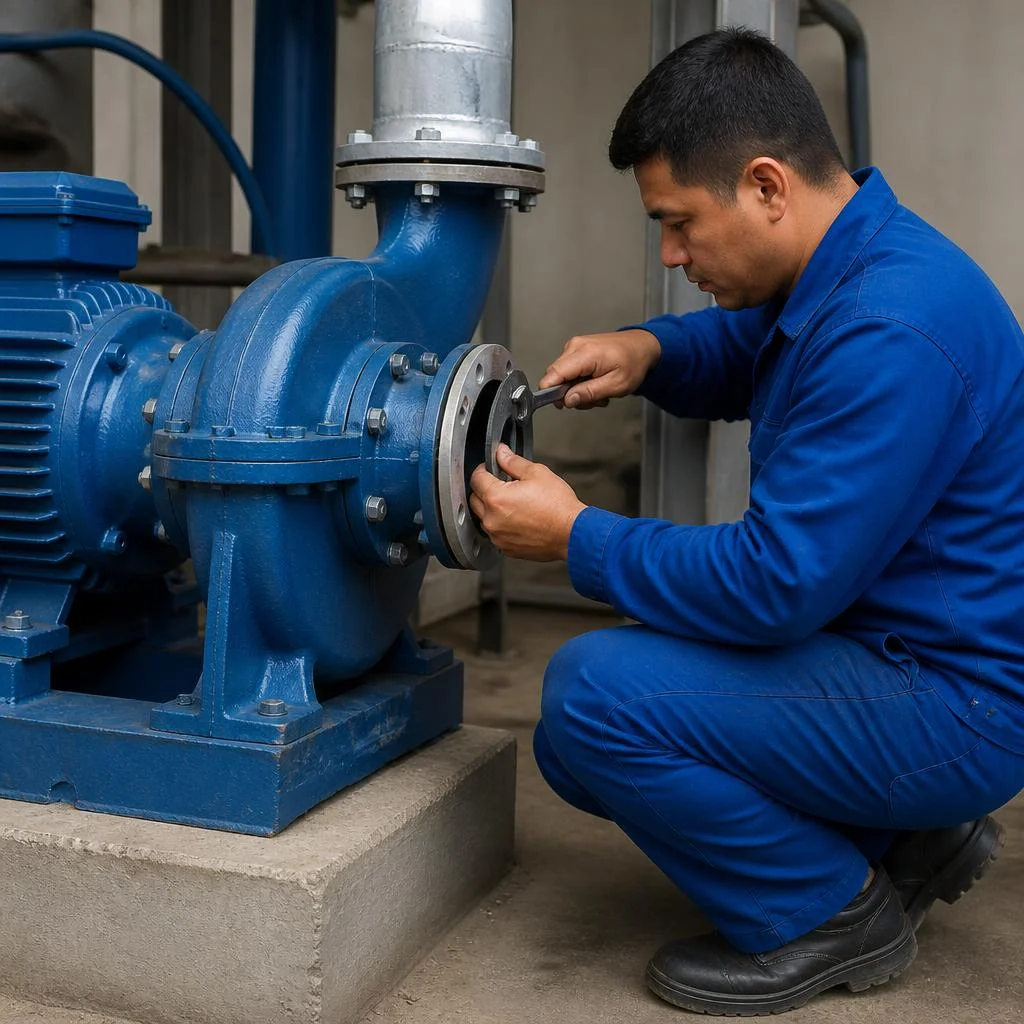
An Eco-Service pumping station technician travels to the address in Tashkent, performs diagnostics on site, and carries out up to 80% of the work — replacement of the pressure switch, automation unit, seals, power cable — without dismantling the station. On-site service covers most requests in the private sector: in Sergeli, Yashnabad, and Mirzo-Ulugbek district, stations are installed in pits and caissons, where the technician gets to with his own tools and a pressure gauge. Diagnostics takes 20-30 minutes: we check the pressure in the hydraulic accumulator, the winding resistance, the operation of the relay and the dry-run sensor. For the visit, inform us in advance of the station model and the well depth — the technician will bring compatible spare parts right away, and the service will be completed in one visit instead of two.
What is done at the service center and what is done on site
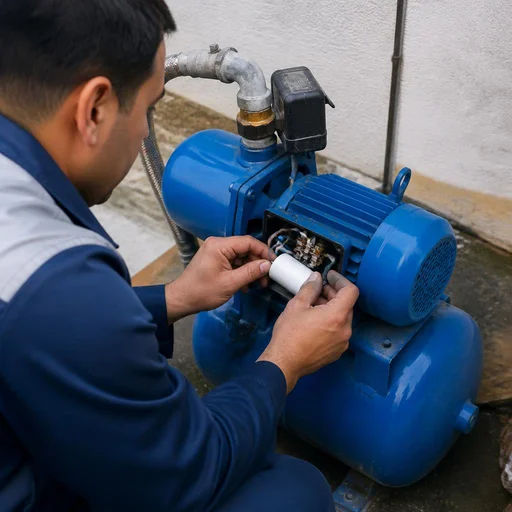
- On site at the client's: replacement of the pressure switch, adjustment of the automation, replacement of the pressure gauge, capacitor, starting relay, and power cable.
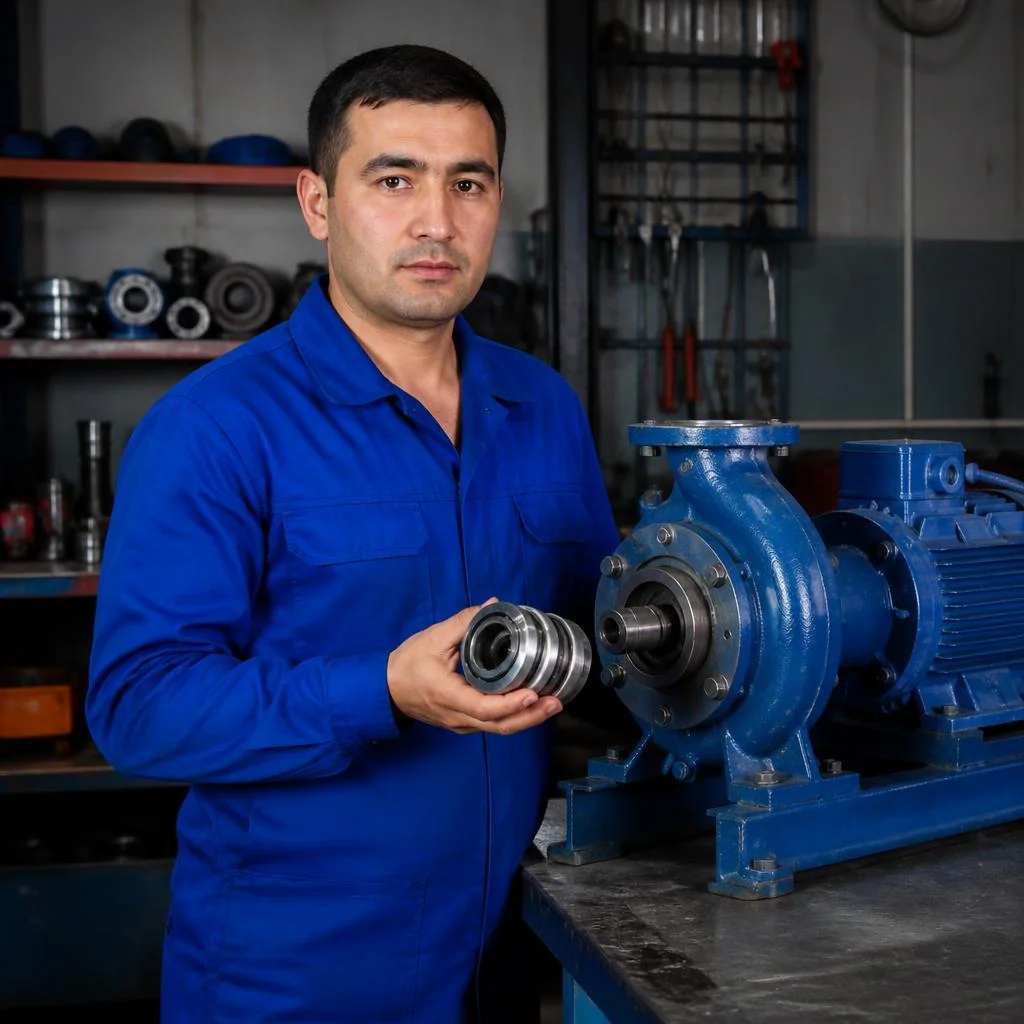
- At the service center: rewinding of the motor winding, replacement of bearings, repair of the impeller, rotor balancing on a test bench.
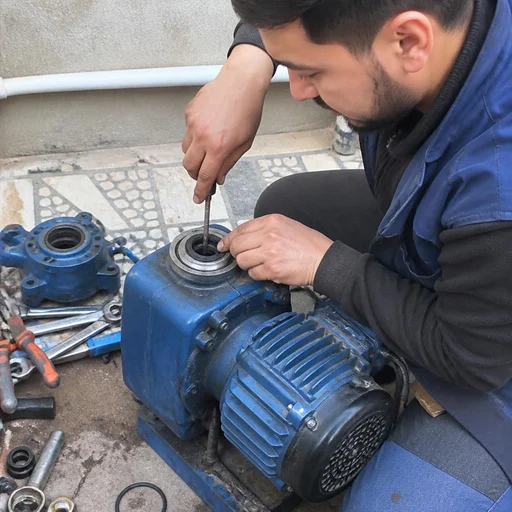
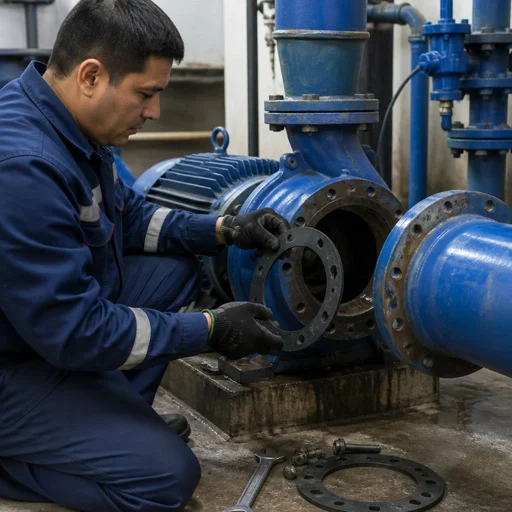
- Requires dismantling: replacement of the mechanical seal and impeller when the fasteners are corroded — the station is removed and taken to the workshop.
- Diagnostics on the test bench: checking the head-flow characteristic after assembly and checking for vibration.
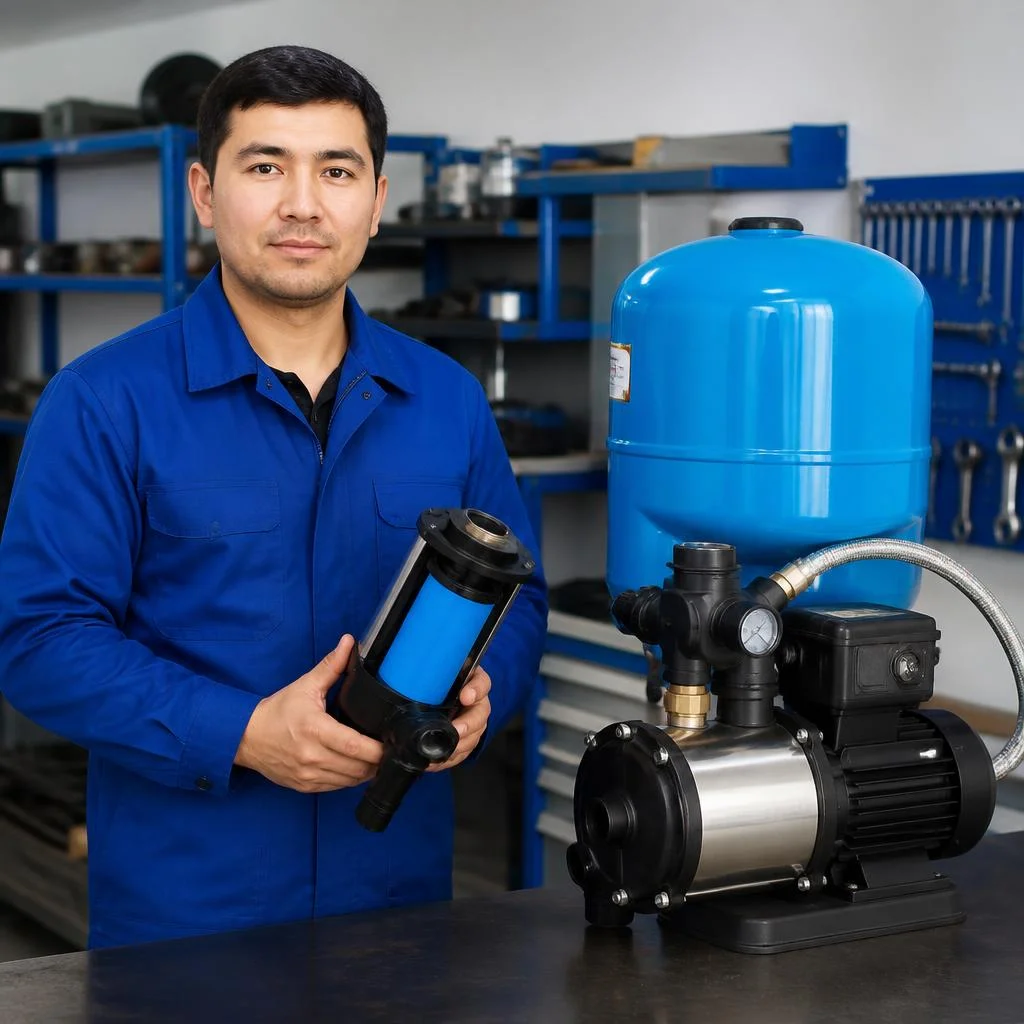
- Hydraulic accumulator: replacement of the membrane is done on site, replacement of the tank as a whole — depending on the condition of the housing.
Repair of a well pump and a water pumping station: what is the difference
A submersible well pump is restored by lifting it out of the well, while a water pumping station with a surface pump is more often serviced right on site; we work with both types. In search, clients often type in a request about repair of a deep-well pump — and end up here, because the difference between the deep-well and surface design determines the entire work technology. Servicing a deep-well pump begins with extracting the unit: cable, winch, disconnecting the cable and pipeline — at a depth of 30-60 meters, the operation takes 2-3 hours just for the lift. A surface pump is removed in 15 minutes: it is unscrewed from the suction line, checked for dry running and cavitation. Lifting a deep-well pump is a separate operation with a cable and winch; specify it in the request so that the technician arrives with the necessary equipment and a crew does not have to be called again.
Which components are replaced during pump station maintenance
The station consists of a hydraulic part, electricals, and automation. Below we'll break down exactly which components fail, what is done with them, and by which symptom wear is identified.
Hydraulic part: impeller, seals, bearings
- Impeller: creates the pressure head; when the blades wear, the station loses pressure and pumps water in bursts.
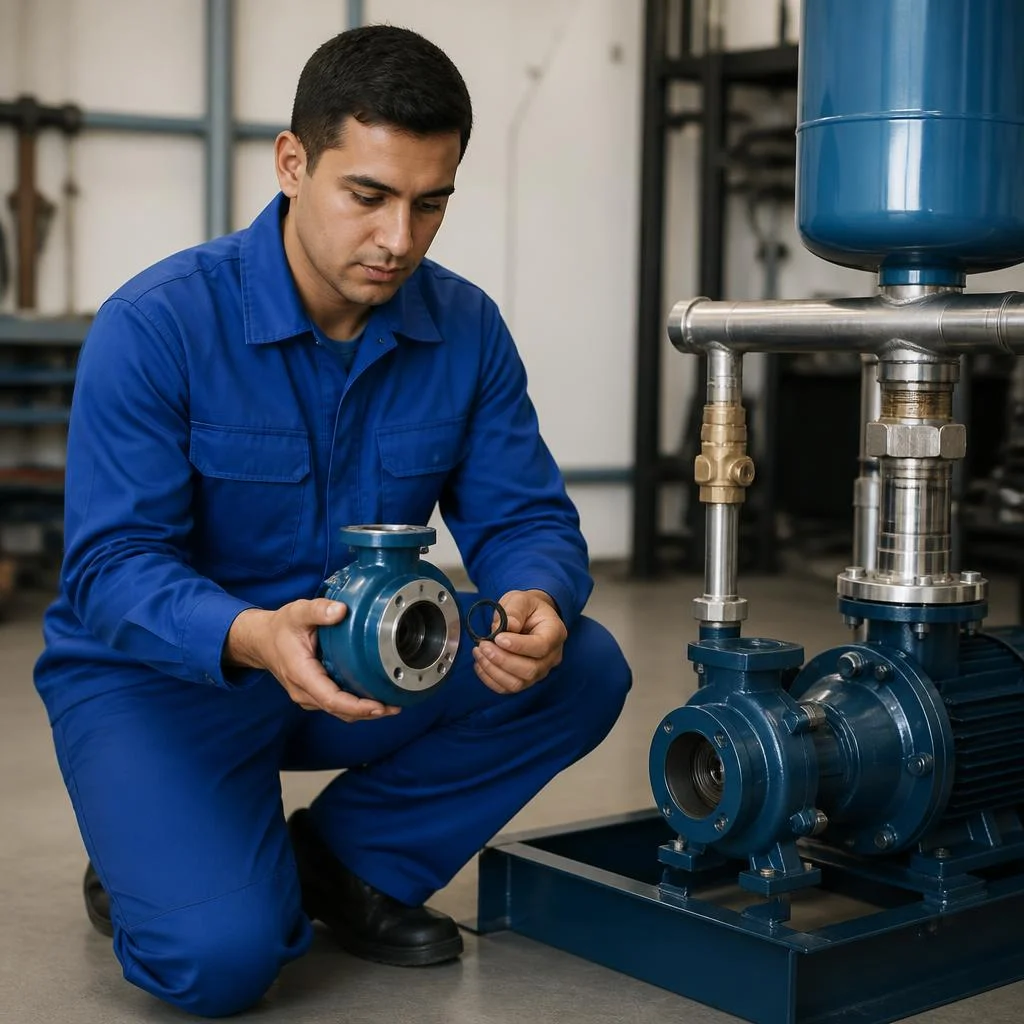
- Mechanical seal: seals the shaft on the water side; wear causes a dripping leak under the housing.
- Stuffing box: seals the shaft in budget models; when worn, water seeps along the pump housing.
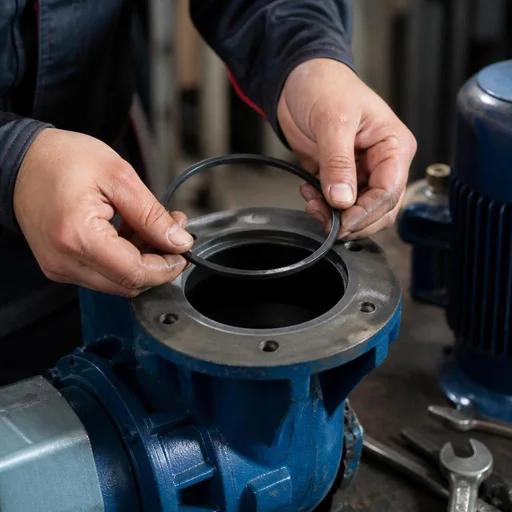
- O-rings: responsible for the joint between the housing and flanges; they dry out and let water through at the connections.
- Motor bearings: support the shaft; play causes vibration, humming, and accelerates wear of the mechanical seal.
Automation and protection: pressure switch, dry-run sensor, automation unit
- Pressure switch: turns the pump on and off based on thresholds; if misadjusted, the unit runs nonstop or won't start.
- Dry-run sensor: shuts off the pump when the water level drops; without it, the motor runs dry.
- Float switch: protects against overflow and dry running in storage-tank setups.
- Automation unit: combines the relay, protection, and indication; if it fails, the station won't reach operating mode.
- Pressure gauge: shows the actual pressure; it is used to set the relay thresholds.
Electrical part: winding, capacitor, starting relay, cable
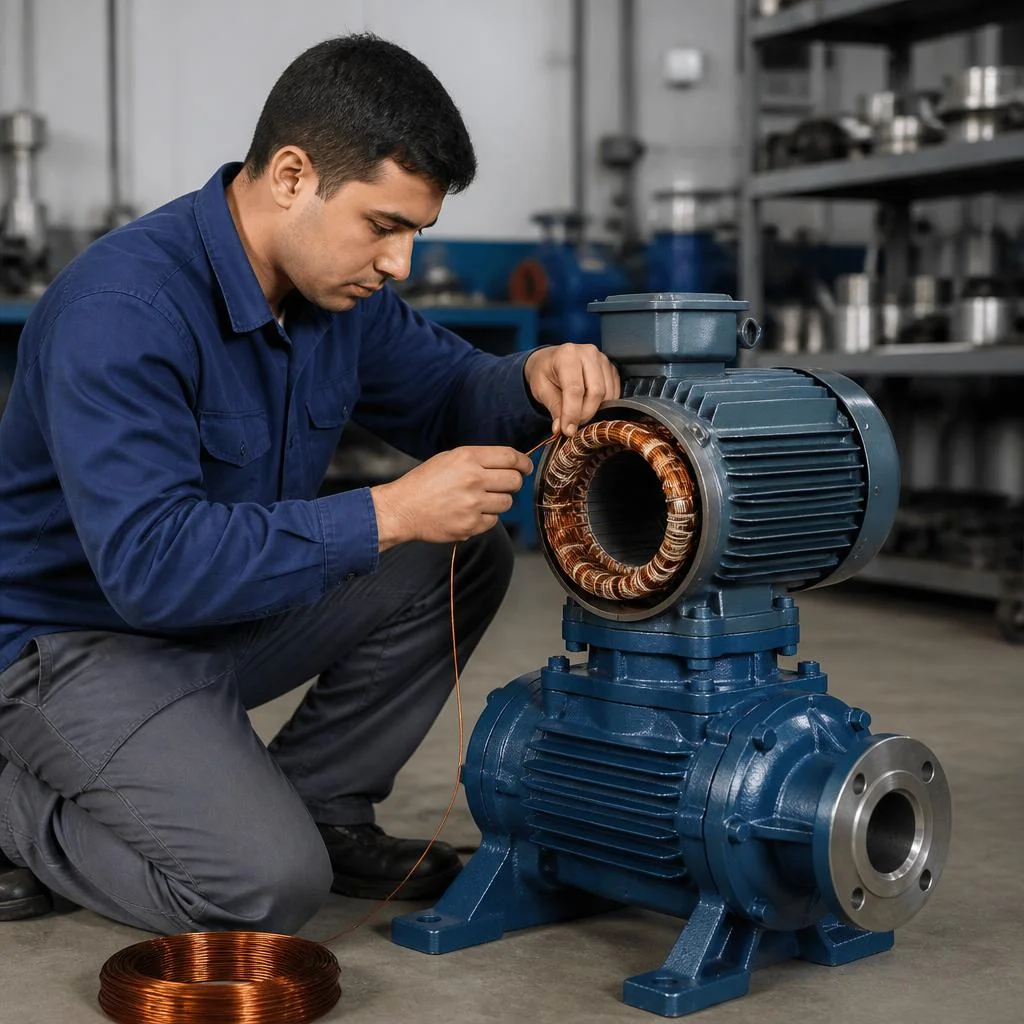
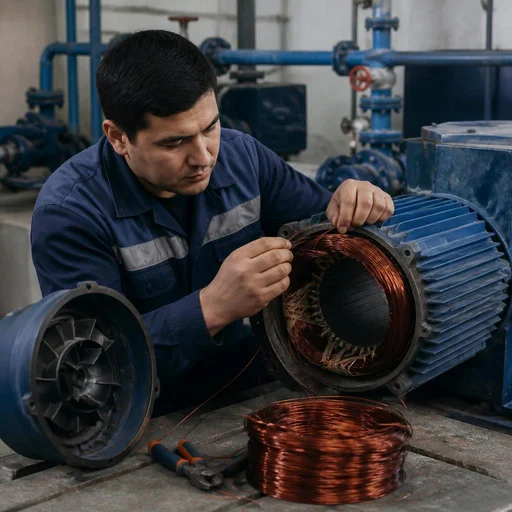
The station's electricals are restored at a service center: the motor winding, capacitor, starting relay, terminal box, and power cable are replaced. Before rewinding, the technician checks the capacitor, starting relay, and terminals — a faulty relay causes overload, which is what burns out the winding. If this step is skipped, the new motor will fail just as quickly. In service center practice, winding rewinding almost always goes hand in hand with replacing the capacitor and relay. A burnt winding is a consequence, not a cause: first they find the component that killed it, and only then install a new motor. Clients often search for "pump station repair technician" — and for such a request we immediately clarify whether the motor hums on startup or is completely silent: this determines whether rewinding is needed or whether replacing the starting relay and capacitor will suffice.
Hydraulic accumulator: membrane replacement or complete tank replacement
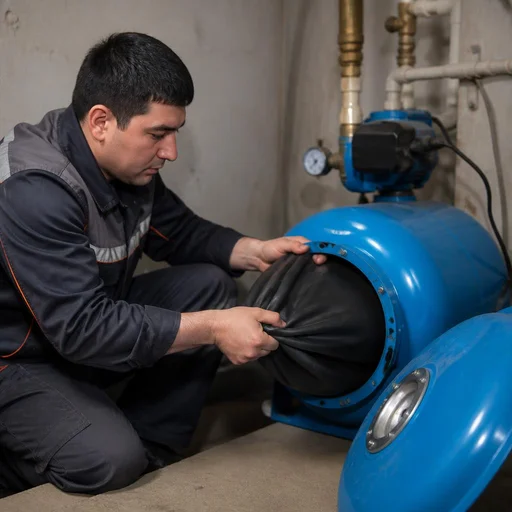
If the membrane is intact, only it is replaced; if the housing is rusted through or deformed, the hydraulic accumulator is replaced entirely; the service performs both options. The membrane doesn't rupture from old age but from pressure surges: when the thresholds are off, the station pumps water in bursts, and the rubber can't withstand it. After replacement, the pressure switch must be adjusted and the air chamber precharge checked — otherwise the new membrane will rupture just as quickly. A common mistake is installing a larger tank without readjusting the thresholds: the pump starts less often but with a greater load at startup.
Comparison of components: what is replaced, why, and when
| Component | What it is responsible for | Symptom of wear |
|---|---|---|
| Impeller | Head and flow rate | Pressure drop, water surges |
| Mechanical seal | Shaft sealing | Dripping leak under the housing |
| Gland seal | Shaft sealing | Water seeping along the housing |
| O-rings | Housing and flange joints | Seepage at connections |
| Motor bearings | Shaft alignment | Vibration, humming, play |
| Pressure switch | Pump activation thresholds | Station does not shut off or does not start |
| Dry-run sensor | Protection against running without water | Pump runs dry |
| Motor winding | Pump drive | Motor hums but does not turn |
| Hydraulic accumulator diaphragm | Pressure buffer | Frequent switching, head fluctuations |
Pump station maintenance: prevention instead of emergency repair
Scheduled maintenance costs less than emergency repair and extends the service life of components. Let's break down what maintenance includes, how often it is performed, and how the schedule differs for a home, a country house, and a commercial facility.
What pump station maintenance includes
- Checking pressure and thresholds: we compare the pressure gauge readings with the settings; if there is a deviation, we adjust the pump's cut-in and cut-out thresholds.
- Inspecting seals and connections: we examine mechanical seals, flange gaskets, and stuffing box seals for leaks and microcracks.
- Testing the dry-run sensor: we simulate a drop in water level — the sensor must shut off the pump without delay and without false tripping.
- Checking the hydraulic accumulator membrane: we measure the pressure in the air chamber and look for ruptures; if elasticity is lost, we replace the membrane.
- Tightening electrical terminals: we check the contacts of the terminal box, capacitor, and starting relay, and tighten loose connections under load.
How often the station needs maintenance and what happens if you skip it
For a household station, maintenance once every 6–12 months is sufficient; with intensive use for irrigation or with hard water, the interval is shortened to 4–6 months. In Tashkent, water often contains elevated levels of hardness salts, so seals and the impeller wear out faster than in regions with soft water, and the pressure switch becomes clogged with deposits. Skipped preventive maintenance rarely leads to a "sudden" breakdown — it accelerates wear of seals and bearings, and restoring a water pump station costs more than a scheduled technician visit. Clients often search for the cost of station restoration — and land on this page, so let us explain the logic of the expenses: the final amount depends on the stage at which the defect is detected. Tie the check to the season: before the start of irrigation and after winter downtime — two dates a year that prevent most future failures.
Maintenance of pump stations at facilities: homes, country houses, and commercial properties
Stations in private homes, country houses, and commercial facilities are maintained at different intervals and with different scopes of work depending on the load. In a private home with one station, two visits a year are enough: checking the pressure switch, membrane, and terminals. At a country house with seasonal irrigation, the schedule shifts to spring and autumn — before system startup and after winterization. Commercial facilities — mini-hotels, car washes, greenhouses — keep equipment under round-the-clock load, so a regular maintenance contract is more effective for them than one-off calls after a breakdown. If the system has a variable-frequency drive, add a check of its parameters: incorrect settings cause pressure surges and accelerate impeller wear. At such facilities, it is almost always cheaper to prevent water pump failure with scheduled inspection.
Repairing a water pump yourself or through a service: which to choose
The owner really can do some of the work themselves, and there will be no harm in that. Let's look at where doing it yourself is justified, and where it leads to a repeat breakdown and unnecessary expenses.
What you can really do yourself
- Pumping up the hydraulic accumulator: check the pressure with a pressure gauge; if it drops below normal, pump in air with a car pump through the valve.
- Cleaning the filter: remove the housing, wash the mesh from sand and rust, check the gasket for scoring and cracks.
- Tightening the terminals: de-energize the station, check the tightness of the contacts on the motor and pressure switch — a loosened screw heats up and burns out.
- External inspection: walk around the housing, find leaks on the flanges, traces of rust and moisture under the terminal box.
Where DIY repair leads to a repeat breakdown
Replacing the mechanical seal, rewinding the winding, replacing the bearings and setting up the automation without a test bench and experience almost always end with another call to a technician. The mechanical seal seats only on a perfectly clean shaft surface with a verified clearance, the winding after rewinding is checked for an interturn short circuit, and the bearings are selected by precision class and fitted with an interference fit — you can't do this by eye. The pressure switch and dry-run sensor are adjusted using a pressure gauge for the specific volume of the hydraulic accumulator and the lift height: shifting the threshold by 0.2 bar results in either constant shutdowns or operation without protection. The main mistake in DIY restoration of a water station is replacing a unit without diagnosing the cause: a new seal or switch fails because the source of the overload has not been eliminated.
When to call a pump station repair technician
A pump station service technician is needed when the station does not hold pressure, hums, does not switch off or the protection has tripped — these symptoms require diagnostics, not random replacement of parts. Clients often phrase the request briefly: I need station service — and from such a description we already understand that a visit with a pressure gauge and multimeter is needed. A common case: the owner replaces the pressure switch, but the cause was an airlocked hydraulic accumulator or a worn impeller — the pressure dropped due to cavitation, not due to the automation. Another scenario: the station holds pressure only at low draw-off, but when two taps are opened it sags — here the suction height, the tightness of the suction line and the condition of the check valve are checked. Restoring a pump station on site takes one visit if the technician arrives with a pressure gauge, multimeter and a set of seals. With us you can arrange the visit in advance: describe the symptoms by phone before the visit — from the description the technician often identifies the unit in advance and takes the needed spare part, saving you a second visit.
Warranty, timelines, and why repairs are better entrusted to a direct provider
The warranty and the service model distinguish a service center from a private technician. Let's break down exactly what you get: coverage periods for the work, who is responsible for the result, and how to verify the reliability of a service before contacting them.
2-year warranty on pumping station repair
Eco-Service provides a 2-year warranty on completed work and installed components — this is a fixed service standard, not a one-off arrangement. The coverage applies to replacement of the impeller, mechanical seal, motor bearings, winding, and the automation unit — the components whose failure most often brings a station back for service. This is exactly how people often write to a service center: water pump station repair — and the technician immediately understands what is meant. After commissioning, the technician records in the report the switch-on and switch-off pressure, the pressure switch and dry-run sensor settings, so that in the event of a warranty claim there is something to compare against. The warranty is valid subject to compliance with operating conditions: if the station was run without water or the relay settings were changed without authorization, the case is deemed non-warranty.
Direct service provider: what this means for the client
Eco-Service is a direct service provider: the work is performed by the service center's own staff technicians, not by contractors, so responsibility for the result rests with a single company. In Tashkent, the service center accepts stations in person, and a staff technician handles the order from diagnostics to commissioning — without passing it on to third parties. With an intermediary between you and the technician, the history is lost: on a repeat visit to the service center, it is restored from their own database rather than from the technician's memory. This matters when, a year later, a seal ring or hydraulic accumulator membrane needs replacing: the history shows which components have already been replaced and which parts are compatible.
Reviews and how to check a service before contacting them
Before contacting them, check the service by reviews on Google Maps and Yandex.Maps, as well as in Telegram channels — there you can see real cases and how they respond to warranty situations. Price should not be the only criterion: for a service with a transparent price list for replacing the impeller, mechanical seal, and pressure switch, the estimate matches the final invoice, whereas with a private technician the figure often surfaces only after the unit has been disassembled. Look not at the average rating, but at how the service responds to negative feedback: the reaction to a warranty case says more about reliability than the number of five-star ratings.
Conclusion
Restoring a station is always work on a specific component, not on "the entire unit." We have put together five conclusions that help you decide on a technician visit, scheduled maintenance, or a do-it-yourself operation.
Key conclusions
- Diagnostics is where the work begins: noise, lack of pressure, or running without switching off point to a specific component rather than the entire station, so the cause is sought first.
- Hydraulics and electrics require different approaches: the impeller, seals, and bearings are restored one way, while the winding, relay, and capacitor are restored another way; some operations are done on site, and some only on the test bench.
- Scheduled preventive maintenance is cheaper than a breakdown: servicing once every 6–12 months extends the service life of components and reduces the risk of a sudden stoppage at the height of the season.
- Simple operations are for the owner: recharging the hydraulic accumulator and cleaning the filter are within your own capabilities; calling a technician for vibration, cavitation, or a burnt-out winding requires diagnosing the cause.
- Warranty matters more than a low one-time price: the two-year term and the direct provider model determine who is responsible for the result after servicing.