








Why a faucet leaks: diagnostics by type and assembly
A faucet leak is always a specific worn-out assembly, not "the faucet broke entirely." We identify the assembly by symptoms and mechanism type, so you don't replace unnecessary parts and don't pay for the work twice.
Where it drips from: 5 typical leak points and their causes
- Spout: water drips constantly, even with the valve closed — the gasket or ceramic cartridge inside the body is worn out.
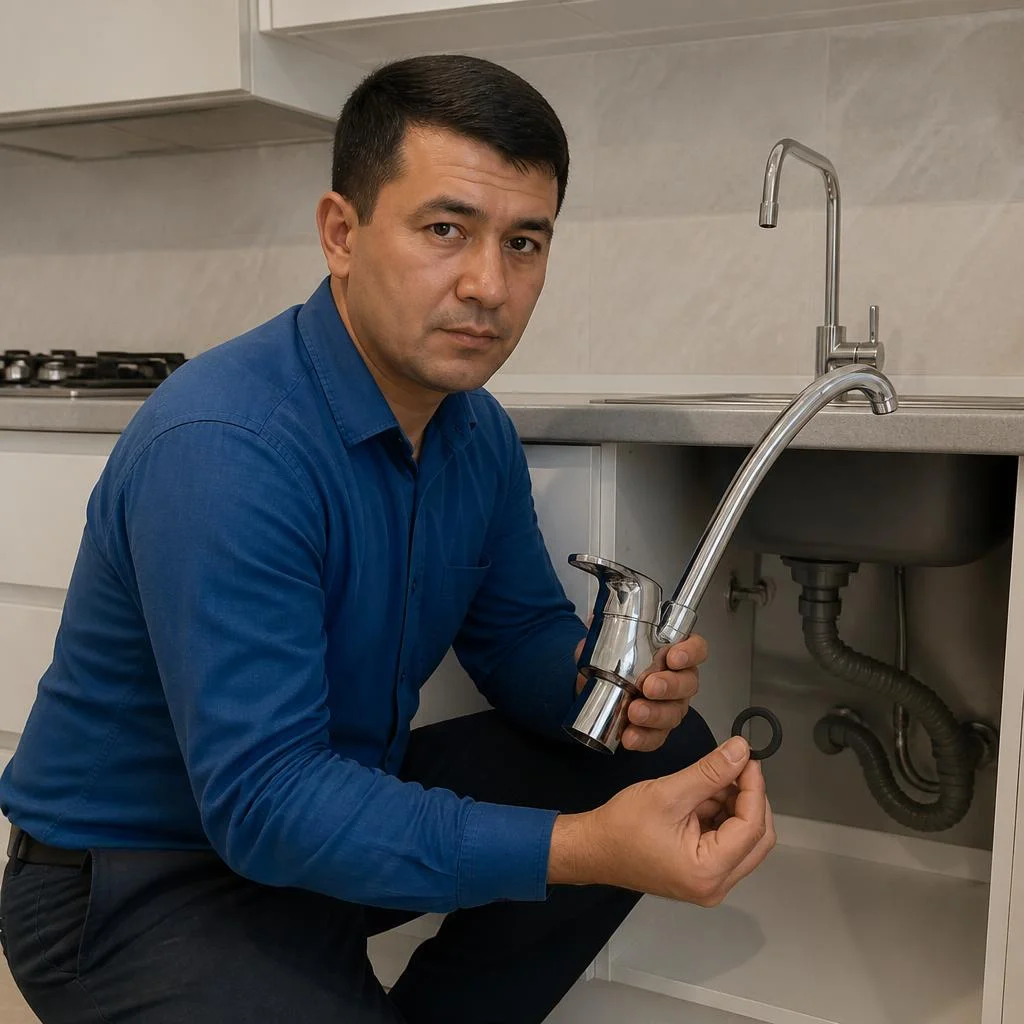
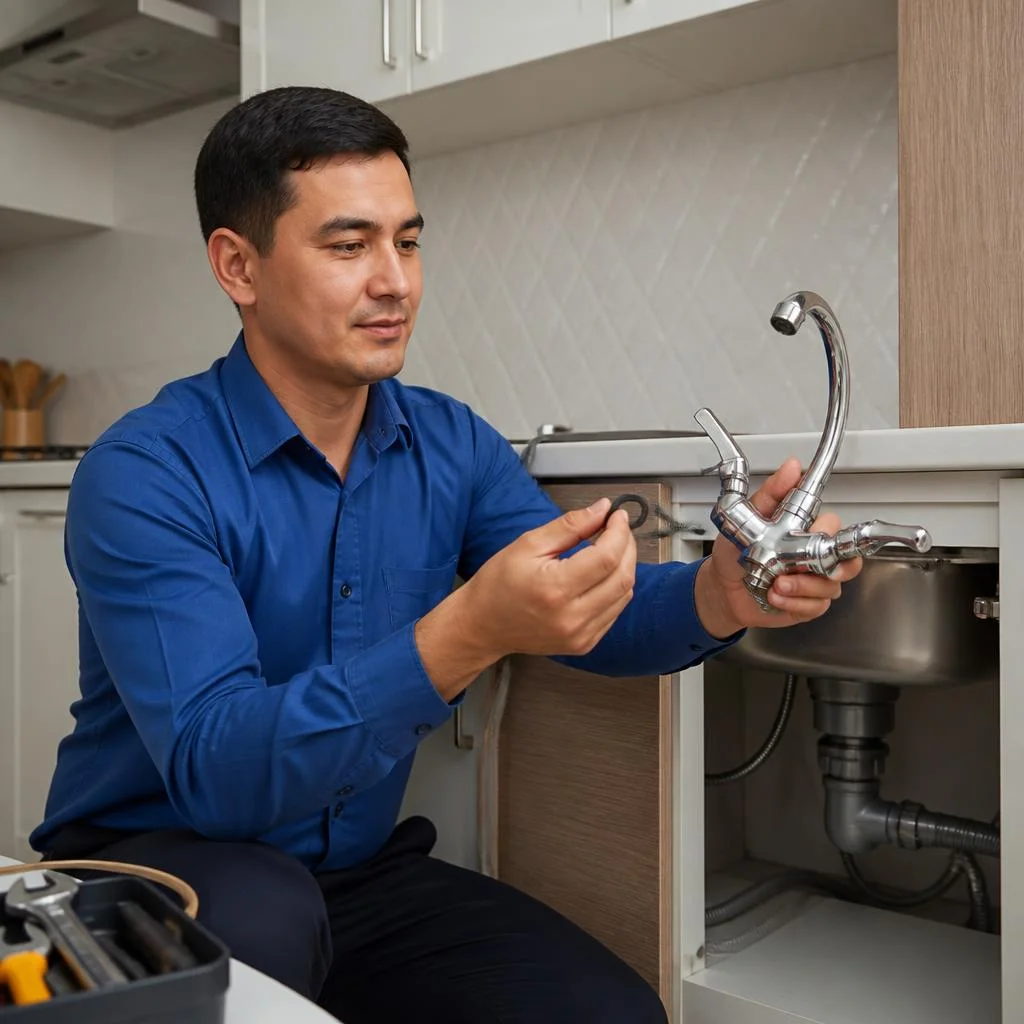
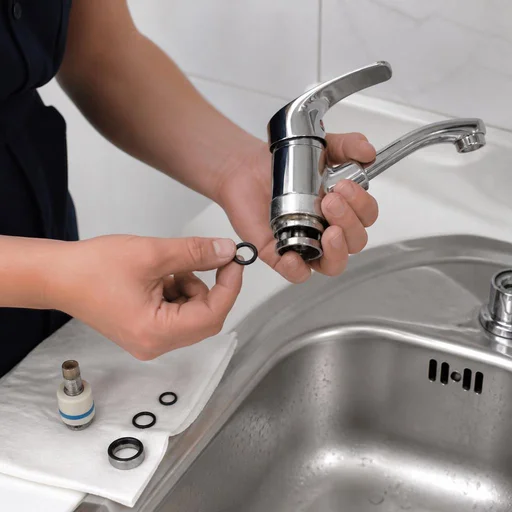
- Lever or stem: drops come from under the base of the handle — the stem seal or the cartridge O-rings are to blame.
- Faucet base: moisture at the base on the sink — the gasket between the body and the surface has compressed, the assembly needs to be rebuilt.
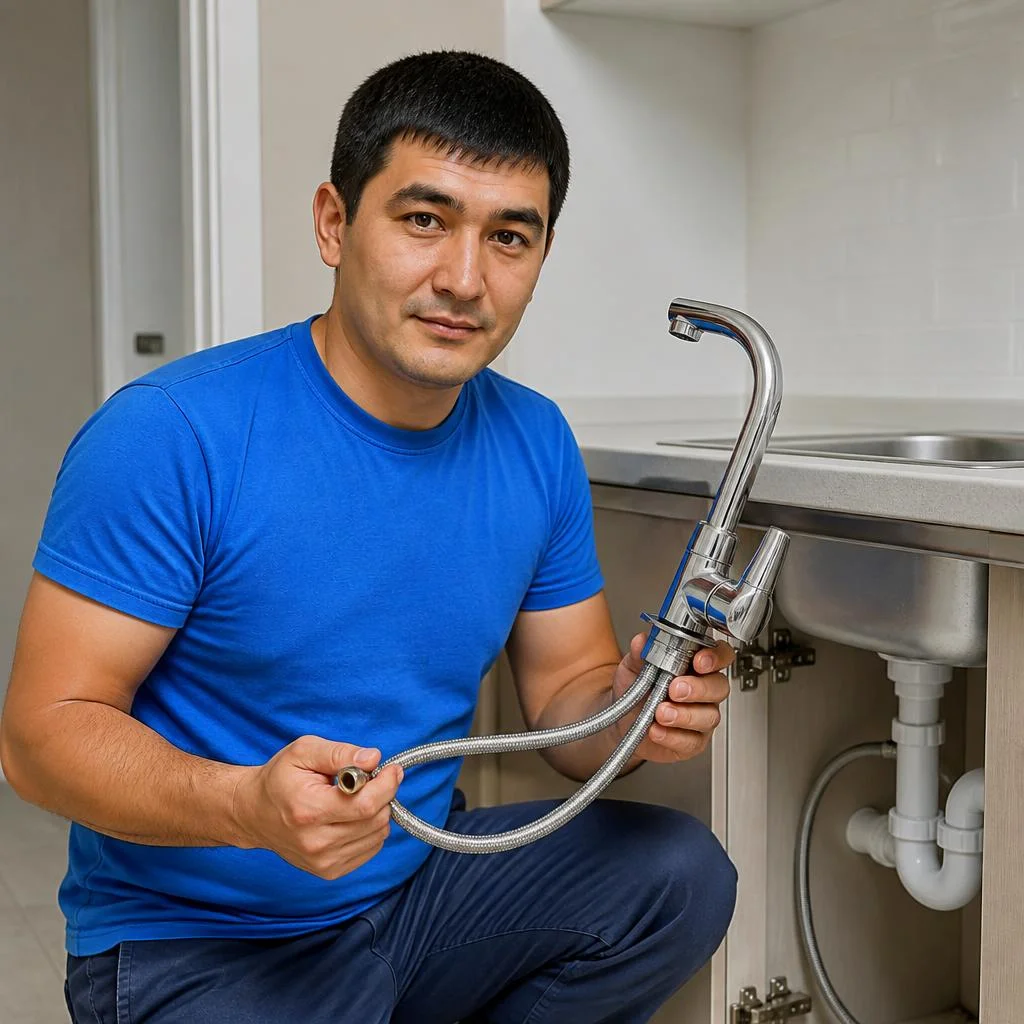
- Flexible supply line: moisture on the threads and nuts — a crack in the braiding or a rupture of the inner tube, the part is replaced entirely.
- Aerator: the stream sprays sideways, pressure is weak — scale and sand have clogged the mesh, cleaning or replacing the diffuser helps.
How to determine the faucet type in 30 seconds
| Faucet type | How to recognize it | Repairability |
|---|---|---|
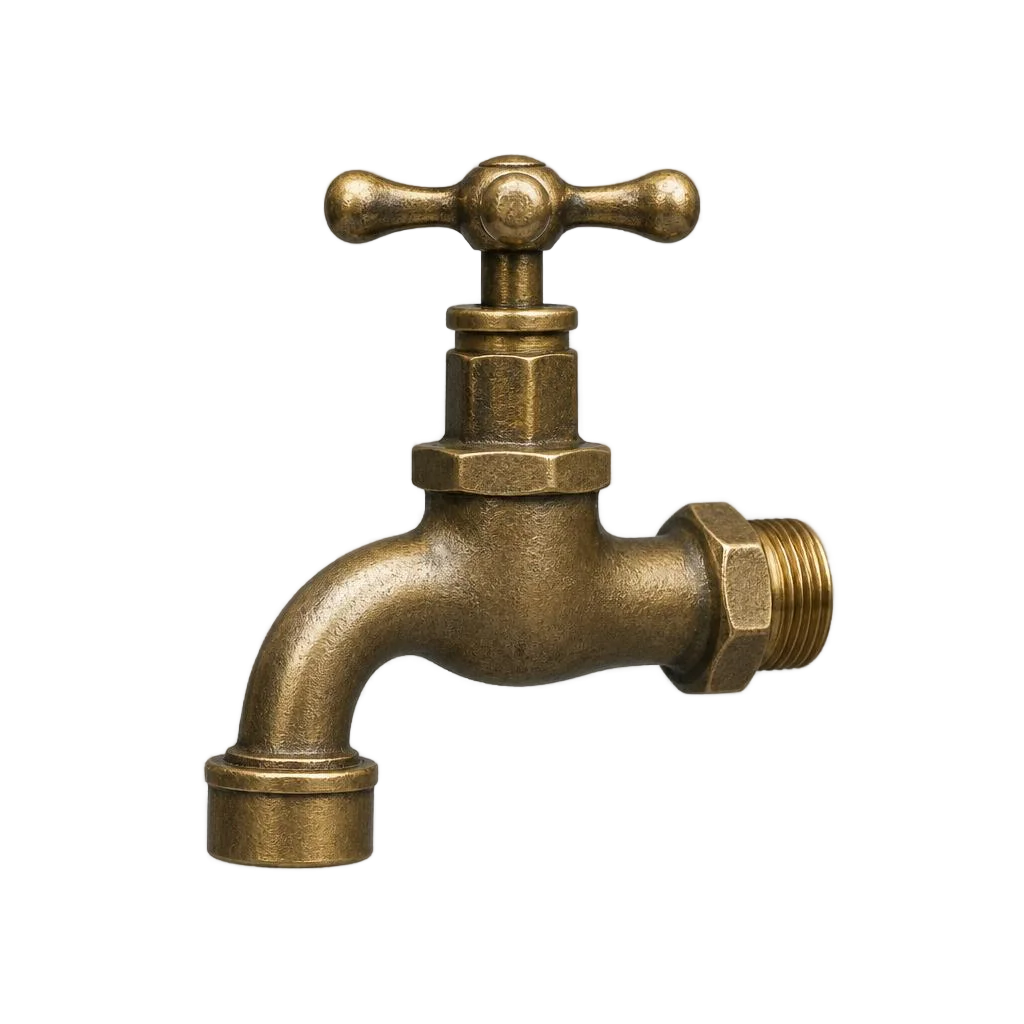
| Compression (valve) | Two handles, turns 3-4 rotations | Repairable: valve head, gasket |
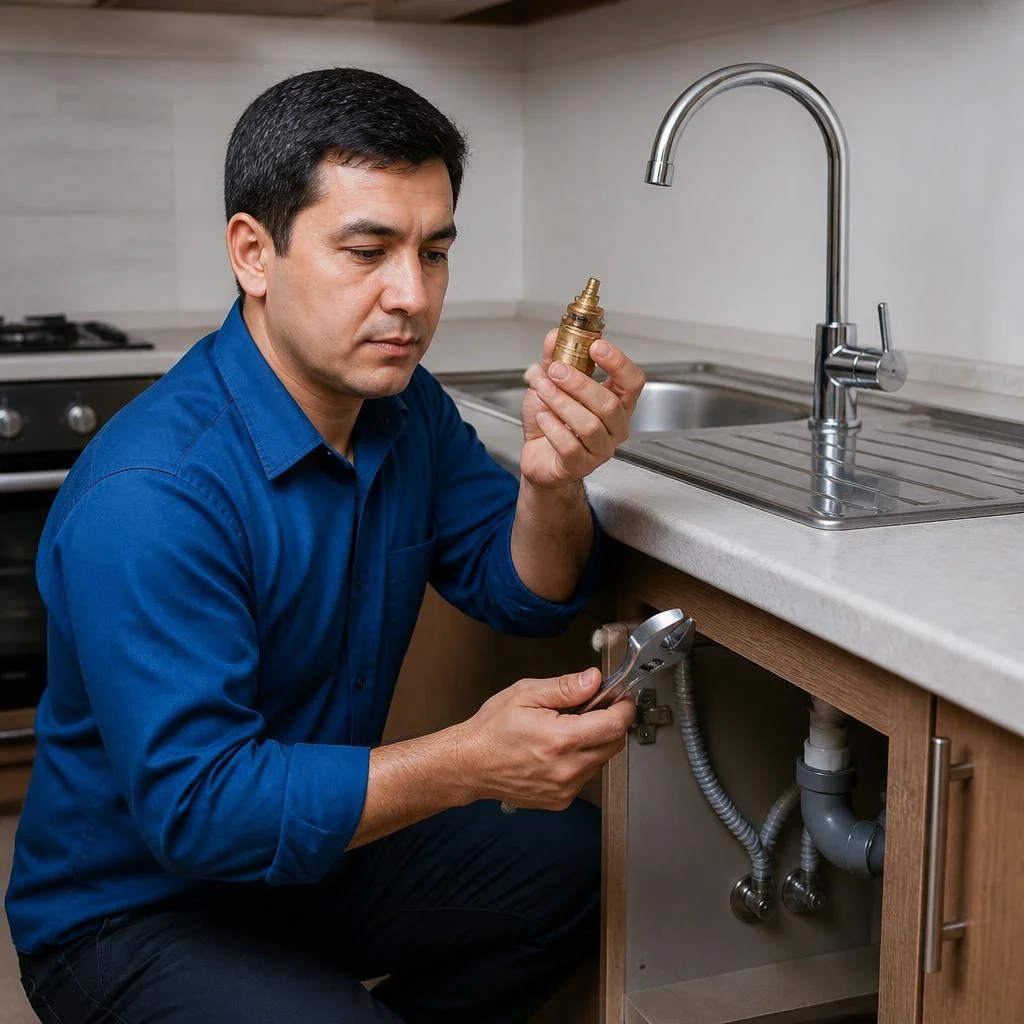
| Ceramic cartridge | One lever handle, smooth action | Repairable: cartridge, seal |
| Ball | One lever, turns 90° | More often replaced entirely |
| Quarter-turn | Handle moves 90-180°, no lever | Repairable if the body is dismountable |
The faucet type is determined by the control method: two handles — compression, one lever handle — ceramic cartridge, 90° turn without a lever — ball. A ball faucet in most cases is not repaired by assemblies — it is replaced entirely, because its shut-off element is a solid sphere; trying to "tighten" it only accelerates wear of the seat. Restoring a quarter-turn faucet is possible if the body is dismountable and the manufacturer supplies replacement bushings.
What to do before the technician arrives: shutting off the water and initial measures
- Shut off the water: close the valve on the supply line to the faucet, and if there isn't one — the main inlet to the apartment or the riser.
- Release the pressure: open the mixer and let the remaining water drain out so the leak weakens.
- Place a container: a basin or bucket under the leak point plus a towel on the countertop and in the cabinet under the sink.
- De-energize the area: if water has reached an outlet or lighting, turn off the breaker on the panel.
- Photograph the assembly: a snapshot of the body and supply line helps the technician select the part in advance.
What to clarify with the technician by phone
Diagnostics by phone saves one visit: state the faucet type, the leak point and the mixer brand — that's enough to prepare the needed part. Faucet servicing begins precisely with correct initial localization: if water runs along the body and not from the spout, the problem is not the cartridge but the stem seal, and replacing the cartridge in this case won't help. Repairing a kitchen faucet often comes down to a single part — a gasket, seal or aerator. The drinking water line and quarter-turn models require a separate approach: repairing a drinking water faucet involves food-grade seals, while repairing a mixer faucet on concealed models involves access through drywall. Clients search for "kitchen faucet repair" — and land on this page, although in fact it's more often about a mixer with two valves. In our practice, repairing quarter-turn faucets takes less time than restoring compression models, because the bushing is replaced without fully disassembling the body. If you're unsure what to call it, describe the symptom to the technician in your own words: repairing a washbasin faucet and repairing a water faucet differ only in the type of seals, not in the set of tools.
Kitchen faucet repair: spout, lever, aerator
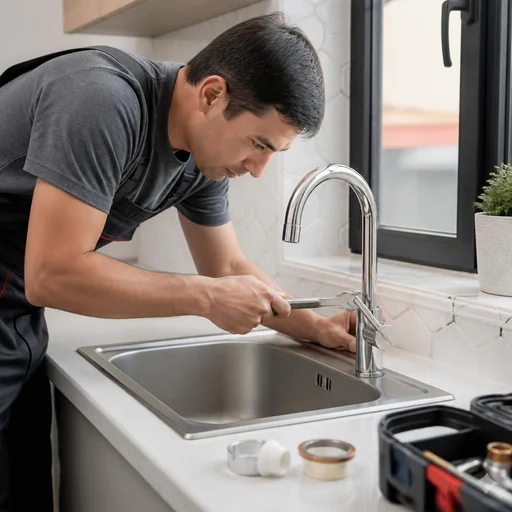
The kitchen mixer works under the heaviest load: constant switching, hard water, food particles in the aerator. Let's break down exactly what fails in lever, swivel, and flexible models and how it is fixed on-site.
Lever mixer: cartridge and seal
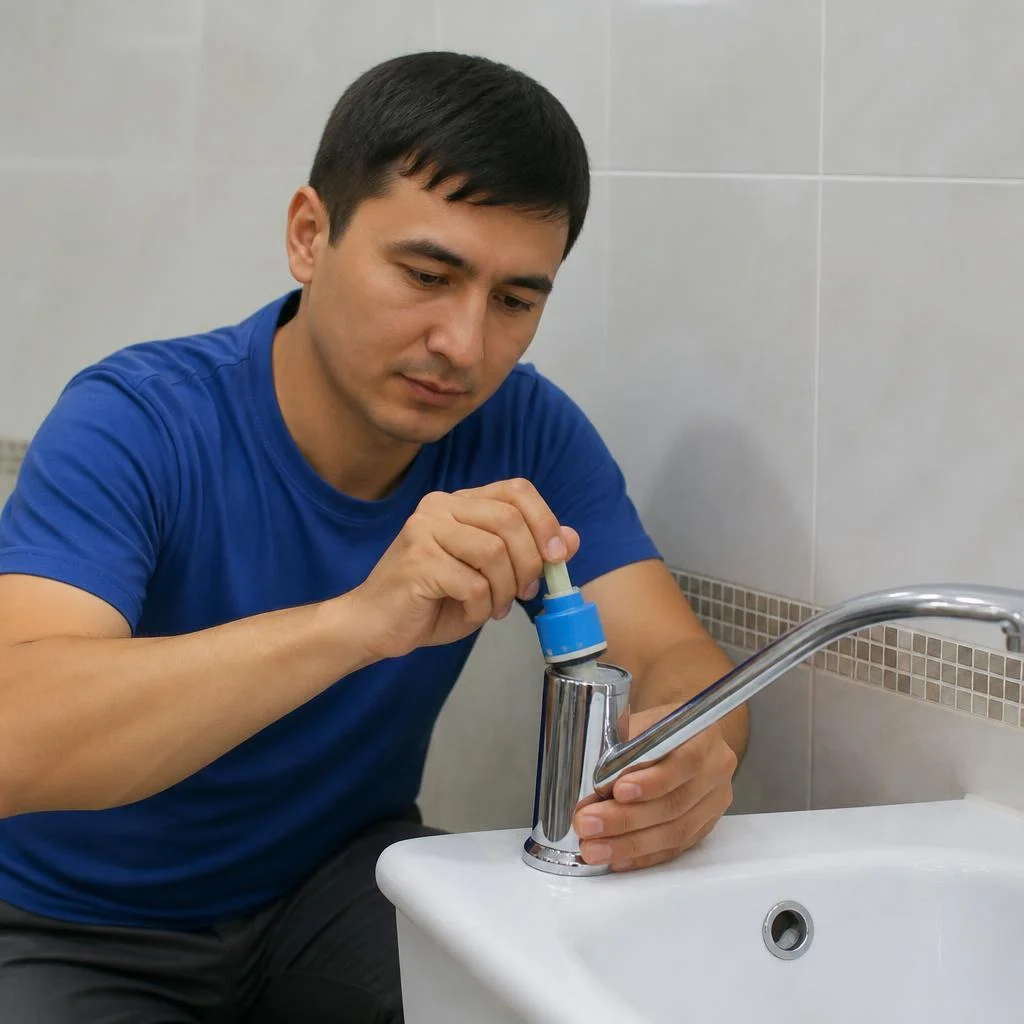
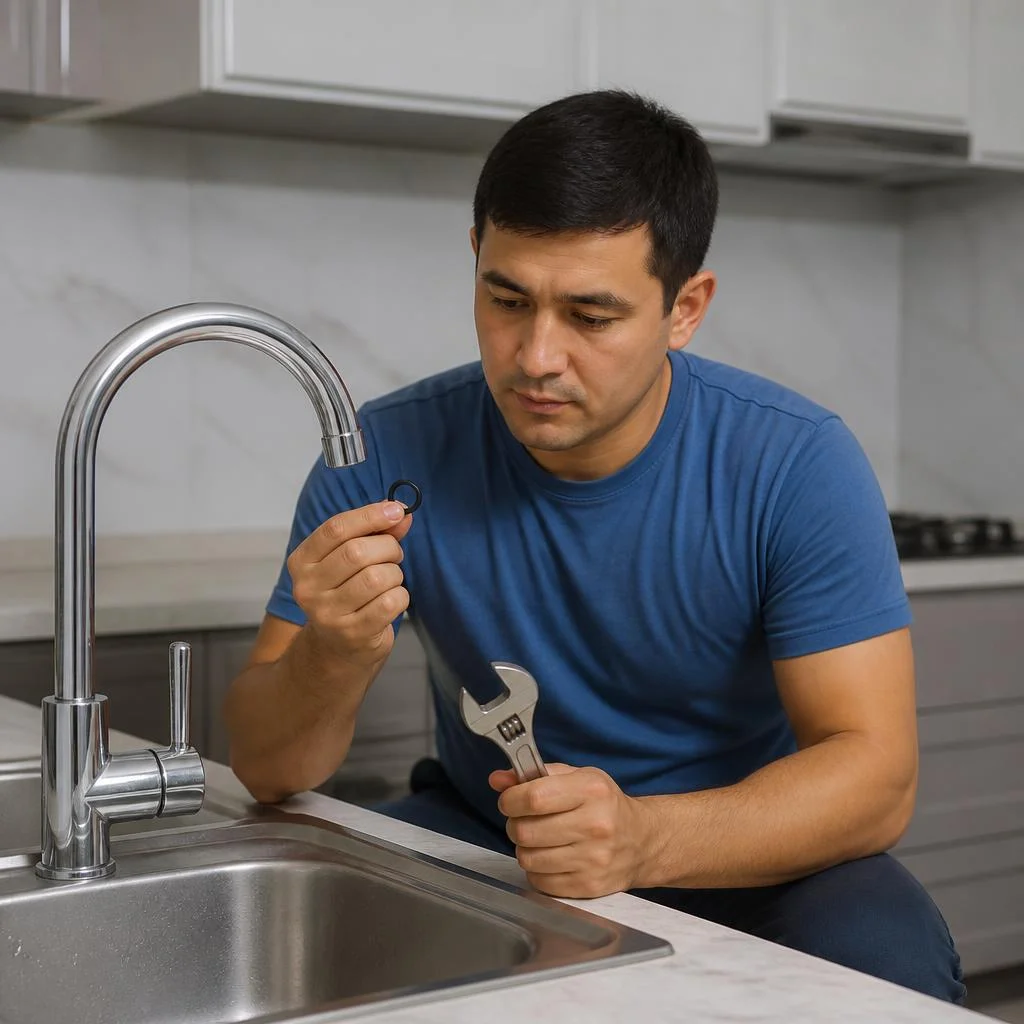
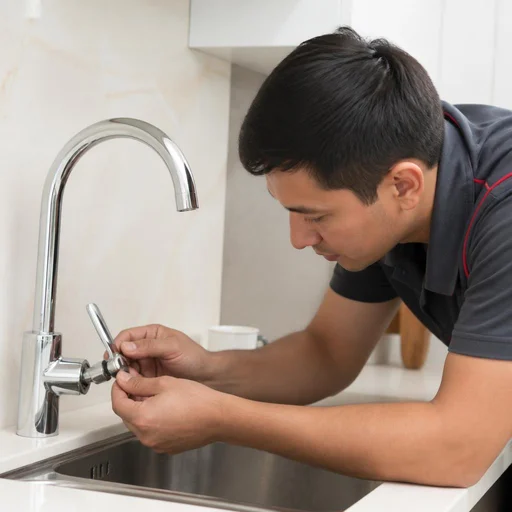
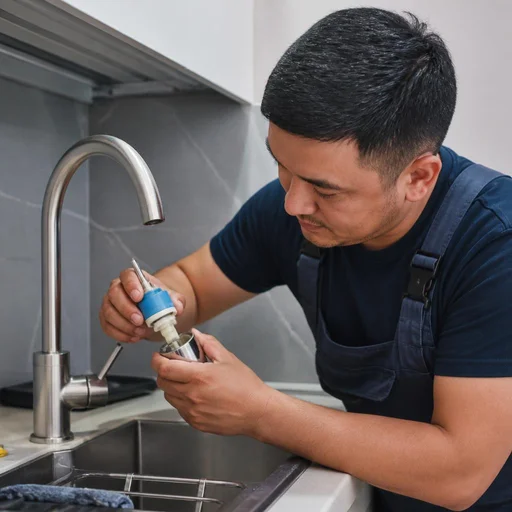
We replace the ceramic cartridge of a lever mixer when it drips from under the lever, and we replace the seal if water runs along the body — both operations are performed on-site in a single visit. Ceramic plates wear not so much from hard water as from abrasive particles: sand from the water supply passes through the aerator, settles on the edges, and within just a few months cuts grooves. A sign of cartridge wear is that the lever moves stiffly or, conversely, drops, while a thin trickle seeps from under the base. When the seal wears, water appears along the body below the lever, and it is easily mistaken for condensation. Clean the aerator once every 3-4 months — this noticeably extends the life of the ceramic, and an Eco-Service technician also checks the seat when replacing the cartridge.
Kitchen faucet with flexible spout: swivel assembly
In a kitchen faucet with a flexible spout, the swivel assembly and the hose O-rings wear out most often — we replace the rings and restore the tightness of the swivel mechanism without replacing the entire mixer. Clients often search for "kitchen faucet with flexible spout repair" — and land on this page, because the problem really is typical. The rings seat into the housing seat, and under lateral load the hose pulls them outward: play appears, the spout wobbles, a puddle collects under the base. The problem is typical for models with a pull-out hose 60-80 cm long, where the spout is turned with one hand by tugging on the tip. We disassemble the assembly, replace the rings, check the hose for microcracks, and reassemble with silicone grease. Train your household to turn the spout by the body, not to pull on the hose — the assembly will last far longer.
Poor pressure and aerator cleaning
Weak pressure in the kitchen in 8 out of 10 cases is a clogged aerator, not a problem with the pressure in the riser; we remove the nozzle, disassemble it, and clean the mesh of scale and sand. If the pressure is not restored after cleaning the aerator, the cause is upstream — in the cartridge or the supply line; you need to check in the direction of flow, from the spout to the inlet, not the other way around. A separate story is repairing a water faucet in a system with two valves: there, weak pressure is caused by a seized valve head, not the nozzle. The technician removes the valve, checks the stem travel, and washes the seat of limescale.
- Aerator: unscrew the nozzle, disassemble the mesh, and wash it of limescale and grains of sand.
- Cartridge: if the pressure is equal on hot and cold water, check the patency of the ceramic channels.
- Flexible supply line: inspect the hose for kinks that narrow the cross-section and reduce flow.
Kitchen sink faucet: replacing the siphon and supply line
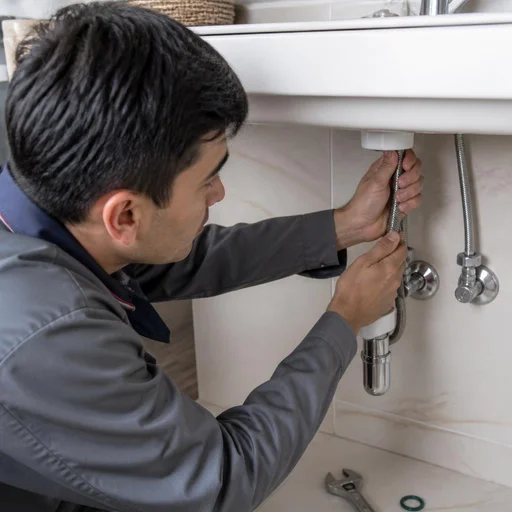
When servicing a kitchen sink faucet, we simultaneously check the siphon and the flexible supply line — a leak under the sink is often disguised as a faucet leak, although the source is in the drain assembly. Water collects at the bottom of the cabinet, runs down the hose to the base of the mixer, and the owner is sure that the faucet itself is dripping. Diagnostics take a couple of minutes: we place a dry napkin under the siphon, a second one under the supply line, and watch where the first drop appears. A flexible supply line has a service life of about 5 years regardless of its appearance: the rubber inside ages and cracks, so with any repair of a kitchen faucet older than that, it is reasonable to replace the supply line preventively. We replace the siphon O-rings during the same visit — a repeat visit because of a small part costs more.
What else we check when repairing a kitchen mixer
Kitchen faucet repair is not limited to the cartridge and aerator: in a single visit, the technician checks the shut-off valves, the type of mechanism, and the condition of related assemblies. It is worth separately discussing the repair of a quarter-turn faucet: in such models the lever moves through 90°, and over time the thrust pin wears down, so the water stops shutting off completely. In a shower cabin the logic is similar, only the assembly operates under constant humidity — we begin repairing a faucet in a shower cabin by checking the cartridge and seals for seizing from limescale.
- Ball valve in the kitchen: the ball plug seizes up from scale, the valve stops shutting off the water — we take it apart, clean the seat and replace the ball.
- Kitchen faucet repair: under this wording, owners lump together gasket replacement, lever adjustment, and fixing spout play — diagnostics take 10-15 minutes.
- Quarter-turn valves: on models with a 90° turn, the stop pin wears out, causing the lever to wobble and the water not to shut off completely.
- Water faucets: in the kitchen these are most often two-handle mixers — here we replace the valve cartridges and gland seals, and check the seating ports.
- Plastic water valve: on plastic models the threaded body cracks, and the job comes down to replacing the whole unit rather than tightening it.
Faucet repair in the bathroom and shower cabin
In the bathroom, the faucet works together with the shower and the washbasin, and a leak in one unit is often mistaken for a malfunction of another. Let's break down how to localize the problem and what actually gets replaced on site.
Mixer and supply line: what we do on site
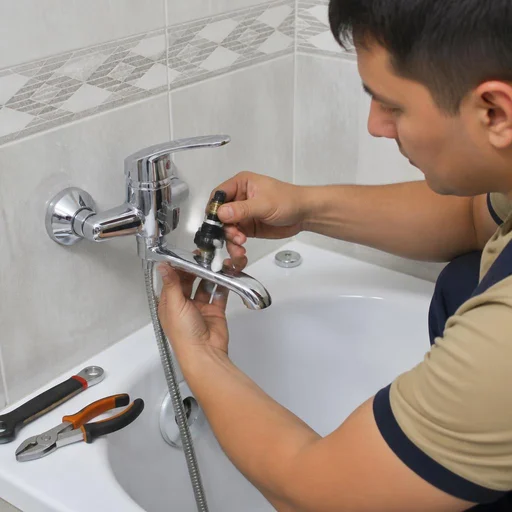
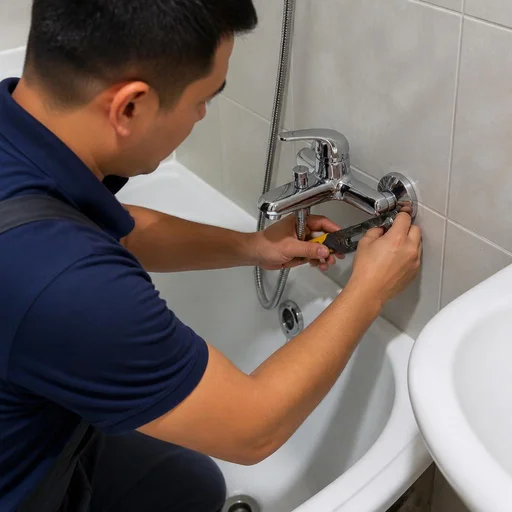
We service the bathroom mixer on site: we replace the cartridge, the valve head, or the packing gland depending on the type, and when the body is worn out we install a new mixer with connection via a flexible supply line. In Tashkent's hard water, the ceramic cartridge becomes encrusted with deposits within 8-14 months — the technician removes the lever, unscrews the retaining nut, and checks the seat for scoring. If the body is intact, it's enough to clean the cartridge of scale with silicone grease; with deep grooves, the unit is replaced entirely. In the bathroom, the cartridge wears out more slowly than the kitchen one, because the water flows without food residue, but it suffers from scale faster: regular cleaning of the cartridge from scale extends its service life more noticeably than in the kitchen. Clients often phrase the request as faucet repair and maintenance — and they get from us the full cycle of work on the mixer, supply line, and shut-off valves in a single visit.
Washbasin faucet and repair in the bathroom
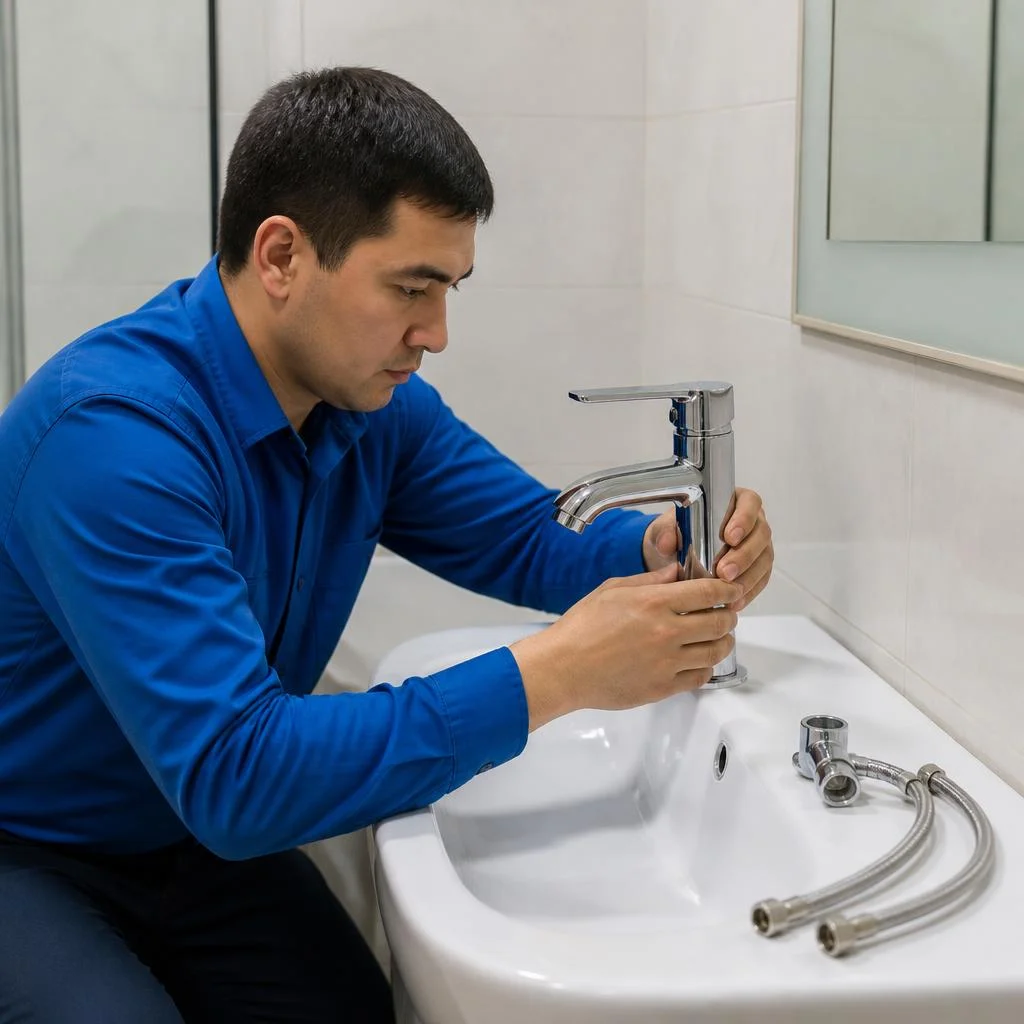
The washbasin faucet most often leaks along the stem or from under the spout nut — we disassemble the unit, replace the O-rings and the packing gland, and if the body is cracked, we offer a faucet replacement. In models with two handles, the cause is usually the valve head: its threads wear out, and water seeps along the stem even when the valve is tightly closed. If it leaks from under the spout, it's enough to replace the O-rings and tighten the union nut — that's 15-20 minutes of work. A separate case is the water-draw faucet on a shared manifold: there the packing gland is replaced and the stem seating is checked. A crack in the body of a washbasin faucet is not sealed — on the next pressure surge it will open up; the only correct solution in this case is replacing the faucet, not "smearing over" the joint. In search, this is most often typed as water faucet repair, and for such a request the technician arrives with a full set of seals and valve heads.
Shower cabin and showerhead: where to look for the leak
Faucet maintenance in a shower cabin begins with diagnosing the hose: the reinforced braiding wears through at the base of the nut, and water drips down under the tray. Work with the shower faucet comes down to replacing the cartridge or valve head depending on the design: in thermostatic models, the thermoelement is checked separately, in lever models — the ceramic unit. A shower cabin faucet breakdown is often confused with a showerhead malfunction, although the source of the leak is in the mixer itself. A showerhead with clogged holes produces a skewed stream that hits one point and destroys the hose at its base; cleaning the showerhead is not cosmetic work but protection of the entire shower unit. Clients often write the request as plastic faucet repair, although there are almost no plastic parts in a shower unit — the body there is brass, and plastic is found only in certain showerhead models and adapters.
Faucet with thermostatic control: nuances of the shower unit
Servicing a faucet with a thermostatic control requires disassembling the body and checking the thermoelement: when the wax capsule fails, the mixer stops holding the set temperature and "drifts" by 10-15 degrees. A valve faucet in a shower unit is encountered less often — such models are installed on old risers, and there the valve head with a leather or rubber gasket is replaced. The technician checks the inlet mesh filters: clogged meshes cause a pressure imbalance between the hot and cold lines, which makes the thermostat trigger in jerks. When ordering spare parts, state the exact mixer model — thermoelements from different manufacturers are not interchangeable in terms of seating size. A separate story is plastic water faucet repair: such units are installed at dachas and in unheated extensions, and there we replace the body entirely, because the plastic cracks along the threads from frost.
Valve, ball, and ceramic faucets: what we repair and how
Each type of faucet is serviced differently: a valve faucet — by components, a ball faucet — by replacement, a ceramic one — by cartridge. Below is exactly what we do with each type and why one unit needs to be taken apart while another only needs replacement.
Repair of a valve faucet and faucet valve
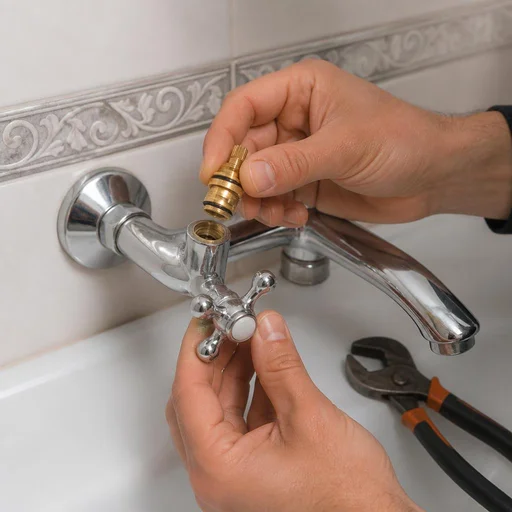
Servicing a valve comes down to replacing the valve cartridge and gasket: we remove the handle, unscrew the valve cartridge, replace the seat seal, and reassemble the unit — the operation takes one visit. On valve models from local suppliers and Turkish GALA, the leak most often comes from the stem: the rubber gasket hardens within 8-14 months of Tashkent water with high hardness, and a drop appears even when the valve is fully closed. A valve cartridge with ceramic discs cannot be lapped — when worn, it is replaced entirely, and an attempt to restore it with sandpaper gives only a temporary effect: after a month the leak returns, and the work has to be started over. Clients often phrase the request as repair of a rotary faucet — essentially it is the same valve unit with a rotary handle, and the approach to it is no different. If you have two valves on a mixer, replace both cartridges at once — the second one fails within a couple of weeks after the first.
Repair of a ball faucet in the kitchen and installation of a ball faucet
We perform the replacement of a ball faucet in the kitchen by the body: the sphere inside is not repairable, so when it jams or leaks at the stem, we install a new ball faucet with the same thread. In Tashkent kitchens, brass ball faucets by Bugatti and Itap, 1/2 inch, are most common — their service life is 8-10 thousand cycles, but with hard water the sphere seat wears out faster, and the faucet starts to let water through even in the closed position. Installing a ball faucet takes 20-30 minutes: we shut off the riser, remove the old body, clean the thread of old flax or tape, wind on new sealant, and tighten with a wrench without overtightening. In search, such work is often typed as repair of water faucets — under this query people come for both ball and valve units, so the technician clarifies the type from a photo before the visit. A ball faucet should not be left in the half-open position for long — the flow washes out the lubricant and the sphere seat; keep it either fully open or fully closed, otherwise its service life will be halved.
Repair of a ceramic faucet and replacement of a ceramic cartridge
| Cartridge type | Diameter | Where it is used |
|---|---|---|
| Standard ceramic | 35 mm | Single-lever mixers for kitchen and bathroom |
| Enlarged ceramic | 40 mm | Mixers with a high spout, Grohe, Hansgrohe models |
| Ceramic with a limiter | 35 mm | Quarter-turn and thermostatic units |
| Ceramic for concealed installation | 35-40 mm | Built-in mixers, concealed systems |
Servicing a faucet with a ceramic cartridge is the replacement of a consumable element, not the restoration of old plates. There is no universal size: before the visit, the technician clarifies the mixer model in order to bring the right cartridge and not have to go for it again. Ceramic plates are sensitive to sand and scale — if there is no coarse filter in the apartment, the service life is reduced from 5-7 years to 2-3. A separate category is repair of a faucet with a thermostatic regulator: inside such a mixer there is a thermostatic cartridge with a wax element that reacts to water temperature and requires flushing from scale or complete replacement of the unit.
Repair of a quarter-turn and plastic faucet
We service quarter-turn valves by replacing the cartridge with a travel limiter, while plastic valves are serviced by replacing the O-rings and flexible supply line — the body of a plastic valve cannot be soldered. Quarter-turn models open to 90 degrees and are found mainly on economy-segment mixers and in irrigation systems: their cartridge wears out after 3-4 years of active use, after which the lever starts letting water through in the closed position. A plastic valve must not be tightened with the force used for a metal one: the threads strip before watertightness is achieved, so we use a torque-based approach and O-rings instead of "tightening". If the plastic threads are already stripped, the assembly can only be replaced; in this case we proceed to install a new body with metal threads. Requests such as shower cabin faucet repair we handle separately: there the mixer is combined with a flexible hose and shower head, and most often the cartridge is replaced along with the body gaskets.
Special types: thermostatic, concealed, drinking water
Thermostatic, concealed and drinking water taps are more complex than ordinary mixers, and servicing them requires specific spare parts. Let's break down exactly what we do with each type and why you can't work by guesswork here.
Servicing a tap with a thermostatic regulator and installing a thermostatic mixer
We service a tap with a thermostatic regulator by replacing the thermoelement and the regulator cartridge, and when installing a new mixer we set the temperature and check operation under pressure fluctuations in the riser. A thermostatic mixer maintains the set temperature thanks to a wax or bimetallic thermoelement that contracts and expands with water heating, and the body additionally contains two check valves and coarse filters against sand and rust. Installing a thermostatic mixer in Tashkent requires checking the system pressure: when fluctuations exceed the operating range, the thermoelement body deforms and the mixer starts letting hot water into the cold line. The thermoelement fails from limescale faster than an ordinary cartridge — if the water is hard, preventive cleaning of the thermostatic mixer should be done once a year, otherwise it will start "jumping" in temperature. Clients often phrase the request briefly — tap repair — and from that phrase the technician immediately understands that a visit with a full set of consumables is needed. Requests also include wording such as kitchen sink tap repair — from that we immediately clarify the mixer model and bring a replacement thermoelement.
Servicing a concealed mixer
We service a concealed mixer through the service opening: we replace the cartridge and seals without dismantling the tiles, and when the supply lines wear out — with partial opening of the wall. A built-in system consists of a mounting unit recessed into the wall and an external part with handles or a thermostat, so access to the ceramic plates goes through the decorative cover plate and the inspection opening. Before the visit, the technician clarifies the model and year of installation: spare parts for concealed systems from different manufacturers are not interchangeable, and a cartridge of one brand will not fit the body of another. If there is no inspection opening, it has to be made in the facing, and precision matters here — a misaligned hole gives access to the supply lines but not to the mechanism itself. A concealed mixer cannot be serviced "by guesswork": a mistake with the spare part model leads to reopening the tiles. In requests this sounds like kitchen tap repair — from that wording we immediately plan work at the sink taking into account the mixer model.
Servicing a drinking water tap and a tap for drinking water
We service a drinking water tap by replacing the cartridge and sealing rings, as well as cleaning the aerator — drinking water taps suffer from limescale more often due to filtered water with high mineral content. A separate tap for drinking water is mounted on the sink next to the main mixer and connects to the filtration system; its body is more compact, and the cartridge is designed for a lower flow, so deposits accumulate in it faster. Servicing a water tap includes disassembling the spout, replacing silicone gaskets and restoring the stem travel, and if the ceramic valve seizes up — a complete replacement of the internal assembly. A drinking water tap must not be washed with aggressive household chemicals: residues of the product get into the first portion of water; for servicing it is enough to disassemble the aerator and rinse it with warm water. A separate line in the price list is shower tap repair, and here we always check the condition of the hose and shower head, because rubber wear accelerates a repeat call. Another frequent request is drinking water tap repair, and for it the technician brings replacement cartridges for filters of various types.
How a technician visit works and what faucet servicing includes
A technician visit is an on-site intake of the request, on-site diagnostics, and work completed in a single visit. Let's break down how the process works, what servicing includes, and what guarantees the client receives.
How to call a technician to your home in Tashkent
- Request: provide the address, faucet type, and symptom — dripping from under the lever, not holding pressure, leaking at the base of the spout.
- Intake: through the Eco-Service service center, requests are accepted by phone or in Telegram; the dispatcher clarifies the details and selects a technician by specialty.
- On-site diagnostics: the specialist disassembles the unit, determines the wear of the cartridge, valve head, or gland packing, and shows the cause of the leak.
- Work in a single visit: if the spare part is in the technician's vehicle, the job is closed right away; otherwise a follow-up visit is scheduled with the required part.
- Payment after inspection: the client accepts the work after checking the pressure and the absence of leaks with the faucet open and closed.
What faucet servicing includes
- Diagnostics of components: the technician checks the cartridge, valve head, gland packing, O-rings, and aerator for wear and scale.
- Replacement of worn parts: selection and installation of a new spare part for the specific mixer model.
- Cleaning the cartridge from scale: with hard water, deposits clog the channels within 8-12 months and reduce pressure.
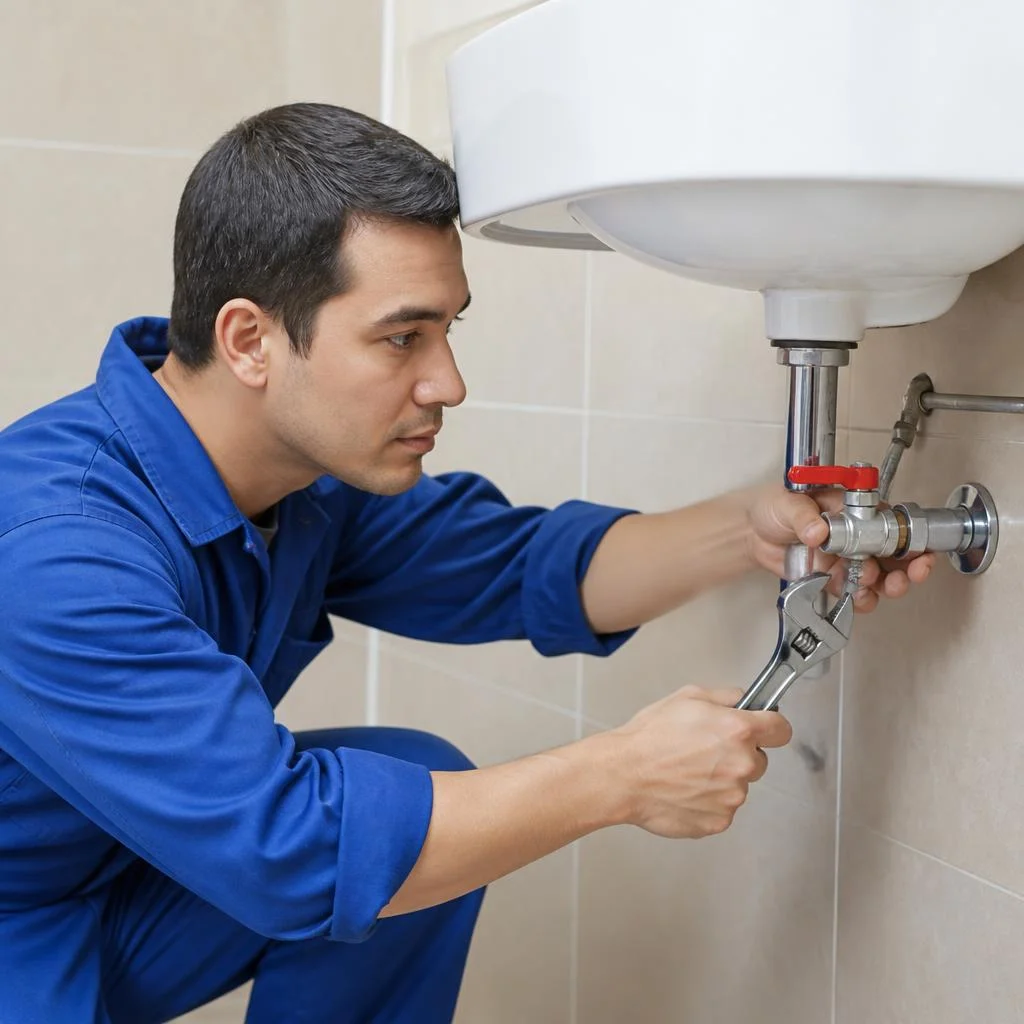
- Checking the supply lines and siphon: inspecting flexible hoses for cracks, tightening connections, checking the tightness of the drain under the sink.
- Scheduled preventive maintenance: cleaning once a year extends the mixer's service life and reduces the risk of a sudden leak at the worst possible moment.
2-year warranty and original spare parts
We provide a 2-year warranty on all work and install original spare parts — valve heads, ceramic cartridges, gland packings, and O-rings from trusted manufacturers. A specific part is selected for each type of mechanism: for a lever mixer — a 35 or 40 mm ceramic cartridge, for a valve-type faucet — a valve head with a rubber gasket, for a ball valve — a seat and stem. The technician records the part model and serial number in the report so that on a repeat request no time is wasted on selection. The warranty covers both the part and the work: if the leak returns for the same reason within two years, the follow-up visit and replacement are performed free of charge. In our experience, most returns are related not to the quality of the spare part, but to a worn seat that was not replaced during the first visit — that is why we always check the seating surface. Requests for valve faucet repair are accepted by phone or in Telegram; the dispatcher clarifies the model and selects a technician.
Water faucet and kitchen faucets: on-site specifics
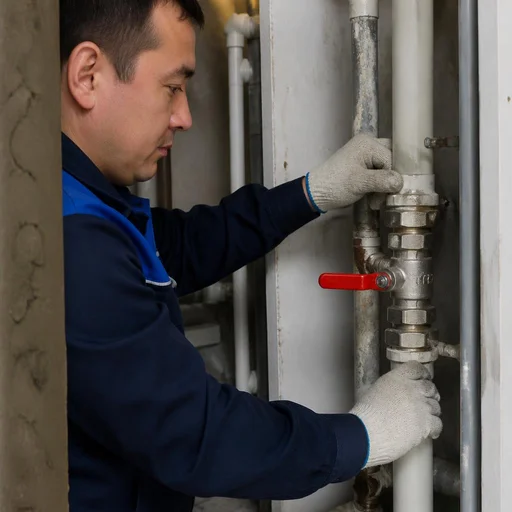
We perform work with the water faucet on-site with the water shut off at the inlet: the technician brings spare parts, tools, and protective materials so as not to leave marks on the plumbing fixtures and tiles. Kitchen faucets and sink faucets are most often associated with cartridge wear or a clogged aerator — these components are replaced in a single visit without dismantling the sink. A plastic faucet requires care: the ABS plastic body cannot withstand over-tightening of the threads, so the technician works with a torque wrench and selects the seal for the specific diameter. A water faucet on the shared inlet to the apartment is serviced only with the riser shut off — we take care of coordinating with the neighbors and the management company so as not to leave the building without water longer than necessary. Clients often phrase the request briefly — water supply faucet repair — and we immediately understand that a visit with a full set of seals is needed. For risers in khrushchyovkas and panel buildings in Tashkent, 40-60 minutes is usually enough to replace the valve and check tightness under operating pressure.
Conclusion
Briefly about what determines the outcome: the type of mechanism, precise localization of the leak, and timely prevention. Below are five conclusions that will help you set the task for a technician faster and return to the same problem less often.
Key conclusions
- The type of faucet dictates the method: a compression faucet is repaired component by component, a ball faucet is replaced entirely, a ceramic one — by replacing the cartridge; repairing a rotary faucet and a kitchen faucet begins with this fork in the road.
- The leak is localized at one point: spout, stem, base, supply line, or aerator — diagnosing by symptom saves time and money.
- Prevention is more important than repair: cleaning the cartridge of scale and clearing the aerator extend service life more noticeably than any intervention after a breakdown.
- A flexible supply line lasts about 5 years: with a water faucet older than this, it is replaced preventively, along with the gaskets.
- Build your request around the fact: state the type of mechanism and the symptom — this speeds up the visit, eliminates a repeat visit for a part, and simplifies faucet maintenance.