








What a grease trap is and why it needs regular servicing
A grease trap is mandatory equipment in the kitchen of a restaurant, café or canteen: it retains grease before it enters the sewer. Without regular servicing, the device stops working and creates a risk of fines during inspections.
How a grease trap is designed and which zones get contaminated first
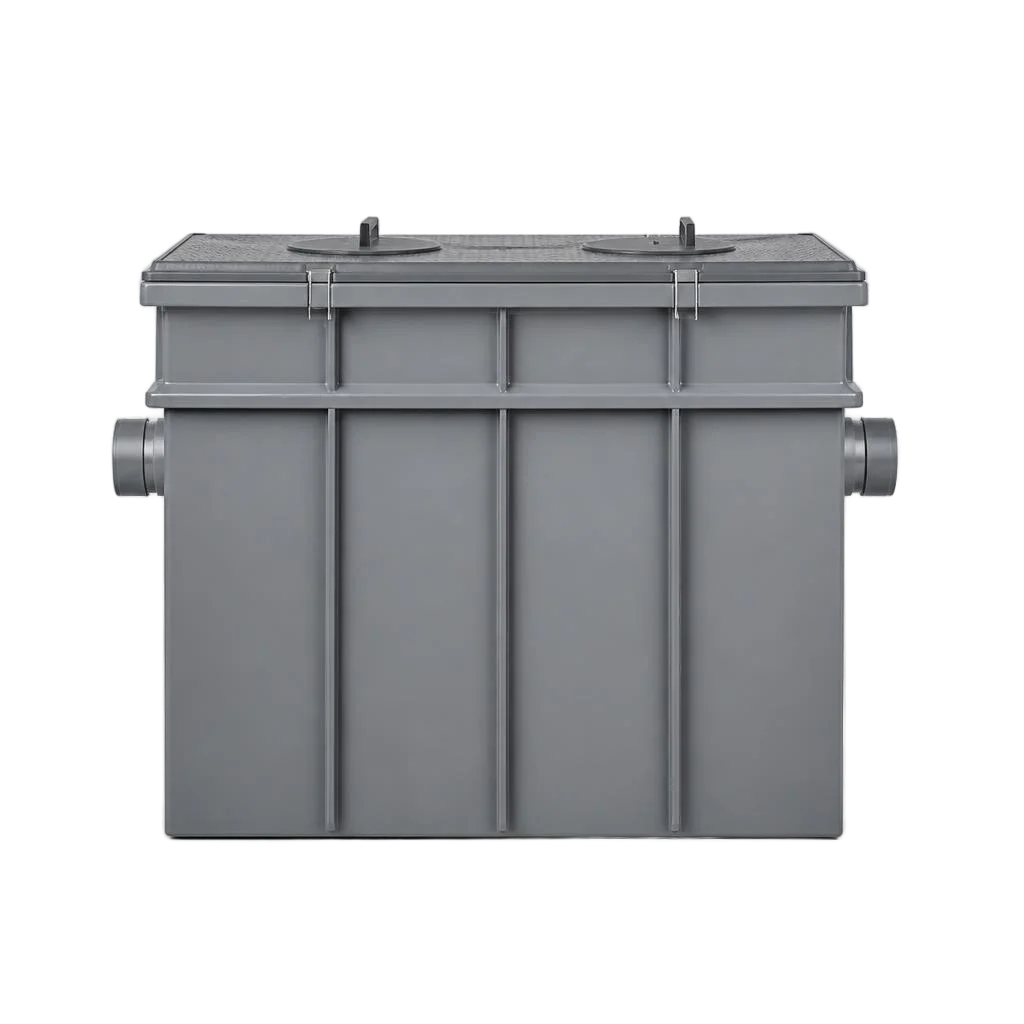
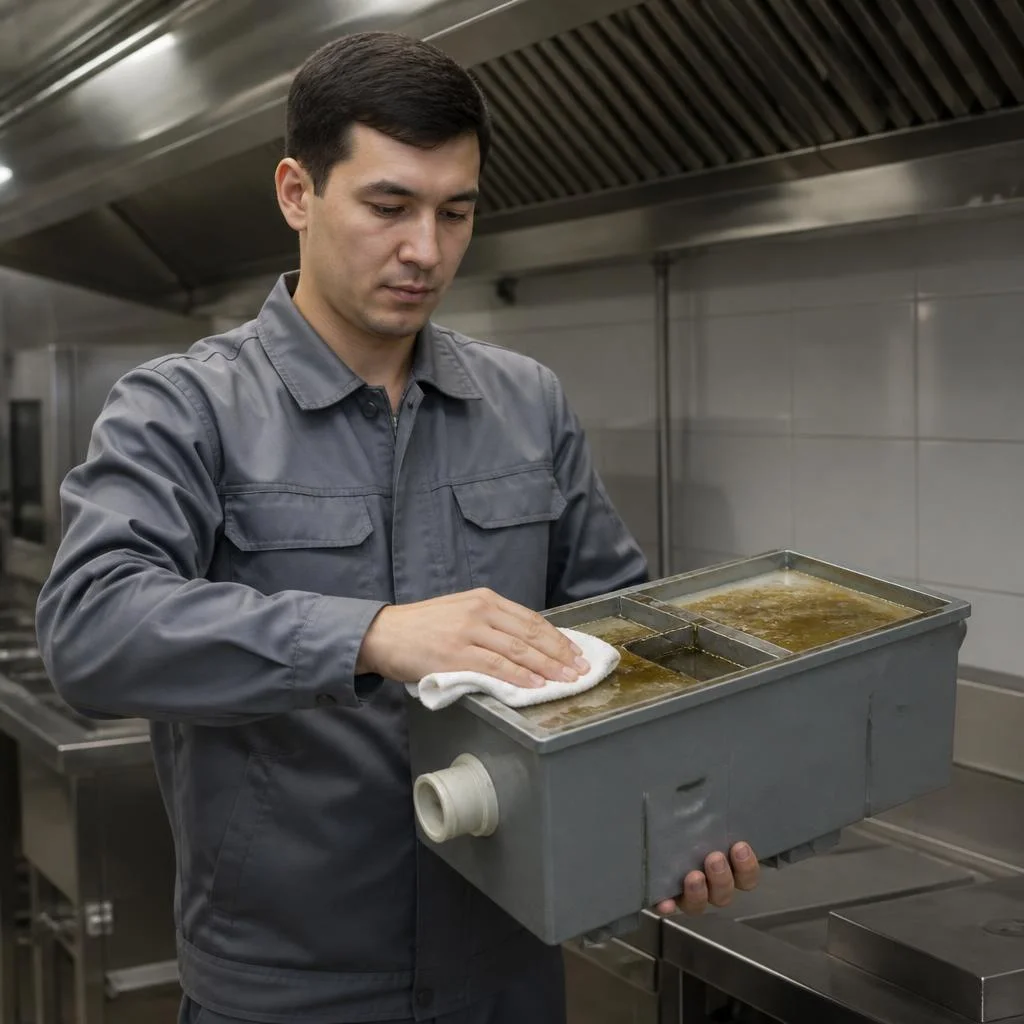
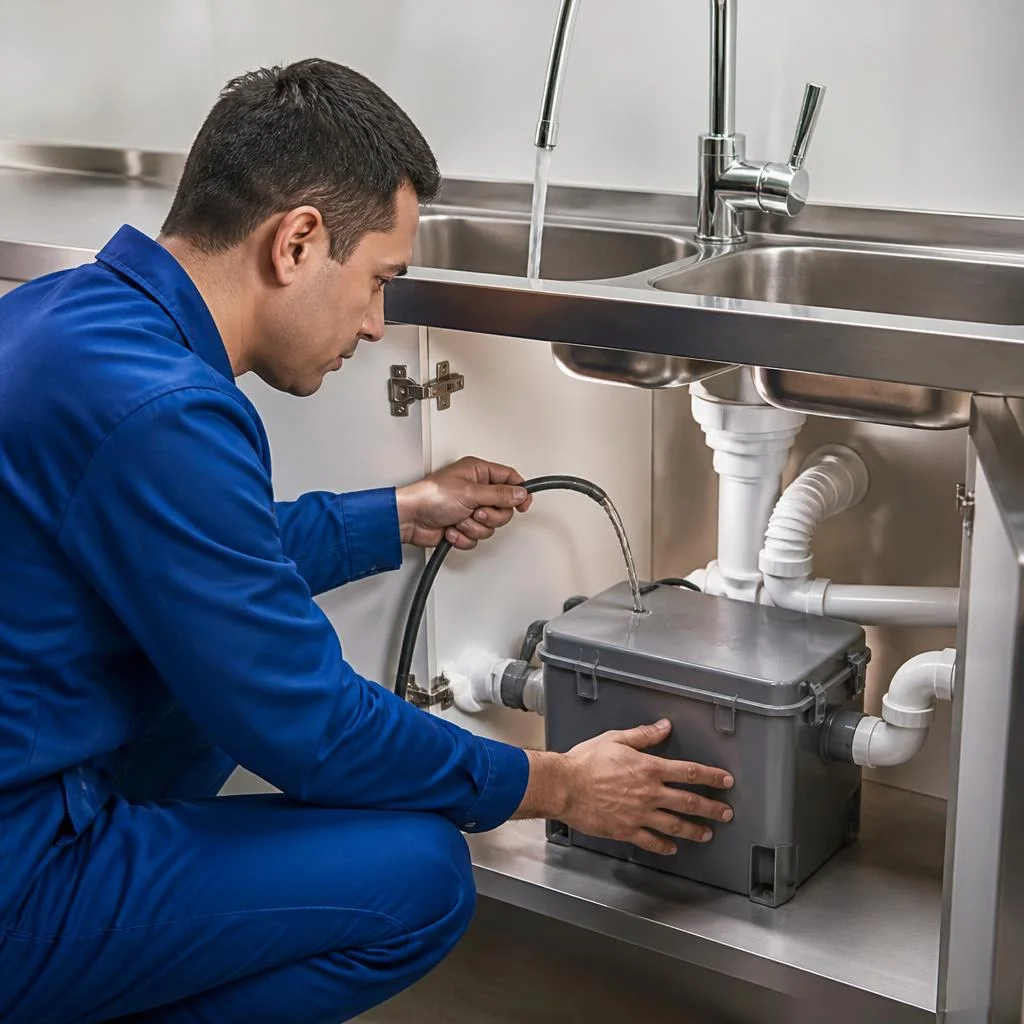
A grease trap separates wastewater into three fractions: grease floats to the surface, water exits through the baffles, and solid sediment settles at the bottom. The first to become contaminated are the top layer of grease and the internal baffles — they are the ones that receive the main flow of emulsified grease from the sink. The gravity principle requires no electricity: the slower the flow, the more complete the separation, which is why in under-sink models the chamber is made narrow and tall, while in floor-standing models it is wide and low. The internal baffles form a labyrinth that lengthens the water's path and forces the grease to float up before leaving the body. If the top layer of grease is not removed in time, it thickens and blocks the baffles — then water drains slowly, and the odour appears before a visible clog. Work begins with the top chamber: remove the grease crust, wash the baffles, check the seals. In our practice, in kitchens with a heavy dish flow, the top layer reaches 3-4 centimetres within just two weeks, so we recommend carrying out the first inspection 10-14 days after commissioning — this reveals the actual accumulation rate for a specific menu.
Under-sink, floor-standing, built-in: how grease trap types differ
| Type | Where it is installed | Servicing specifics |
|---|---|---|
| Under-sink | small kitchens, cafés, coffee shops | quick access to the chamber, frequent cleaning in small portions |
| Floor-standing | restaurants, canteens, food courts | large chamber volume, contents must be pumped out |
| Built-in | large kitchens, HoReCa chains | access only through a hatch, requires complete disassembly of the body |
We service all three types: each category has its own set of operations and frequency schedule. Built-in models are more difficult to service — without complete disassembly and replacement of seals, it is impossible to reach the baffles, so they are cleaned less often but take longer, and the gaskets are checked for tightness after each disassembly.
How often to clean a grease trap: schedule and signs of clogging
- Restaurants and canteens: servicing at least once a month with an average kitchen load.
- High-load kitchens: once every 2–3 weeks — with a flow of hot dishes of more than 8 hours per shift.
- Small cafés and coffee shops: once every 4–6 weeks, if the sink volume is small and the grease does not have time to thicken.
- Unscheduled servicing: when there is an odour from the grease trap, slow drainage or grease surfacing at neighbouring points.
- Servicing on a high-volume schedule: for food courts and chains, the schedule is built for each point separately, taking into account the menu and the number of seats.
Full grease trap service cycle: from video inspection to odor elimination
A full cycle is not just pumping out. It includes camera diagnostics, mechanical removal of grease and sediment, hydrodynamic and steam washing, chemical treatment, and a final leak test.
Video inspection and diagnostics: where service begins
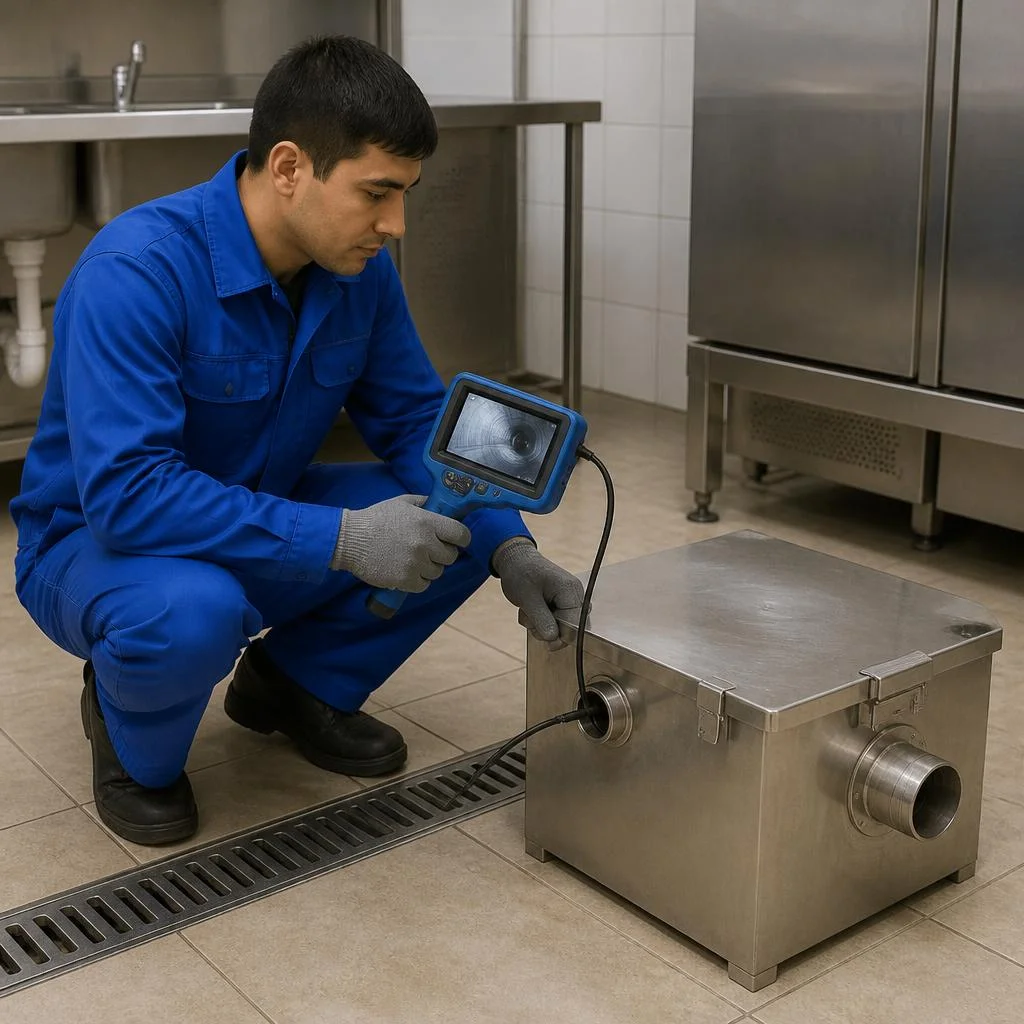
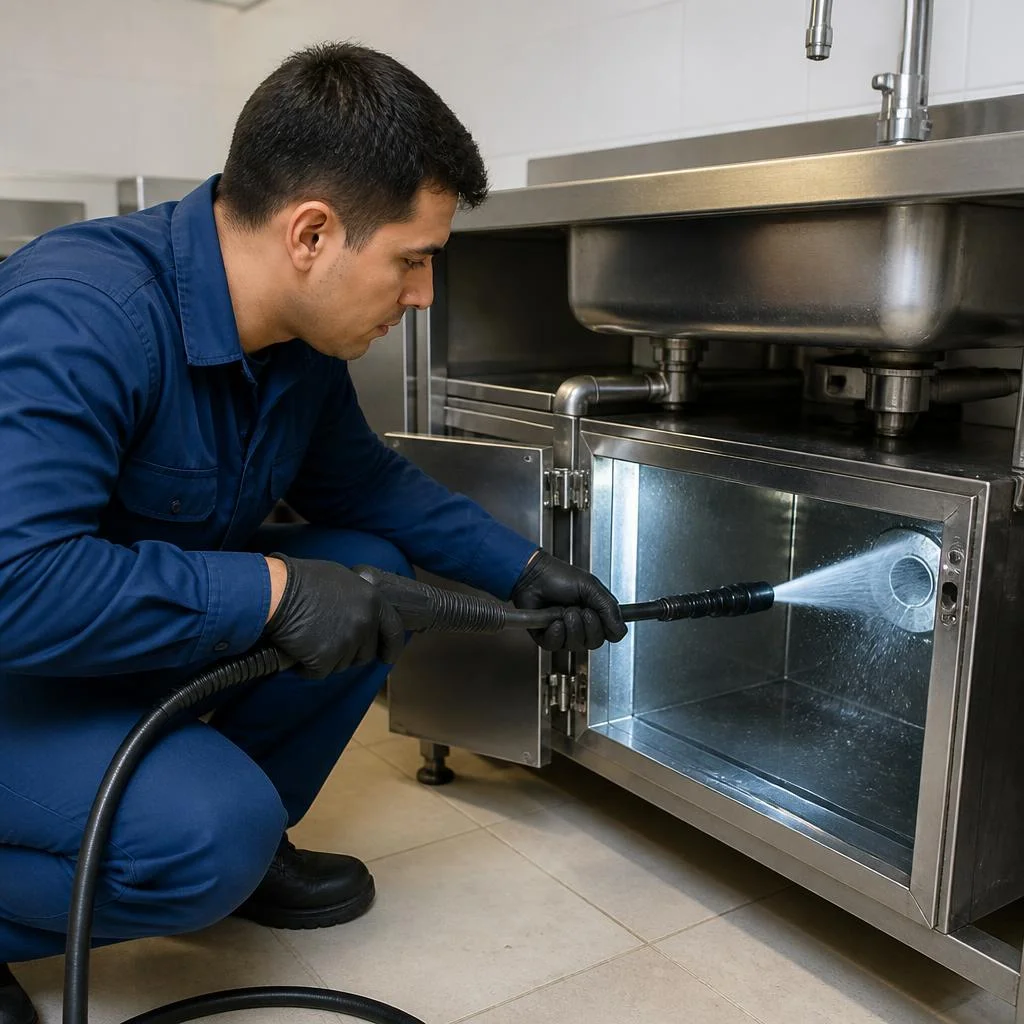
We begin every procedure with a video inspection of the internal walls — the camera shows the actual condition of the baffles, branch pipes, and discharge pipeline before work starts. We inspect floor-standing models of 100-500 liters through the top hatch, built-in models through the inspection hatch under the sink, and in inlet branch pipes with a diameter of 50-110 mm the camera passes through bends and turns where a scraper cannot reach. Video inspection often reveals cracks in the body and worn seals that are not visible from the outside; without diagnostics, these defects are discovered only after a leak — and a leak under the sink means tearing up the wet floor and replacing a section of the sewer line. We save the camera recording and hand it over to the customer along with the report: it shows which areas were contaminated before the work and what remained after.
Pumping out the contents and removing the top layer of grease
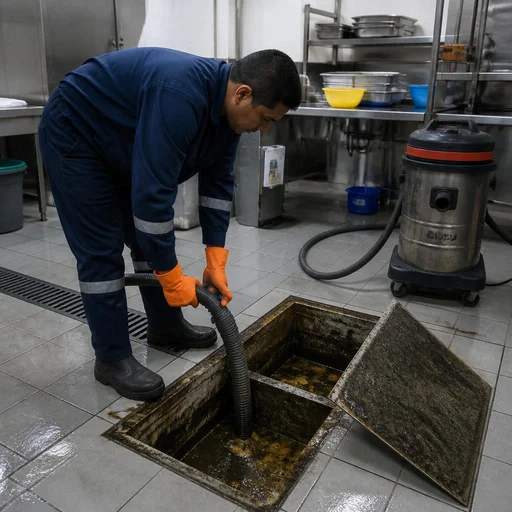
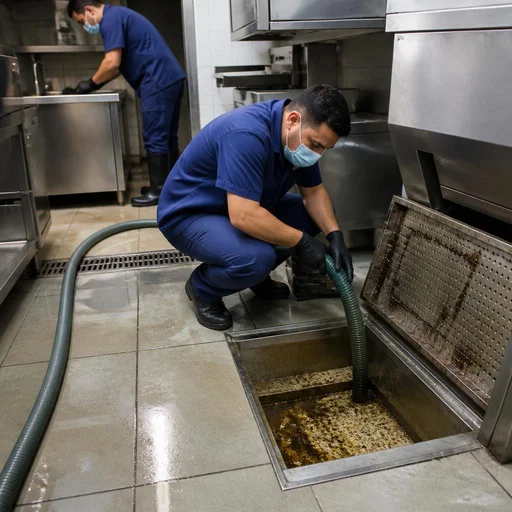
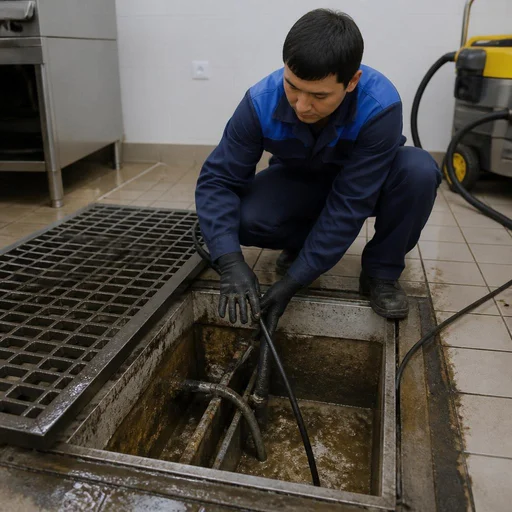
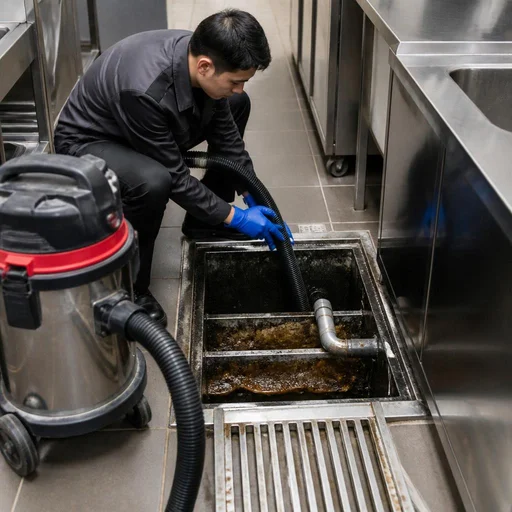
- Pumping grease out of the grease trap: a vacuum truck extracts the liquid fraction and water from the body; the work takes 20-40 minutes depending on the chamber volume.
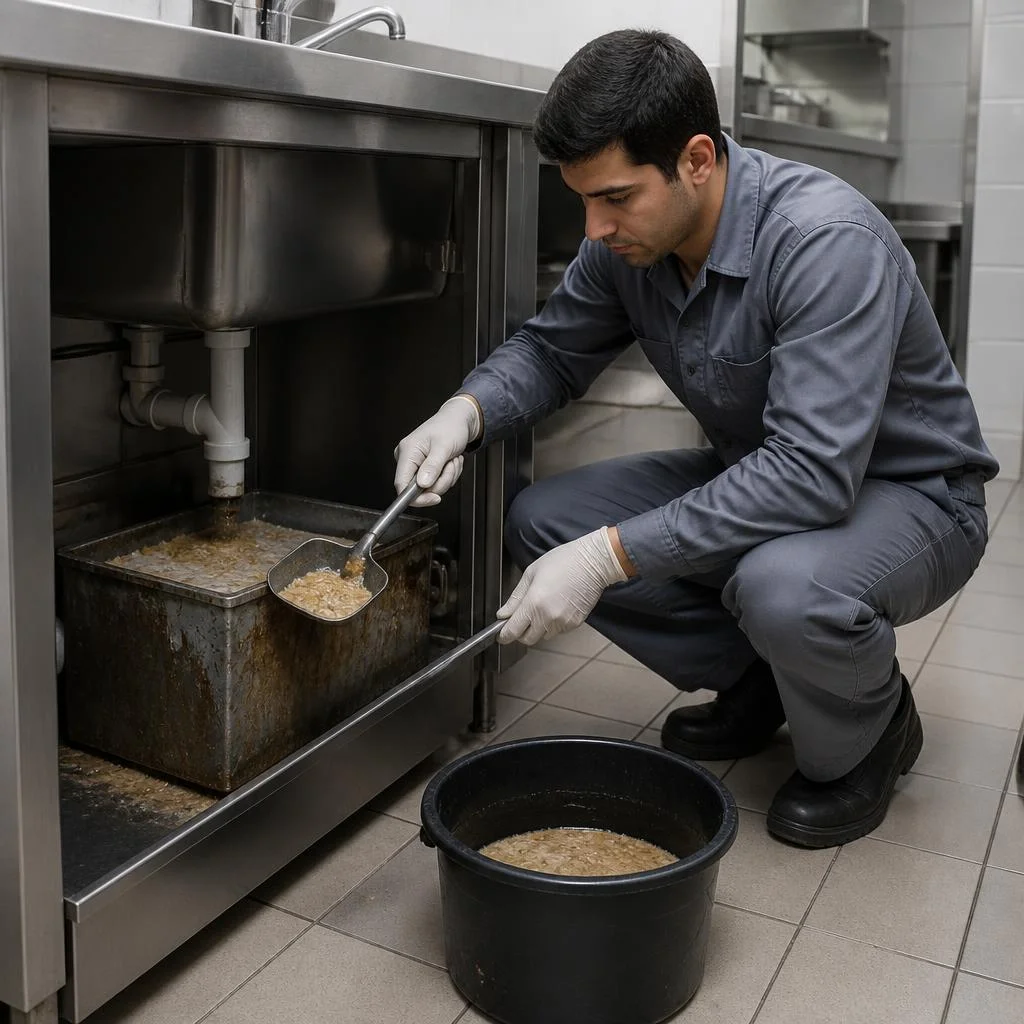
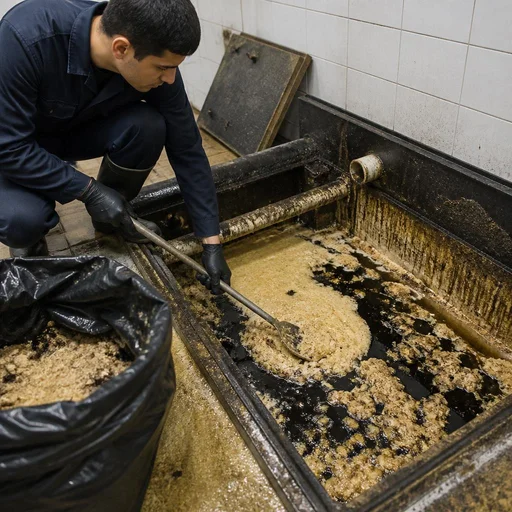
- Removing the top layer of grease: the solidified crust, 2 to 8 cm thick, is cut off and unloaded separately — it goes for disposal as grease waste.
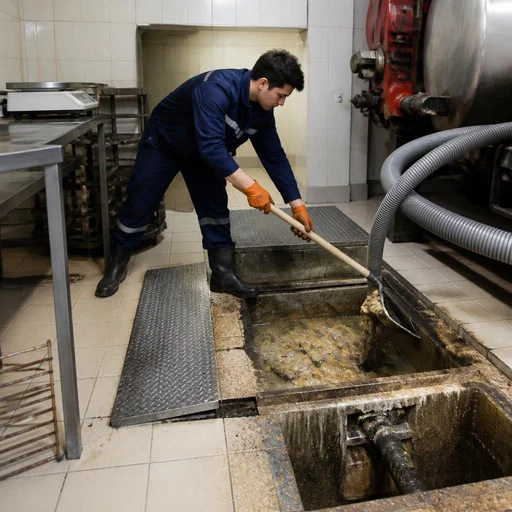
- Scooping out sediment from the bottom: the dense layer of grease, starch, and detergents is lifted from the bottom with scoops, otherwise it remains and interferes with washing.
- Inspecting the body after emptying: an empty chamber allows you to see cracks, chips, and coating delamination that the grease was hiding.
- Recording the volume of waste: we enter the amount of grease and sediment removed into the report — this data is needed for a regular service contract.
Hydrodynamic and steam washing: how old grease is removed
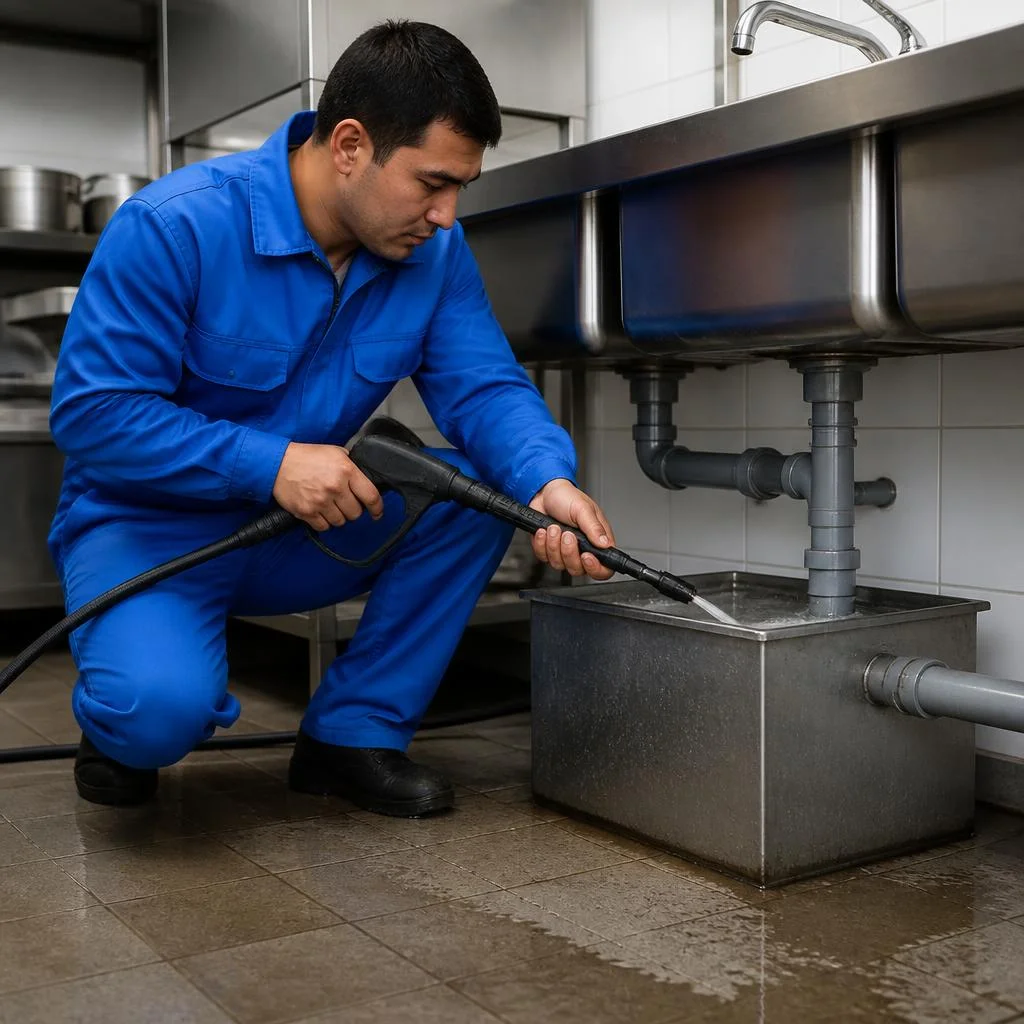
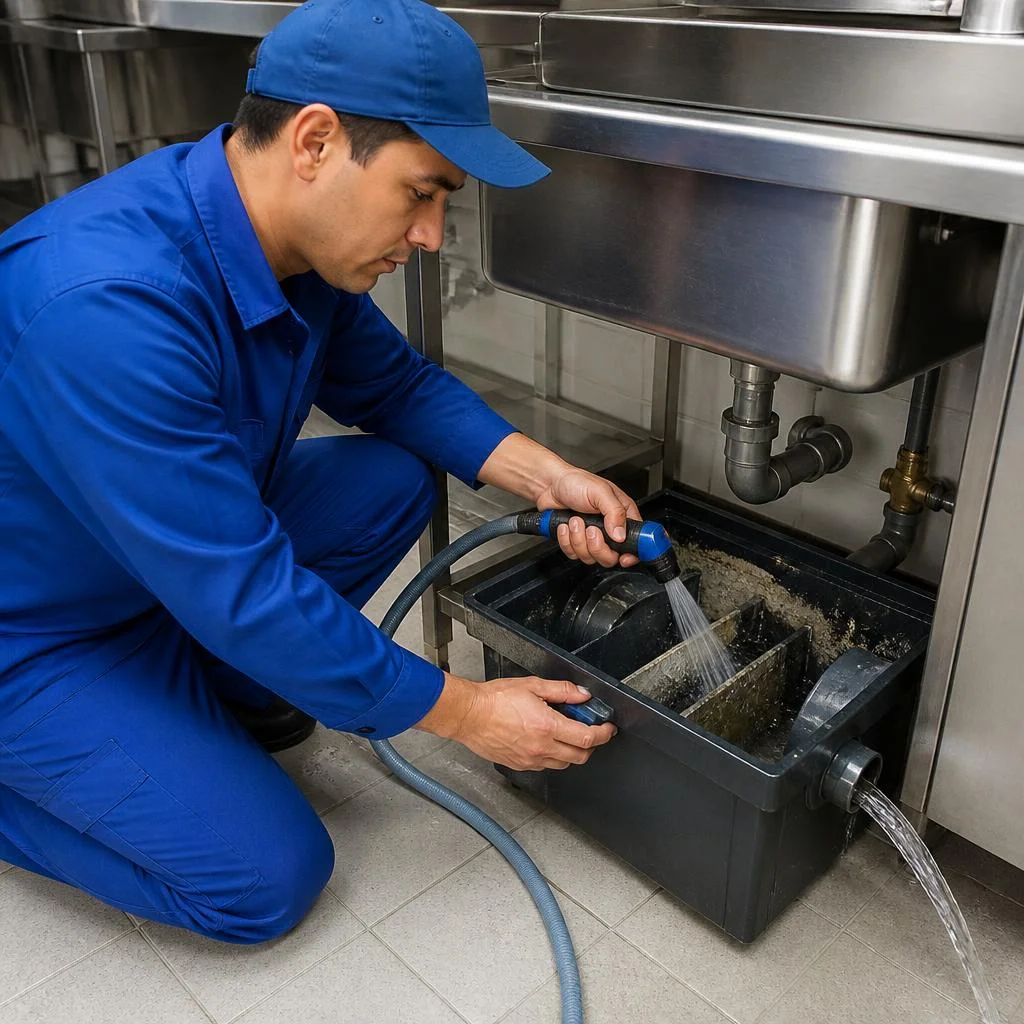
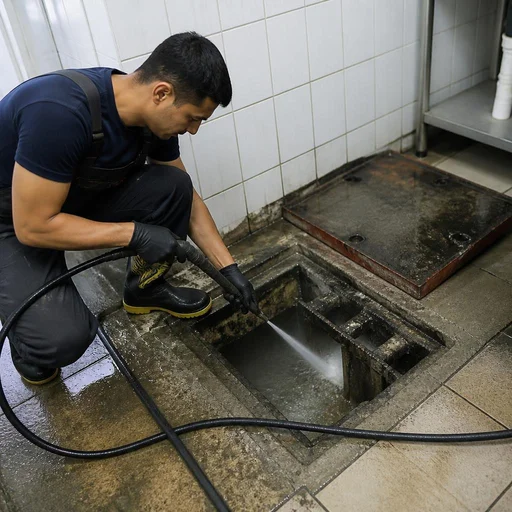
We use hydrodynamic high-pressure water washing and steam cleaning — they remove old grease from the walls, baffles, inlet branch pipes, and the discharge pipeline. Hydrodynamic cleaning operates at a pressure of 150-200 bar: a rotating nozzle removes carbon deposits from the chamber walls, and a flexible hose runs through the discharge pipeline with a diameter of up to 150 mm for 15-20 meters from the grease trap. A steam generator supplies steam at a temperature of 140-160 °C and softens grease plugs in corners and behind baffles where a mechanical scraper cannot reach. Clients often search for grease trap cleaning — and land on this page, although such a query represents a whole set of works rather than a single operation. Steam cleaning must not be used on thin-walled plastic models — overheating deforms the body; for such grease traps we select a gentle hydrodynamic mode with pressure up to 100 bar and a water temperature no higher than 60 °C.
Chemical treatment, degreasing, and odor elimination
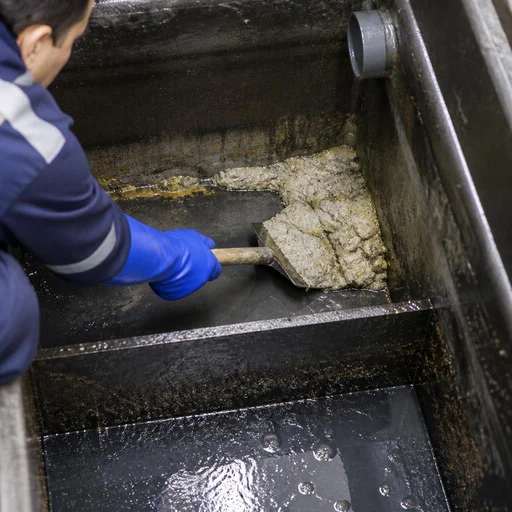
- Cleaning the walls with a scraper: remnants of softened grease are removed manually along the entire height of the chamber and at the joints of the baffles.
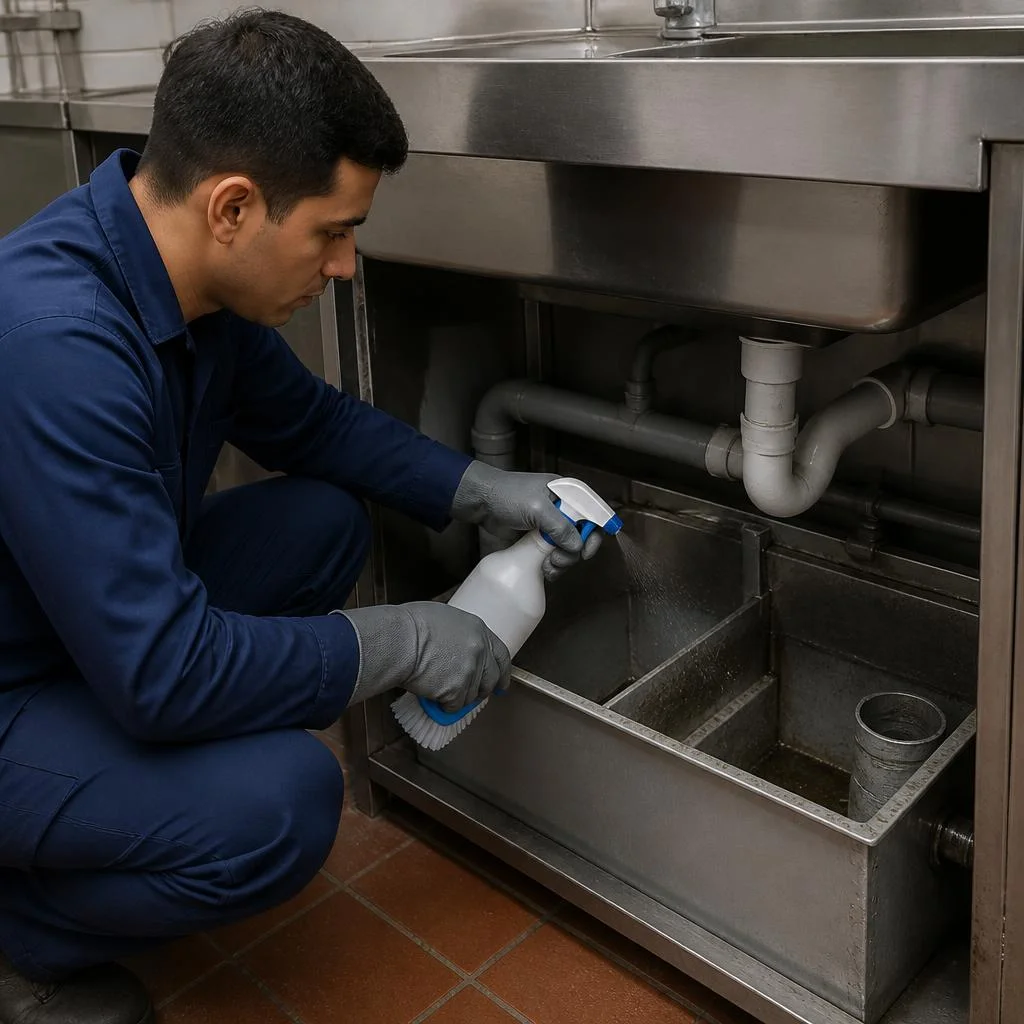
- Chemical treatment: an alkaline reagent is applied to the walls, baffles, and bottom, left to stand according to the instructions, and rinsed off with pressurized water.
- Degreasing internal surfaces: a final pass over the body removes the film on which grease settles again.
- Eliminating grease trap odor: we treat the body and drain traps with a neutralizer — the odor leaves from under the sink rather than being masked with an air freshener.
- Leak test: we fill the chamber with water and check the joints, seals, and connection to the sewer line for seepage.
Grease trap maintenance for restaurants, cafés and HoReCa chains
For HoReCa, regular maintenance is not a one-off service but a continuous schedule tied to the kitchen's operating hours. Visit schedules, night shifts and the package of documents for inspections are tailored to each specific site.
Grease trap maintenance contract: how the schedule is built
Work under a contract includes a fixed visit schedule, maintenance log keeping and issuance of a work completion report after each visit. We determine the frequency based on three parameters: the size of the dining area, the type of equipment — under-sink, floor-standing or built-in — and the average daily kitchen load. For a café chain, we synchronize the schedule across all locations in a single document: this simplifies reporting for inspections and eliminates the situation where one location falls out of the schedule. The contract specifies not only the dates but also the list of operations — pumping out the contents, scraping the walls, flushing the inlet pipes. At sites with a 24-hour kitchen, we set a more frequent schedule than the standard one: the top layer of grease builds up faster than the standard schedule can handle.
Night cleaning without stopping the kitchen: how it works
We carry out grease trap cleaning at night, when the kitchen is not operating — the equipment is ready by opening time, and the restaurant's workday is not interrupted. A night visit requires that access to the grease trap be clear in advance: if the equipment is cluttered with supplies or boxes, the work takes longer, and some operations are postponed to the next visit. At sites with dense development and a single service entrance, the crew coordinates the time with security and the shift manager so as not to block deliveries. In searches, clients often type grease trap cleaning — and land on our page, although essentially they need the same night procedure. Practice shows: at chain locations where the grease trap is cluttered, hydrodynamic flushing takes 30-40 minutes longer — clear the access area before the crew arrives.
Documents for the sanitary service and reporting after cleaning
- Work completion report: issued after each visit — with a list of operations, the date and the signature of the person responsible.
- Maintenance log: filled out on site, recording the frequency and the condition of the equipment before and after the work.
- Video inspection: we attach a recording of the interior walls — it confirms the actual condition of the grease trap.
- Contract and schedule: keep a copy — the inspector compares the stated frequency with the entries in the log.
- Missing log: the most common reason for a fine, even if the grease trap is actually clean — the inspector looks at the records, not at the condition of the equipment.
Cleaning the grease trap and adjacent sections: inlet pipes, pipeline, sewer
A blockage is rarely limited to the grease trap body. Most often the problem extends into the inlet pipes and the discharge pipeline, so the entire line needs to be serviced, not just the visible chamber.
Flushing the inlet pipes and discharge pipeline
Servicing a grease trap without flushing the inlet pipes and discharge pipeline is incomplete: grease accumulates precisely in these sections and is the first to cause a sewer blockage. The cross-section of the inlet and outlet pipes is two to three times smaller than the body — on an under-sink model this is 50 mm versus a 100–150 mm working chamber — so a grease plug forms in the narrow spot faster than in the tank itself. We flush the inlet pipes and discharge pipeline with a high-pressure hydrodynamic unit: the jet cuts the caked-on grease off the walls and carries it into the inspection manhole, after which the technician checks flow with a test run of water. The pipe diameter is critical: if after flushing the water drains more slowly than usual, it means dense sediment remains in the discharge line, and a second pass is needed immediately, not a month later.
Doing it yourself or calling a specialist: what actually works
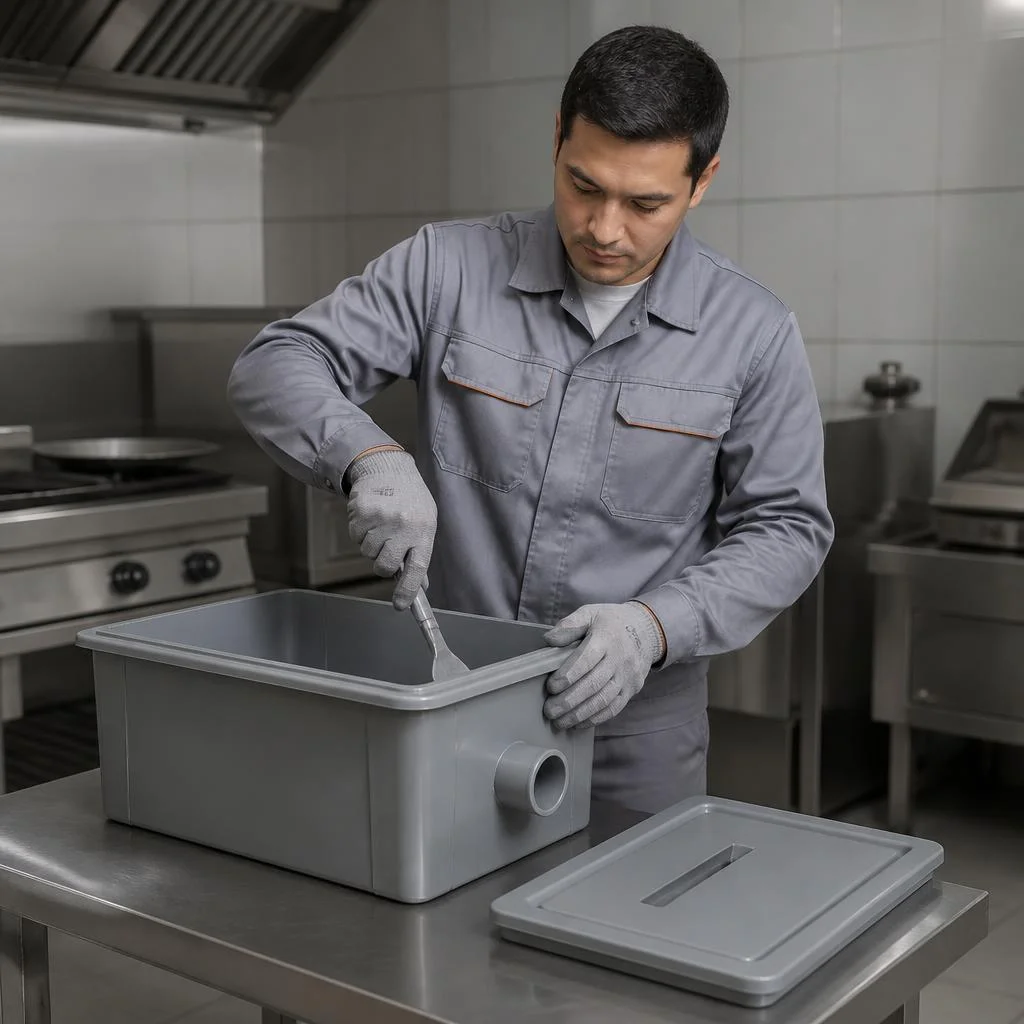
- Removing the top layer: scooping the floating grease out of the under-sink body with a spoon or ladle is realistically doable on your own in 20–30 minutes.
- Pumping out the contents: without a vacuum truck it is impossible to remove the bottom sediment and water from a floor-standing grease trap — the volume reaches 200 liters.
- Cleaning the baffles: old grease on the internal baffles can only be removed with a scraper and hydrodynamic cleaning; by hand it remains as a film.
- Flushing the pipes: a household plumbing snake cannot get through the bends of a 50 mm discharge pipeline; a high-pressure machine is needed.
- Eliminating the odor: private technicians often limit themselves to pumping out and do not flush the baffles — outwardly the equipment looks clean, but after 2–3 weeks the odor returns.
Installation and connection of the grease trap to the sewer
Eco-Service installs the grease trap and connects it to the sewer while maintaining the slope — this determines whether the grease will be retained in the body or pass into the pipeline. For floor-standing models of 100–200 liters, the working scheme is a slope of the discharge section of 2 cm per linear meter with a diameter of 50 mm; at a lower value the water stagnates, at a higher one the grease does not have time to float up and slips through into the municipal network. The connection is made through a siphon with an inspection port, so the line can be serviced without disassembling the body, and the unit itself is placed on a level pad next to the sink or in a pit with access for pumping out. A mistake during connection is insufficient slope of the discharge pipeline: the water drains slowly, the grease settles in the pipe, and the equipment stops performing its function. Checking the installation is simple: after the first shift, open the inspection port — if water in the discharge line stands above the pipe level, the slope is redone.
Can a grease trap be cleaned without disassembling the body
A full cleaning is carried out with partial disassembly: the lid is removed, the basket trap for large fractions is taken out, and the internal baffles are reached. Without removing the lid, only the surface of the grease in the receiving chamber is accessible — that is enough for a week or two, after which the layer grows and overflows into the discharge line. In practice we have encountered floor-standing models where the basket had not been removed for six months: the grease had compressed into a dense briquette that had to be cut off with a scraper and hauled away separately from the water. If the inlet grate is clogged, the water flows around it and erodes the walls of the pit — then restoration of the base is added to the servicing.
Eco-Service Warranty, Timelines and Terms of Work
We are accountable for the result in writing: the warranty is confirmed by a certificate, response times are recorded upon request, and customer reviews are openly available on maps.
Grease Trap Service Warranty — 2 Years
Eco-Service provides a 2-year warranty on grease trap servicing: if within this period an odor or clog appears due to our fault, a specialist makes a repeat visit at no extra charge. We set out the terms in the work completion certificate — there we also record the recommended service interval for the specific kitchen load: for a canteen with 80 seats, this is once a quarter; for small coffee shops, once every six months. The warranty does not cover cases where the grease trap is overfilled due to a violation of the operating schedule on the client's side, which is why we state the recommended interval directly in the certificate. When entering into a service contract, the client sees the full frequency regulations — this allows budgeting in advance. If you are checking the cost, it consists of the scope of work and the type of installation, and warranty obligations are included in the price without a separate line item.
Response Times and Operating Hours of the Service Center in Tashkent
The Eco-Service service center operates in Tashkent: an on-site visit is coordinated on the day of the request, and scheduled work is performed at a time convenient for the kitchen. For urgent cases — a clog or a sudden odor — we keep a reserve slot: the earlier the request comes in, the higher the chance of resolving it the same day. The night shift allows servicing a restaurant without stopping the hot shop — the crew arrives after closing and finishes before opening. We accept requests via Telegram and by phone; for regular clients, the visit schedule is coordinated in advance and does not require a separate call each time. In search, clients often type "Grease trap cleaning" — and land on our page, so for such a request the dispatcher immediately clarifies the type of installation and the volume of the compartment. Visits outside Tashkent — to Samarkand, Bukhara, Namangan — are planned by prior appointment so as not to delay the crew on the road.
Customer Reviews and How We Confirm Quality
- Google Maps and Yandex.Maps: clients leave reviews about grease trap servicing, most often noting compliance with deadlines and the absence of odor after the work.
- Repeat orders: the reviews show whether the client comes back again — this is the main indicator that the problem did not return a month later.
- Before and after photos: upon request, we send photos of the inner walls and partitions taken before and after washing.
- Work completion certificate: a document listing the operations and the recommended interval — it can be attached to the kitchen's internal reporting.
- Service contract: for restaurants and chains, we set out the schedule and scope of work so that SES inspections pass without remarks.
Fat waste disposal and what happens after servicing
After servicing, fat, bottom sediment and contaminated water remain at the site. They cannot be discharged into the sewer or poured onto the ground — let's break down how fat waste disposal works.
Where fat is disposed of after pumping out
Pumping out grease traps ends with the removal of fat waste: the Eco-Service company transfers it for disposal rather than discharging it into the sewer or onto the ground. The collected mass is taken to a specialized landfill, where the fat is processed into technical products, and the water fraction is treated before discharge. Mixed sediment with sand, food residues and detergents goes into a separate stream, because a conventional aeration station does not accept it. In Tashkent, removal is documented: the client keeps a disposal receipt, which will be useful during a SES inspection. Pouring fat into the sewer after servicing reduces the work to zero: the fat settles in the city networks and comes back as a blockage in the same section.
What is included in pumping out a grease trap and how it differs from a full cleaning
- Pumping out the grease trap: removes the liquid fraction and part of the bottom sediment using a vacuum unit, but the walls remain coated with a film of fat.
- Removing the top layer: collects the solidified fat from the surface without affecting deposits below the water level.
- Scraping the walls with a scraper: removes the baked-on layer from all internal surfaces of the chamber.
- Flushing the internal partitions: a separate operation for the inlet and outlet lines, not performed at all during pumping out.
- Chemical treatment: dissolves residual deposits and eliminates the source of odor, whereas pumping out alone does not remove the odor.
Conclusion
We have gathered the main things that determine the result of grease trap servicing: from the work schedule to the documents for inspections. Below are the conclusions worth keeping in mind when planning.
Main conclusions
- Regularity matters more than intensity: a grease trap serviced on schedule produces blockages and odor less often than one that is cleaned up after the fact.
- Full cycle: diagnostics, pumping out, mechanical and hydrodynamic flushing, chemical treatment, inspection of the pipes — only together do they give a result.
- Documents: the act and log after servicing protect against fines during SES inspections.
- Do-it-yourself servicing: handles the top layer of fat, but the partitions and pipeline require equipment.
- Waste disposal: fat must be removed, not poured into the sewer — otherwise the blockage comes back.