
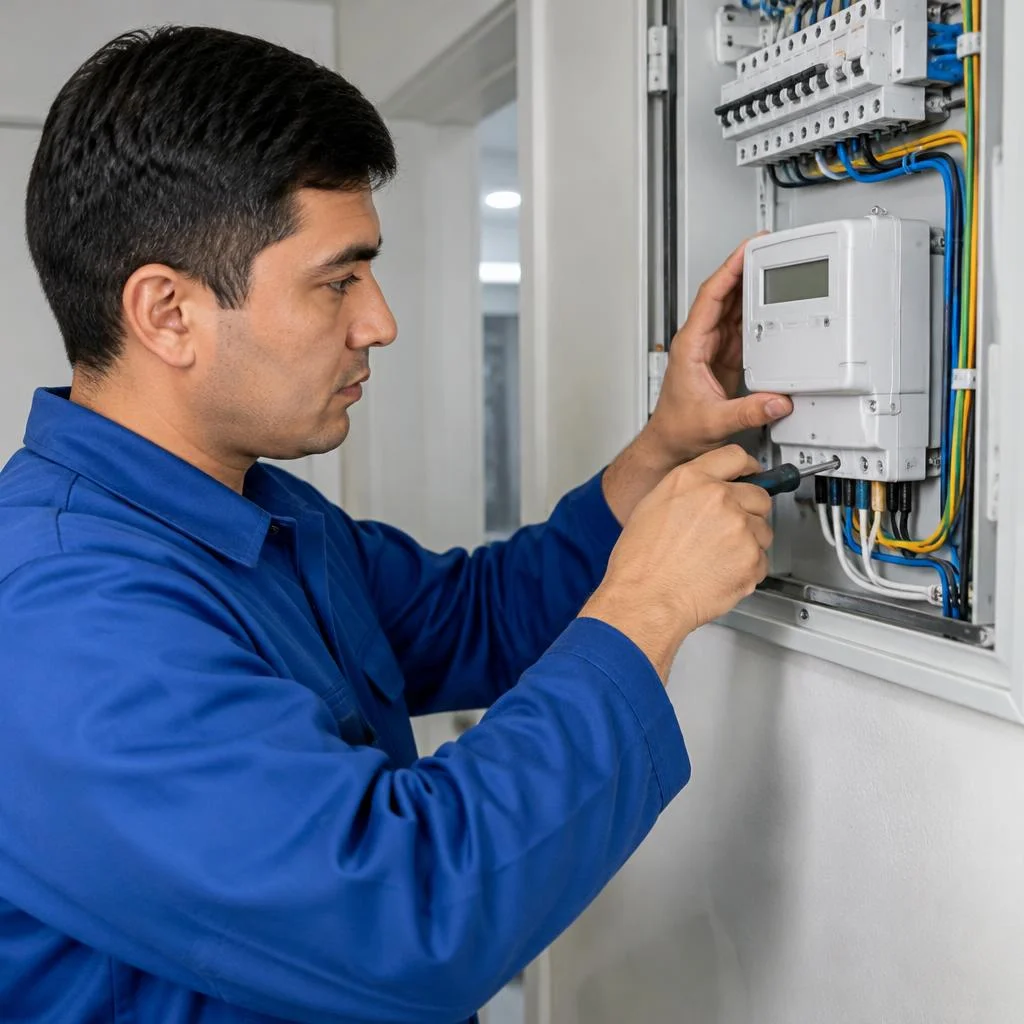
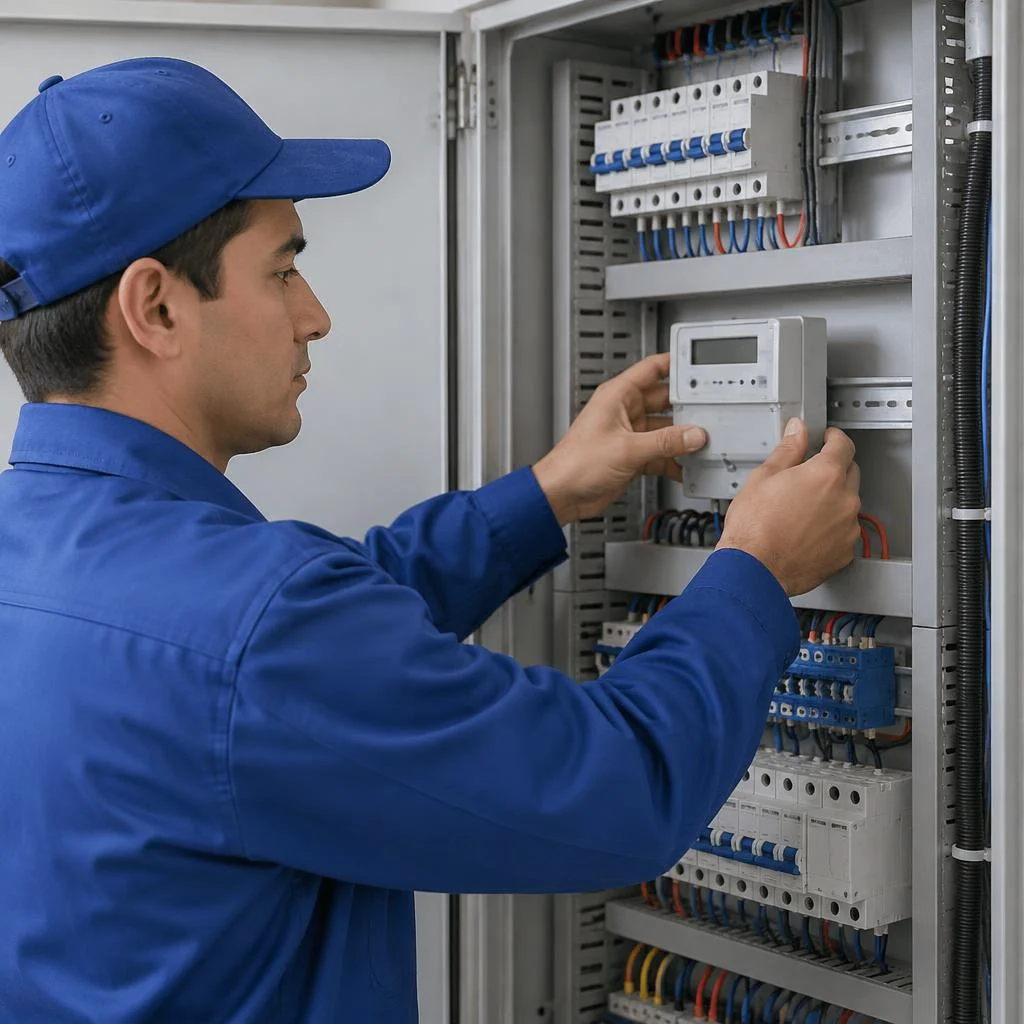
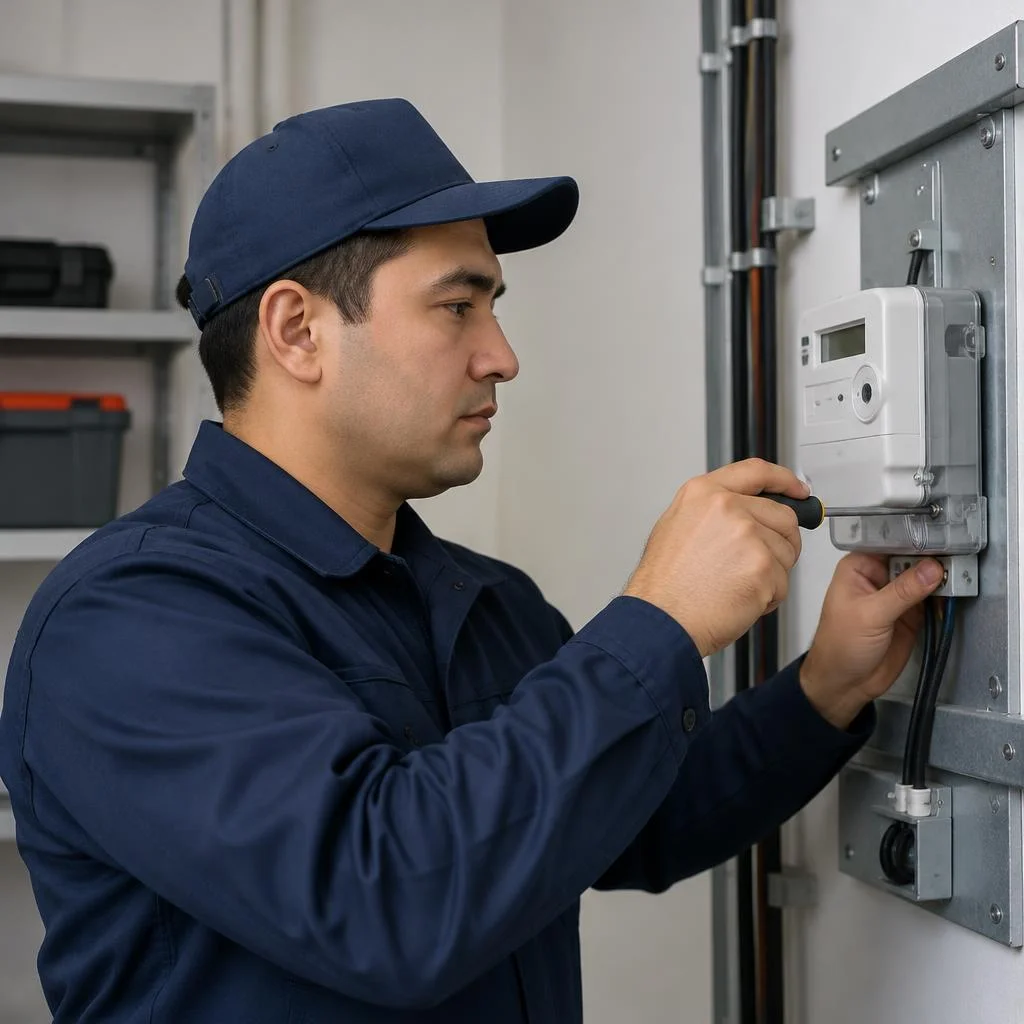
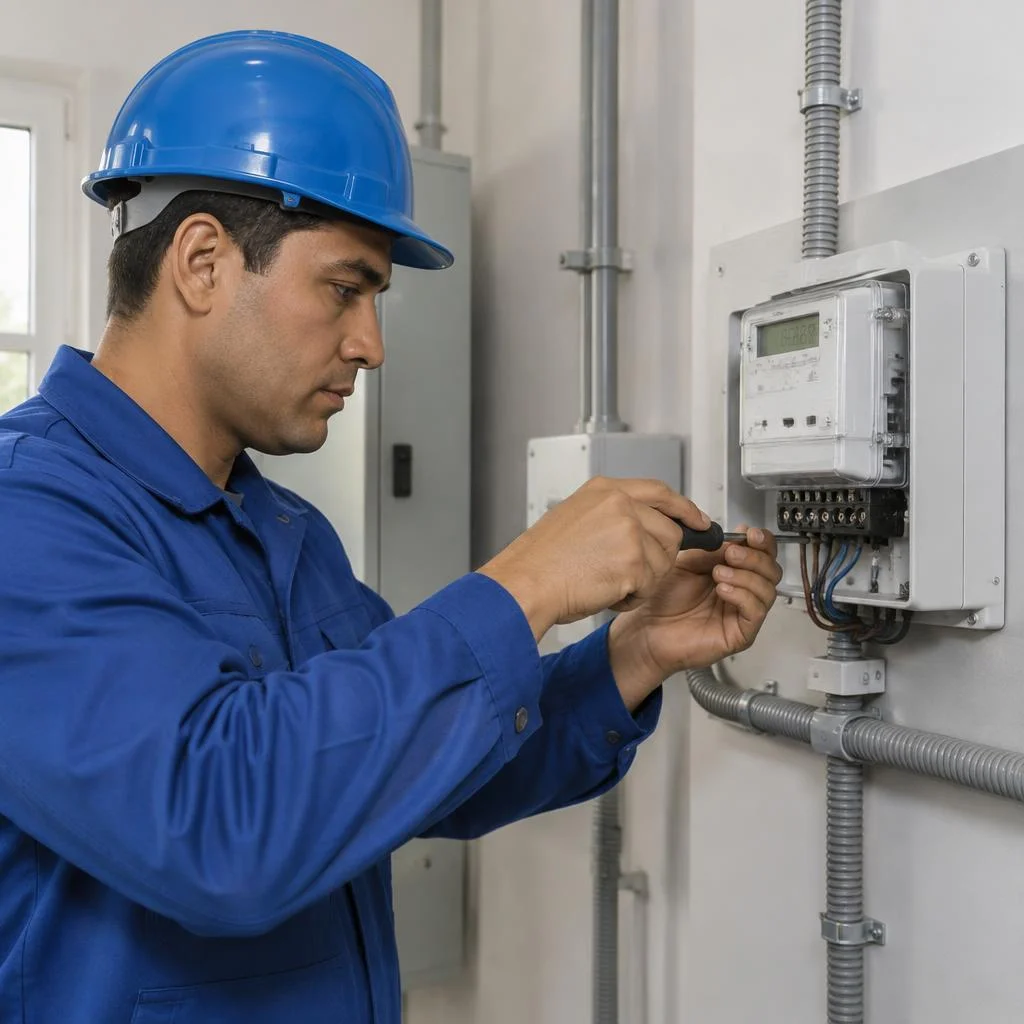
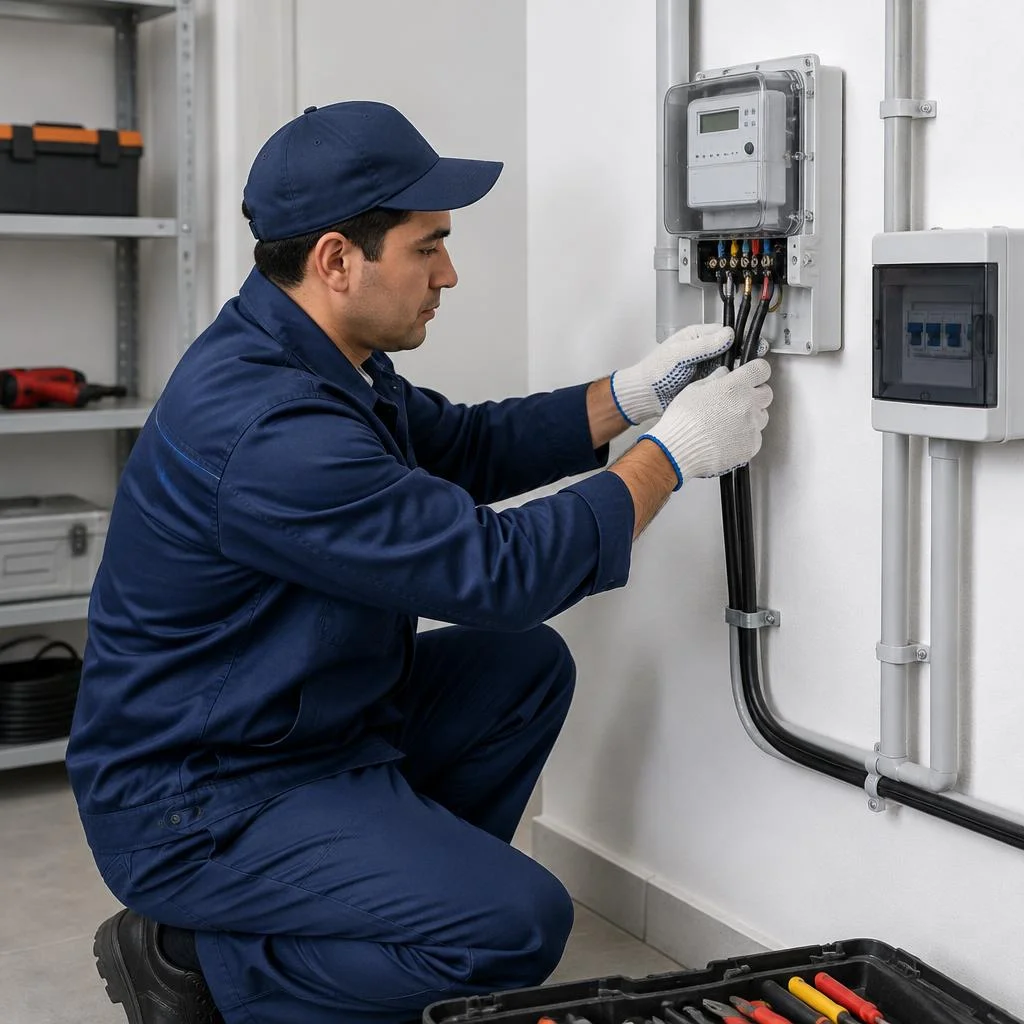
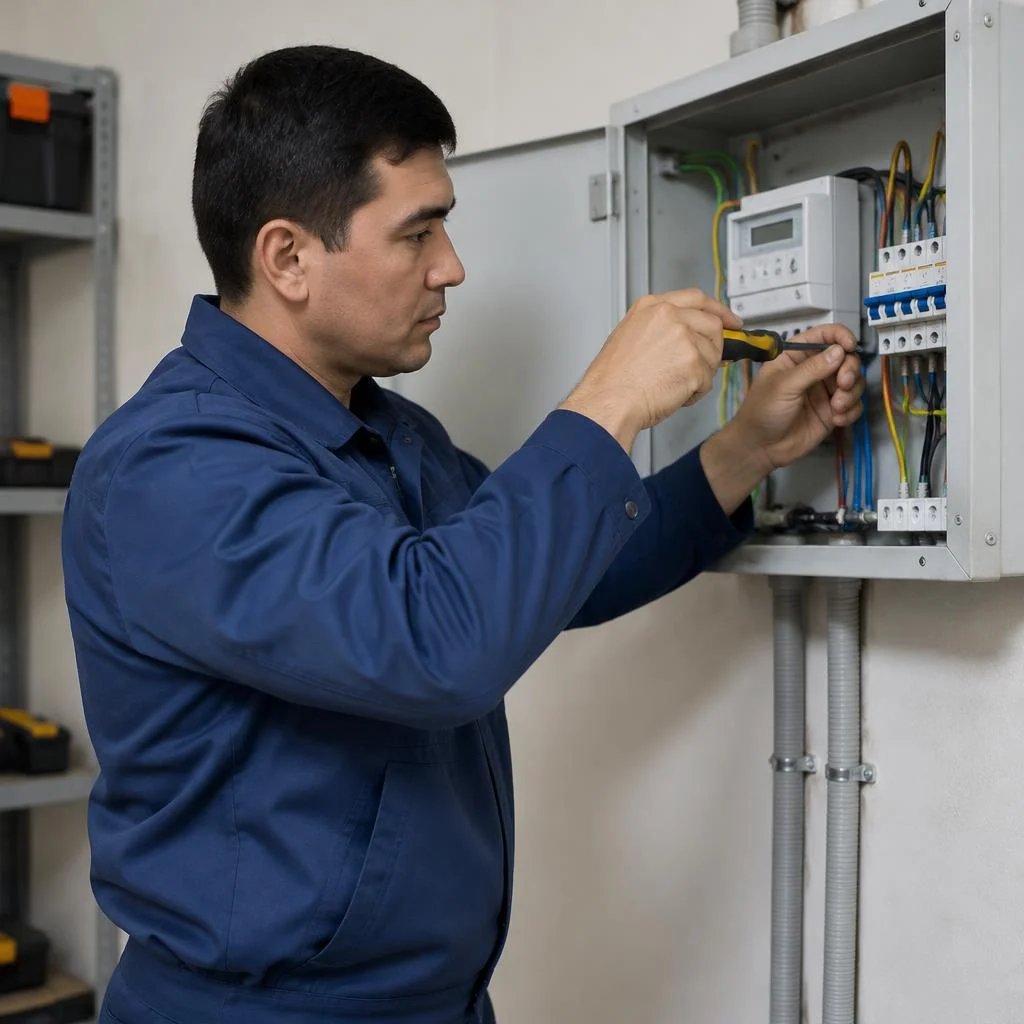








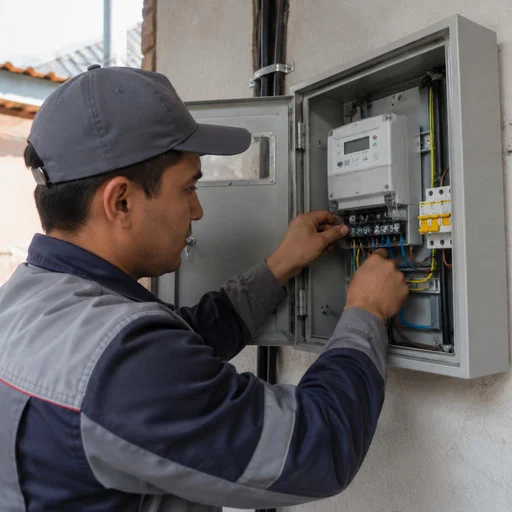
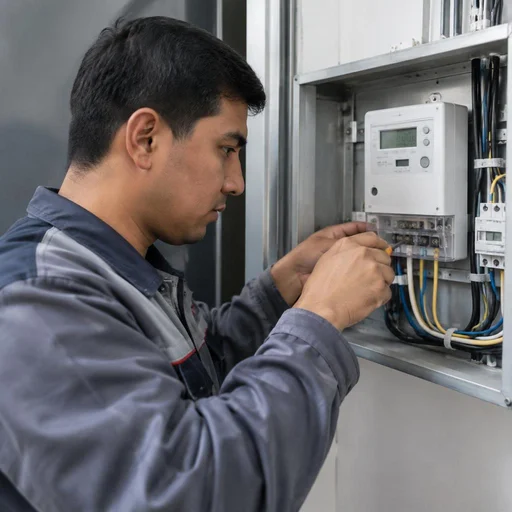
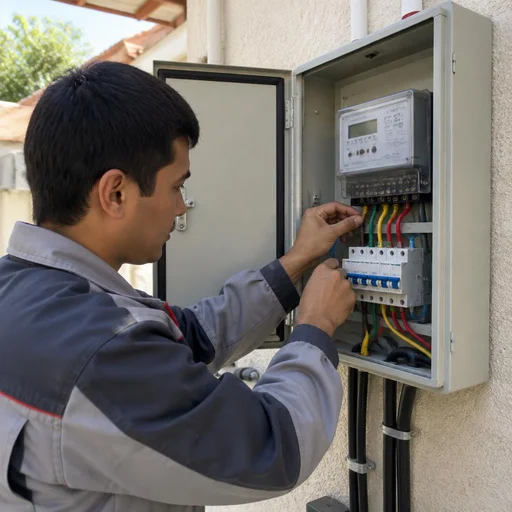
What electricity meter installation work Eco-Service performs
Electricity meter installation is not a single operation, but a set of works tailored to the type of facility, the number of phases and the entry point. Below we break down the options: from a single-phase unit in an apartment to a turnkey three-phase system in a private house.
Single-phase or three-phase: which meter the facility needs
We install single-phase 220 V meters for apartments and three-phase 380 V meters for private houses with heavy loads. The rated current is selected based on the incoming circuit breaker: for an apartment with an electric stove and air conditioner this is 40-50 A, for a house with a 12 kW electric boiler and a welding machine — 63 A and above. The accuracy class for household metering is 1.0 or 2.0; for commercial facilities the energy supply organization requires 0.5S. Installing electricity meters in a Tashkent apartment with a gas water heater is done without reworking the incoming line, while for an electric boiler in the private sector a three-phase incoming line is laid at the design stage. If an electric boiler, welding or machine tools are planned in the house — lay a three-phase incoming line in advance; reworking a single-phase unit later is more expensive and requires new approval.
Installation options: DIN rail, pole, complete panel replacement
| Installation option | Where it is used | What is included | Special feature |
|---|---|---|---|
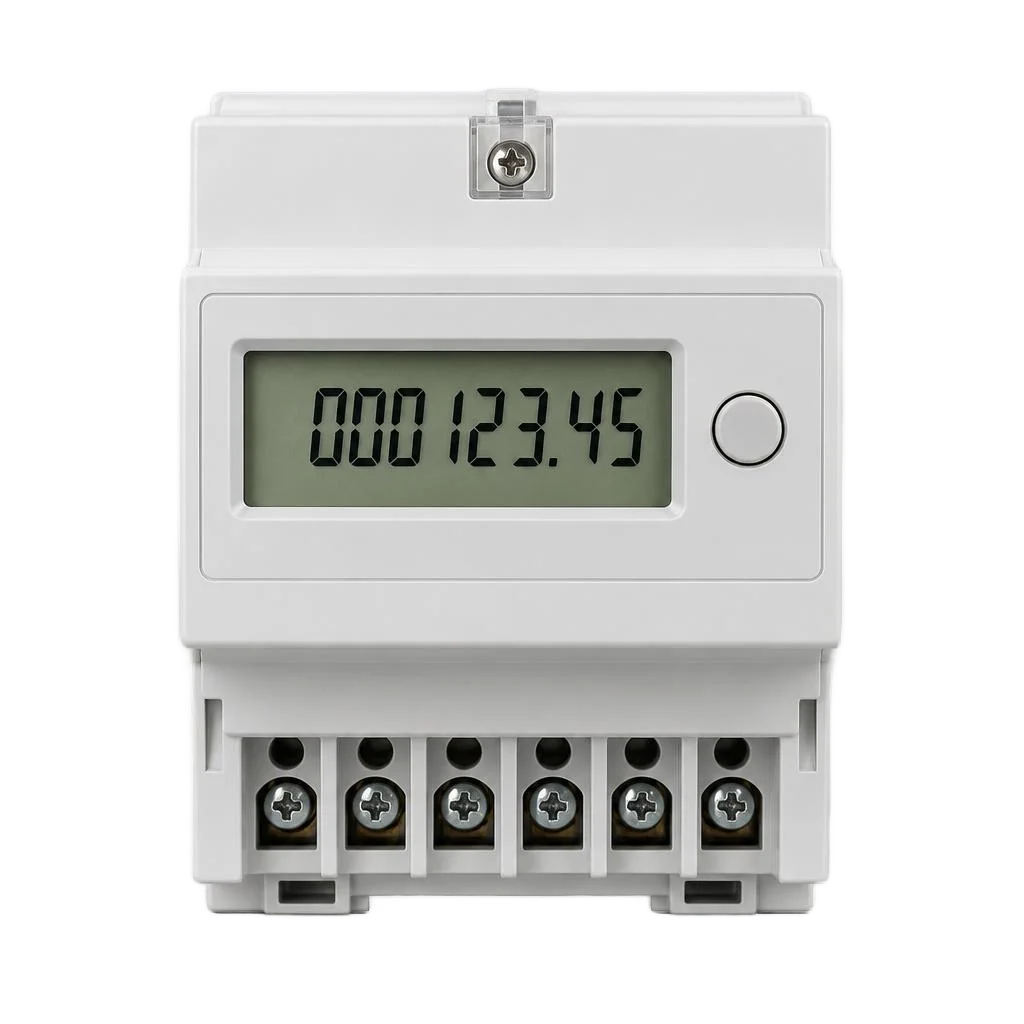
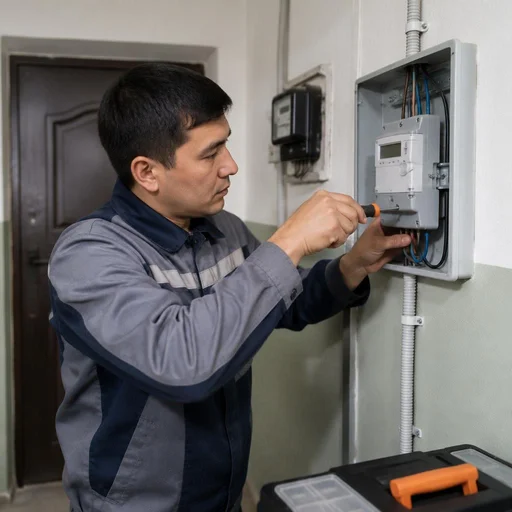
| On a DIN rail | apartment, office | meter, circuit breaker, panel | compact, accessible for taking readings |
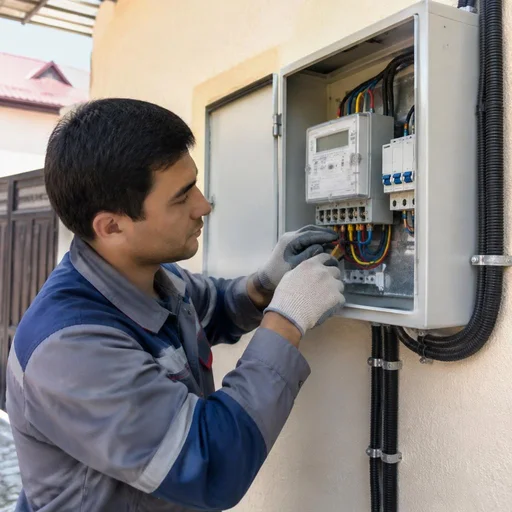
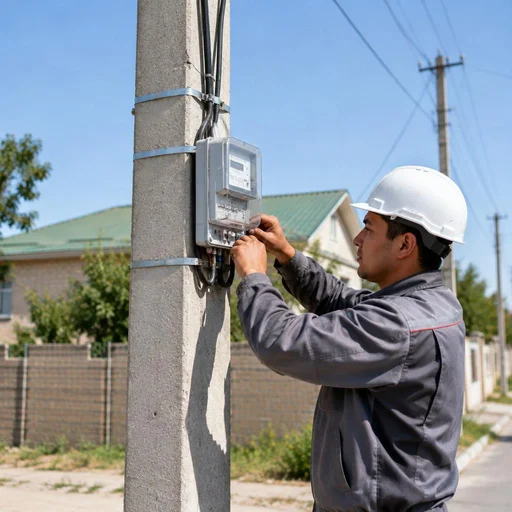
| On a pole | private house, residential area | box, cable, fasteners | moisture protection, slack for sag |
| With panel replacement | old housing stock, wear | new panel, circuit breakers, RCD | complete rebuild of the unit |
| Turnkey (3 phases) | house with 380 V | panel, incoming line, RCD, configuration | ready for sealing |
Outdoor pole installation requires a moisture-proof box rated at least IP54 and a cable reserve for sag — otherwise in winter the wire tightens and tears the terminals. In multi-story buildings in Chilanzar and Yunusabad, the device is more often mounted on a DIN rail in the floor panel, while in makhallas with overhead incoming lines — in a separate box on the facade or pole. When ordering electricity meter installation in Tashkent, check whether the estimate includes fasteners for the box and corrugated conduit for the incoming cable.
Replacement and relocation: when the old meter no longer fits
- Verification interval: for single-phase devices it expires after 16 years, for three-phase — after 8, after which the readings are not accepted for metering.
- Mechanical damage: a cracked glass, traces of terminal overheating or a broken seal — grounds for an unscheduled replacement.
- Switching to multi-tariff metering: an old induction device does not support "day-night" zones; an electronic one with tariff functionality is needed.
- Relocation of the metering unit: during renovation, redevelopment or moving the panel to the facade, the new location is first approved, then installed.
How electricity meter installation works: stages from request to seal
Electricity meter installation is a sequence of preparation, assembly of the metering unit, connection to the grid, and testing. Each stage is documented: the technician leaves the diagnostic results, the diagram, and the readings after the test run.
Preparation: diagnostics, diagram, and cable routing
Before starting work, we check the existing circuit with a multimeter, determine the cross-section of the incoming cable and the route to the metering unit. Diagnostics reveals the condition of the terminal block, the presence of twisted splices in the old panel, and the actual load by group. Cable routing to the meter is done in corrugated conduit or a wall chase — open wiring on the wall is acceptable, but in living rooms it is hidden in a channel so that the insulation is not damaged during renovation. Checking the circuit before work begins takes 15-20 minutes and immediately exposes a typical problem: an undersized circuit breaker rating under a heavy load. The cross-section of the incoming cable is selected to match the breaker rating, not "by eye": an undersized cross-section heats up under load and melts the meter's terminal block. At Eco-Service, diagnostics and cable routing are handled as a single stage so that we don't have to go back to the wall twice.
Panel assembly and installation of metering devices in the unit
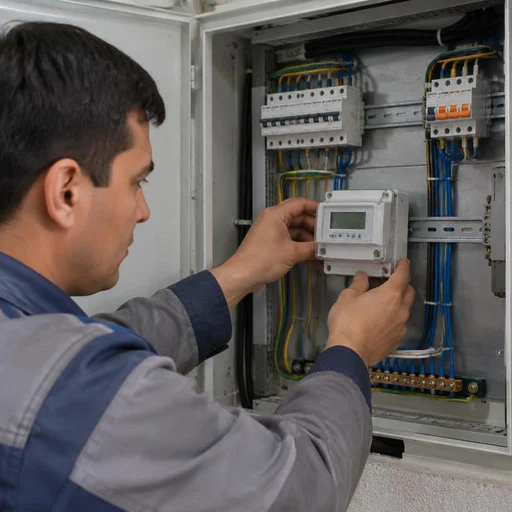
- Panel enclosure: selected based on the number of modules — the meter, circuit breaker, RCD, and voltage relay take up 6-9 positions on the DIN rail.
- Protective automation: the circuit breaker is installed according to the incoming rating, the RCD — at 30 mA to protect the line from leakage.
- DIN rail: the meter is secured to it with clips, which simplifies replacement without dismantling the entire panel.
- Line marking: each group is labeled so that when a breaker trips, the technician and the resident can immediately see the problem area.
- Diagram inside the panel: a single-line diagram is attached to the door — it speeds up acceptance.
Connection to the grid and test run
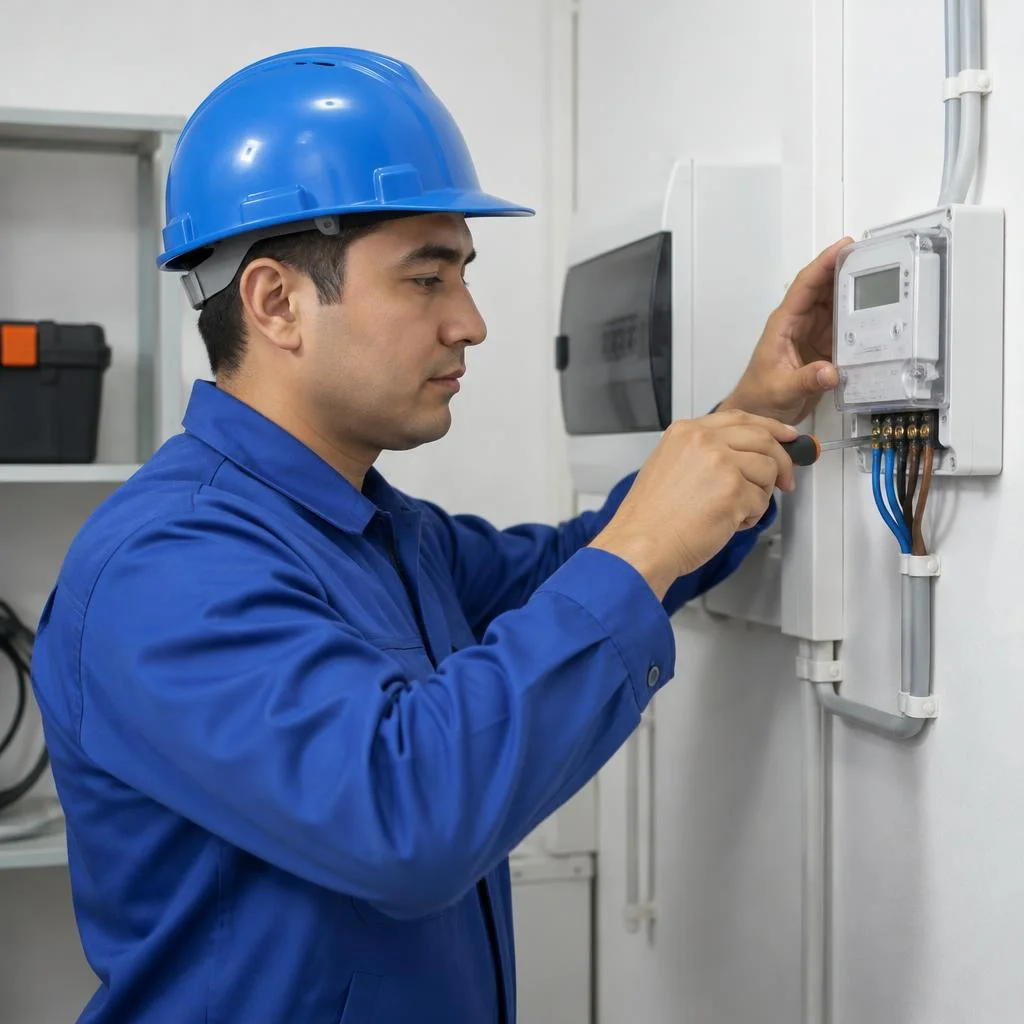
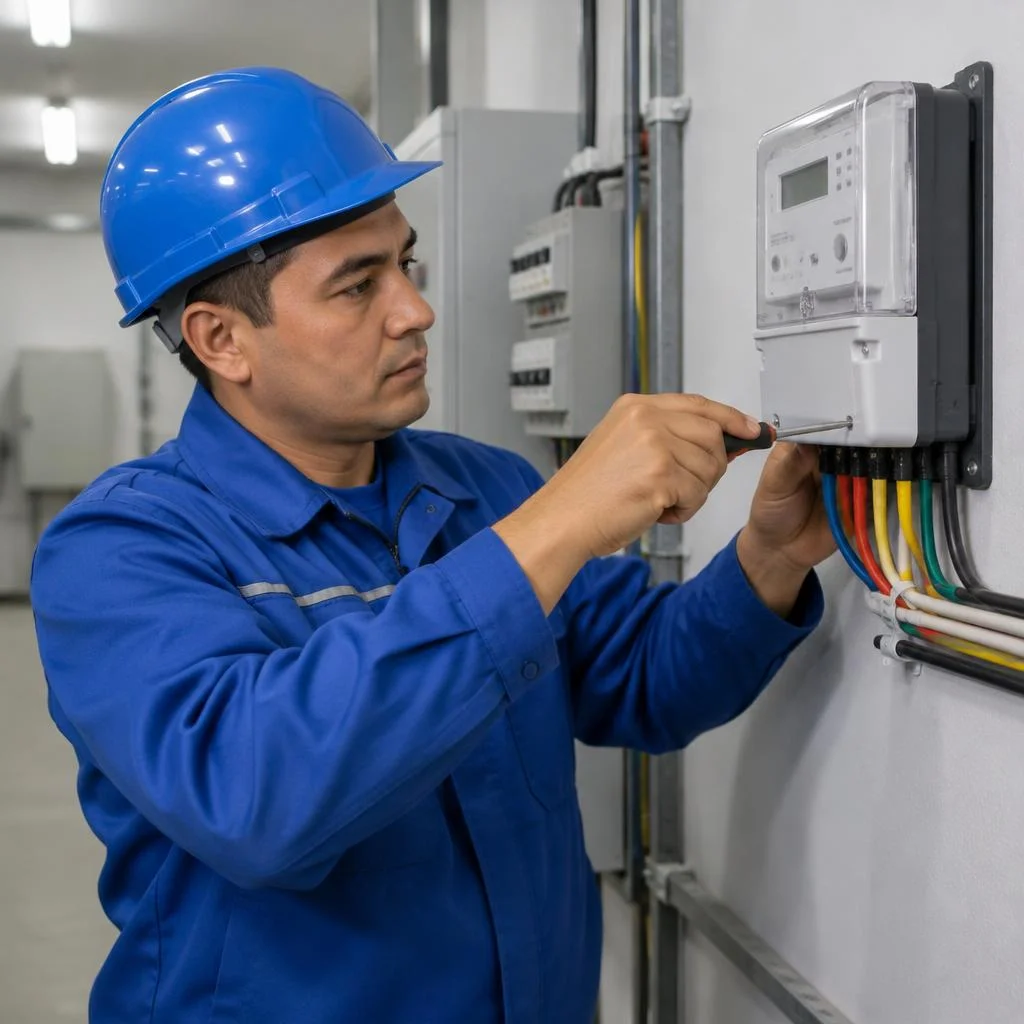
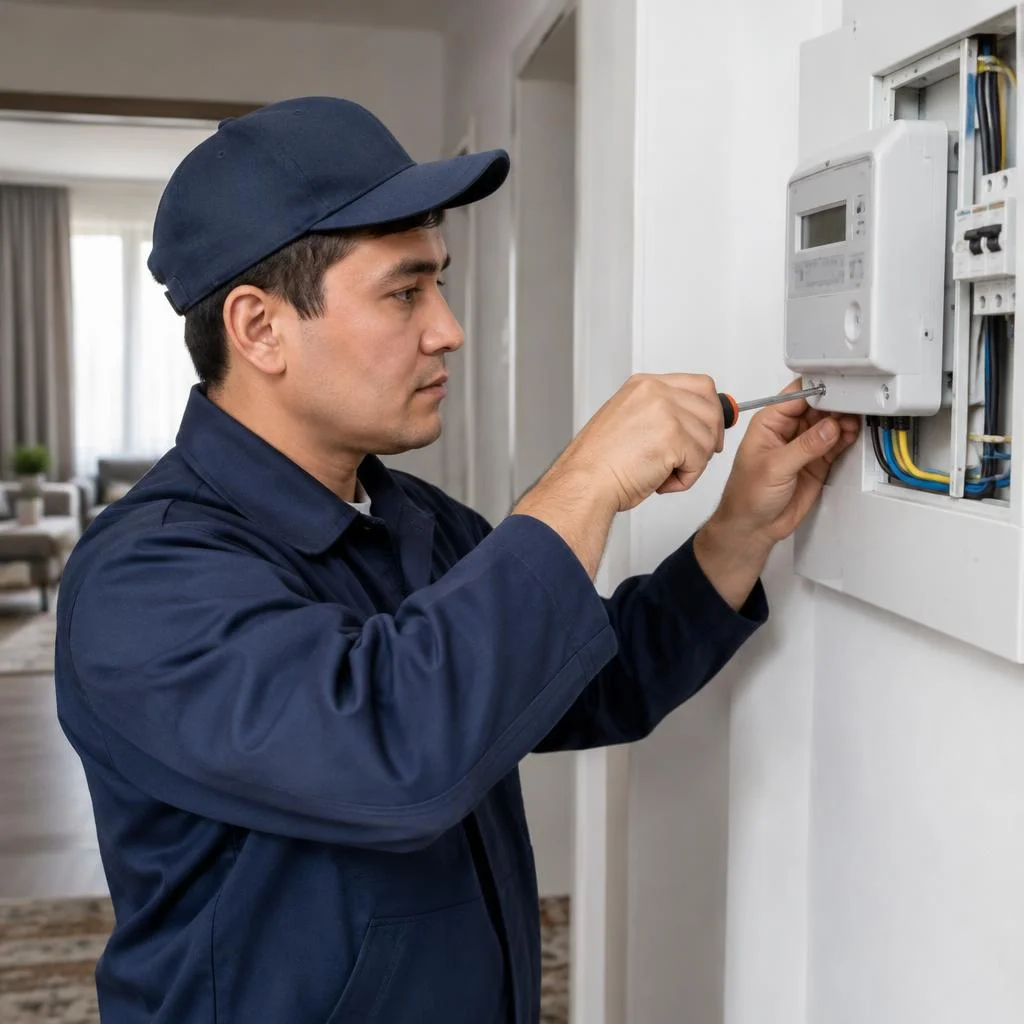
Connecting the electricity meter to the grid and the test run take one technician visit — usually within a working day. The wiring runs from the incoming cable through the breaker to the meter, then to the RCD and distribution groups; each terminal is tightened with a torque screwdriver, because an under-tightened contact heats up more than an overload. The test load — a kettle, heater, or welding machine — shows how the device measures inductive and active loads. After the run, we always check the metering mechanism under a real load: inductive loads and electronics are measured differently, and the discrepancy is only visible during the test. The readings and the circuit check result are recorded in a report — this document will be needed when accepting the metering unit. In search queries, clients often phrase the task differently — and land on this page, although in fact it is about a single device in a specific unit. In essence, the work in the metering unit is completed precisely by signing the report.
Approval and Sealing in "Hududiy Elekt Tarmoqlari"
Work on the metering unit is only half the battle. For the meter to be placed on the balance sheet and its readings to be accounted for, the metering unit must go through an application, acceptance, and sealing process at "Hududiy Elekt Tarmoqlari". Let's break down the procedure step by step and examine where mistakes are most often made.
Application and Documents for Installing Electricity Meters
- Meter replacement application: submitted to the district office of "Hududiy Elekt Tarmoqlari" before work begins, with the facility address and the reason for the request.
- Owner's passport: original and copy, plus a document for the facility — cadastral extract, lease agreement, or technical passport.
- Subscriber's account details: number, current readings, absence of debt — the inspector verifies these against the database.
- Technical parameters: meter type, number of phases, proposed installation location — approval depends on these.
- Approval: after verifying the data, installation permission is issued — only with it is the work on installing electricity meters in Tashkent considered legal.
Acceptance, Commissioning Act, and Sealing
Sealing is performed by an inspector of the power supply organization after inspecting the metering unit and signing the commissioning act. The installation of electricity meters is completed precisely by this stage: until the seal is applied, the meter is not legally considered commissioned. The inspector checks the connection diagram, the integrity of factory seals, the compliance of circuit breaker ratings with the project, and the marking of the incoming cable. Based on the inspection results, a commissioning act is drawn up in two copies, a control seal is placed on the terminal cover and, if the panel is shared, on the compartment door. After installation, the documents — the act, the seal, and the updated account — remain with the subscriber; readings are calculated on their basis. In applications, clients often write briefly — electricity meter installation Tashkent — and from this wording we immediately understand that a full cycle with acceptance is needed. Through Eco-Service, the acceptance package is prepared in advance so that the inspector does not find any discrepancies. Before the inspector arrives, do not close the panel tightly — they need access to the terminal block and the manufacturer's seals.
What Is Considered Unauthorized Connection
Connecting or relocating a metering unit without an application and acceptance is considered unauthorized — even if the meter is functional and sealed by the factory. Inspectors record such cases by the discrepancy between the load at the input and the account readings: a spike in consumption without a record in the database is immediately visible. The absence of an application leads to under-metering, and under-metering leads to recalculation according to the norm for the entire period since the last inspection. The fine is charged not for the fact of the work, but for the unmetered consumption over the period — therefore a "quiet" meter relocation is almost always more expensive than legal registration through an application.
Multi-tariff metering and meter configuration
A multi-tariff device pays for itself where the main load falls on nighttime hours. Let's look at which facilities it suits and how tariff zones and the reading transmission channel are programmed.
Who benefits from a multi-tariff meter
We recommend a multi-tariff meter for facilities with nighttime load: electric boilers, underfloor heating, electric vehicle charging. In practice, a two-zone device is installed in private homes with electric heating, car washes on the second shift, and small workshops with a nighttime cycle — there, the share of consumption after 23:00 reaches 40-50% of the daily volume. In search, clients often phrase the request as installation of electricity meters — and land on this page, although what is meant is specifically a multi-tariff device with programmable zones. Configuring a multi-tariff meter takes about an hour: the technician programs the zone boundaries, checks the device's internal clock against real time, and verifies the transition between tariffs. Calculate the benefit by the share of nighttime consumption: if less than a third of the energy is consumed at night, the payback of the device will stretch over years.
Configuring tariffs and transmitting data
- Programming zones: the technician enters the boundaries of the nighttime and daytime tariffs, checks the device's internal clock, and records the transition between zones.
- Installing the electricity meter: in the metering unit, the device is mounted on a DIN rail or a pole, after which it is connected to the incoming cable and the circuit breaker.
- RS-485 interface: a wired channel connects the device to a controller or the energy supply company's computer at a distance of up to 1200 meters over twisted pair.
- GSM module: the device sends readings itself over the cellular network, and the operator collects data without a controller's visit; in a basement or a metal panel, the signal is lost, and the intervals accumulate in the device's memory until communication is restored.
Warranty, timelines and technician qualifications
Electrical installation carries risk: a mistake in connections leads to overheating, device failure and a repeat visit. That is why here we cover the warranty period, specialist certification and realistic timelines for work at the site.
2-year warranty on installation
Eco-Service provides a 2-year warranty on installation work for electricity meter installation. The two-year period covers the connections in the metering unit, mounting of the device, assembly of the panel and connection to the grid — everything that depends on the technician's hands. The warranty does not cover voltage surges in the city grid: during a spike to 380 V and above, the device's electronics burn out, and this is not a warranty case. For protection, a voltage monitoring relay is installed — it cuts power when parameters go beyond acceptable limits and costs less than a new meter. A claim is filed based on the work completion report: the technician visits, checks the connections and fixes the installation defect. Electricity meter installation — that is how clients phrase the request when they are looking for a technician, and in that same request the question of cost almost always comes up: "electricity meter installation price" is asked together with the warranty, and rightly so — ownership of the device depends not only on a one-time payment, but also on whether the work will have to be redone.
Technician certification and in-person service center in Tashkent
- Electrical safety group: installation is carried out by technicians with certification and experience on single-phase and three-phase metering units.
- Site visit: the specialist arrives with tools, sealing materials and consumables for the specific type of device.
- Eco-Service in-person service center: in the capital, the metering unit can be brought in and shown in person, rather than describing the problem over the phone.
- Disputed cases: if a defect in the device or connections is suspected, in-person diagnostics take less time than correspondence.
- Documents: the technician prepares a work completion report — it is needed both for the warranty and for the energy supply organization.
Work completion timelines
We complete a standard meter installation in one visit, and comprehensive work involving panel replacement in two. A single-phase device on a DIN rail with a ready panel is installed in 1.5-2 hours, a three-phase unit with connection to automation and an RCD takes 3-4 hours, and a full panel replacement with relocation of the metering unit stretches over two visits. The timeline depends not only on the technician, but also on the readiness of the site: if the cable route is not prepared, cable laying and wall chasing are added to the work, which means several more hours. Installation at sites with old aluminum wiring takes longer — the incoming cable has to be replaced and the cross-section selected for the load. In practice, we recommend sending photos of the panel and incoming cable in advance: based on them, the technician will give a realistic timeline, not an average one from the price list.
Typical mistakes when installing electricity meters
Most problems with a metering unit arise not because of the device, but because of the work and the lack of coordination. Installing electricity meters without an application and acceptance is the most common reason for refusal to register. Let's look at the mistakes that cause a site not to be accepted for metering or the unit to operate unsafely.
Mistakes that will prevent the device from being accepted for metering
- No application: installation without contacting "Hududiy elekt tarmoqlari" is treated as unauthorized connection — the unit will not be registered.
- Broken factory seals: the terminal cover must remain sealed by the factory until the inspector's examination.
- Panel inaccessible for inspection: if there is no free access to the terminal block, acceptance is postponed until it is redone.
- No commissioning certificate: without a signed metering document, consumption is considered unmetered.
- Diagram does not match the design: a discrepancy between the single-line diagram and the actual installation leads to refusal of acceptance.
Technical mistakes during installation
- Phase and neutral swapped: the device counts correctly, but the RCD trips falsely or does not trip at all.
- Undersized cable cross-section: the incoming wire heats up under load, the insulation melts, and the risk of fire increases.
- No grounding: the panel enclosure and DIN rail remain energized if the insulation breaks down.
- Loose contact at the terminals: contact resistance heats the terminal block, and the contact burns.
- Saving on the incoming circuit breaker: a rating higher than the calculated one does not protect the line during a short circuit.
- Laying the cable right next to the meter: interference and heating distort the readings of multi-tariff models.
Conclusion
Installing electricity meters is work where the technical part and the paperwork are directly connected: even neatly performed work will not be accepted for metering without properly completed documents. We have gathered the main things worth keeping in mind before starting.
Key takeaways
- Phase configuration by input: 220 V — for an apartment and a typical house, 380 V — where a powerful load such as an electric boiler or machine tools operates.
- Application and acceptance: installation without contacting the power supply organization leads to a recalculation for unmetered consumption according to the standard.
- Multi-tariff metering: the device pays for itself only with a significant share of night-time consumption — laundry, boiler, electric car charging at night.
- Cable and diagram: the cross-section of the incoming wire and the "phase-neutral" order affect the operation of the protection no less than the model of the device.
- Warranty and authorization: a warranty period for installation only makes sense together with the master's authorization and the possibility of an in-person visit for a warranty case.
- Check after installation: a test run under load and comparison of readings with a reference device reveal an error before sealing, not after.