









Which electrical panels are installed in apartments and private houses in Tashkent
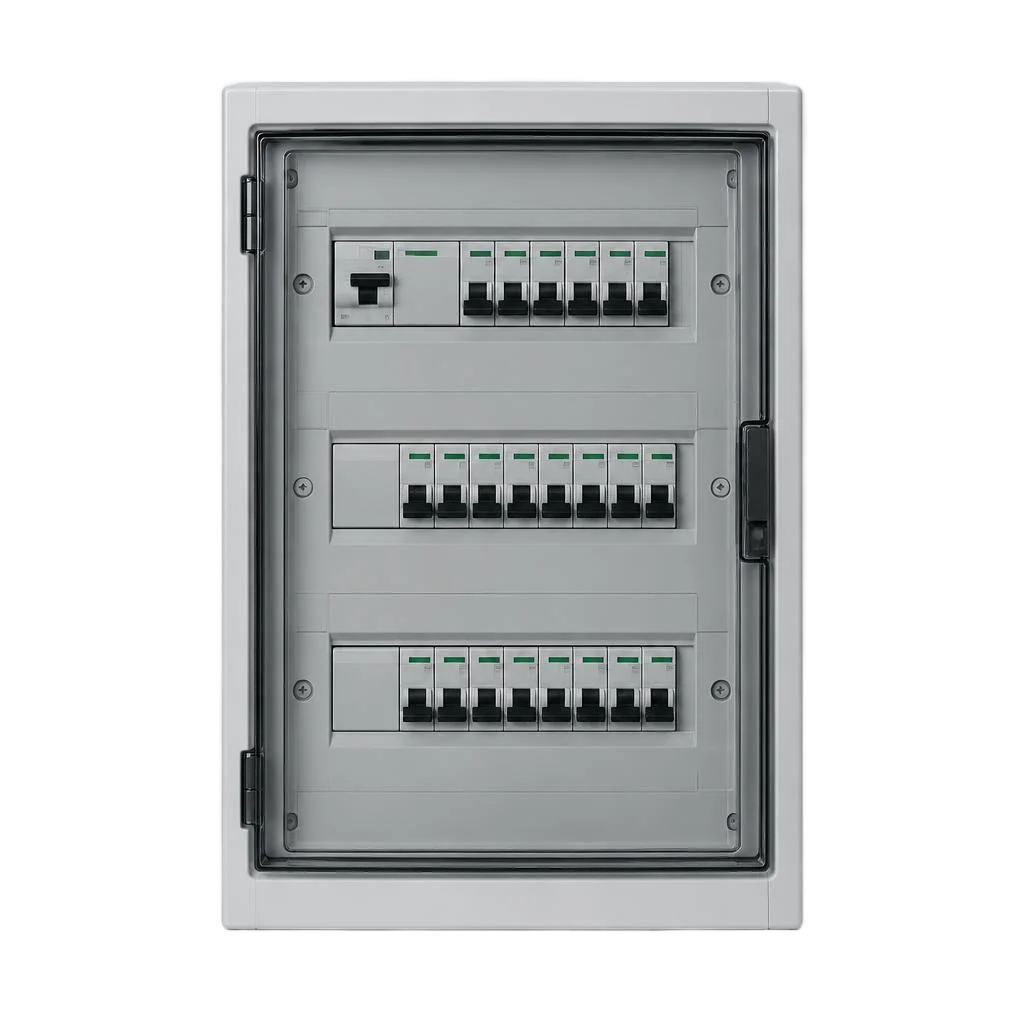
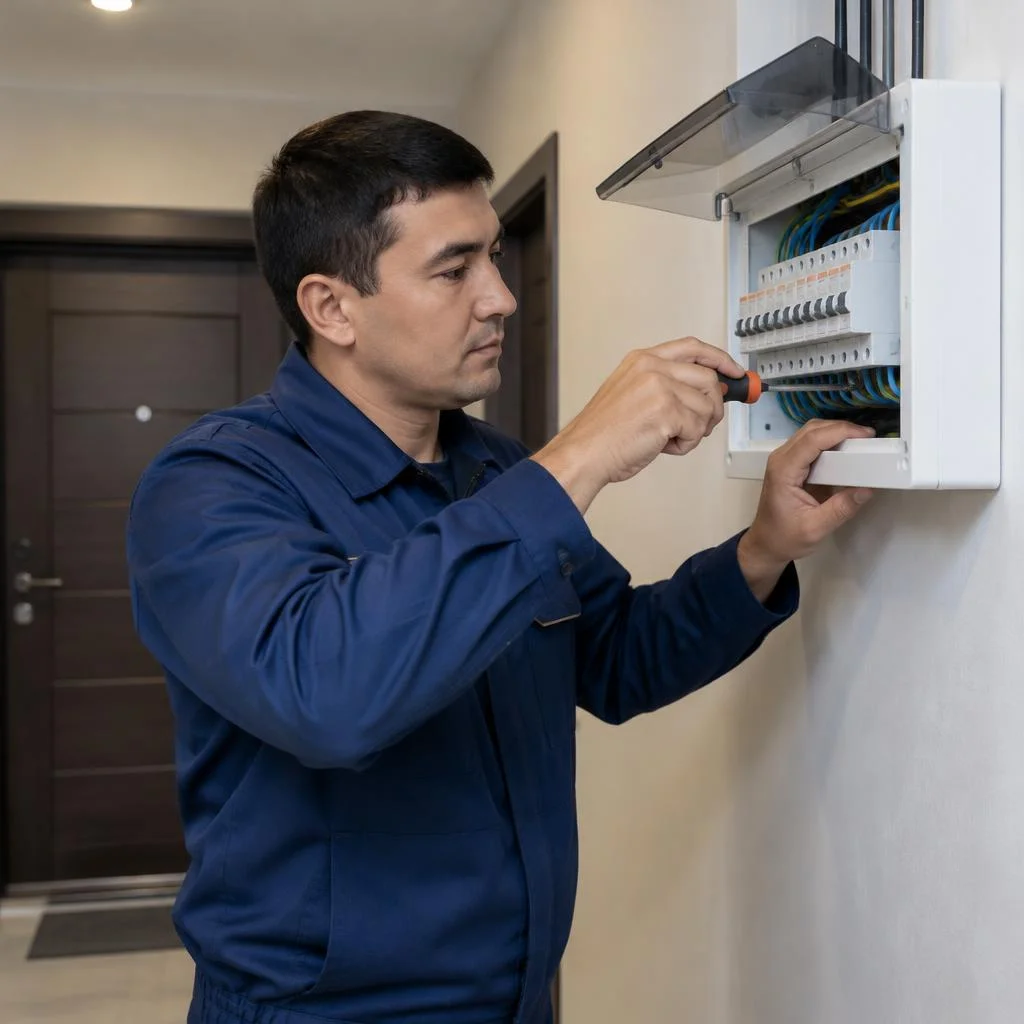
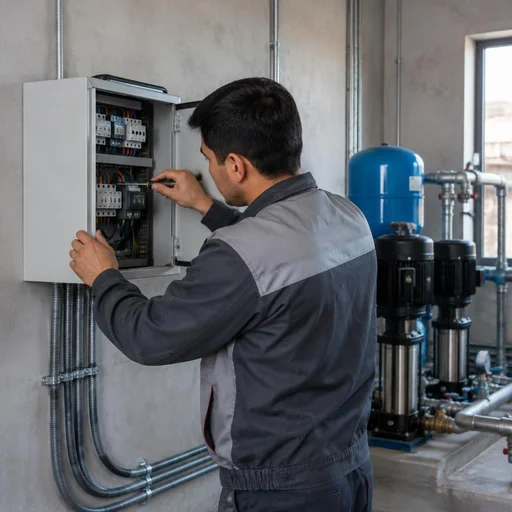
An electrical panel is the "brain" of a property's electrical network: the incoming supply, metering, distribution and protection all converge here. The type of panel is determined by its purpose — distribution, metering, lighting, automation — and by the installation method: a surface-mounted enclosure or recessed installation in a niche.
Distribution, incoming and metering panels: what is the difference in their tasks
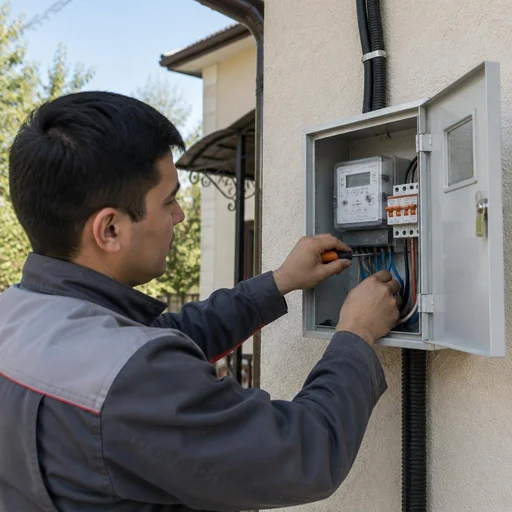
We install distribution panels as the main unit of an apartment, incoming panels at the point of entry to the property, and metering panels under the electricity meter. A distribution panel in a Tashkent apartment with an electric stove carries 8–12 group circuits: lighting, room sockets, kitchen, bathroom, air conditioners, washing machine. The incoming panel receives the cable from the riser or from the supply to a private house and holds an incoming circuit breaker rated 40–63 A, a voltage relay and, in a three-phase network, a contactor. The metering panel is assembled separately for the electricity meter: single-phase in an apartment or three-phase in a private house, with a sealable cover for the inspector's access. If a house has only one panel "for everything", a voltage surge will burn out both the metering and the circuits — separating the units extends the service life of the equipment.
Lighting, automation and RCD panels: what tasks they are assembled for
- Lighting panel: assembled for lighting groups — separate circuits for rooms, kitchen, bathroom, hallway and outdoor lighting of a private house.
- Automation panel: controls loads via a contactor — boiler, pump, underfloor heating, ventilation, operates on a relay or timer signal.
- Panel with RCD: protects circuits from current leakage, installed on socket groups, wet areas and the property's incoming supply.
- Panel with RCBO: combines a circuit breaker and an RCD in a single module — saves space on the DIN rail in tight enclosures.
- Metering panel with RCD: a rare assembly where the incoming protection and the electricity meter are in the same enclosure with a sealable section.
Surface-mounted or recessed: how to choose the installation type
| Installation type | Where it is used | What it includes | Limitations |
|---|---|---|---|
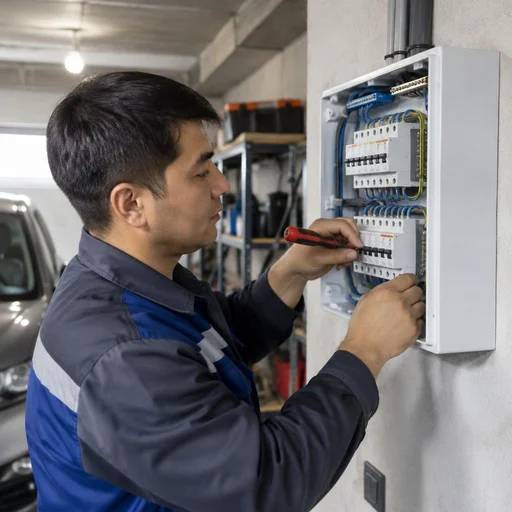
| Surface-mounted | panel buildings, private structures, garages | wall mounting, cable entry, connection | protrudes 10–15 cm from the wall |
| Recessed (in a niche) | new buildings, partitions, drywall | chasing, fitting into the niche, flush mounting | not allowed in load-bearing walls |
| On a DIN rail (inside) | any panel enclosure | assembly of modules, marking of groups | requires space for the rail |
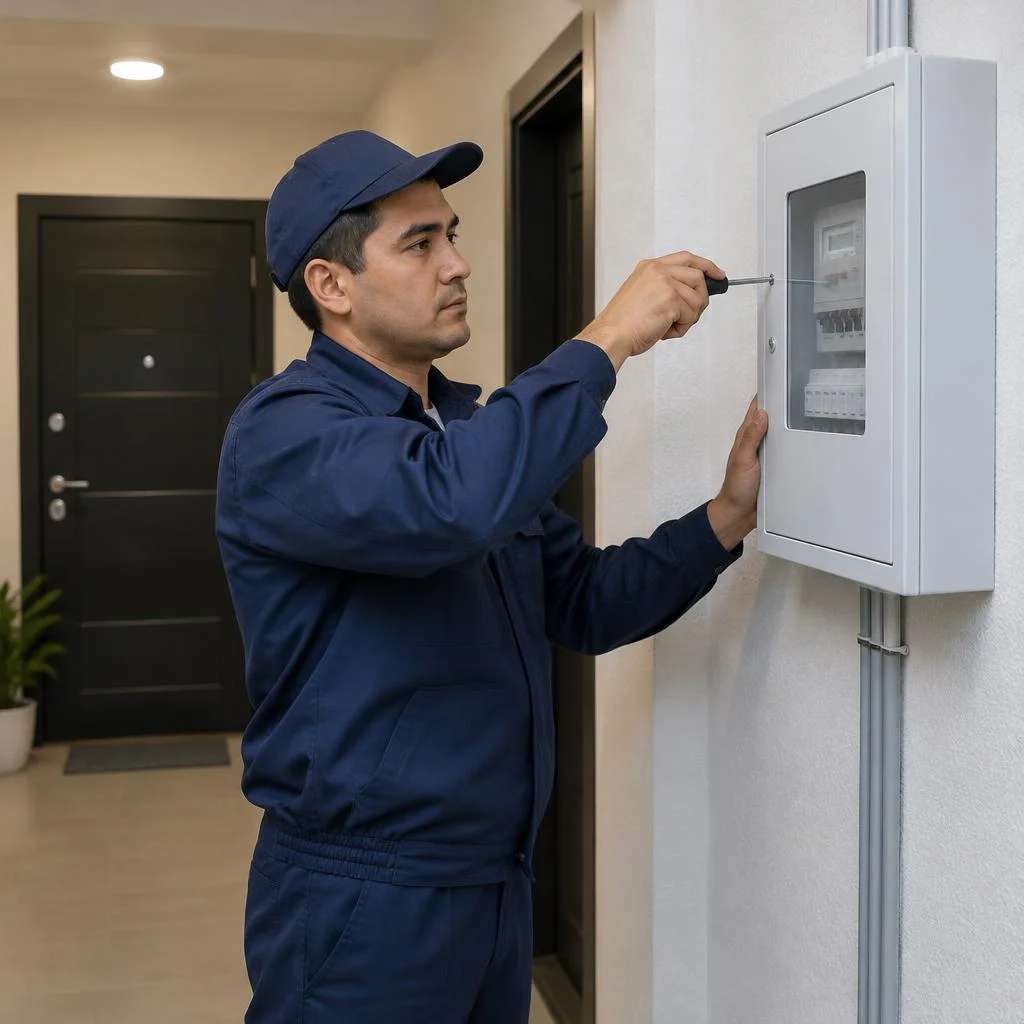
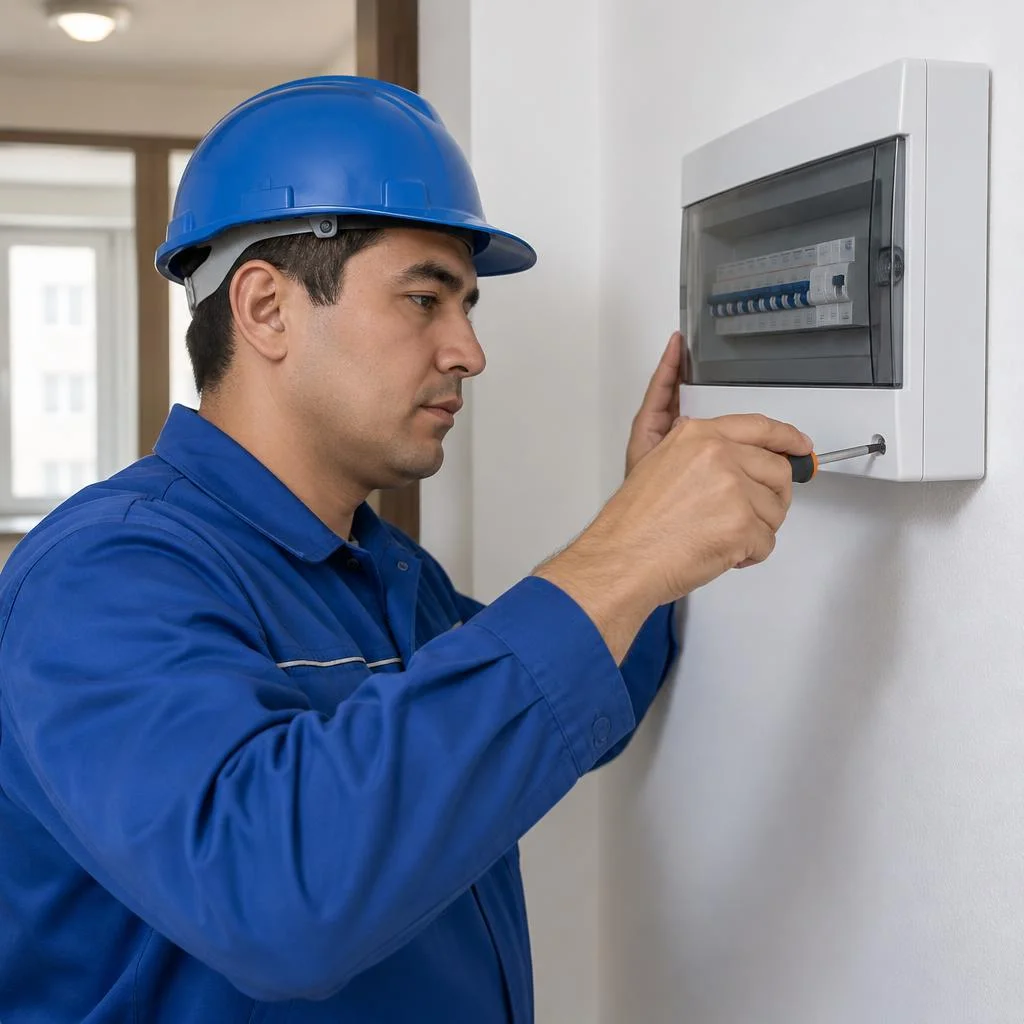
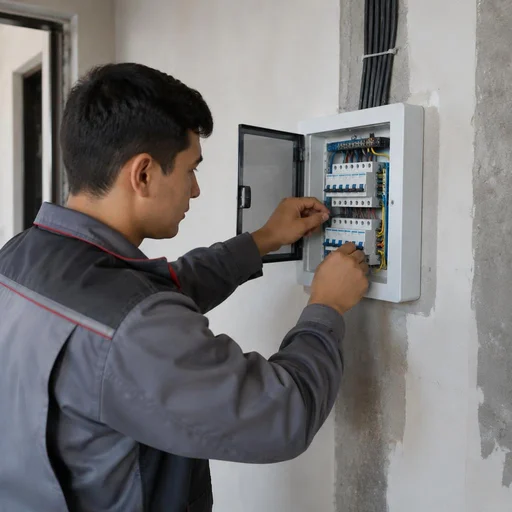
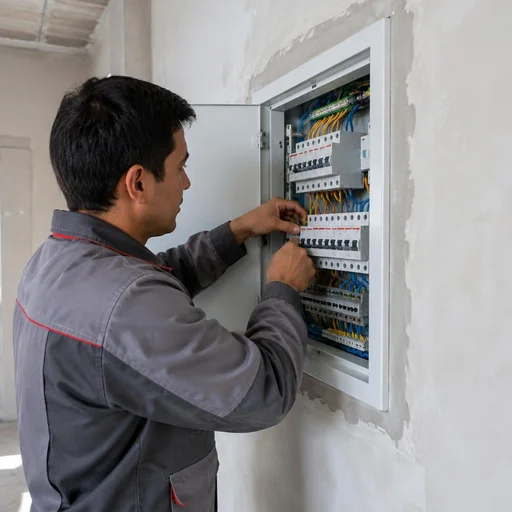
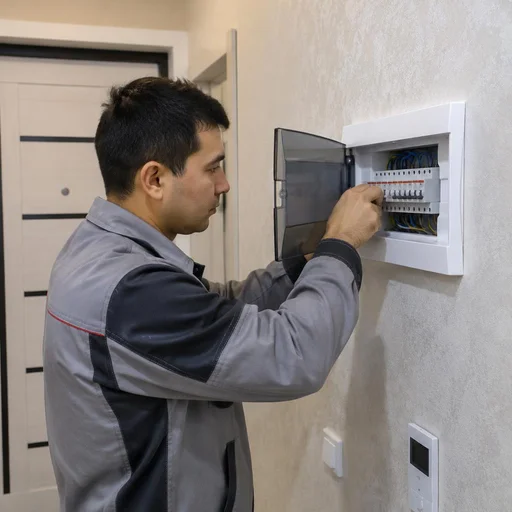
Installing an electrical panel in a surface-mounted enclosure takes less time than assembly in a niche: no chasing or wall patching is needed. In panel buildings, load-bearing walls must not be chased — only partitions or drywall are chosen for a recessed panel, and in Khrushchev-era buildings with thin walls a surface-mounted enclosure is more often installed. Electrical panel installation in Tashkent is a task where the installation type determines both the scope of work and the final estimate: the surface-mounted option is cheaper to install, the recessed one looks neater in the interior. Clients often phrase the request as: electrical panel installation Tashkent — and based on this wording the technician immediately clarifies whether it concerns an apartment, a private house or a garage, because both the enclosure and the set of modules depend on the property.
What electrical panel installation includes: work stages and DIN-rail assembly
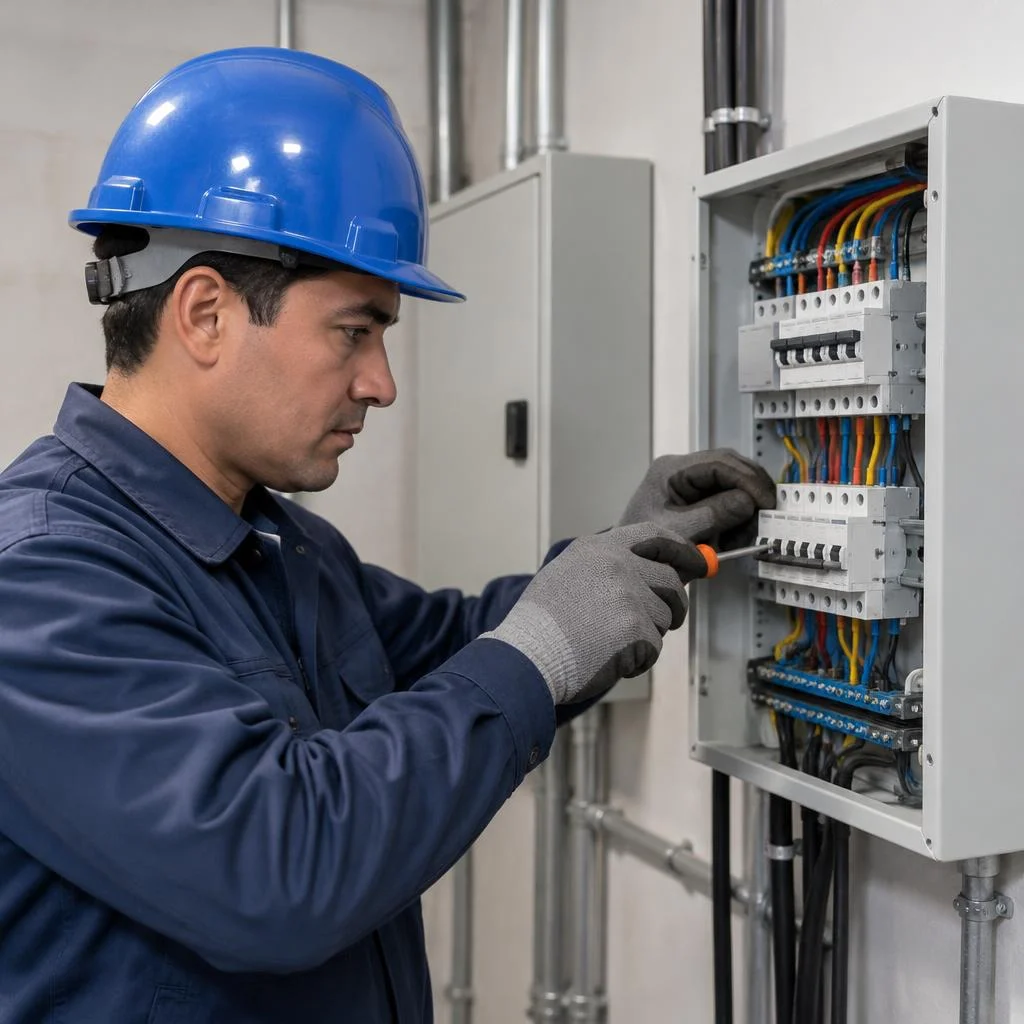
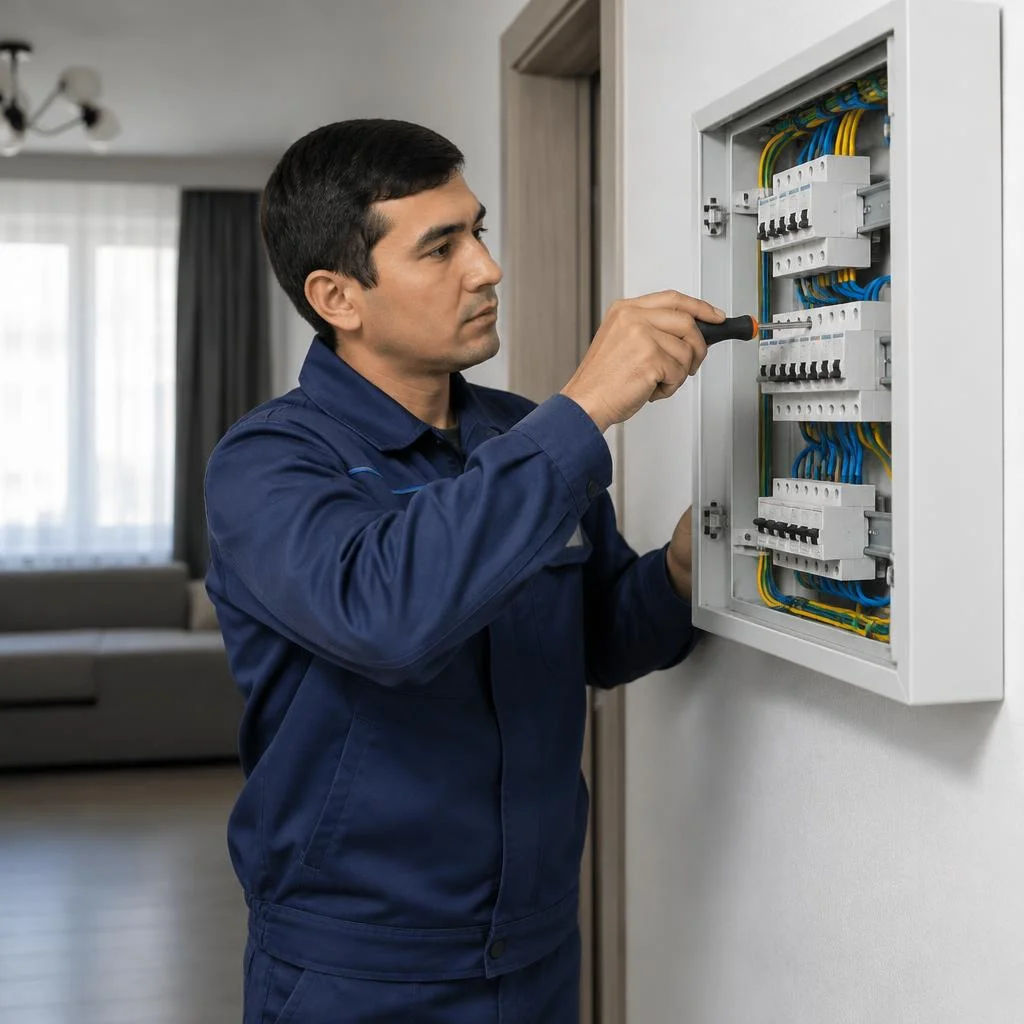
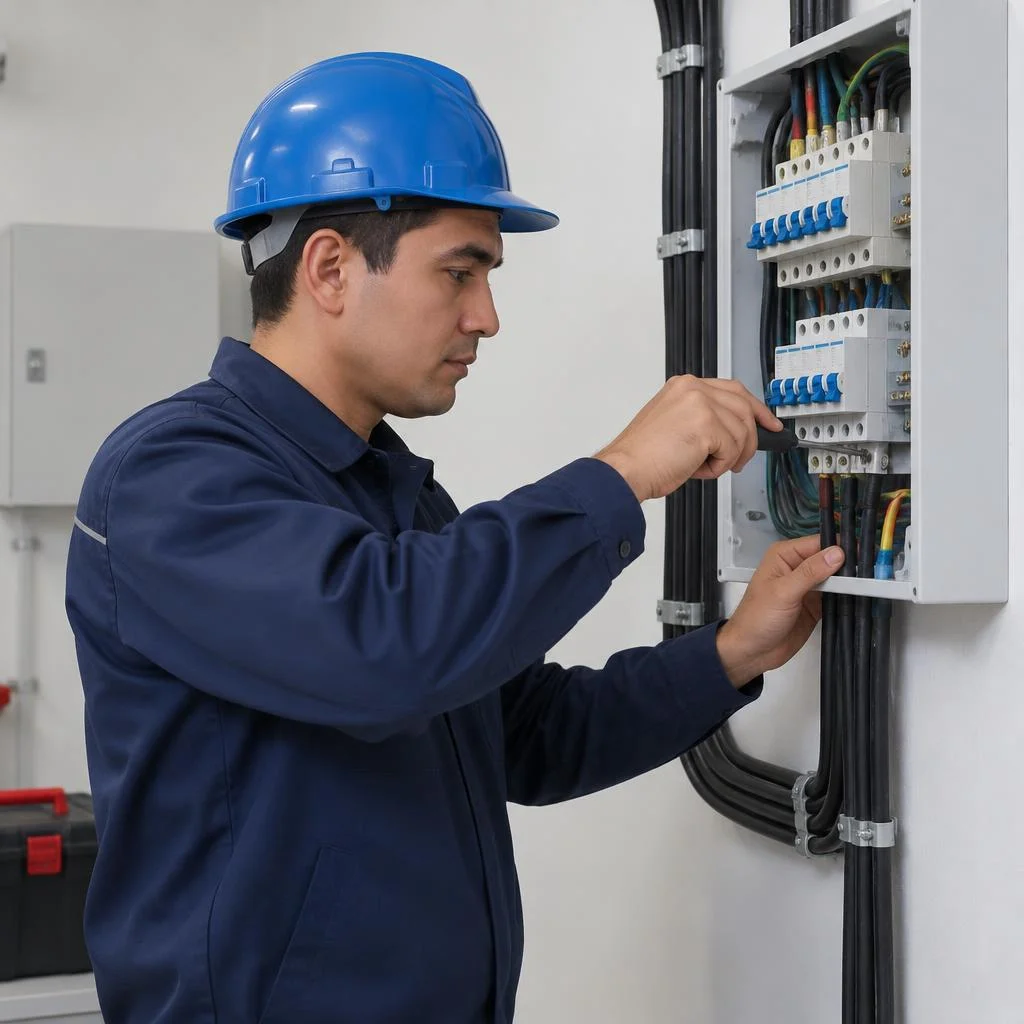
Electrical panel installation is not "hanging a box on the wall," but a sequence of operations: marking the route, wall chasing, mounting the enclosure, DIN-rail assembly, connection and testing under load. Below is what each stage looks like from the inside, with standards and typical mistakes.
Preparation: marking, wall chasing and routing the incoming cable
Eco-Service starts with marking the route and chasing for the incoming cable — the cross-section is selected for the total load of the property. For an apartment with an electric stove and boiler, the incoming cable is usually 6–10 mm² copper; for a private house with a three-phase connection — 4–6 mm² per phase. We chase for the cable to a depth of 25–30 mm in load-bearing walls, vertically only; horizontal runs go along the ceiling in corrugated conduit or cable trunking. Uzbekistan standards (O'zDSt 2754 and the current edition of the PUE) require a separate PE protective conductor along the entire route. Clients often search for "electrical panel installation and connection price" — and land here, because the final estimate is built at this stage: the length of chasing, wall material and number of circuits determine the labor costs. In brick the work goes faster than in reinforced monolithic concrete. Skimping on the incoming cable cross-section is the main cause of terminal heating and neutral burnout after 1–2 seasons.
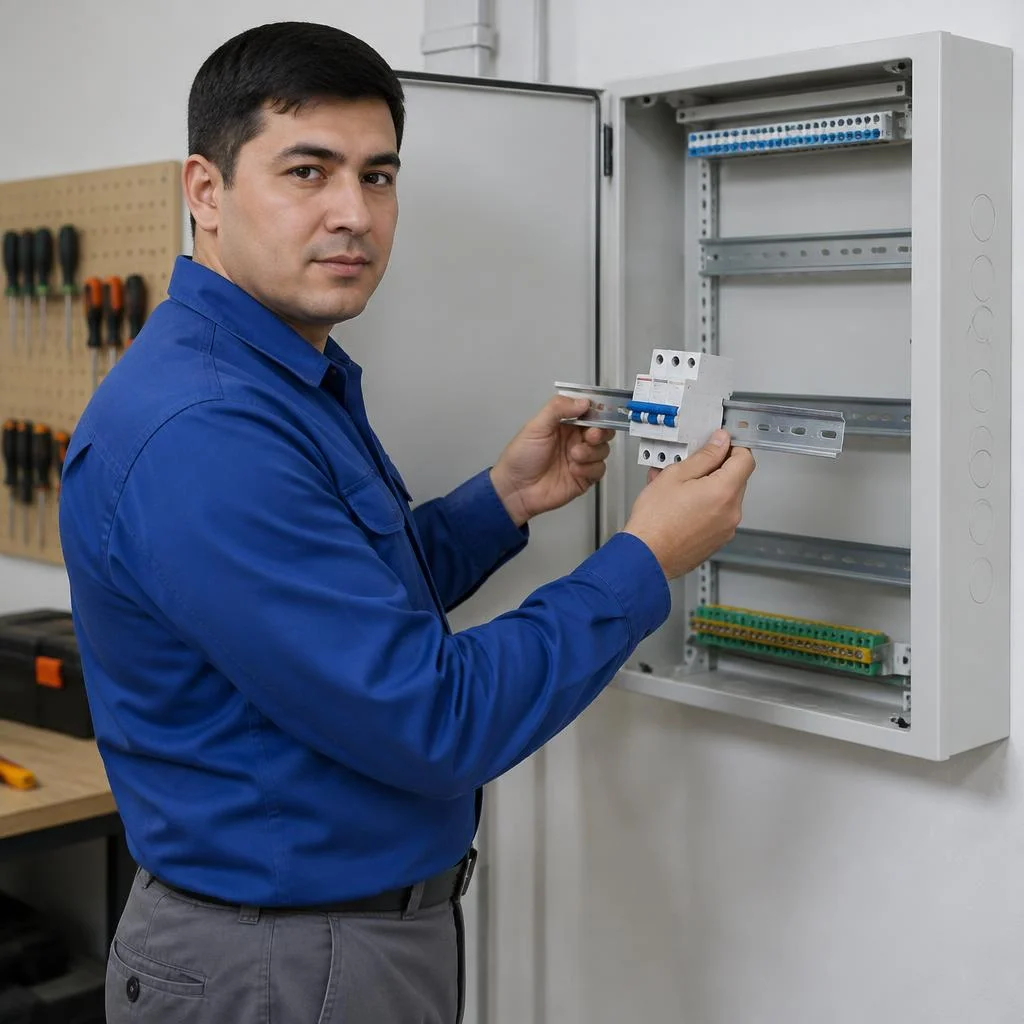
Panel assembly on DIN rail: order of modules
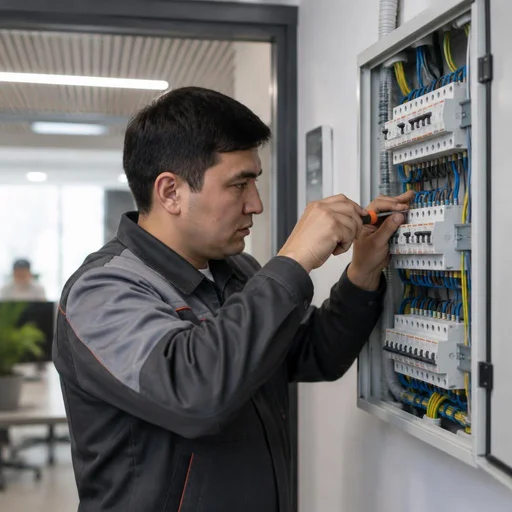
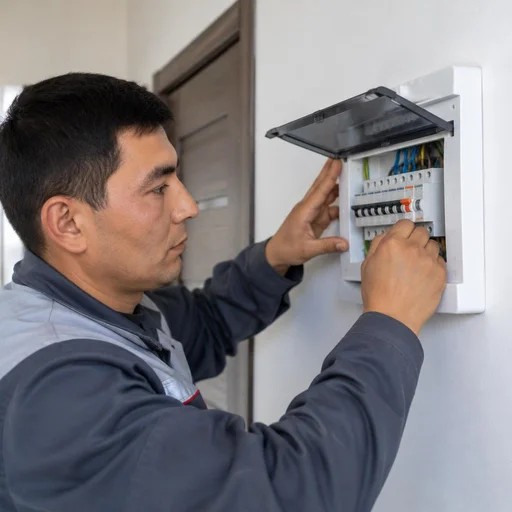
- Main circuit breaker: installed first on the left, rated one step above the sum of the branch breakers, with headroom for the property's peak load.
- Voltage relay: protects appliances from grid surges, relevant for old feeders and the private sector with voltage drops.
- RCD or RCBO: for wet areas, kitchen and socket circuits, 30 mA leakage for personal protection.
- Branch circuit breakers: by line — lighting 10 A, sockets 16 A, stove and boiler 25–32 A, each on its own module.
- Terminal blocks: for neutral and PE, so you don't cram 5–6 wires onto a single breaker screw.
- Labeling: tags on each circuit indicating the room and purpose of the line.
Connecting breakers, RCDs and the earthing bus
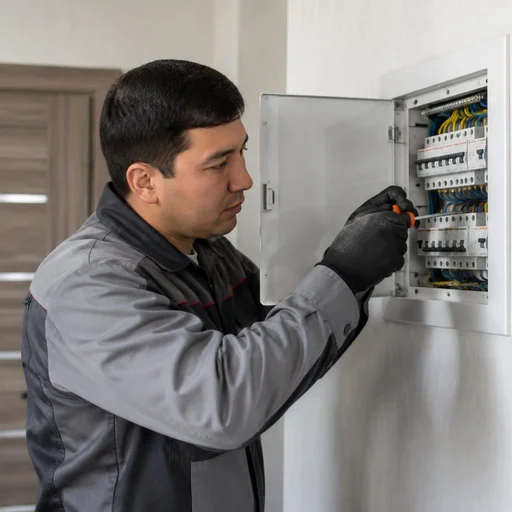
Eco-Service connects the breakers, installs RCDs and RCBOs, and runs the earthing bus with a separate conductor to the panel enclosure. We strip the incoming cable by 12–15 mm, crimp the cores with ferrules, the terminal tightening torque is 2–2.5 N·m, and re-tightening is mandatory a day after the first load. We install an RCBO on lines with concealed wiring and wet areas: it catches both leakage and overload, whereas a "breaker plus RCD" combo takes up two modules. The earthing bus is connected to the building's main earthing terminal with a conductor no thinner than the phase conductor; in Tashkent high-rises — via the floor panel. Earthing must not be "landed" on the neutral or a heating pipe: if the neutral breaks, phase voltage appears on the enclosure, and an RCD won't save you — it only trips on contact, and until then voltage will be present on all metal parts.
Flush mounting and relocating the electrical panel: when they're needed
Flush mounting is done during "finish-ready" renovation, and relocating the electrical panel — when the panel interferes with the layout or sits in a damp place. For a flush mount, chase foam block or drywall to a depth of 100–120 mm for a surface-mount enclosure of 12–24 modules; in panel buildings the load-bearing walls are left alone — a surface-mount option is used. Relocating the electrical panel to another room requires a single continuous length of incoming cable from the floor panel or a terminal block in a place accessible for inspection. Eco-Service performs electrical panel relocation to another room while preserving the circuits and re-labeling. Electrical panel installation in Tashkent also means working in dense built-up areas: in old housing stock the route is often run along the facade rather than inside the walls. Extending the incoming cable with a twist when relocating is not allowed — only a single continuous length or a terminal block, otherwise the connection heats up under load and becomes a point of failure.
Installation of electrical panels in a new building, private house and panel high-rise
The requirements for the panel depend on the property: in a new building, a flush-mounted panel is more often installed, in a private house three-phase metering is added, and in a panel high-rise a surface-mounted enclosure is used.
New building: install the panel before finishing
In a new building, Eco-Service mounts the panel in a niche before plastering — this way the enclosure sits flush and does not spoil the finish. The work is carried out in coordination with the developer's electricians: the markings for the niche are agreed with the apartment plan, the incoming cable is run from the floor riser, and the chasing for the cable is done on concrete and aerated block before the floor screed. No permit is required for installation: a panel inside an apartment is not a redevelopment, but relocating the floor panel or interfering with the building's shared lines must be agreed with the management company. Installing electrical panels in Tashkent at the rough finishing stage is cheaper: there is no need to dismantle finished plaster and re-lay tiles. If the panel is installed after the screed, you will have to chase the finished wall — dust and the risk of damaging fresh plaster.
Private house: three-phase input and voltage relay
In a private house, Eco-Service installs a three-phase meter and a voltage relay — in case of phase imbalance or a surge, the equipment switches off automatically. For a house of 15-20 kW, a 380 V input is used: the three phases are distributed into groups — the boiler and pump on one line, the kitchen and water heater on the second, lighting and sockets on the third, so that an imbalance does not trip everything at once. The voltage relay is installed after the main circuit breaker, and the trip threshold is set for the local grid: at 250-260 V on a phase, the power is cut within fractions of a second, and restoration occurs with a delay of 3-5 minutes. In the private sector of Tashkent, surges when lines are switched are the norm; a voltage relay is cheaper than replacing a burnt-out refrigerator or boiler.
Panel high-rise: surface-mounted panel without chasing load-bearing walls
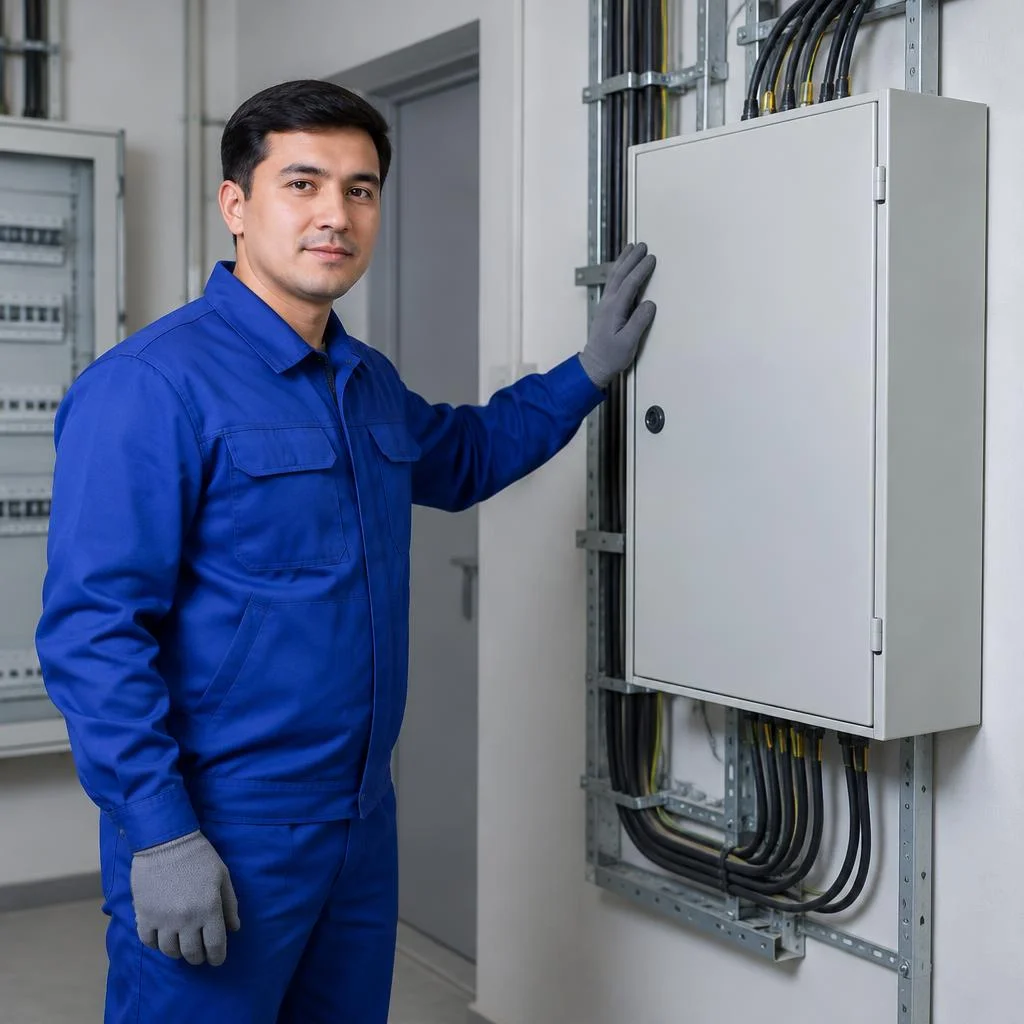
In a panel high-rise, Eco-Service installs a surface-mounted panel — we do not chase load-bearing walls, and the input is run through existing channels. The panel is reinforced and thin: a deep chase for a niche weakens the slab, so the enclosure is fixed with anchors on top of the wall in the hallway or on the stair landing, and the cable is run in a cable duct from the floor riser. For an apartment with a gas stove and air conditioner, 12-18 modules on a DIN rail are sufficient. In panel buildings, grounding is often absent as a loop — it is run to a separate conductor and checked before connecting the RCD.
Panel components: breakers, RCDs, meters and brands available in Uzbekistan
The contents of the panel determine how long it will last: breakers, RCDs, RCBOs, voltage relays and the meter are selected for the load and the budget. We break down exactly what to install and which brands can actually be bought in Uzbekistan.
Breakers, RCDs and RCBOs: what to install and why
Eco-Service installs breakers rated for the line, RCDs — for wet zones and the incoming supply, and RCBOs — where both protections need to be combined in a single module. Modular DIN-rail circuit breakers protect the line from overload and short circuit: a 16 A breaker goes on a socket group, 10 A on lighting, and a separate 32 A device on the hob. A 30 mA RCD goes on the bathroom, kitchen, washing machine and incoming supply, while a 100 mA fire-protection RCD covers the entire apartment. An RCBO takes one module instead of two and is convenient in tight panels, but when it trips it is harder to determine the cause — an RCD plus a breaker can be diagnosed faster, because you can immediately see which device tripped. In our practice, panels with RCDs and RCBOs in wet zones cut callouts for false tripping in half: separating the protections lets you find the problem line in a minute. Clients often search for установка электрощита цена — and the first thing they ask is how many modules will go toward protecting the groups.
Meter, voltage relay and contactor: metering and protection
- Electricity meter: a single-phase one is installed in apartments with a 220 V supply, a three-phase one — in private houses where a boiler, pump or workshop operates.
- Voltage relay: disconnects the line when surges exceed 250 V or voltage drops below 180 V, protecting appliances from burning out.
- Contactor: switches a powerful load on command from the voltage relay or a timer — water heater, boiler, pump.
- Space in the panel: the relay and contactor take up 2-3 modules and require a separate DIN rail next to the incoming breaker.
- Connection order: incoming cable, meter, voltage relay, contactor, group breakers.
Breaker brands in Uzbekistan: IEK, EKF, Schneider, ABB, Hager
| Brand | Segment | Where it is used | Availability in Uzbekistan |
|---|---|---|---|
| IEK | budget | apartments, country houses, lighting groups | Uzum Market, Texnomart, OLX.uz |
| EKF | mid-range | apartments, offices, socket groups | Uzum Market, Texnomart |
| Schneider Electric | premium | incoming supply, wet zones, critical lines | specialized suppliers |
| ABB | premium | incoming supply, automation, private houses | specialized suppliers |
| Hager | premium | incoming supply, commercial facilities | specialized suppliers |
On the incoming supply and in wet zones, saving on the brand is not justified: the difference in the price of a module is incomparable to the cost of replacing the wiring after a contact burns out. Eco-Service builds lighting and automation panels using devices from any of these brands — the lineup is selected according to the facility's load, and the price of the electrical panel is made up of the number of modules and the complexity of installation.
Terminal blocks and ground busbar: the little things that decide everything
Eco-Service installs terminal blocks for connections and a separate ground busbar — without them the panel loses protection and reliable contact. DIN-rail terminal blocks connect the incoming cable to the breakers and distribute neutral and phase conductors without soldering or twisting, while the ground busbar collects all PE protective conductors at a single point and connects it to the house's grounding loop. In our panels we mount the busbar on an insulating holder so that the PE does not touch the metal enclosure directly. A twist of copper conductors oxidizes within 2-3 years and heats up under load; a terminal block maintains contact for decades, and the cost of panel installation pays for itself through the absence of emergency callouts.
2-year warranty, service center in Tashkent and acceptance of work
After installation, the panel should not just "work" — it should be tested under load. The warranty and service center determine who to contact in case of a failure and how quickly it will be resolved.
2-year warranty: what it covers and what it doesn't
- Connections and terminal tightening: loosening of contacts on circuit breakers, RCDs and the grounding bus under normal operation is covered.
- Mounting and assembly: the 2-year warranty covers the seating of modules on the DIN rail and the panel enclosure in a niche or on a wall.
- Commissioning: testing of circuits under load, labeling and configuration of the voltage relay are included in the warranty obligations.
- Incoming cable: the section from the connection point to the main circuit breaker is the installer's area of responsibility.
- Not covered: voltage surges above the norm and independent replacement of modules — such cases are recorded during acceptance.
Acceptance: how to check the panel after installation
- Load by circuits: each line is switched on separately, the technician checks the heating of terminal blocks and voltage stability at the sockets.
- Labeling of circuit breakers: each module indicates its circuit — kitchen, lighting, room sockets; without labels, operating the panel turns into a guessing game.
- RCD test: the "Test" button on the residual current device trips instantly; if the delay is more than a second, the module is replaced before signing the acceptance report.
- Visual inspection: no signs of overheating on insulation, even seating of circuit breakers on the DIN rail, closed blanking plugs on free slots.
- Documents: the certificate of completed work listing the installed modules and the warranty card — these are used to file a claim in case of a failure.
Service center in Tashkent: in-person reception and on-site visits
Our own Eco-Service service center operates in Tashkent — reception is in person, and technician visits cover Chilanzar, Yunusabad, Mirzo-Ulugbek and other districts. Installation of electrical panels with warranty support means that on a repeat request the technician arrives with the same components that were originally installed — there is no need to search the market for a compatible module. Clients often phrase their request as the cost of installing an electrical panel — and from that wording the technician immediately understands the scope: the number of circuits, the type of enclosure, the presence of a voltage relay. Over its years of operation, the service has accumulated customer reviews for apartments in the Yashnabad and Sergeli districts, private houses in the Kibray direction, and office panels in the center. In my opinion, it is in-person reception that wins over remote consultations: the technician sees the panel as a whole, not from the client's words over the phone. If after installation the RCD tripped for no apparent reason — do not reset it again, but record the trip time and call a specialist: this way the cause is found in one visit instead of three.
Common mistakes when installing an electrical panel and how to avoid them
Most accidents in a panel are not factory defects but installation errors: undersized cross-section, twisted splices, missing grounding, and incorrect breaker ratings. Let's go through the anti-patterns we most often find during diagnostics.
Undersized cross-section and twisted splices: why the panel overheats
An undersized cross-section of the incoming cable and twisted splices instead of terminals are the two main causes of heating and burning of contacts in a panel. When a boiler, washing machine, and air conditioner are all hung on a line with 2.5 mm² wire at the same time, the total current exceeds the permissible value for copper by almost double, and the insulation melts long before the breaker trips. A twisted splice instead of terminal blocks adds contact resistance on top of this: under load, the contact point heats up to 90-120 °C, and in dense developments with old risers, such a junction fails within the very first week. In search, clients often type exactly this: electrical panel installation in Tashkent — and land on a breakdown of the mistakes we find during diagnostics. A copper twist under load oxidizes faster than an aluminum one — contact resistance grows, and the connection point becomes a fire hazard. Before assembling the panel, ask to measure the actual load of each group with clamp meters — the cross-section is selected based on current, not on the thickness of the old cable in the wall.
Missing grounding and RCD: why it's dangerous
Without grounding and an RCD, the body of a household appliance, when insulation breaks down, becomes live — a person receives an electric shock upon touching it. In panel buildings of Tashkent development, the grounding loop is often absent as a category: the entrance panels have only neutral and phase, and the third wire in the outlet is simply not connected. If, at the same time, the washing machine or boiler is connected without an RCD, a leakage current of 30 mA does not disconnect the line, and the body remains live until the moment of contact. An RCD without grounding trips, but later and not always — the grounding loop and the RCD work as a pair, not instead of each other. When installing a grounding bus in an apartment without a building-wide loop, we run a separate conductor to the floor panel or organize a potential equalization system — this is cheaper than replacing burnt-out appliances after a breakdown.
Incorrect breaker ratings and "bugs"
- Overrated rating: a 25 A circuit breaker is installed on a 1.5 mm² lighting line — the wire melts before the protection trips, because the rating is selected for the appliance's power, not for the cable's cross-section.
- A "bug" instead of a module: a homemade jumper made of wire holds any current, disables the protection completely, and turns voltage surges into a fire in the wiring behind the wall.
- Replacing a device without recalculating the line: when connecting a new air conditioner or boiler, the breaker is left as before, even though the load on the group has doubled and requires a larger cross-section.
- Ignoring a voltage relay: without it, peak surges up to 260-280 V knock out modules and destroy electronics — the relay disconnects the line before the equipment burns out.
Conclusion
We've gathered the main things worth keeping in mind before ordering work: how the panel type, module order, cable cross-section, and protection are connected. Below are brief conclusions that help you make a decision without unnecessary rework.
Key takeaways
- Panel type for the task: distribution, metering, lighting, automation, or with an RCD — the enclosure is chosen after calculating the load, not by the size of the niche.
- Assembly order on the DIN rail: incoming, voltage relay, RCD, then group breakers with line markings — this way diagnostics takes minutes.
- Cross-section and terminals matter more than the enclosure: the incoming cable for the total current and the tightening of terminal connections affect heating more than the panel brand.
- Grounding and protection go as a pair: a grounding bus without residual current protection doesn't catch leakage, and protection without grounding trips with a delay upon touching the body.
- Acceptance under load: checking voltage drop and breaker heating after an hour of operation confirms installation quality better than any promises.