

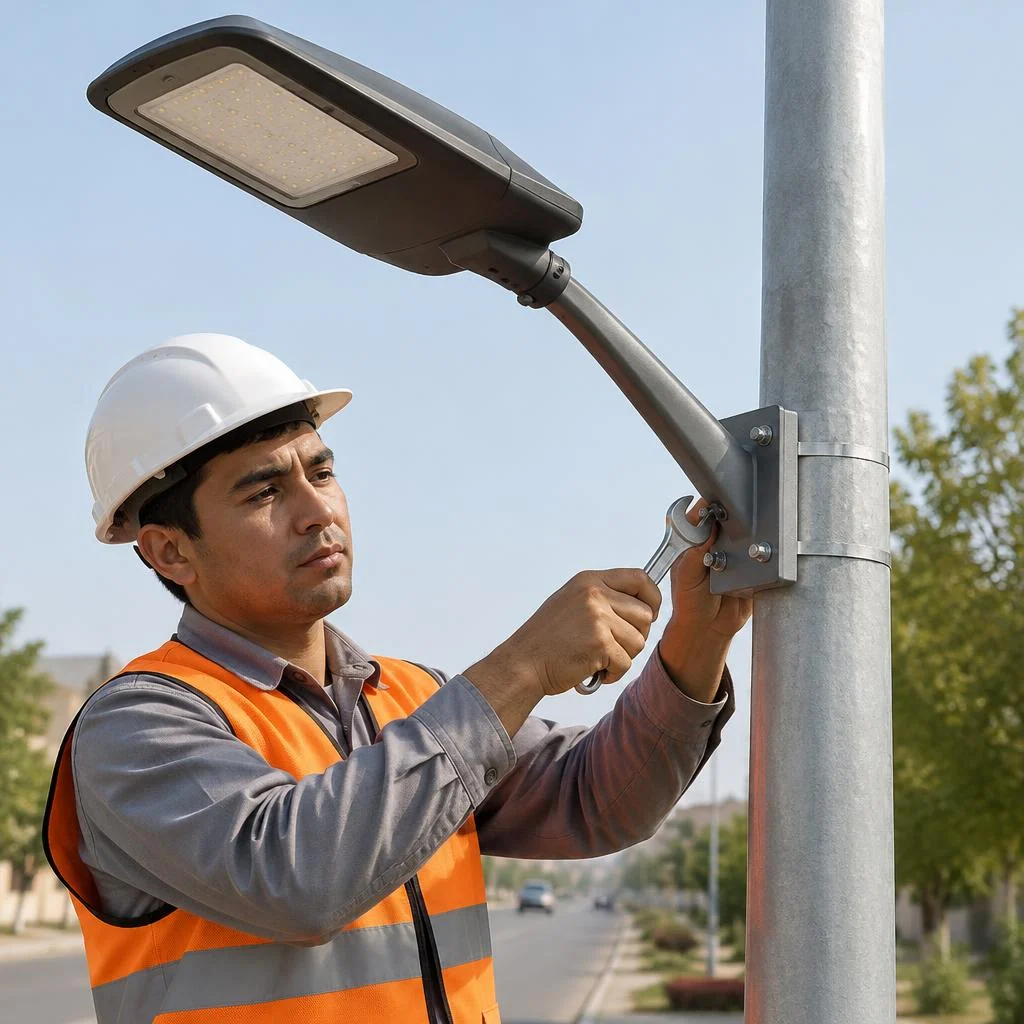








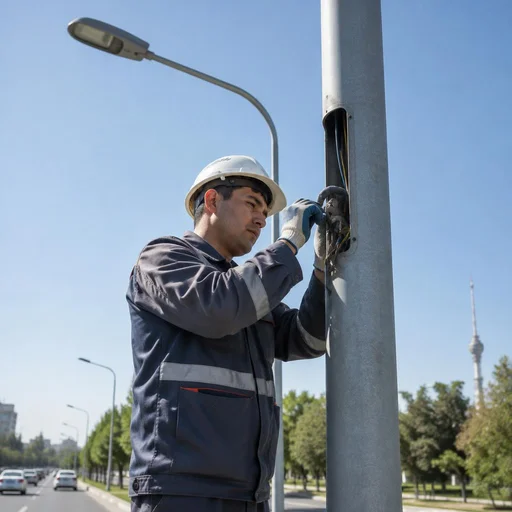
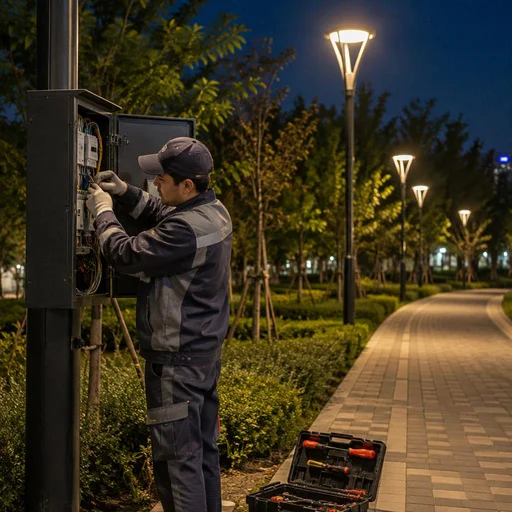
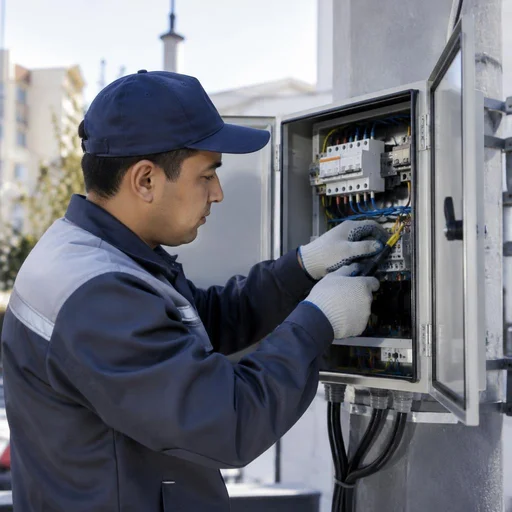

What outdoor lighting installation includes: the full cycle of work
Outdoor lighting installation is not "hanging a lantern," but an engineering chain of eight to ten stages, where skipping any link breaks the entire network. Let's break down exactly what is done on site — from route marking to commissioning.
Marking the lighting route and calculating the network load
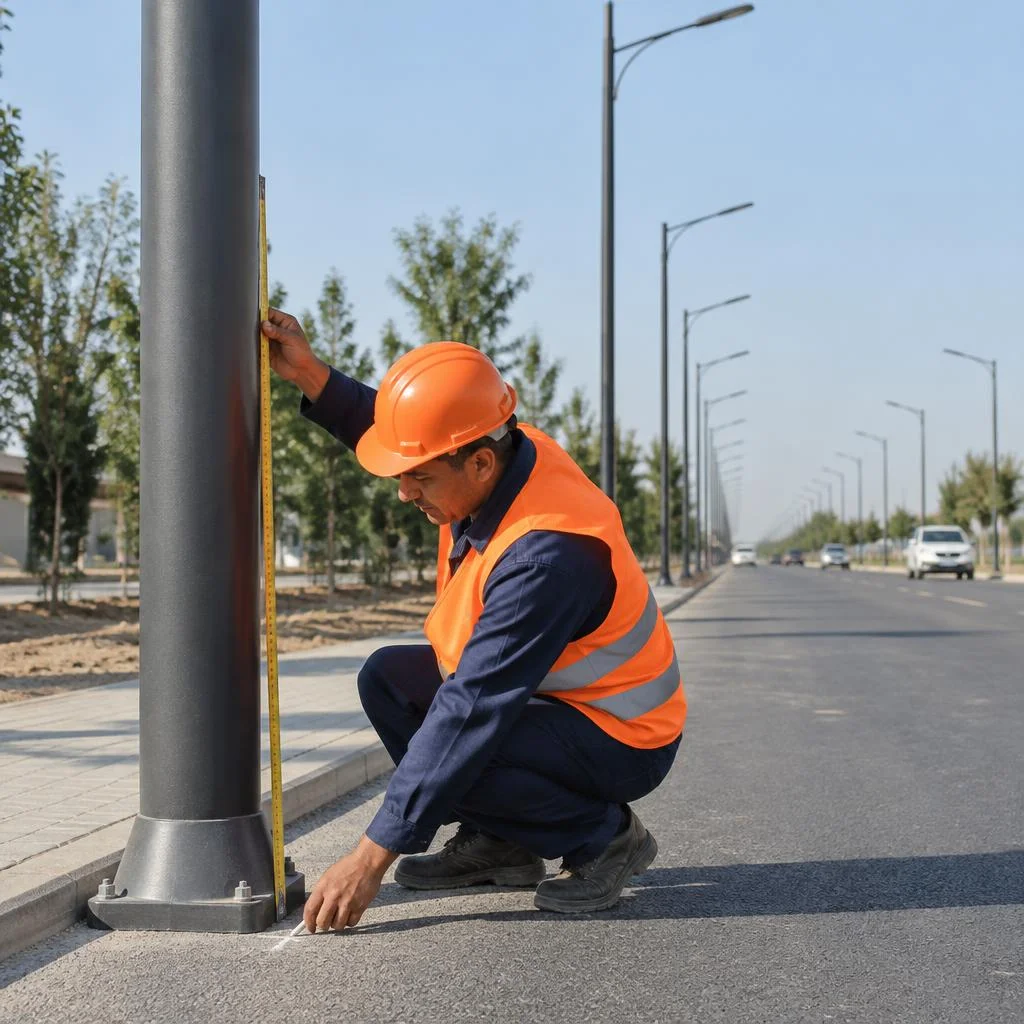
We begin work with marking the route and calculating the load of the lighting network — these are the first two stages, without which it is impossible to select the cable and circuit breakers. During marking, the installation points of the poles, the tie-in to existing networks, and terrain elevation changes are fixed; in the calculation, the wattage of each luminaire is summed up, multiplied by the simultaneity factor, and determines the cable cross-section and the rating of the protective circuit breaker. For a line of twenty cantilever luminaires at 100 W each with a route length of 400 meters, the working cross-section comes out to 4×16 mm² — if undersized, the cable heats up already under load. Clients often find us with the query outdoor lighting installation price — and land precisely on this stage: the estimate is put together after marking and calculation, not before them. An error in the load does not show up immediately, but after 6-12 months — through cable overheating and false tripping of circuit breakers; recalculating a finished line is more expensive than doing the marking correctly.
Pole installation: metal and concrete
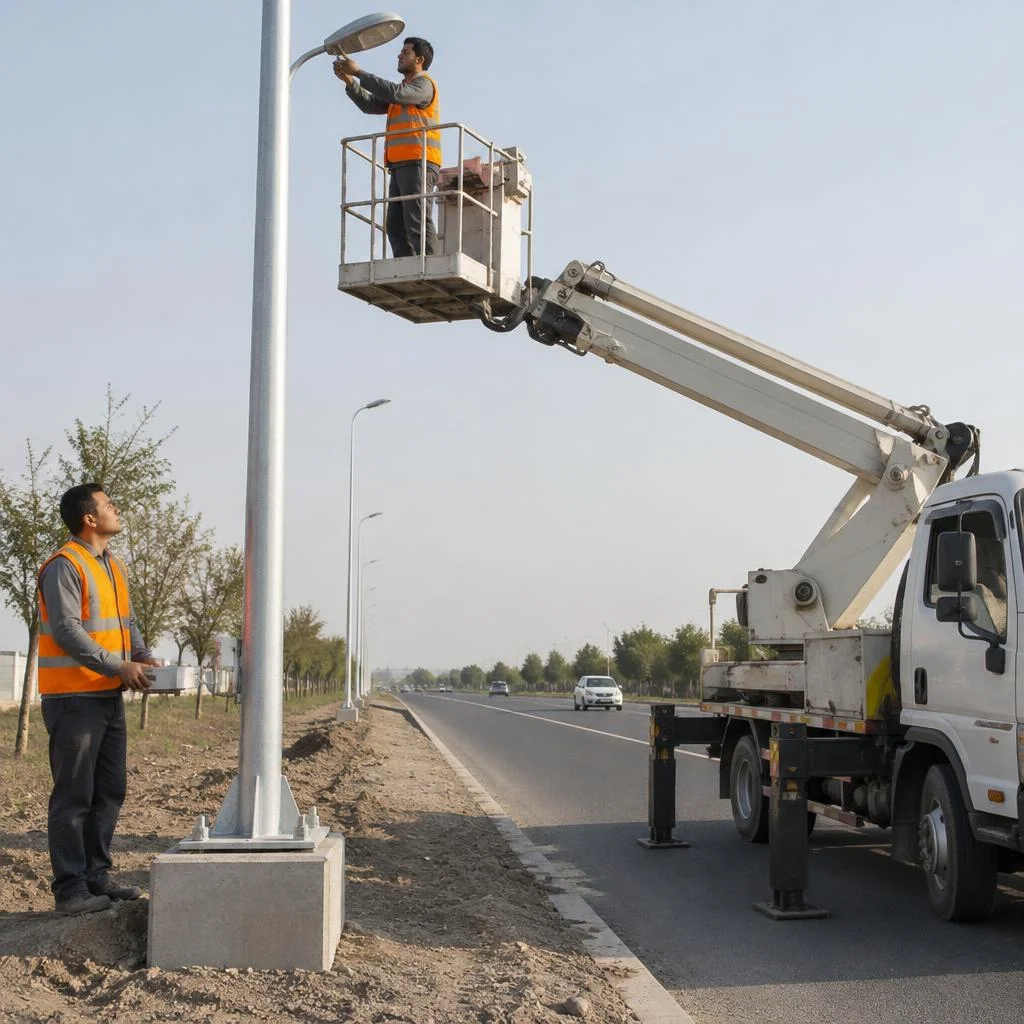
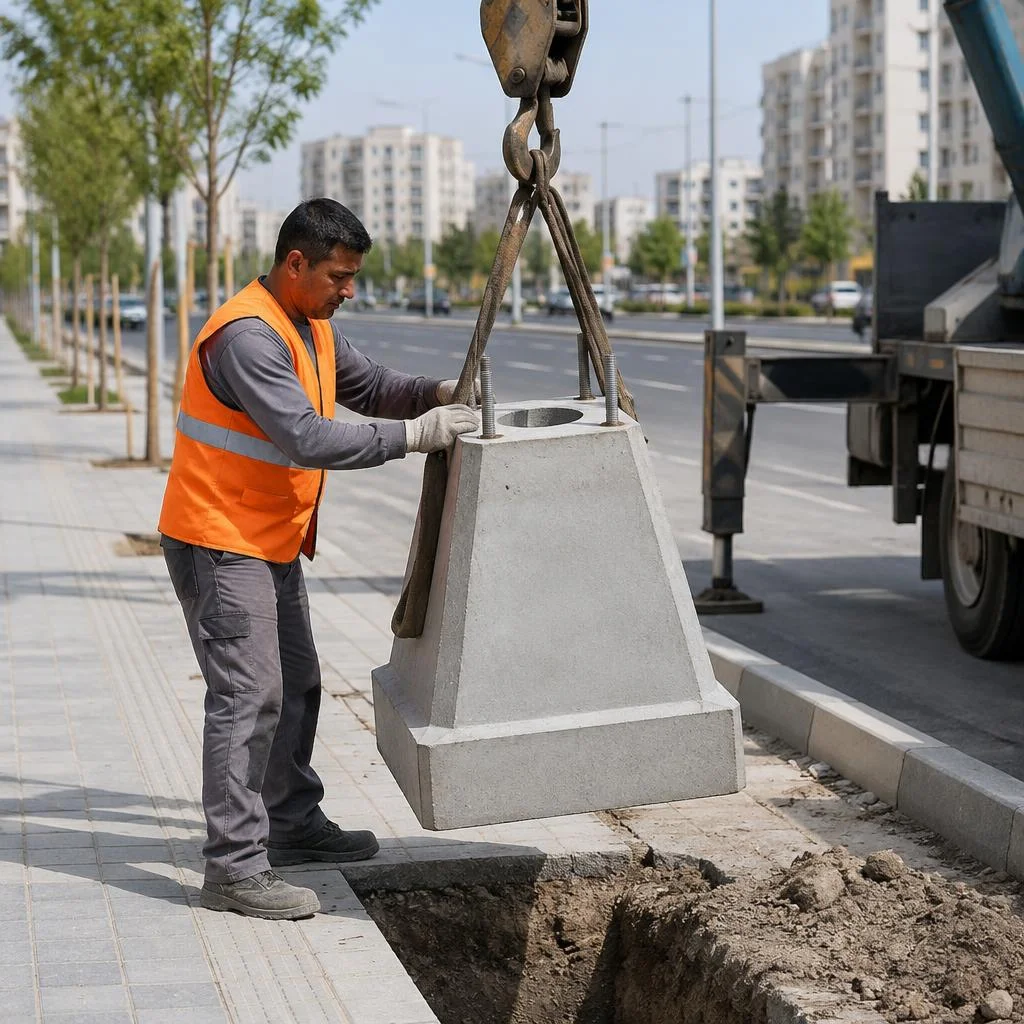
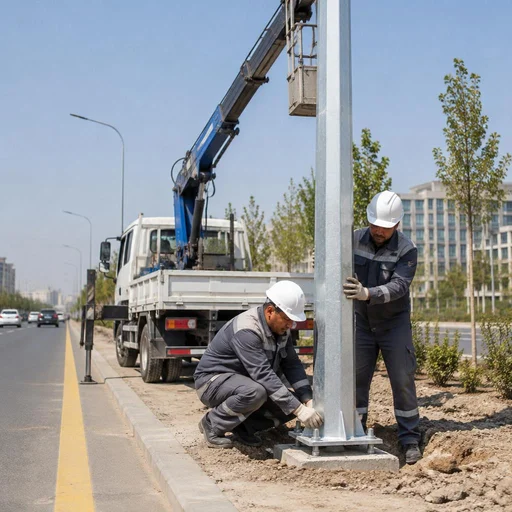
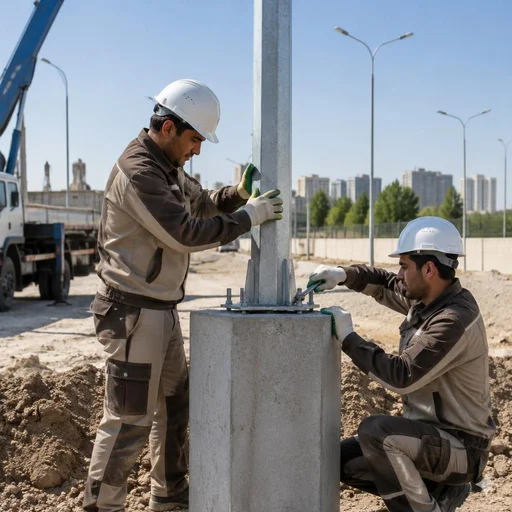
We install metal and concrete poles — the choice depends on the soil, wind load, and the purpose of the line: the approaches for a highway and a park are different. A metal pole 8-12 meters high is mounted on anchor bolts in a concrete foundation; it holds a cantilever luminaire and a bracket for the tension cable; a concrete pole with embedded studs is cheaper in material, but heavier to install and requires equipment for lifting. On Tashkent highways with heavy traffic, metal poles are used more often — they better withstand vibration from traffic flow and wind gusts up to 25 m/s. On the subsiding soils of the Uzbek capital, a concrete pole requires a reinforced base, otherwise after a season it develops a tilt; a metal pole with anchor fastening is more reliable in this case.
Cable laying: trench, overhead, facade
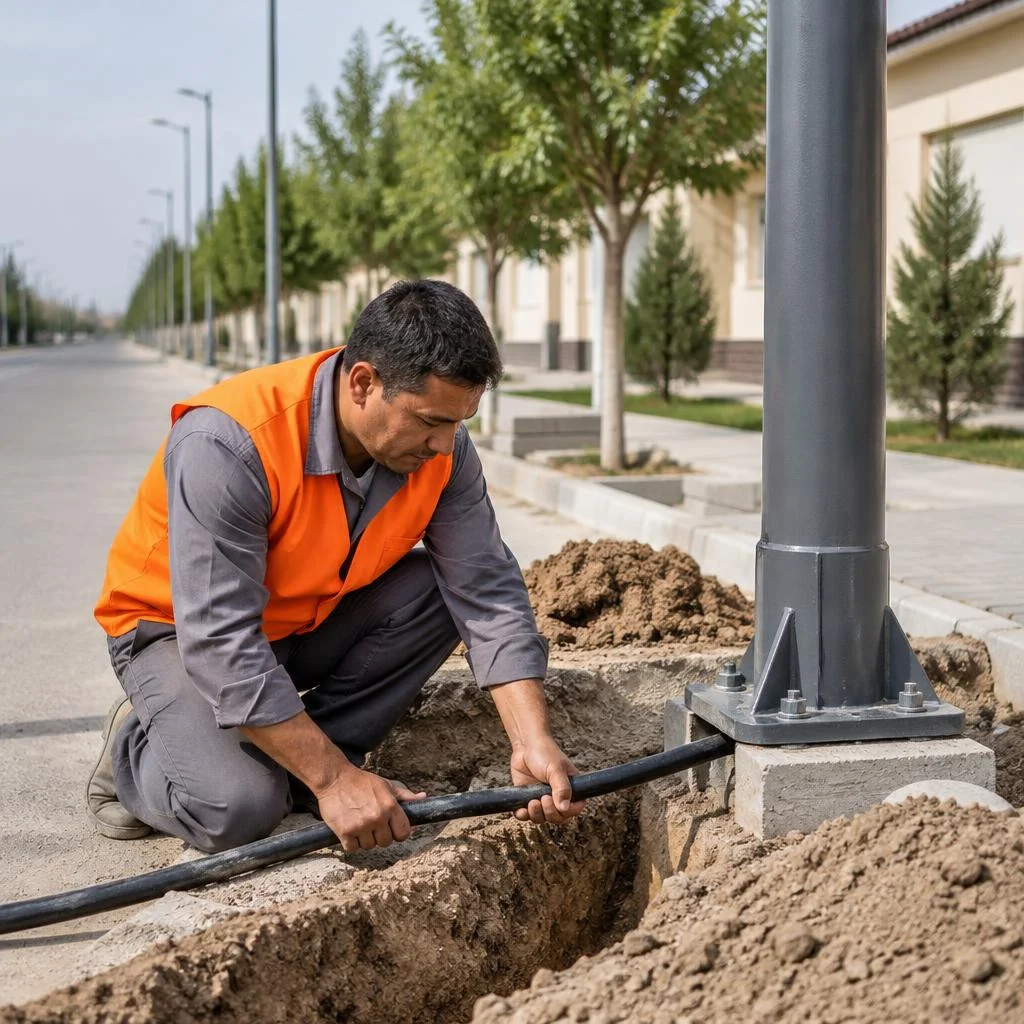
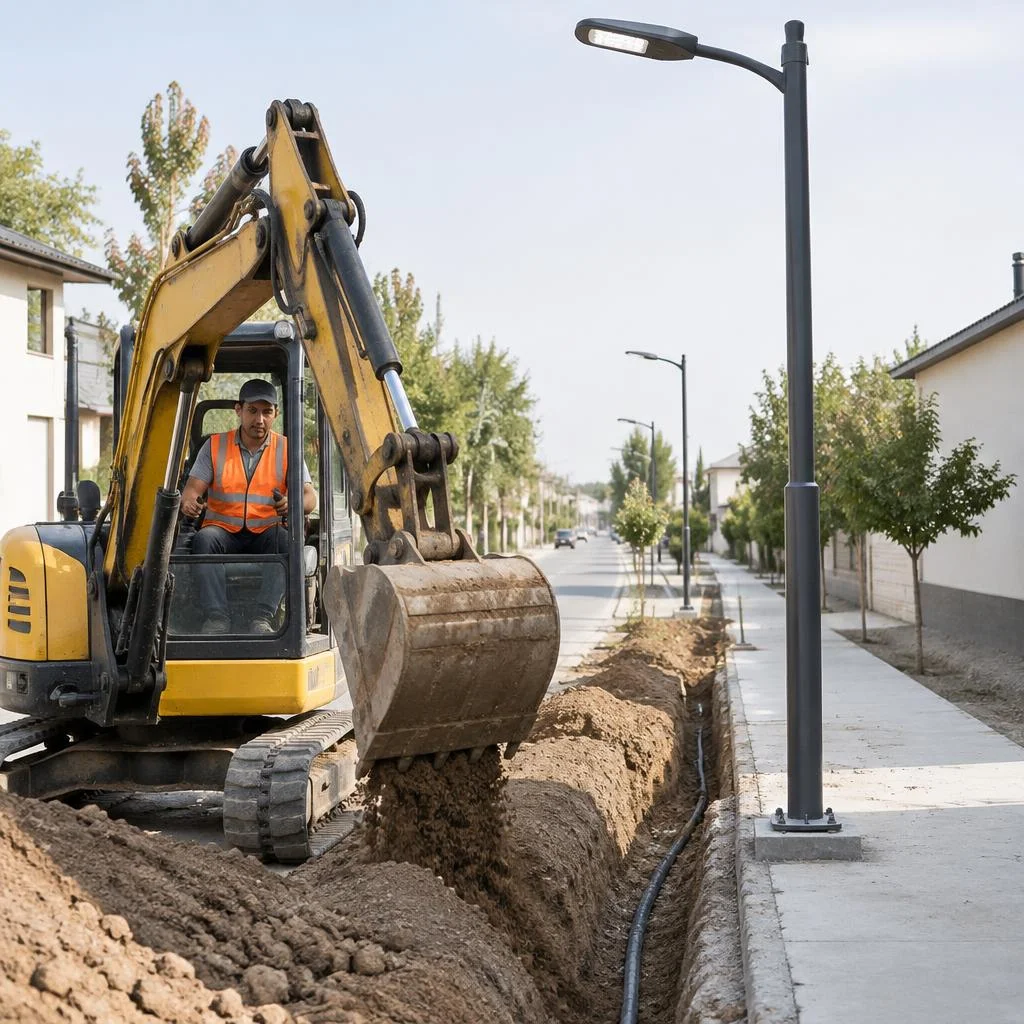
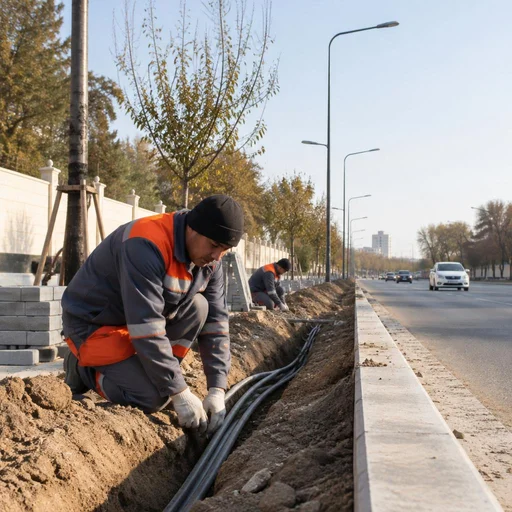
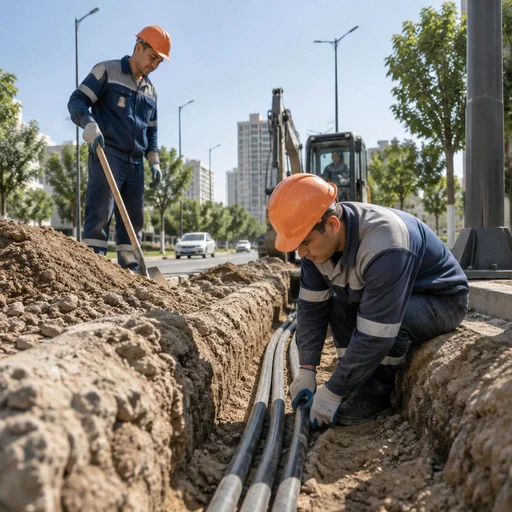
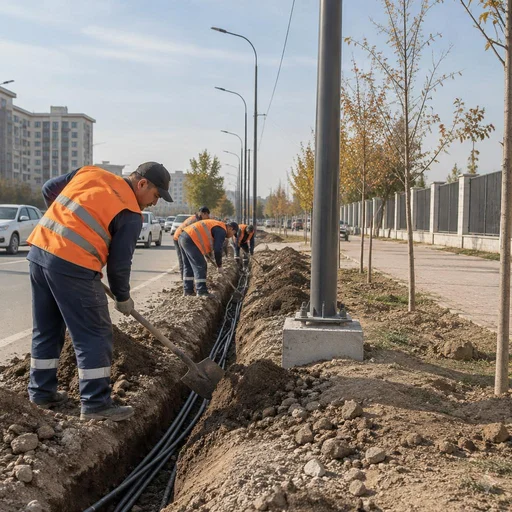
We lay cable in three ways — in a trench, overhead on a tension cable, and in corrugated conduit along the facade; the method is chosen based on the site, not the installer's habit. Digging the trench for the cable is done to a depth of 0.7 meters with a sand cushion, a warning tape is laid on top, then backfilling of the trench and restoration of the surface are performed; laying the cable overhead on a cable speeds up handover twofold, but is unacceptable over children's playgrounds and parking lots. Laying cable in corrugated conduit along the facade is used on courtyard lines and building accent lighting — where digging up dead asphalt is more expensive than fastening the corrugated conduit on clips. In search, clients often type outdoor luminaire installation — and land on this page, although what is discussed here is the underground and overhead part of the line, not the fixtures themselves. Overhead laying is cheaper in earthworks, but vulnerable to wind and icing; in a trench — more stable, but requires backfilling and surface restoration.
Assembling the panel, connecting luminaires and automation
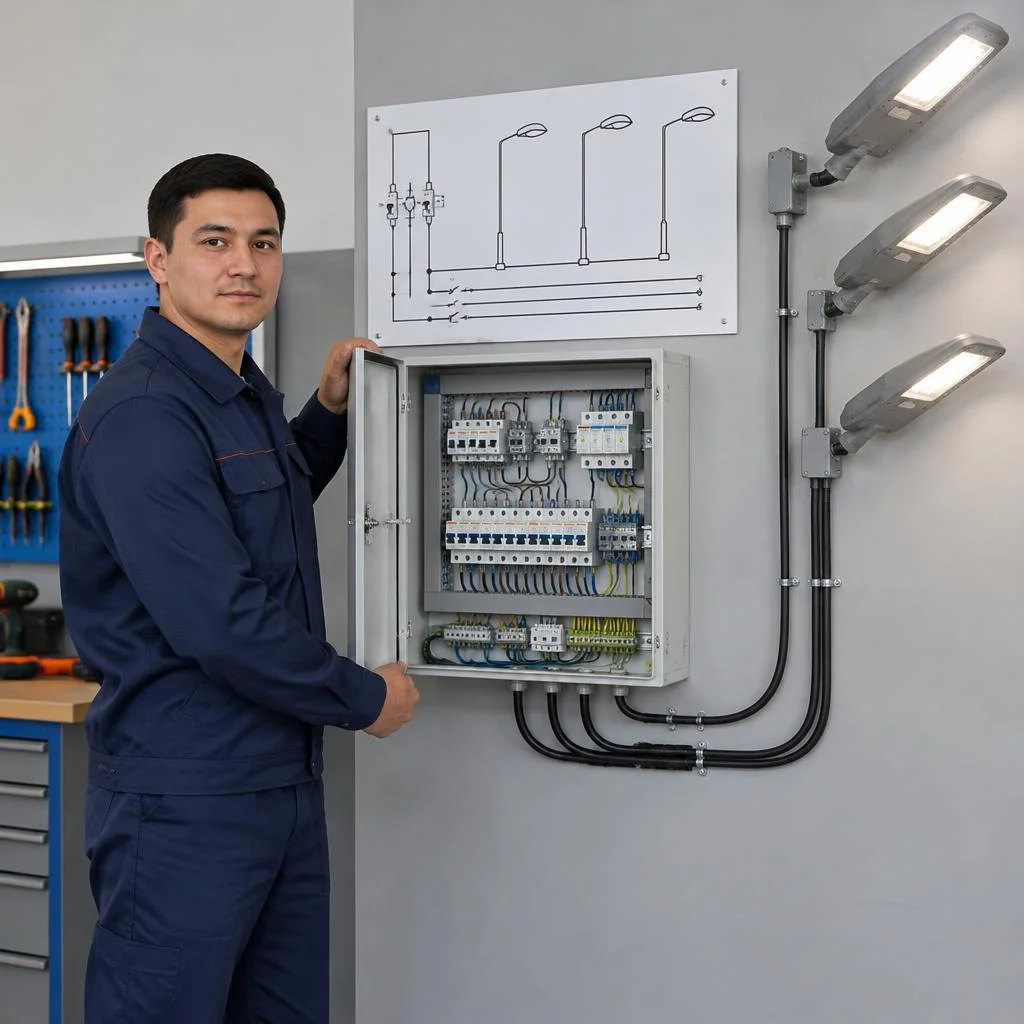
We assemble the outdoor panel, connect the luminaires, and install automation — a photocell or astronomical timer, so that the lighting turns on without human involvement. In the panel, an incoming circuit breaker, a 30 mA RCD, a contactor for the entire group, and terminal blocks for each line are mounted; the connection of outdoor luminaires is done in groups, so that a break in one line does not extinguish the entire site. The photocell is placed on the facade or pole and closes the circuit when illumination drops, while the astronomical timer is programmed with coordinates and a calendar. The astronomical timer is more accurate than a photocell: it does not "go blind" from headlights and does not turn off the light on a cloudy day, because it works by coordinates and calendar, not by a light sensor.
Which objects we light: highway, courtyard, park, facade
The same street lighting project looks different for a highway, a courtyard, a park and a facade — the poles, luminaires, installation height and automation differ. We break down each type of object separately.
Highway and courtyard lighting
We install highway lighting on tall poles with cantilever luminaires and courtyard lighting on shorter poles or wall-mounted brackets, and the illuminance standards for these objects differ by orders of magnitude. For a highway, the uniformity of the light patch between adjacent poles is critical: a 30-40% illuminance gap along the road is read by the driver as dark dips, even though formally the lux levels are within the norm. In a courtyard the priority is different — the absence of blind spots at entrances, playgrounds and parking bays, so we position the poles so that the overlap of the light cones is at least 20%. The same luminaire at a height of 9 metres and at a height of 4 metres produces a completely different result in terms of the illuminated area. In my opinion, saving on pole height in a courtyard is worse than saving on the fixture's power: a low pole with a powerful lamp dazzles the residents of the first floors.
Park lighting and garden luminaires
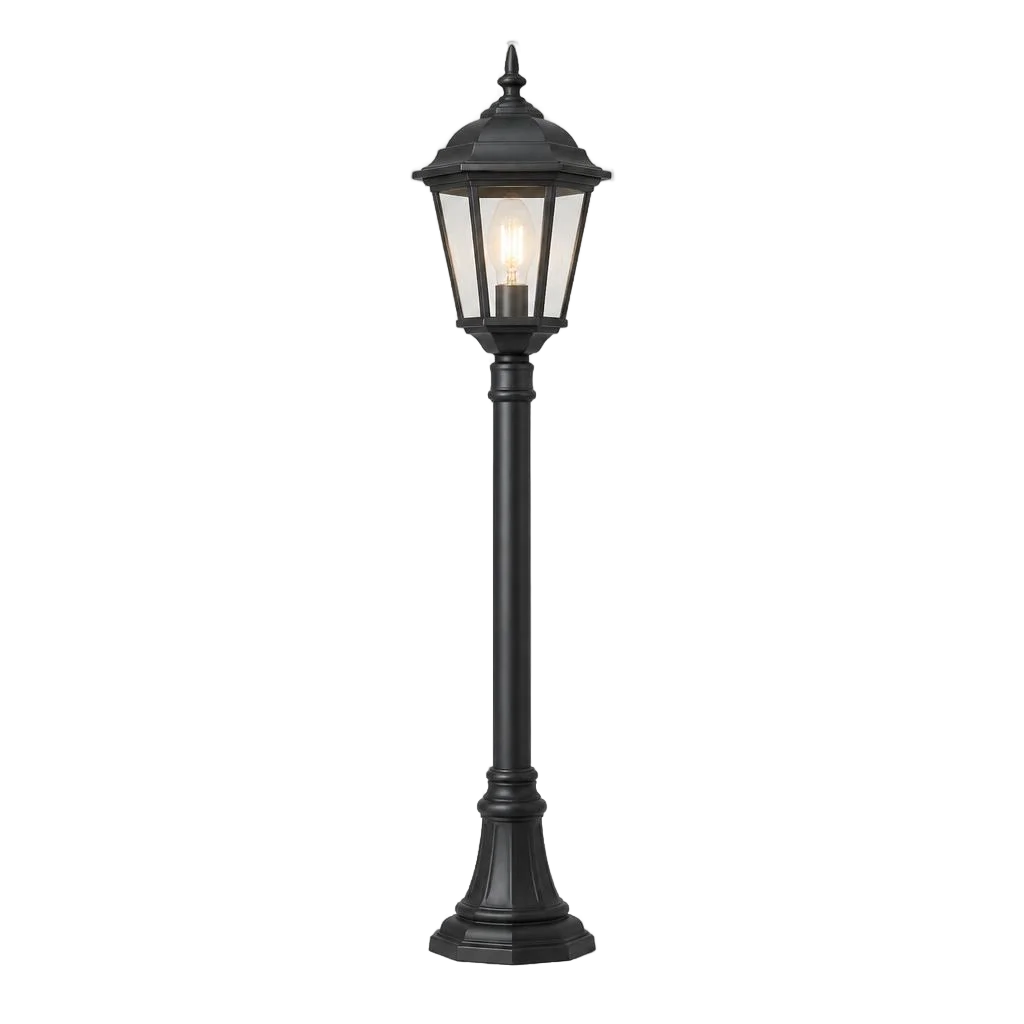
We carry out the installation of garden luminaires and park lighting — on low poles and in the ground, with an emphasis on decorativeness and the safety of paths, rather than on maximum brightness. In a park, what matters more is not lux levels but the absence of harsh shadows on the paths and the illumination of dangerous changes in terrain, steps and turns of the alleys. Overlighting harms plants: with round-the-clock illumination of the trunks, deciduous species shed their leaves prematurely, and the lawn burns out in patches. For alleys in Tashkent, for example in the park area near the Botanical Garden, we usually alternate a park luminaire on a 3-4 metre pole with recessed in-ground models along the kerb. Festoon lighting in the trees here works as an accent, not as the main source. A practical point: before ordering the installation of street lighting lamps, mark out the points so that the shadow of the bushes does not fall on the path — moving a fixture in the ground after the paving slabs have been laid is more expensive than designing it correctly from the start.
Facade lighting and festoon lighting
Eco-Service carries out the installation of street luminaires on facades — linear luminaires, LED floodlights and festoon lighting — with the cable laid in corrugated conduit along the wall. The cable in the conduit is fixed along the facade at a spacing of 30-40 cm, and on brick and concrete walls it is additionally protected from ultraviolet radiation: ordinary conduit without UV stabilisation cracks within two seasons. A linear luminaire along the cornice gives an even wash of the wall, while an LED floodlight throws a narrow beam and highlights individual elements — the entrance group, the sign, the columns. For retail properties on the avenues of Tashkent, we more often combine both techniques: a wash along the contour plus accent lighting of the entrance. Facade lighting requires calculating the tilt angle of the floodlight: if installed incorrectly, the light goes into the windows of neighbouring buildings, and the property receives complaints instead of the desired effect.
Comparison of luminaires by object
| Object | Luminaire type | Installation height | What matters |
|---|---|---|---|
| Highway | Cantilever LED | Tall pole | Uniformity of the light patch |
| Courtyard | Cantilever / bracket | Medium | No blind spots |
| Park | Park luminaire | Low | Soft light, safety |
| Facade | Linear / floodlight | Per project | Angle, no light spill into windows |
| Accent lighting | Festoon | Per project | IP moisture protection |
LED is displacing mercury-vapor and sodium-vapor lamps not only in energy consumption but also in service life: replacing a lamp on a high mast using a cherry picker costs more than the fixture itself. Therefore, the installation of streetlights — the price is ultimately determined not by the cost of the device, but by the cost of its maintenance over the entire service life — on a main road, the difference between LED and mercury-vapor lamps pays for itself within the very first replacement cycle.
Installation of street lighting: how the work proceeds on site
The process on site follows a fixed sequence — from the site visit and measurements to commissioning. Below is how the stages are structured, how long they take, and what is required from the customer.
Site visit, measurements, and project preparation
Eco-Service begins with a site visit: it measures the route, clarifies the connection points, and prepares a schematic — without this stage, the work turns into improvisation. On site, the engineer marks out the lighting route according to the actual terrain: calculates the spans between poles, the suspension height, and the tilt angles of the brackets so that the light falls on the road, not on the fence. Then he assembles the connection schematic for the lighting panel: divides the line into groups, selects the rating of the circuit breakers, and the installation location of the photocell or astronomical timer. The question "street lighting installation price" does not yet have a final answer at this stage — the estimate depends on the number of poles, the length of the route, and the method of laying. During the site visit, it is important to record not only the length of the route but also the connection points to the existing network and the places where digging is not allowed — utilities, tree roots, paving.
Earthworks and line laying
Eco-Service digs a trench for the cable, lays the line, and backfills it — this stage takes up most of the time on site with underground laying. Trench digging for the cable is done to a depth below the frost line, and cable laying in the trench is performed with a sand cushion underneath and protection on top — this way the line is not damaged by seasonal ground movement. In dense areas where a trench cannot be cut, the line is run overhead or in corrugated conduit along the facade. Backfilling of the trench is done in layers with compaction: if backfilled in a single pass, after a season the soil will settle and a wave will form along the route, noticeable on the paving. In our practice, on a site with 400 meters of route, earthworks take two to three days with two crews — the rest of the time goes to poles and connections.
Installation of poles, fixtures, and commissioning
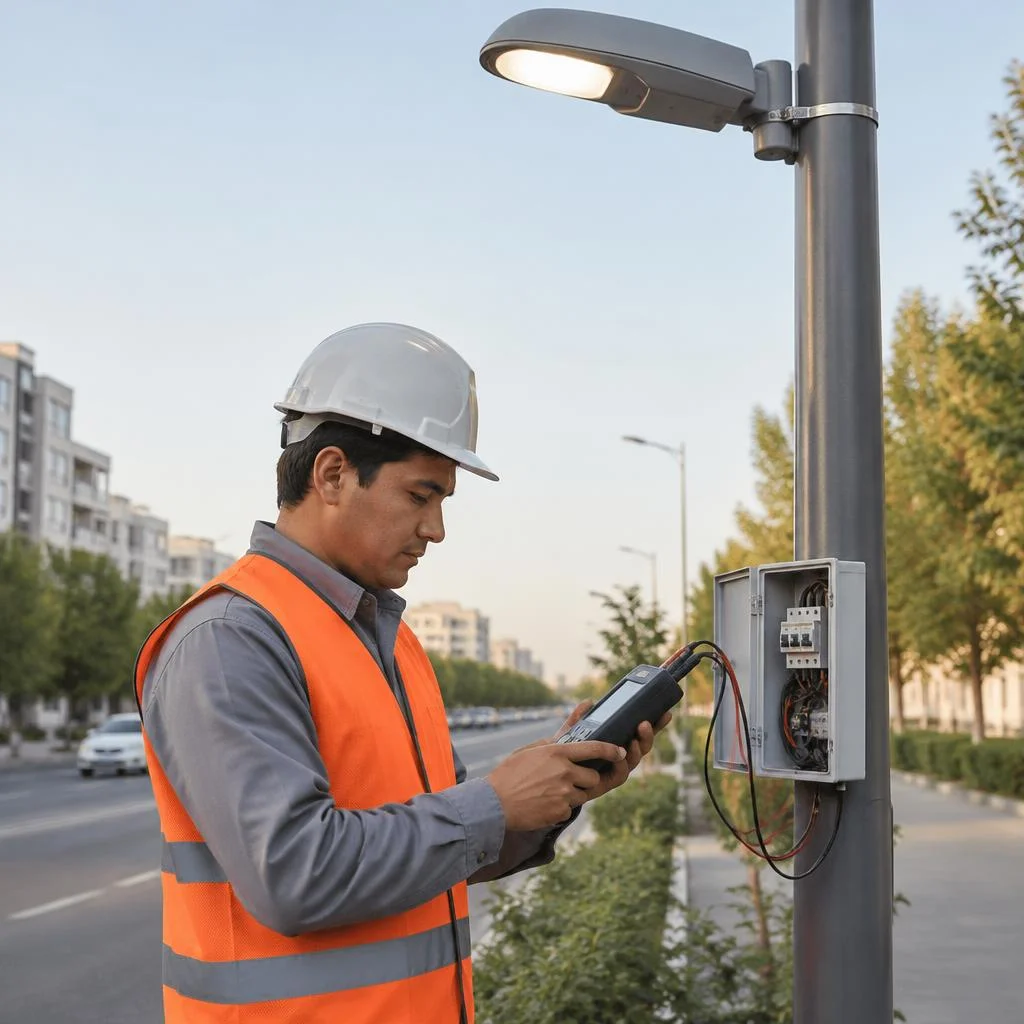
Eco-Service installs the poles, attaches the brackets and fixtures, assembles the panel, and starts up the line — commissioning confirms that the automation and protection work. A metal pole is placed on a concrete foundation with embedded anchors, a concrete pole — on a prepared pad; the bracket is fastened to a wall with anchors if the line runs along the facade. The cantilever fixture is set at the tilt angle for the specific span so that the light pool does not drift to the side. During commissioning, they check not only "whether it lights up or not" but also the tripping of the RCD and circuit breakers under load — this is what protects the line in an emergency. The work is completed by checking the grounding of the poles before energizing: without it, an energized housing is dangerous to people and animals.
Installation of street lamps and light fixtures: what equipment to choose
Installation of street lamps and light fixtures is a choice among several types of equipment and two automation schemes. We break down what to install and when, so the line works for years without rework.
Types of light fixtures: console, park, linear, floodlights
Eco-Service installs four main types: console light fixtures on poles, park lights on low posts, linear lights on facades, and LED floodlights for accent lighting. Console models are installed on main roads and along Tashkent streets — mounting is done on a pole bracket at an angle to the roadway. Park light fixtures on posts up to three meters high illuminate alleys and public gardens with a soft diffused flux. Linear housings are mounted on a flat surface of a facade or parapet; they provide even coverage without spots. LED floodlights with an adjustable bracket direct a narrow beam onto a sign, gate, or architectural element. The installation of street light fixtures price depends on the housing type and lifting height, so the type of fixture determines not only the light but also the mounting method: a console fixture requires a pole, a linear one requires a flat facade surface, and a floodlight requires an adjustable bracket.
Photorelay or astronomical timer: what to choose
Eco-Service installs a photorelay for simple lines and an astronomical timer where predictability of switching on is needed regardless of weather and light exposure. The photorelay reacts to the level of natural light and starts the line at dusk; its installation takes about half an hour directly in the lighting panel. The astronomical timer works by the object's coordinates and a calendar: for Tashkent it automatically shifts the on and off times by season, without reacting to cloudiness or the headlights of passing cars. A photorelay is cheaper, but its sensor can be "fooled" by a headlight or a street lamp opposite; an astronomical timer is free of this, but requires precise setting of coordinates and a seasonal schedule. Installation of street lighting lamps at sites with a constant schedule is more often designed specifically on a timer — fewer false triggers in fog and rain.
Cable and protection: cross-section, SIP, RCD
Eco-Service selects the cable cross-section for the design load and installs protection — circuit breakers and RCDs — so the line does not overheat and disconnects in the event of a fault. For overhead inputs and sections between poles, self-supporting insulated wire SIP with aluminum conductors is used: it withstands wind load and does not require corrugated conduit. Underground sections are enclosed with power cable in a trench with a sand cushion. A cross-section "with a margin" is not always better: an oversized cross-section makes the line more expensive and complicates laying, while an undersized one overheats; load calculation here is more important than intuition. In requests, clients often write briefly — installation of street lighting lamps — and from this wording the technician immediately understands that a full cycle is needed: from wire calculation to connecting the panel. Another frequent request reads like this: installation of a street light fixture price — and here it is important to immediately clarify the pole height and housing type, because both the wire and the protection depend on them. Grounding of pole housings and the panel is done with a separate loop, and the RCD is installed on a group so that a fault on one line does not shut down the entire site. We recommend laying protection according to the design current with a small step — this simplifies replacing light fixtures during modernization.
Norms and requirements: SHNK, GOST, illuminance
Street lighting in Tashkent is governed by SHNK and GOST — from illuminance norms to requirements for poles and grounding. We break down what this means in practice.
Illuminance norms for streets, courtyards and parks
Illuminance norms differ by the category of the object: highways require more lux, courtyards and parks — less, and this is factored into the calculation even before work begins. Category A arterial lighting is designed for 20-30 lux on the roadway, district-level streets — for 15 lux, courtyard driveways and pedestrian paths — 4-6 lux, and park alleys — 2-4 lux at the surface level. SHNK 2.01.05 and GOST 33175 set these thresholds, as well as uniformity: the ratio of maximum brightness to minimum on the road must not exceed 3:1, otherwise the driver's eye adapts to the bright spots and loses the dark sections. In park lighting the same principle works differently — what matters is not so much brightness as the absence of sharp jumps between luminaires. The norm is not "the brighter, the better": overlighting in a courtyard area keeps residents from sleeping, while underlighting on an arterial road increases the accident rate, so balance matters more than maximum.
Requirements for poles, cable and grounding
Poles, cable and grounding are subject to requirements for stability, cross-section and protection — their compliance is checked when the line is accepted. Metal street lighting poles are installed on a buried foundation designed for the wind load of the specific region, concrete ones — on a prepared base with vertical alignment; a deviation from vertical of more than 1 cm per meter of height is considered a defect. The cable in the trench is laid with protection from a warning tape, SIP overhead — with a standardized sag, and the cross-section is selected for the total load of the line with a margin: for arterial sections usually from 16 mm² copper, for courtyard ones — from 6 mm². Grounding is done with a separate loop with a resistance of no higher than 10 ohms, and the lighting panel is equipped with an RCD and circuit breakers rated for the design current. Grounding is the most common item that is economized on during the work stage, and remembered at the first accident; restoring it on a finished line is harder than doing it right away.
Warranty, service and maintenance of lighting networks
After the project is handed over, the line operates for years, and the question is not who assembled it, but who is responsible for it going forward. We break down warranty obligations, the service framework and scheduled maintenance of networks.
2-year warranty on installation
Eco-Service provides a 2-year warranty on outdoor lighting installation — it covers the work and connections performed by our crew. The warranty scope includes terminal connections in the lighting panel, fastening of poles to the foundation, sealing of entries into luminaires and tensioning of the cable on spans between poles. A claim is filed against the handover certificate and receipt: the crew visits, records the nature of the failure and fixes it at its own expense if the cause is a defect in assembly rather than external impact. The warranty is valid only if operating conditions are observed: if the line is overloaded without authorization or the panel is tampered with, a warranty case may not apply.
Own service center in Tashkent
Eco-Service is a direct supplier with its own service center in Tashkent: requests are received and processed in person, without forwarding to a subcontractor. A request is accepted by phone or in Telegram, the dispatcher records the site address, network type and nature of the fault, then schedules a crew visit with the necessary tools and a stock of terminals, sealant and fasteners. The service center maintains main, park and courtyard networks installed both by our crew and by third-party contractors — under a one-off contract. A direct supplier is responsible for the result as a whole: there is no chain of "we — to the subcontractor, the subcontractor — to the technician" in which responsibility is diluted.
Maintenance of lighting networks after handover
Eco-Service maintains lighting networks after handover: it checks connections, automation and the condition of poles — on a scheduled basis, not only after a breakdown. The schedule includes tightening terminals in the lighting panel, checking the settings of the photocell and astronomical timer, measuring grounding resistance, inspecting brackets and anchors for corrosion and loosening. For main lines the interval is once a season; for park and courtyard lines two visits per year are enough: in spring and before the start of the autumn season. A scheduled check of the panel and photocell once a season is cheaper than an emergency call-out: most outdoor lighting failures begin with oxidized contacts, not with a broken cable.
Conclusion
Outdoor lighting installation is not a separate operation but a connected chain of decisions: from route marking and load calculation to grounding, automation and commissioning. Below are the main takeaways worth keeping in mind before starting work.
Main takeaways
- Engineering chain: the work covers marking, load calculation, earthworks, poles, cable, panel, automation and commissioning — skipping any link carries over to the next stage.
- Luminaire type for the site: a main road, courtyard, park and facade require different solutions in terms of power, installation height and beam angle — there is no universal model for all tasks.
- Switching automation: a photocell and an astronomical timer affect operating convenience and the line's energy consumption differently; the choice depends on seasonal fluctuations in daylight hours.
- Illumination standards: SHNK requirements and grounding are laid down at the calculation stage, not added after installation — redoing a finished line is more expensive than a design correction.
- Warranty and maintenance: a two-year warranty and scheduled maintenance determine how the line will behave after a year and after five years of operation.