













What work an electrician performs at home and in an apartment
A specialist at home covers the full cycle: from emergency diagnostics of a short circuit to final lighting installation. Below are five areas that most often prompt calls to an apartment and a private house.
Diagnostics: finding a short circuit and checking the panel
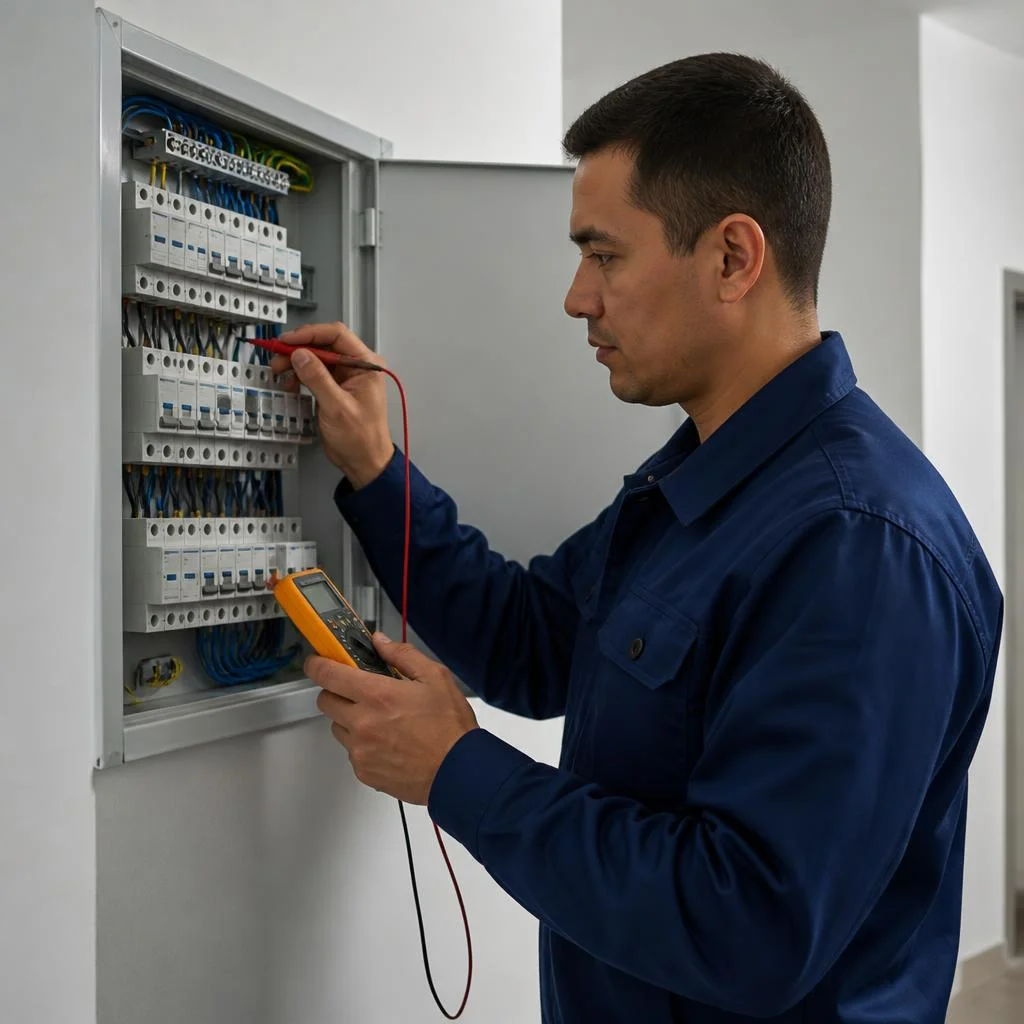
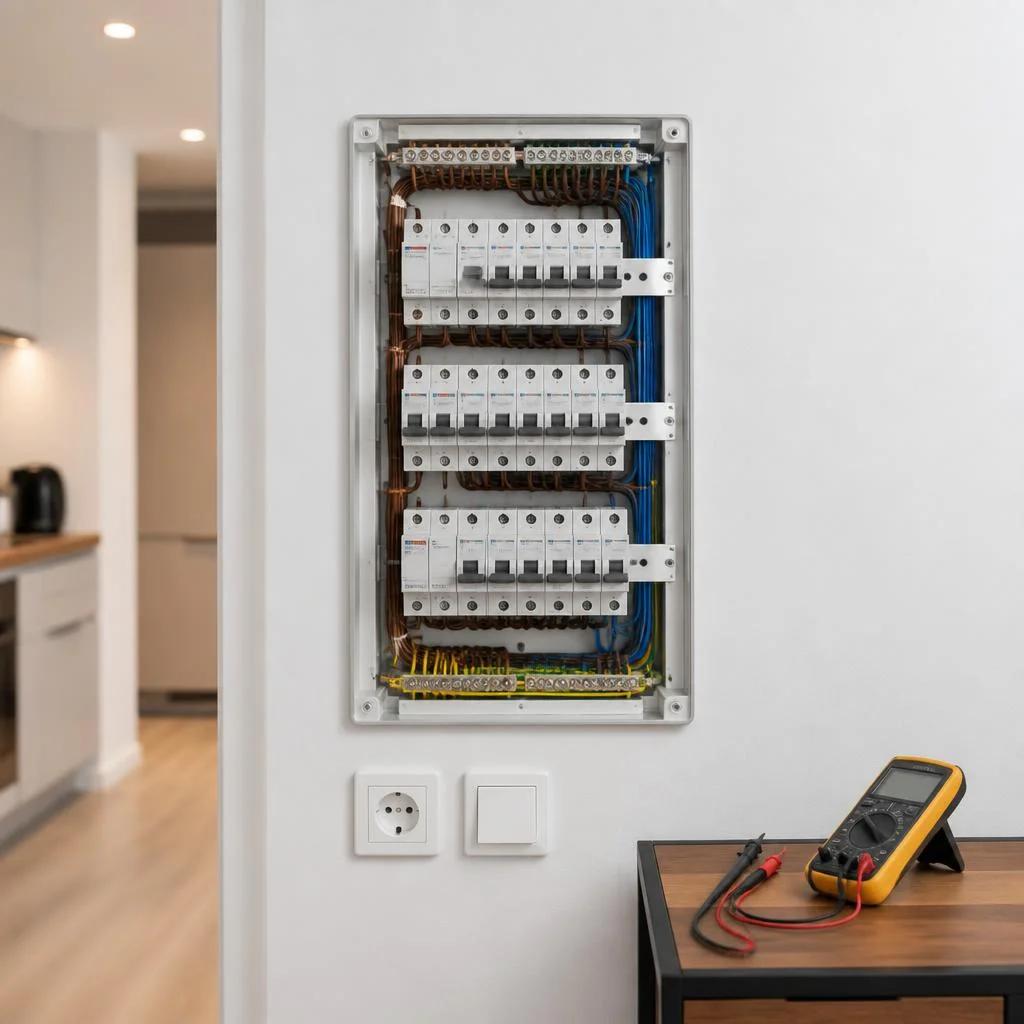
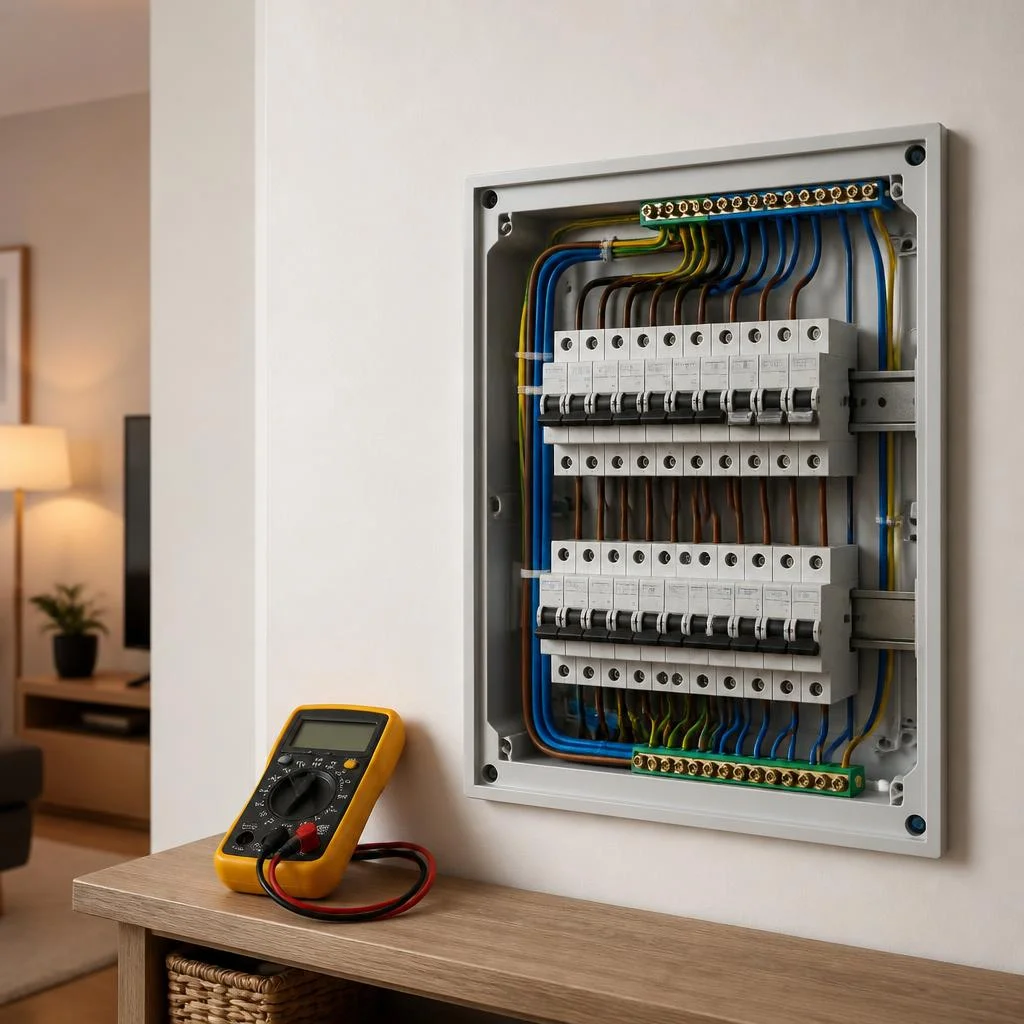
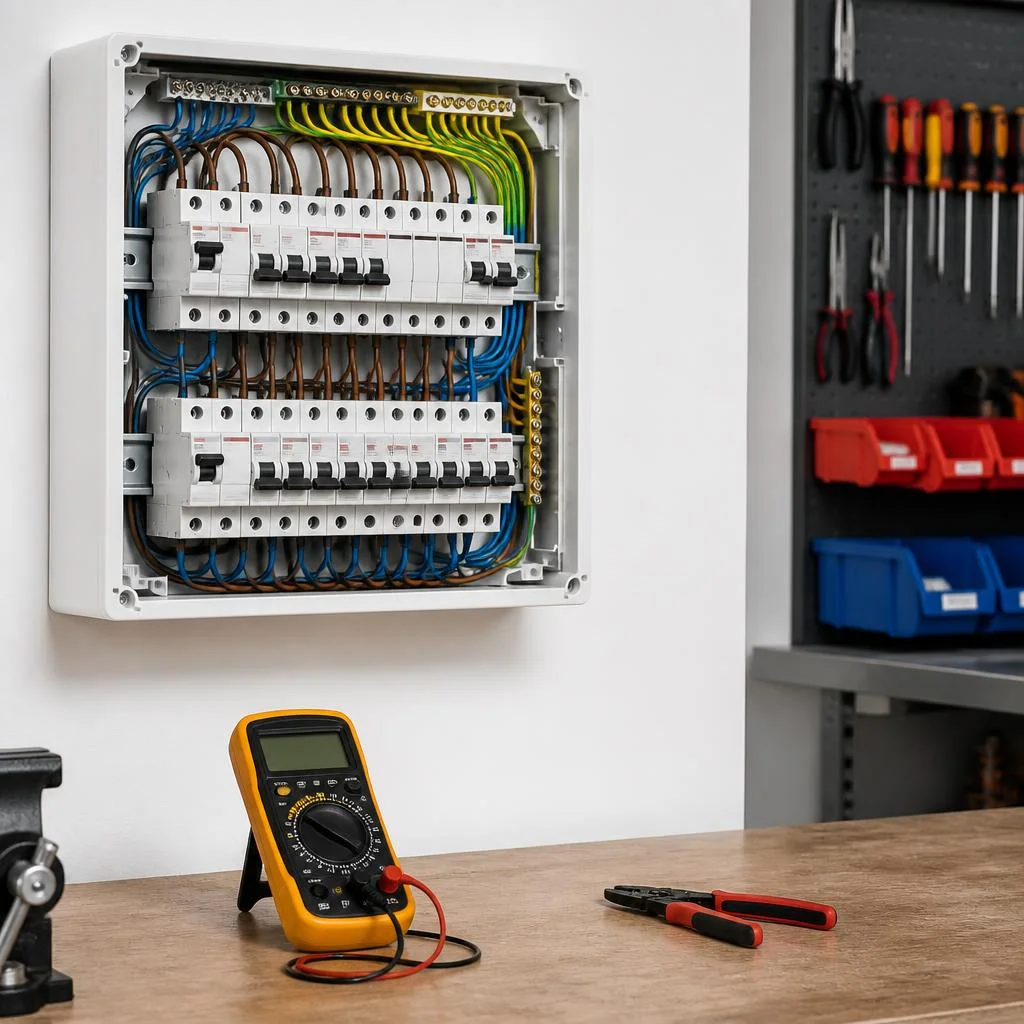
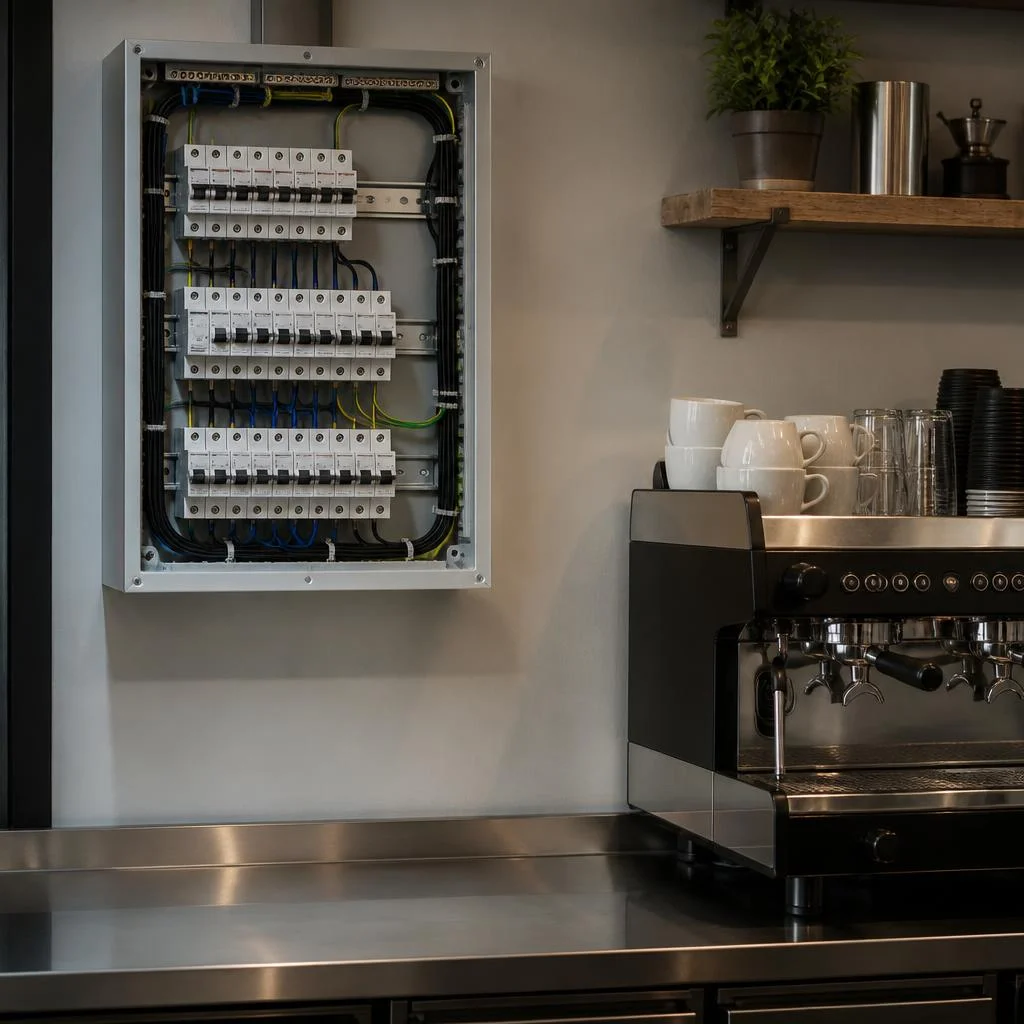
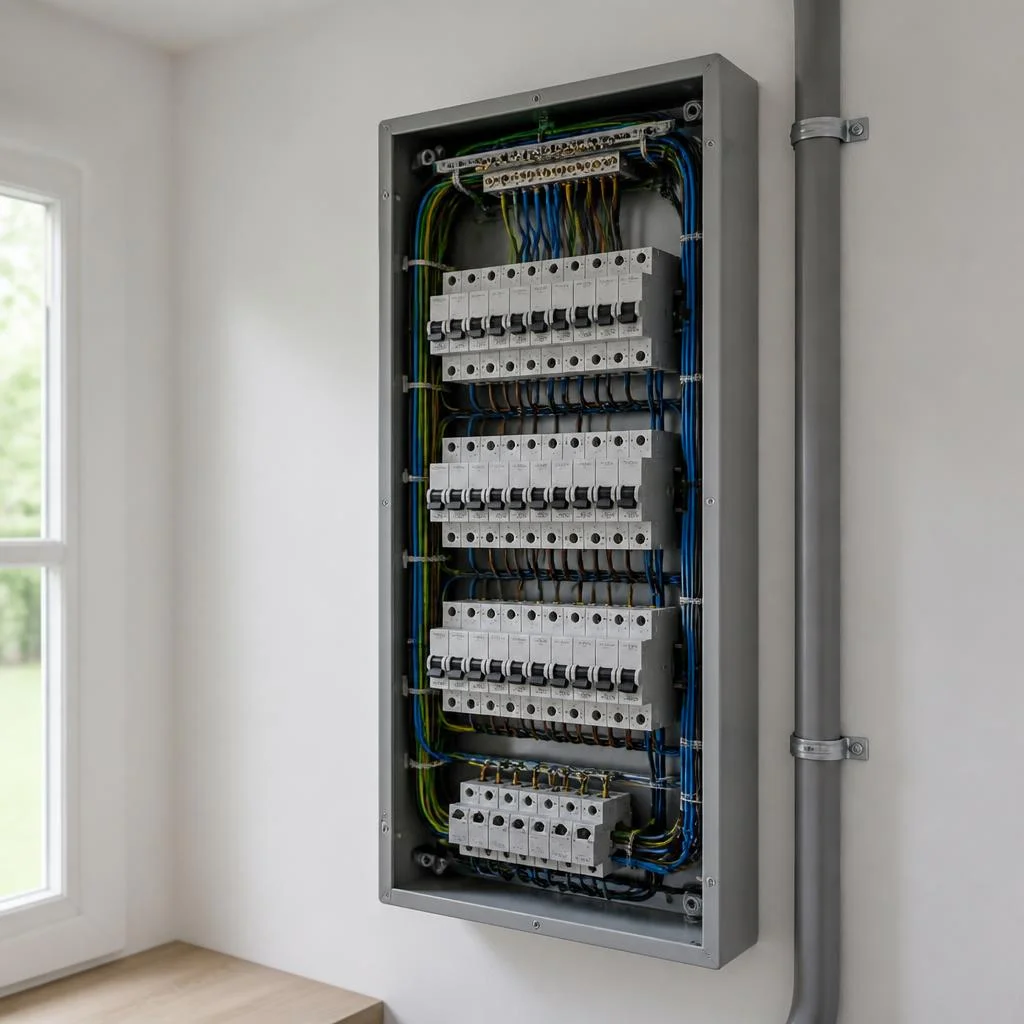
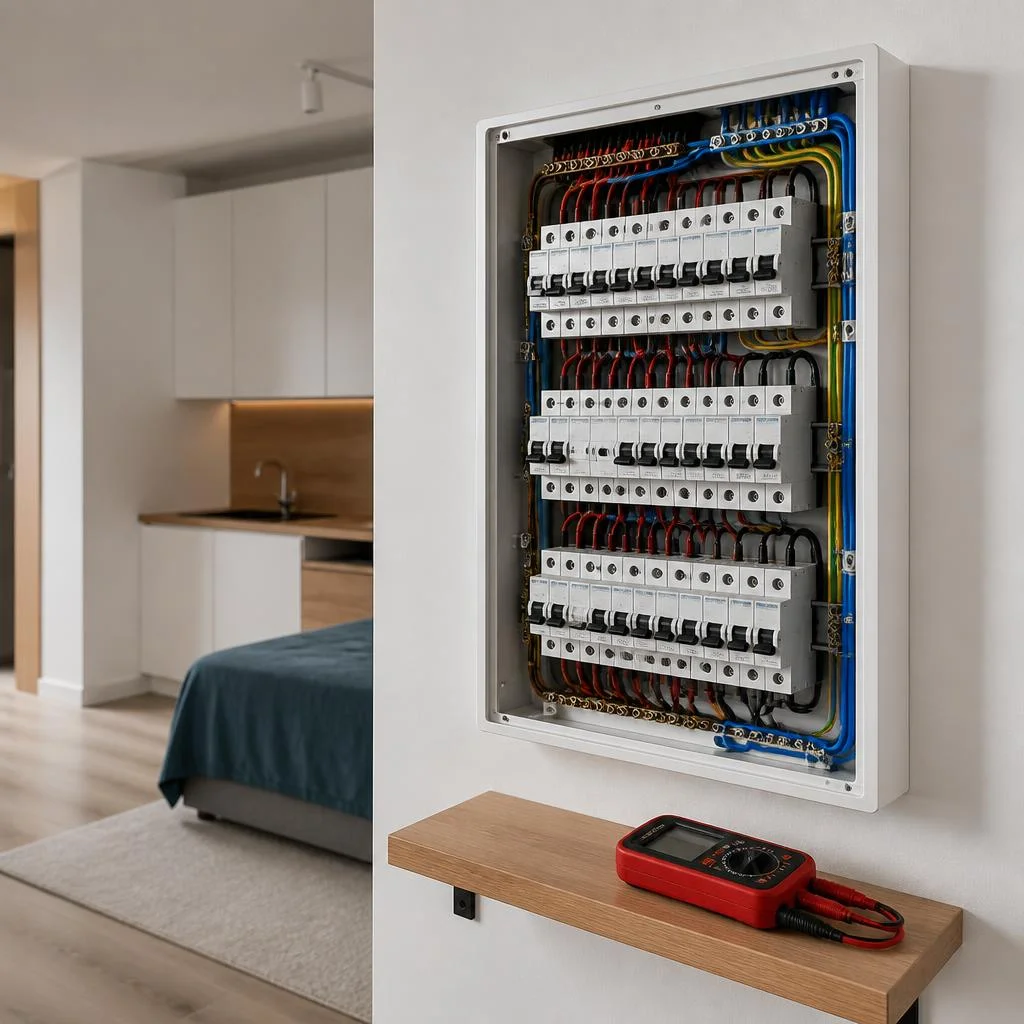
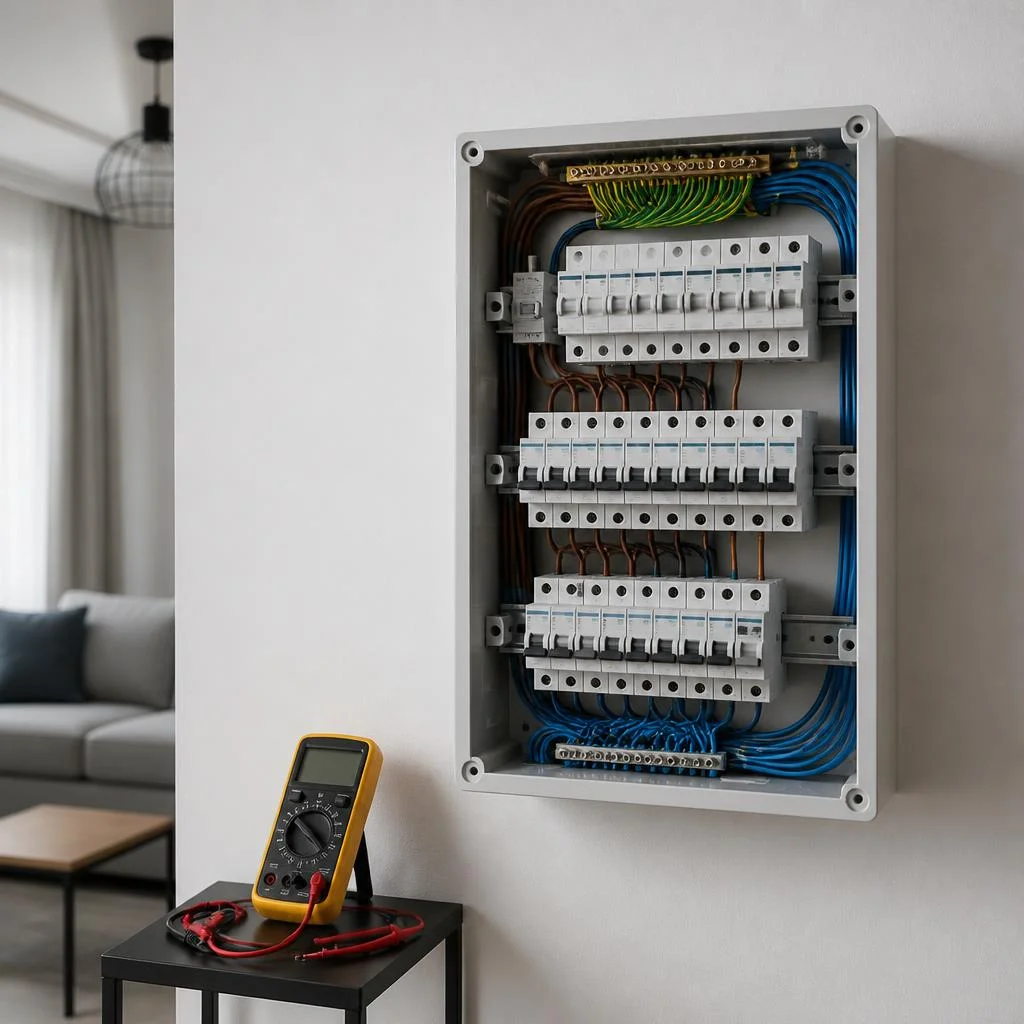
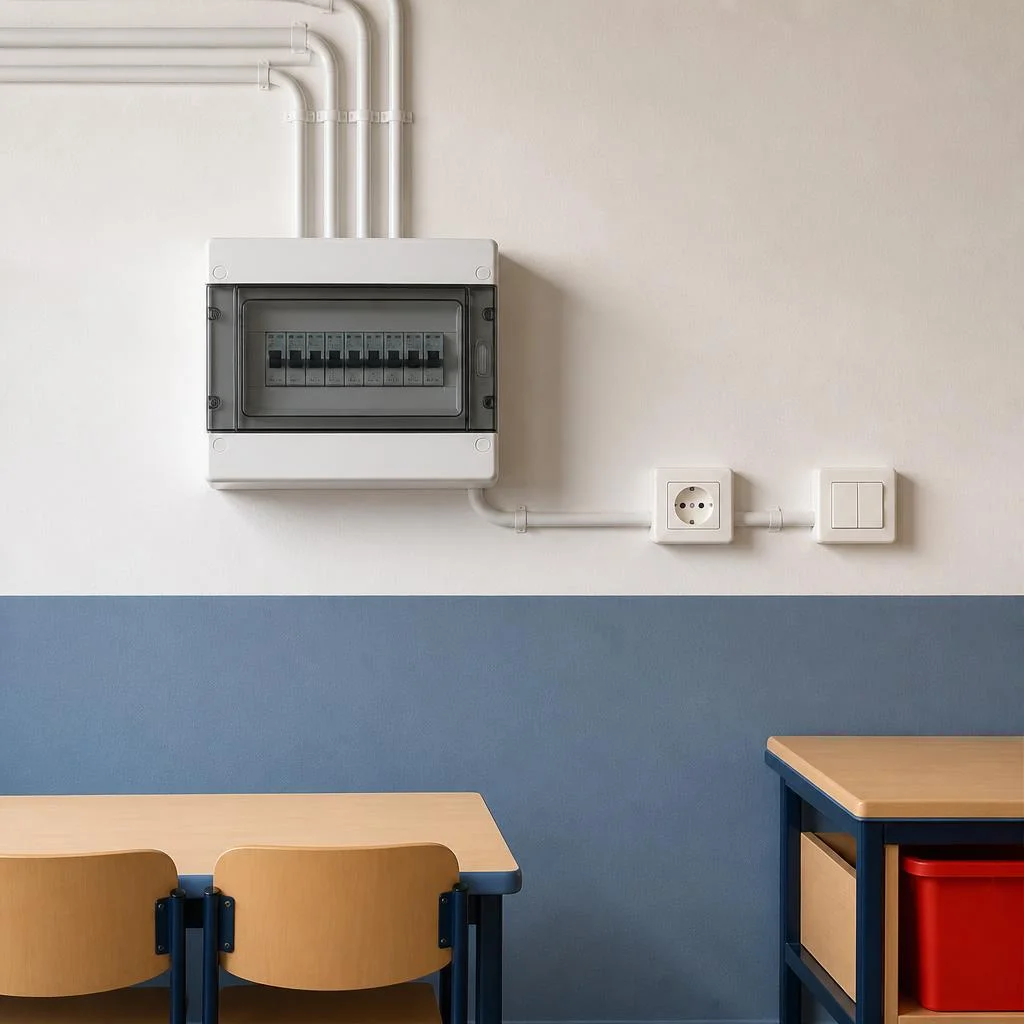
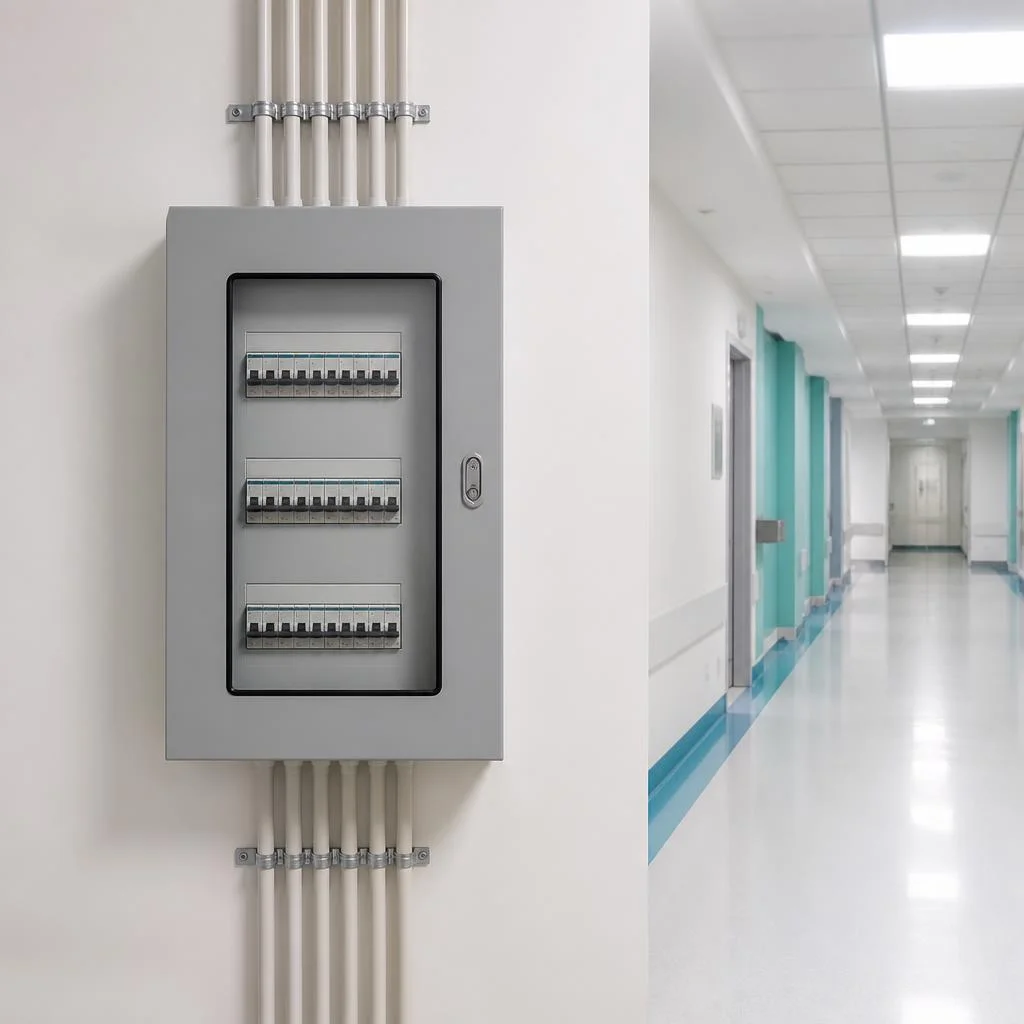
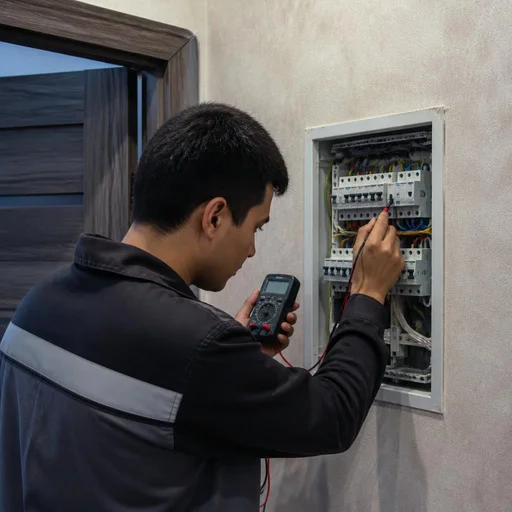
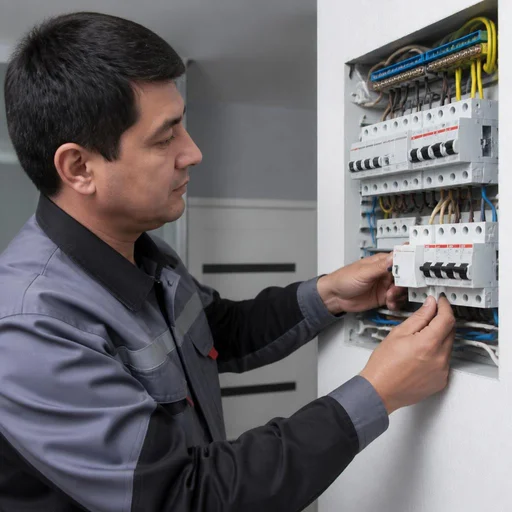
Our specialist finds a short circuit by step-by-step continuity testing of the lines and checks the panel with circuit breakers and RCDs — from the incoming cable to each group. First, all groups are switched off and power is supplied one by one: this locates the damaged section in 20-40 minutes without opening up the walls. Then, using a multimeter and clamp meter, the insulation resistance, leakage current and terminal heating are measured — an oxidized contact on the neutral bus causes false tripping of the RCD. The circuit breaker is tested under load, not "by eye": the thermal release may fail to trip under overload. If the breaker trips again after being switched on, do not "cure" it by replacing it with a higher rating — first find the cause of the leakage or short circuit, otherwise overheating of the VVG cable remains hidden. A common case from practice: an evening call when the fuses have blown, and by morning a precise answer is needed as to where the line has broken down.
Installation and replacement of electrical wiring: apartment and private house
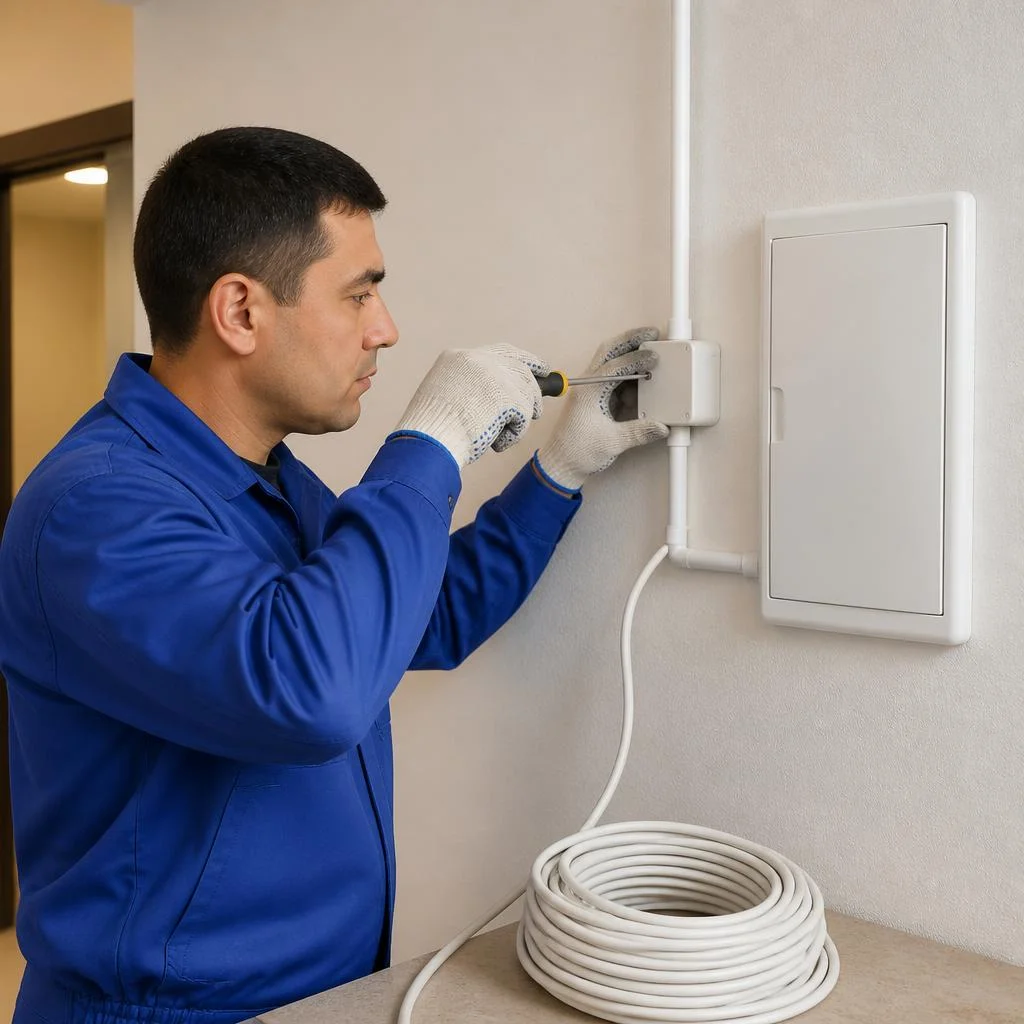
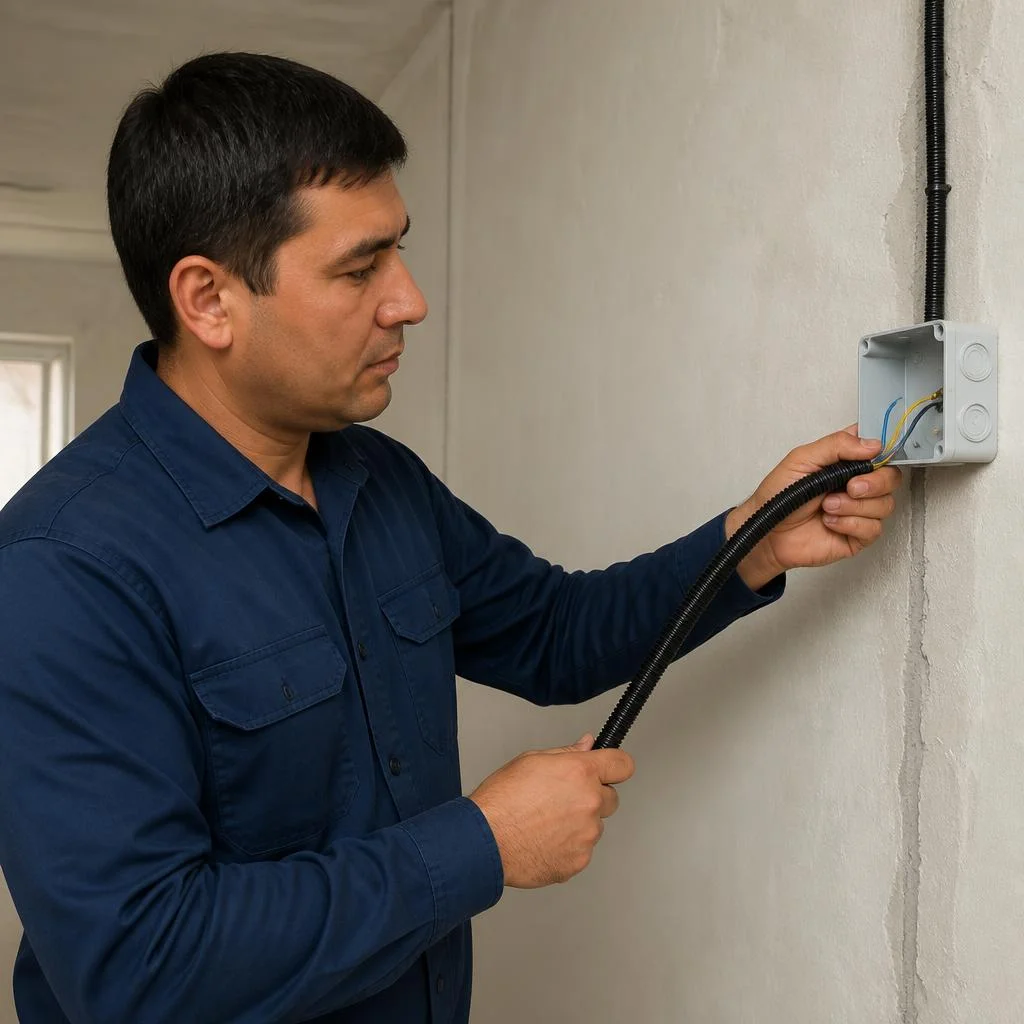
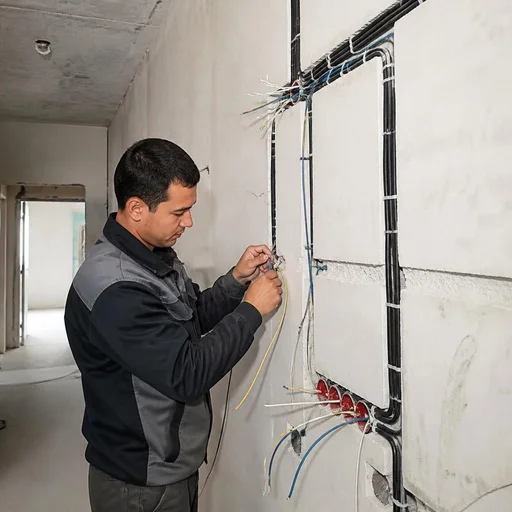
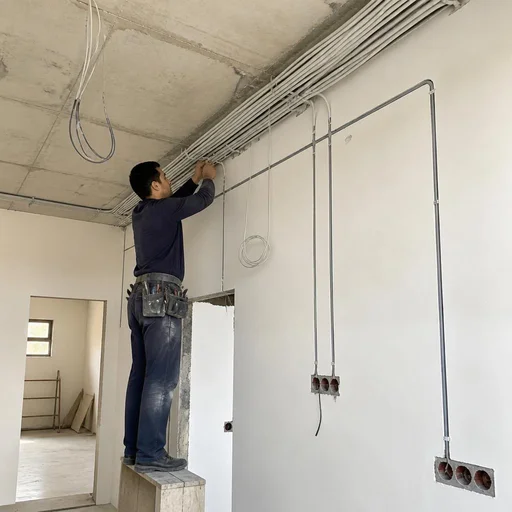
Eco-Service installs electrical wiring in an apartment and in a private house, and during renovation first conducts an audit of the old line so as not to chase the walls twice. The audit includes measuring the cross-section of the conductors, checking the twists in the junction boxes and inspecting the panel — according to data from our call-outs, 2.5 mm² aluminum wiring does not withstand the simultaneous load of a boiler and an air conditioner. Next, we draw a routing plan with division into groups: separate lines for the kitchen, washing machine, air conditioners and lighting. For installation we use VVGng-LS or NYM cable with copper conductors — they do not propagate combustion. For wooden floors and frame houses, concealed installation in a chase is unacceptable — the cable is run in a metal pipe or corrugated conduit with a non-combustible sheath. The master's work at this stage requires not only tools but also a design: without a group plan, replacing electrical wiring turns into endless rework. In search, this service is often entered as electrician work Tashkent — and this query leads to our page.
Concealed and open cable routing: chasing and corrugated conduit
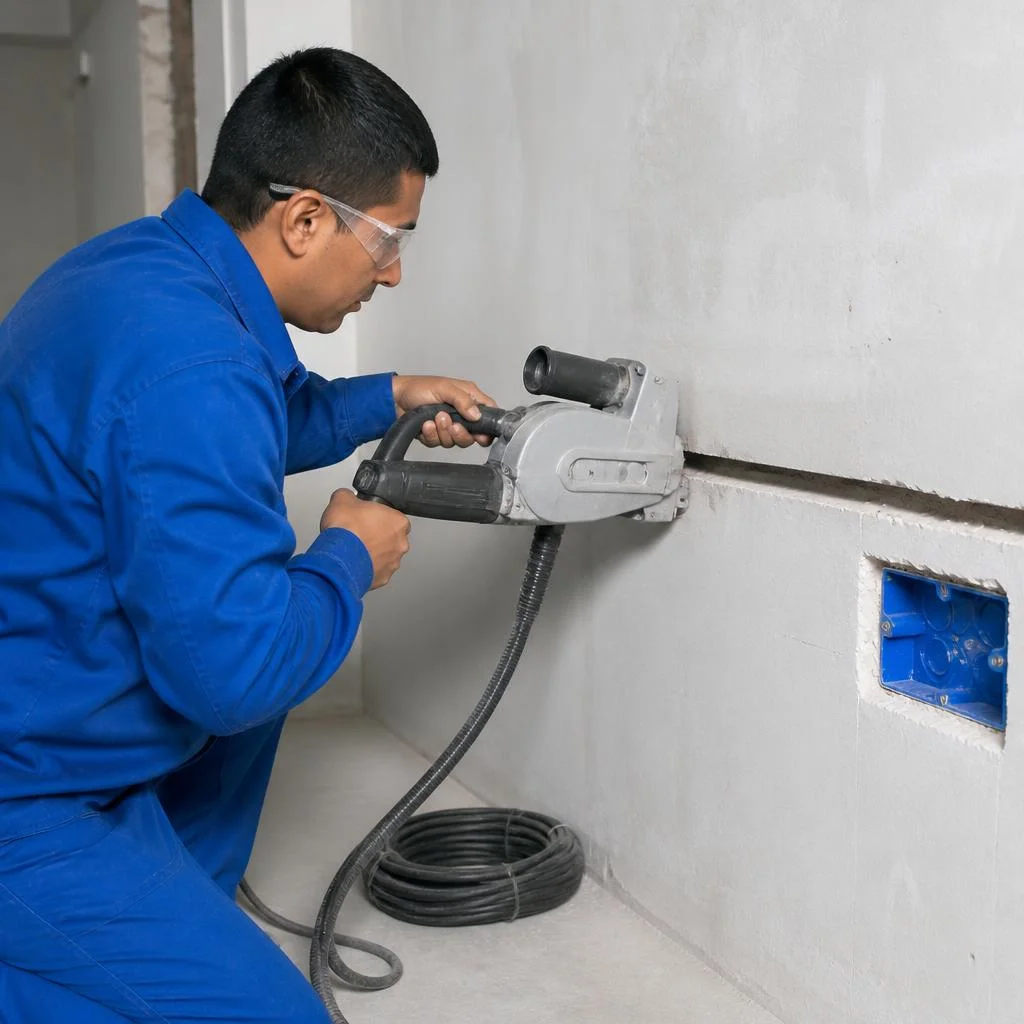
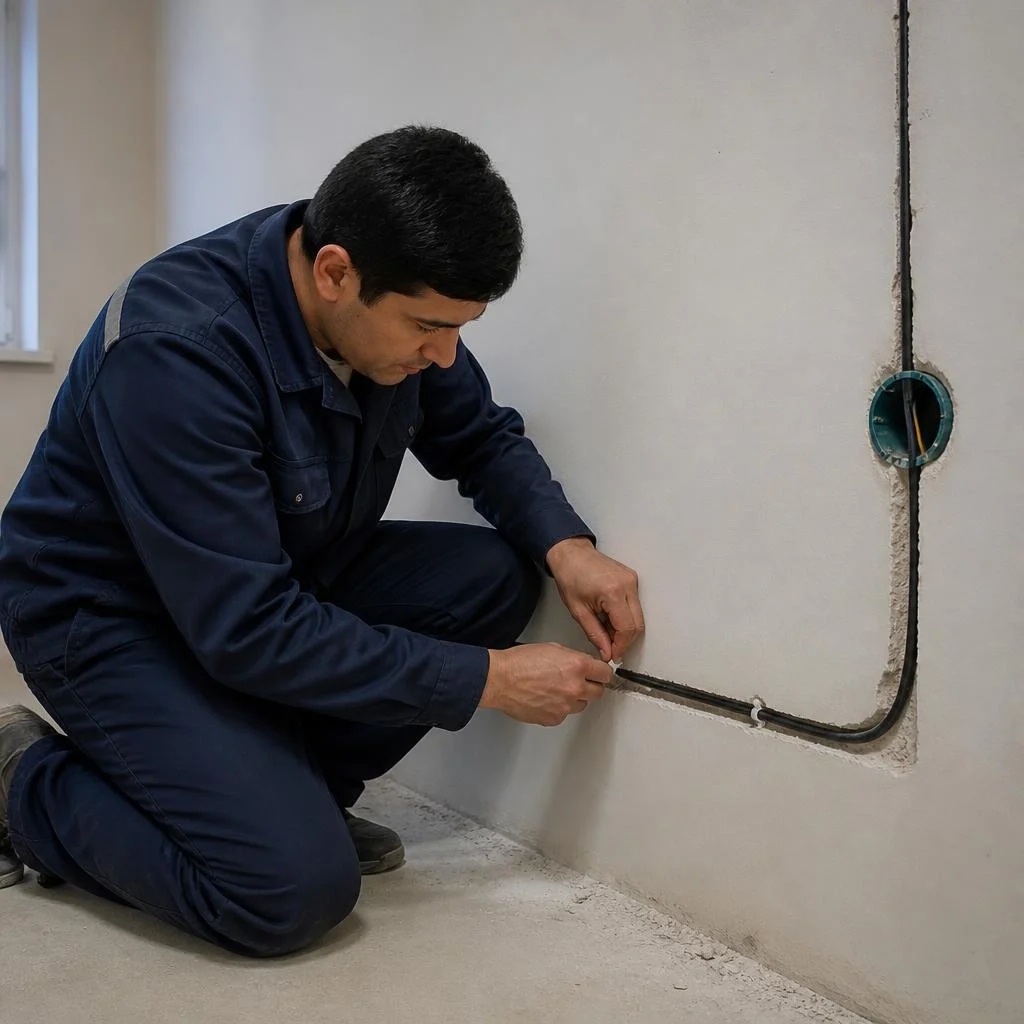
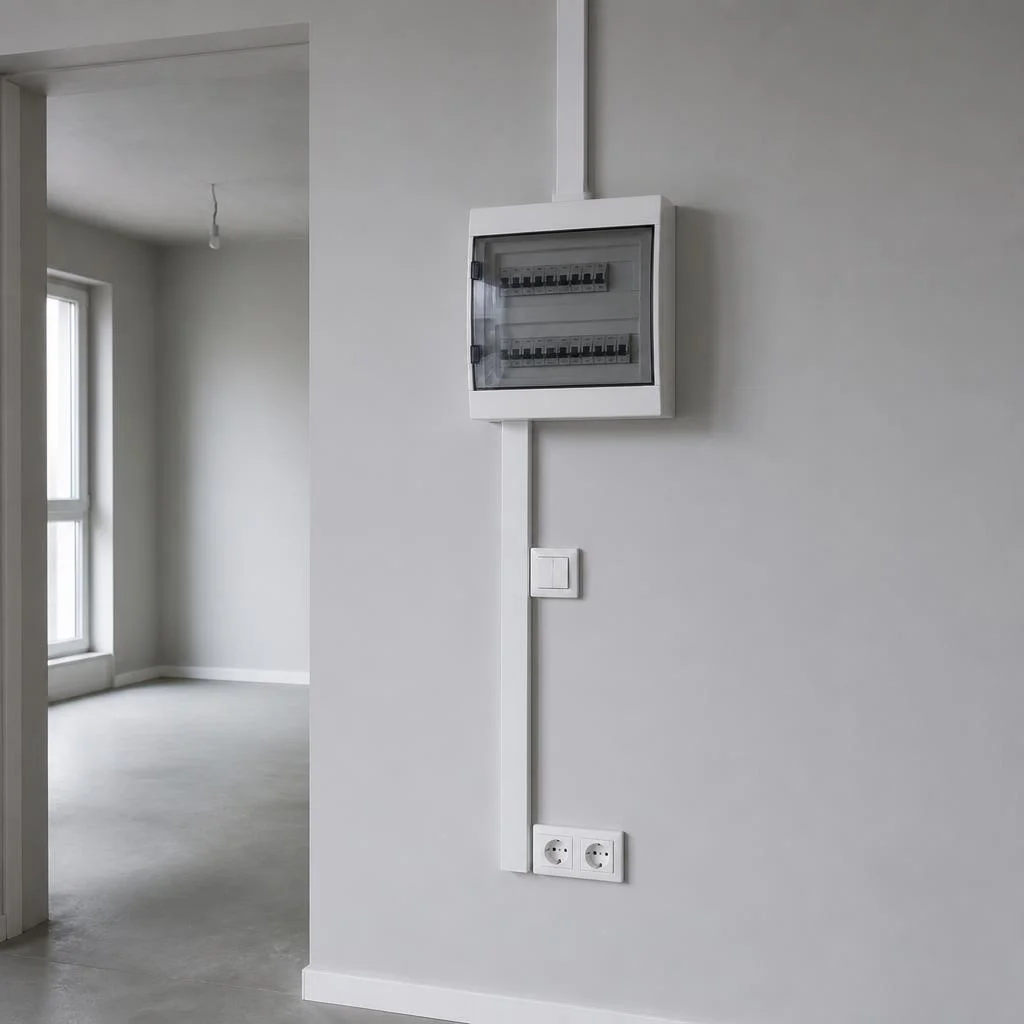
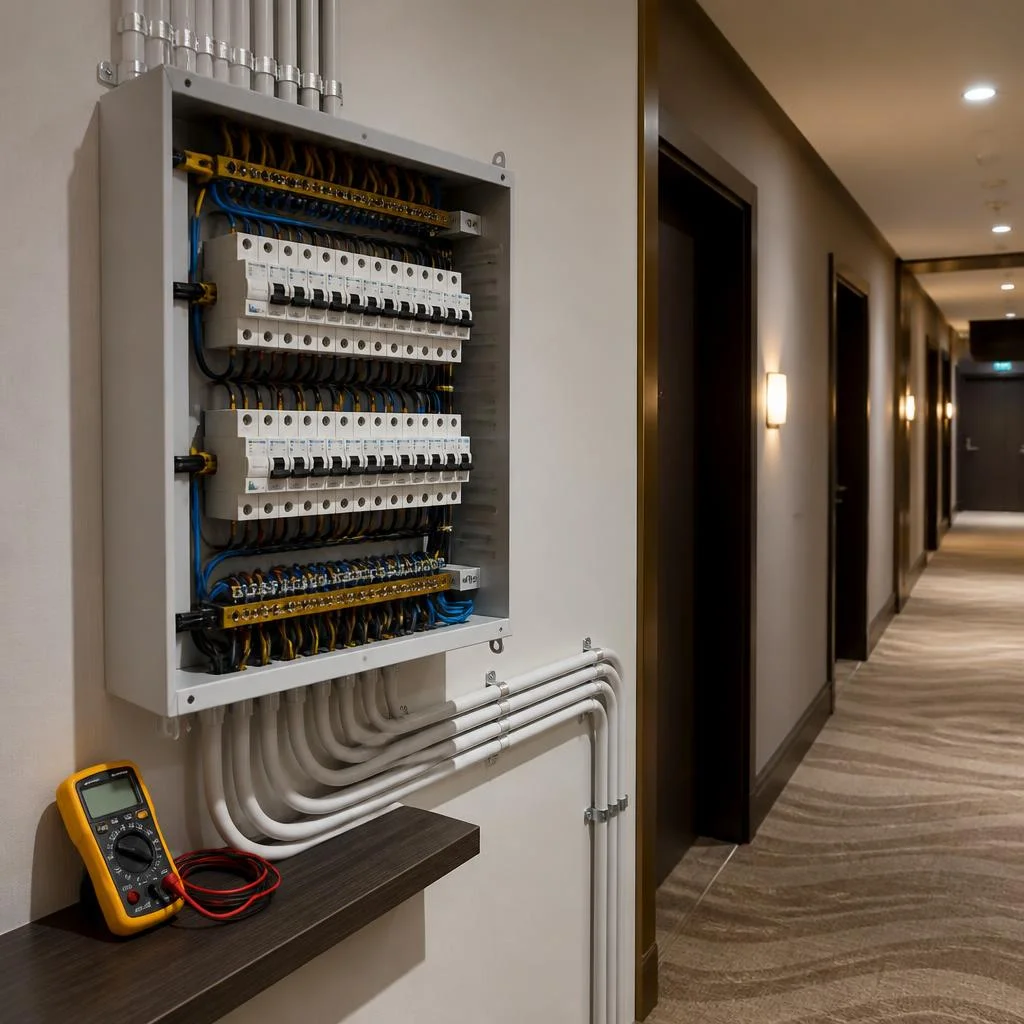
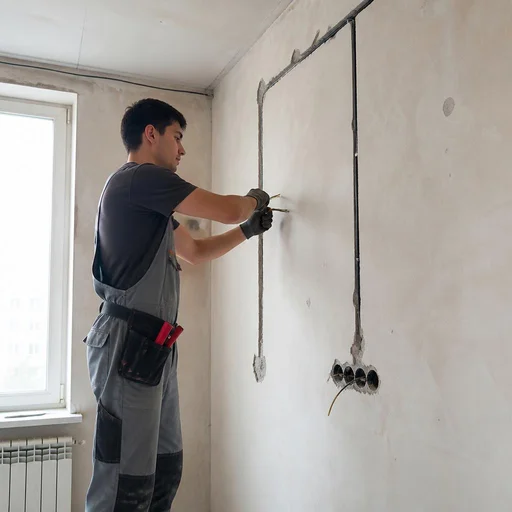
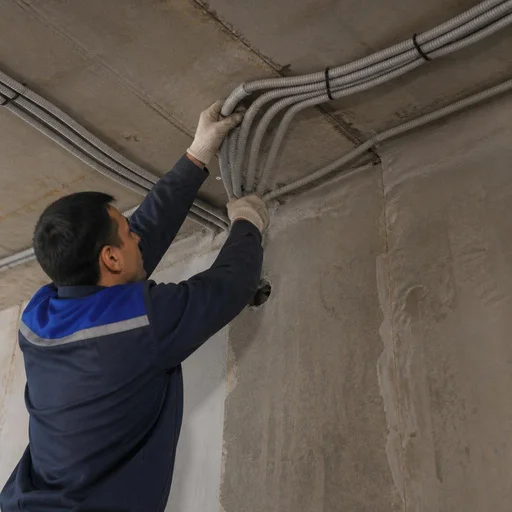
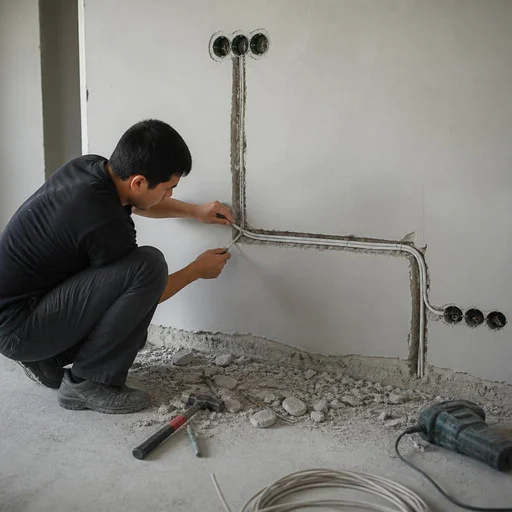
We perform wall chasing for cable, concealed routing and routing in corrugated conduit — the method is chosen based on the wall material and renovation requirements. In brick and aerated concrete, a wall chaser with a vacuum cleaner produces an even 20×30 mm groove in one pass; in concrete, a rotary hammer with a diamond core bit is used. Open routing in corrugated conduit or cable duct is appropriate in utility rooms and at the entry into the house — it is easier to service and replace. Chasing load-bearing walls in panel buildings is limited in depth and direction — horizontal chases longer than permitted weaken the structure, so routes are run predominantly vertically. Working on panel series is a separate competency: not every master knows the permissible groove depth in a specific building series.
Installation and relocation of sockets, switches, blocks
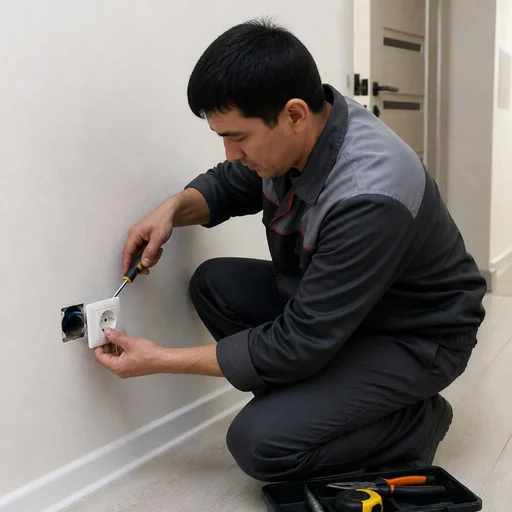
- Socket installation: mounting the back box, connecting the conductors with polarity and grounding checks, testing with a tester under load.
- Socket replacement: dismantling the old point with an inspection of the terminals — burnt contacts are replaced with new ones rather than stripped again.
- Switch installation: one-gang, two-gang and two-way circuits, connection according to L and N markings.
- Socket block installation: two to four units in a common frame in the kitchen or workshop, with a separate power line and breaker.
- Socket relocation: extending the line through a junction box or pulling a new cable in a chase according to a new plan.
Lighting installation: chandeliers, spotlights, strip lights, wall sconces
- Chandelier installation: mounting to a ceiling anchor or hook, wiring to the terminal block, testing each group.
- Chandelier replacement: removal of the old fixture with inspection of the twists in the ceiling box — a common cause of flickering.
- Spotlight installation: cutting out according to a template, connection via a plug connector, calculation for a series or parallel circuit.
- LED strip installation: laying into a profile with a diffuser, connection via a power supply and dimmer, soldering the contacts.
- Sconce installation: wall mounting with the cable routed out of the wall, connection via a switch or sensor.
- Fluorescent lamp connection: installation of a ballast and starter, or conversion to an LED tube with rewiring of the circuit.
- Load calculation: for a strip longer than 5 meters, a power supply with a power reserve and feeding from both ends is needed — otherwise the far end shines dimmer.
- Choosing a specialist: work on light fixtures in Tashkent is most often limited to ceiling structures — on a stretch ceiling, anchors are installed before the membrane is mounted.
How an electrician's work proceeds: visit, diagnostics, estimate
A request starts a clear chain: a call or message on Telegram, a technician's visit, inspection of the site, a line-by-line estimate, a contract, and handover of the work by acceptance report. Let's break down each stage — from first contact to signature on the report.
Technician visit on the day of request and nighttime emergency call-out
Eco-Service arranges a technician visit on the day of request across Tashkent, including nighttime emergency call-outs for power outages or the smell of burning wiring. The dispatcher clarifies the address and nature of the fault — a socket sparking, a breaker tripping, power lost in the entire apartment or only in one room. The crew arrives with a thermal imager, multimeter, clamp meter, and a set of breakers, so most emergencies are localized in a single visit, without a second trip for parts. In the Yashnabad, Mirzo-Ulugbek, and Sergeli districts, travel takes on average 40-60 minutes; during rush hour in Chilanzar — up to an hour and a half. In the search bar, clients often type a query about calling a technician to their home — and land on this page, although behind that wording is an ordinary request for a visit. Before the crew arrives, if you smell burning cable, de-energize the apartment at the main breaker and do not switch it back on — energizing under load often causes a fire in the wall chase.
Wiring audit and estimate approval before work begins
Before work begins, an Eco-Service specialist conducts a wiring audit, records the scope in the estimate, and formalizes a contract — the amount does not change during the process unless new points are added. The technician opens the socket boxes, checks the cross-section of the conductors, the condition of the twists in the junction boxes, the rating of the breakers on each line, and the presence of grounding. Work on the site starts only after the customer has seen the breakdown by lines: lighting, kitchen socket group, room sockets, washing machine, air conditioner. Each item in the estimate is tied to a specific section — this eliminates disputed extra charges in the middle of installation. People type the query "electrician work" when they are looking for a one-time visit for a single fault, not comprehensive installation — and in that case the estimate is calculated based on the inspection, not the project. Ask for the estimate to specify the cable cross-section and breaker ratings for each line: this protects against substituting copper with a thinner equivalent during installation.
PUE standards and on-site safety practices
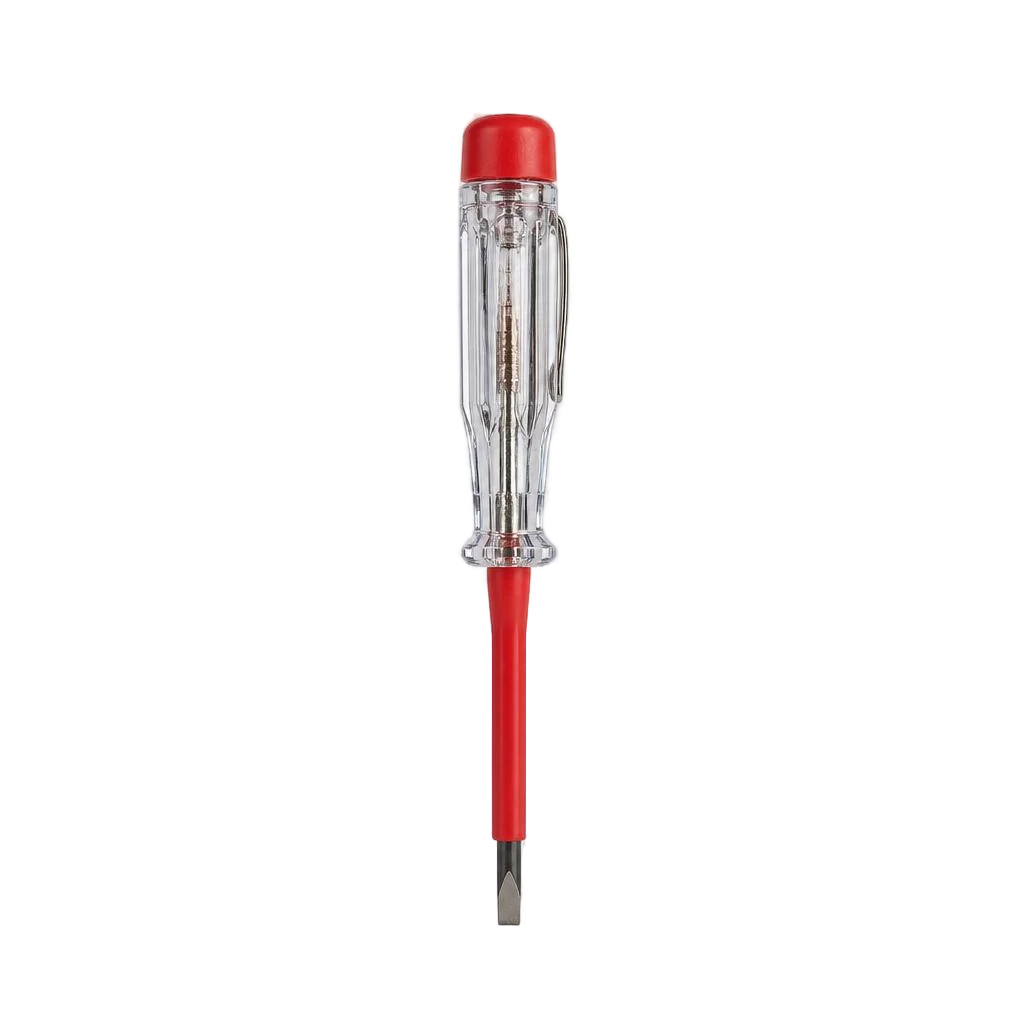
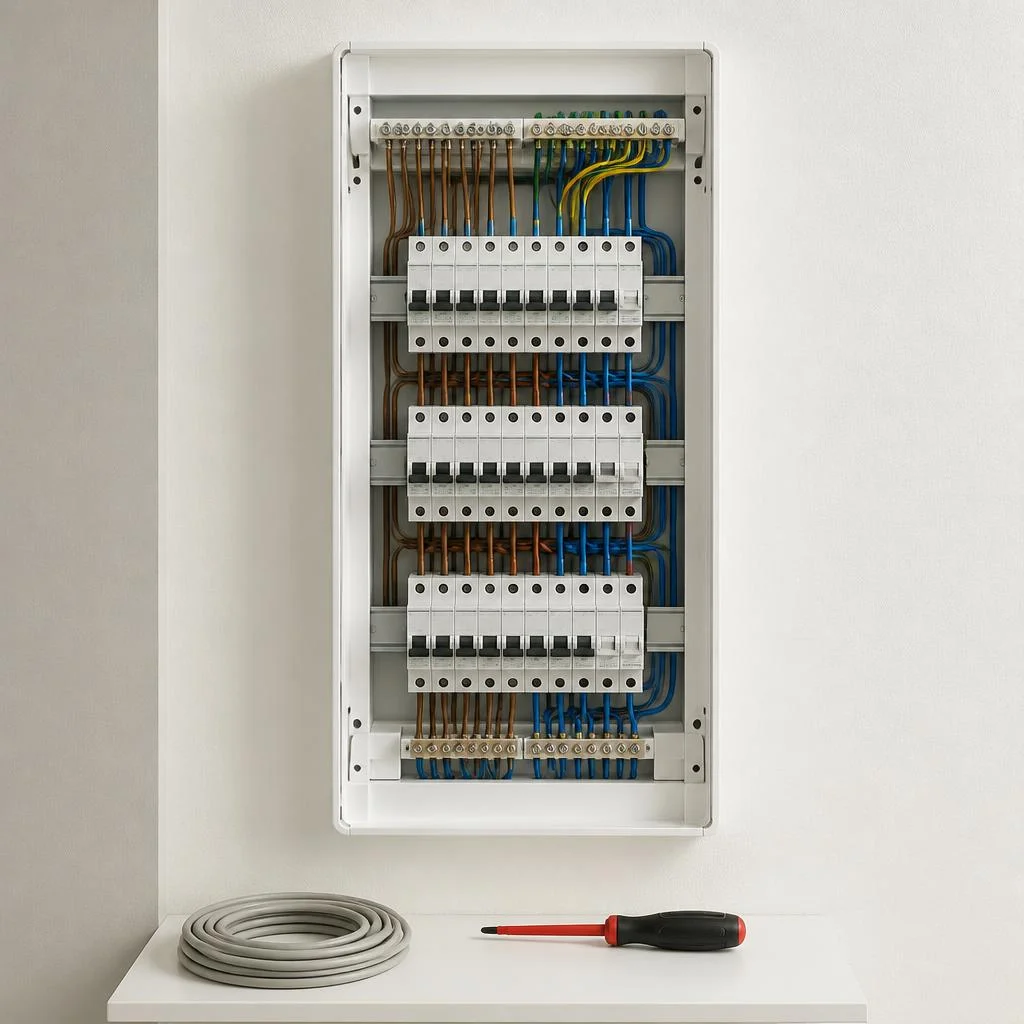
Electrical installation is carried out in accordance with the PUE: cable cross-sections for the load are observed, line protection with breakers and RCDs, as well as safety rules when working under voltage. For socket groups in living rooms, a 3×2.5 mm² cable with a 16 A breaker is used; for lighting — 3×1.5 mm² with a 10 A breaker; for an electric stove — a separate 3×6 mm² line. Work on the panel begins only after de-energizing at the input and verifying the absence of potential with a tester — this is a basic rule that is violated during emergency repairs. Connections are made with Wago terminals or by crimping with a ferrule; twists on copper are left only as a temporary solution. The absence of an RCD in wet zones — bathroom, kitchen, outdoors — is the main cause of electric shock in households; this point should be checked first when accepting the work.
Electrician for home: apartment, private house, new building
The scope of the master's work depends on the type of property: in an apartment it's distribution into groups and final points, in a private house an incoming supply, outdoor lines and outbuildings are added, in a new building they start with an audit of the factory scheme.
Electrical installation in an apartment: scope and stages
In an apartment, Eco-Service carries out installation from the panel to the final points: distribution into groups, wall chasing, cable laying, installation of sockets, switches and light fixtures. The work is divided into three stages: first, marking out points for furniture and appliances, then distribution of groups from the electrical panel with separate lines for the kitchen, air conditioner and boiler, then final installation of sockets and light fixtures. For a two-room apartment of 60-65 m² with stretch ceilings it takes 5-7 working days, the route length reaches 180-220 meters of VVGng cable. In apartments with stretch ceilings, the route for light fixtures is laid before the membrane is installed — after installation, access to the ceiling wiring is closed off. Clients sometimes phrase the request as electrician work in Tashkent — essentially it's the same thing: a full cycle from marking out to connection.
Electrician in a private house: incoming supply, panel, outdoor lines
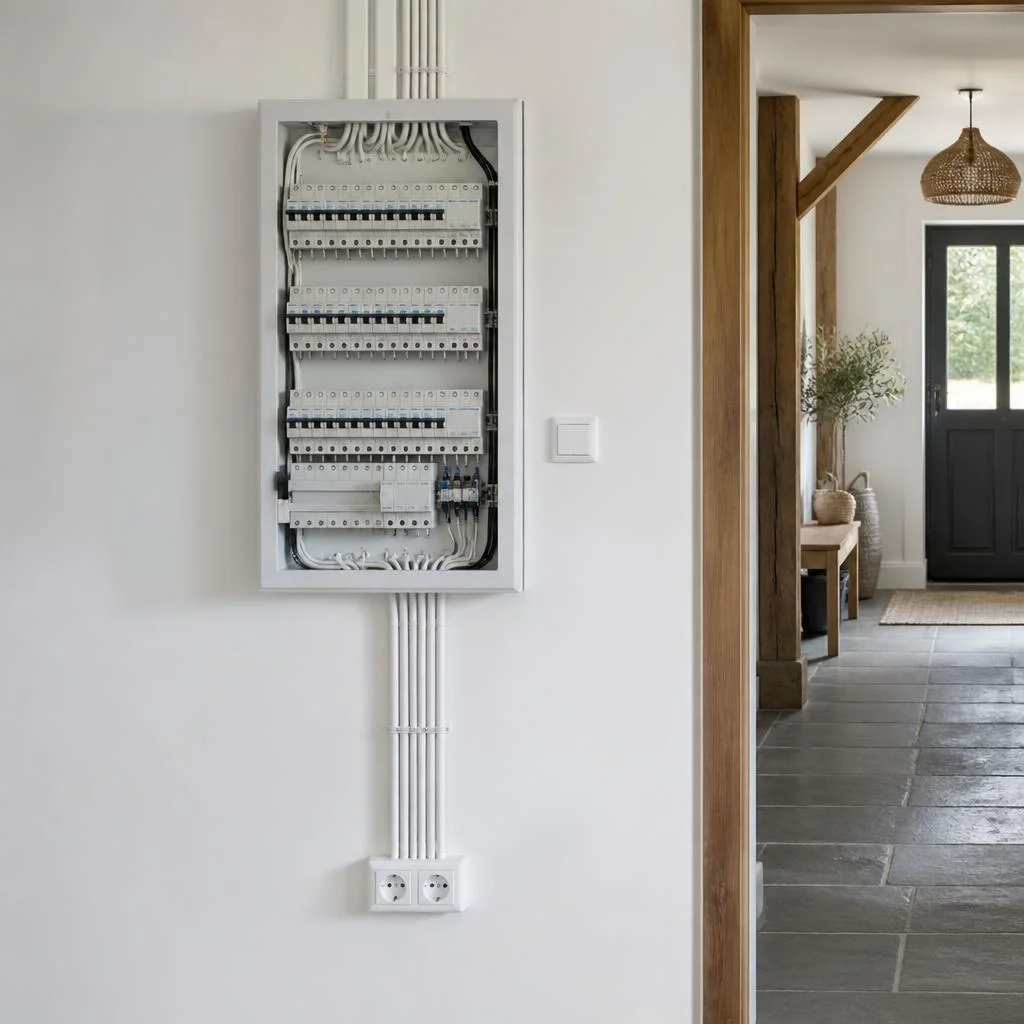
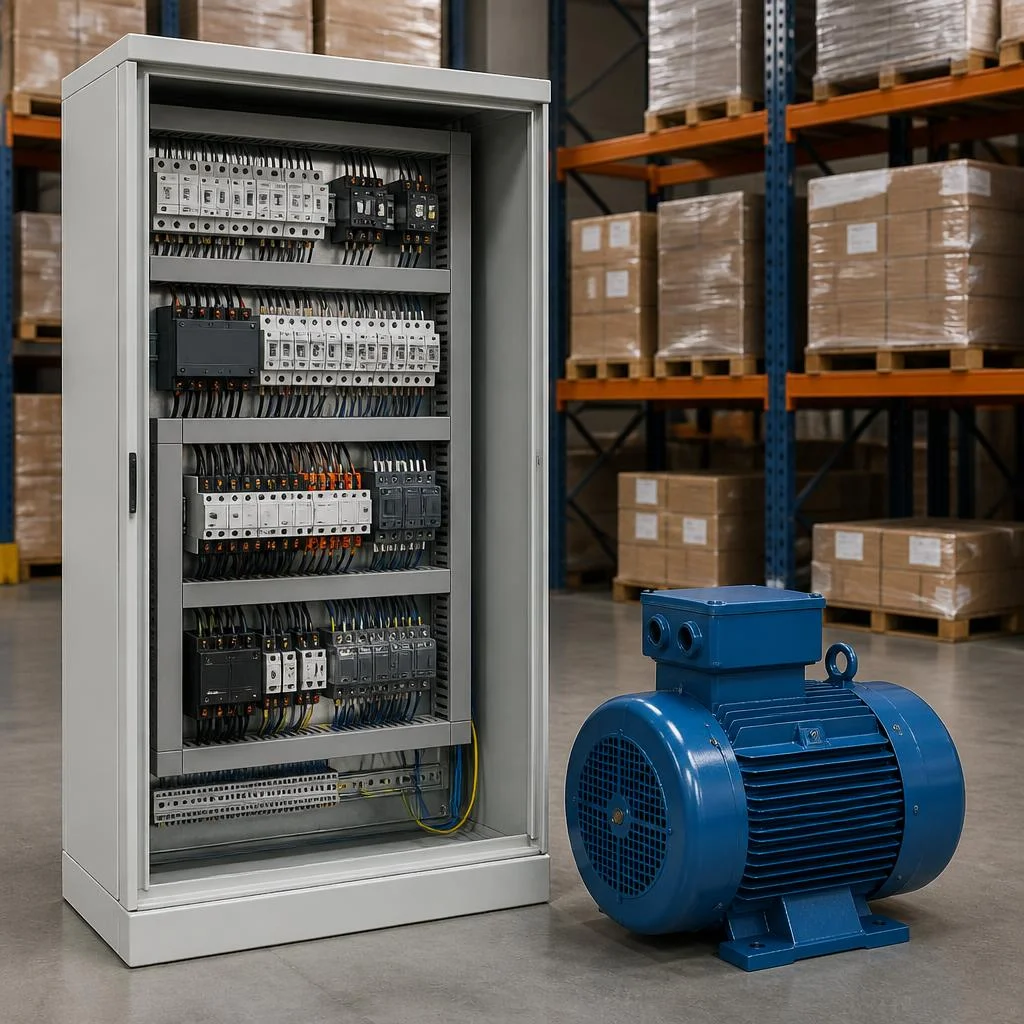
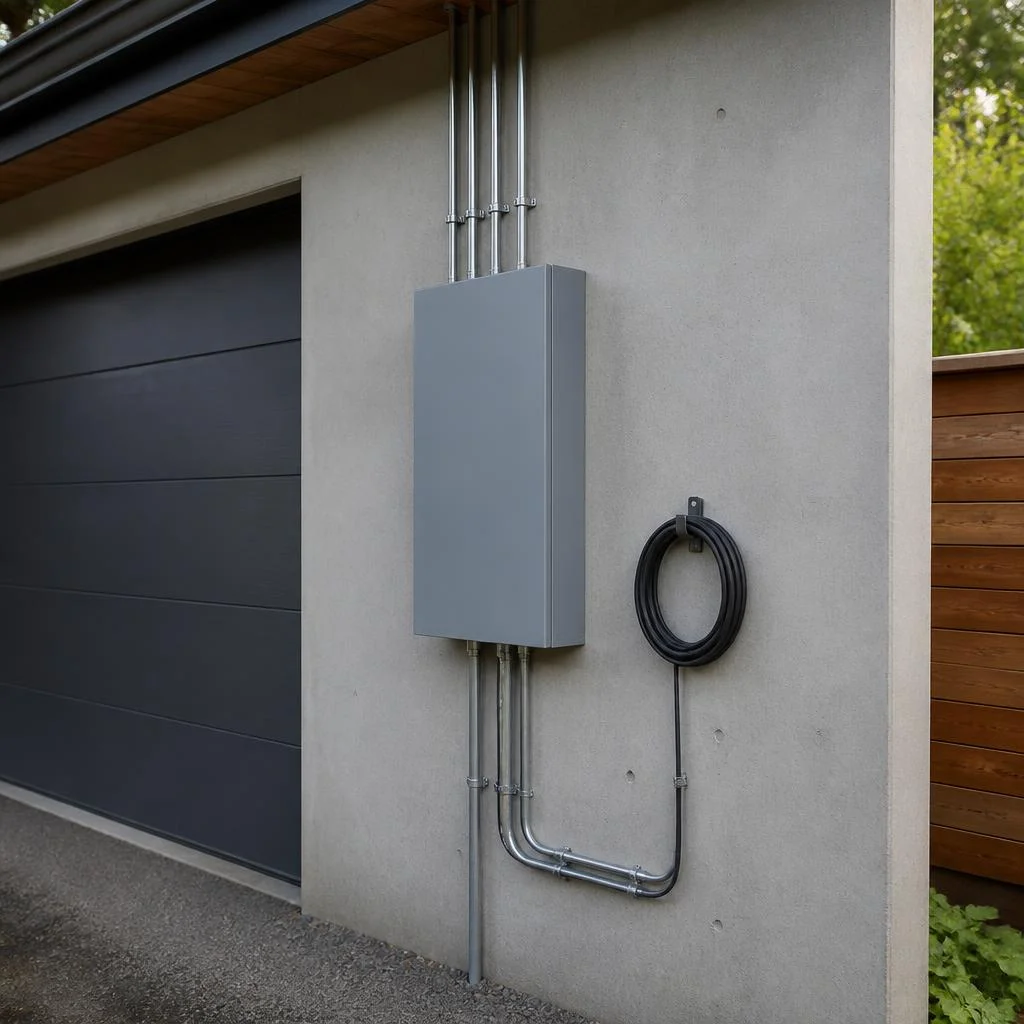
In a private house we install the incoming supply from a pole or a well, assemble a panel with circuit breakers and RCDs, run lines outside, to outbuildings and for site lighting. For a house of 120-150 m², a panel with 24-36 modules is installed: an incoming circuit breaker, an RCD at 100-300 mA, separate groups for the boiler, pump, bathhouse and garage. The incoming supply from a pole is done with cable with a supporting messenger wire or SIP, the underground supply from a well — with armored cable in a trench 0.7 meters deep. For outdoor lines and incoming supplies, cable with UV and moisture protection is used, and connections are made only in sealed boxes — twisted joints outdoors oxidize within a single season. In the private sector, masters often look for side work themselves: electrician job openings Tashkent — a typical request from those who want to join our crew on seasonal projects.
Electrician in a new building: what to check before renovation
In a new building, Eco-Service checks the factory wiring, cable cross-section and panel before finishing begins — the developer often installs a minimal set of circuit breakers without RCDs. The wiring audit includes continuity testing of each line, measuring the cross-section with a caliper and checking the junction boxes: at Tashkent residential complex sites in panel series, they often find 1.5 mm² cable on the kitchen line, where a minimum of 2.5 mm² is needed. Based on the results, a rework plan is drawn up — RCDs are added for wet zones, high-power appliances are separated into individual groups, and if necessary the incoming circuit breaker is replaced. Factory twisted joints in the junction boxes of a new building are best redone before plastering: after finishing, access to them is closed off, and that is precisely where overheating most often occurs.
Wiring audit in a new building: what the master checks
The specialist's work at the acceptance of a new building begins with continuity testing of the lines before plastering: the master checks the cable cross-section with a caliper, the presence of grounding and whether the groups match the design scheme. They also separately look at where the lines are routed — job openings in Tashkent are posted on local platforms primarily for projects with full wiring, where an electrical safety permit is required. In panel series of Tashkent residential complexes, an undersized cross-section on the kitchen line and twisted joints in junction boxes without soldering are often found. Before finishing begins, defects are recorded in a report and the list of rework is agreed with the developer or the owner.
Comparing electrician services: what to choose for the task
We bring the services together in a table by property, scope and format of work, so the client can choose the right scenario for their task.
Services table: property, scope, format of work
| Service | Property | Scope of work | Format |
|---|---|---|---|
| Replacing a socket / switch | apartment, house | point work | visit for 1 point |
| Installing a block of sockets | kitchen, office | group of points | dedicated line |
| Moving a socket | apartment | 1–3 points | chasing + installation |
| Wiring installation in an apartment | apartment | turnkey | distribution + finishing |
| Wiring installation in a house | private house | turnkey | incoming supply + panel + lines |
| Replacing electrical wiring | apartment, house | full replacement | dismantling + installation |
| Chasing walls for cable | any property | by linear meter | preparing routes |
| Lighting installation | apartment, house | point / comprehensive | chandeliers, strip, sconces |
Point work or comprehensive installation: how to choose
Eco-Service recommends a point visit if up to three points are being replaced, and comprehensive installation if a renovation with wiring replacement or redevelopment is planned. A symptom such as a heating back box or the smell of burnt insulation indicates wear of the entire line: then a wiring audit is needed, not a local fix. A request to find a handyman for one-off work often comes from contractors — but with a point replacement of a socket, the cable in the back box may crumble, and then a local repair will give a temporary result. Clients often state the task briefly — electrician work — and from this phrase the technician clarifies the property, the number of points and the condition of the line before the visit. In our practice, on properties older than twenty years, a point replacement without checking the entire circuit brings the client back again within a month.
Warranty, contract and payment for electrician services
An order for electrical installation is documented: before work begins, the list and cost are agreed upon; after completion, an acceptance certificate is signed. Below is what the warranty period covers and what methods can be used to pay for the completed scope of work.
2-year warranty on electrical installation work
Eco-Service provides a 2-year warranty on electrical installation work: if a defect in the installation appears during this period, the technician makes a repeat visit and fixes it at no additional cost. The warranty period is counted from the date of signing the completed work certificate and covers twists, connections in back boxes, mounting of circuit breakers on the DIN rail and fastening of cable in corrugated conduit. A repeat warranty visit is arranged as a separate request: the technician records the nature of the fault, checks the diagram against the estimate and eliminates the cause, not just the consequence. By the way, in our practice, a third of warranty claims are related not to the installation itself, but to the owner independently replacing a circuit breaker. The warranty is valid provided the diagram and ratings of the circuit breakers are preserved: replacing a breaker with a higher rating removes the line's protection and voids the obligations. Some clients come to us through the search query electrician work Tashkent — and after the first project they stay on for ongoing maintenance.
Contract, certificate and payment via Click, Payme, Uzcard, Humo
Work is formalized with a contract listing the services and a certificate after completion; payment can be made via Click, Payme, Uzcard or Humo — in cash or by card. Every item is included in the list: installation of electrical wiring, installation of sockets and switches, lighting installation, wall chasing for cable. Before signing, check that the contract states the cable brand and cross-section, the ratings of the circuit breakers, and the presence of an RCD on wet lines. The certificate is signed after testing under load — running each line at operating current. Payment is accepted in parts: an advance for purchasing materials and the remainder after acceptance. In the contract, record not only the list of works, but also the cable brand and breaker ratings: in a dispute, this is the only document confirming that the installation was performed according to the agreed diagram. If you are looking for a crew through advertisements, compare: job listings in Tashkent are published without specifying ratings and diagrams — and without them there will be nothing to base a quality claim on. In search, such listings are often typed as electrician job in Tashkent, but for the customer what matters more is not the headline, but the attached diagram.
How to choose an electrician in Tashkent: criteria and risks
When choosing a specialist, people look at permit documents, grade and experience, the set of tools, the format of the work paperwork, and reviews on maps. Below are the verification criteria and the risks that surface after installation.
Qualification and grade of the specialist: what to check
Qualification is confirmed by the electrical safety group and grade: for household work, group III–IV and at least three years of experience at sites are sufficient. Ask for a certificate with a mark indicating the admission group — it is assigned by a certification commission after testing theory and practice, and the renewal record is in the document itself. The grade shows what voltage and what systems the specialist has worked with: the third allows servicing up to 1000 volts, the fourth — working in a team and supervising a shift. Experience is verified by sites: ask how many apartments and private houses the specialist has handled from wall chasing to connecting the panel, and not just replaced sockets. Clients often phrase the request as electrician work in Tashkent — from such a phrase it is clear that the person needs a confirmed permit, not a one-off side job. Ask what device he will use to find the fault: a multimeter and clamp meter show load and leakage, while checking with a test lamp does not reveal hidden insulation defects.
Private specialist or service company: risks and advantages
A private specialist is cheaper and faster for spot work, but does not provide a contract or warranty; a service company draws up documents and bears responsibility for the result. On a one-off socket replacement or chandelier connection, the price difference is noticeable, and for a single point a private specialist is often justified. On complex installation in a new building or rewiring in a private house, the risks are different: the volume of hidden work is large, and fixing someone else's mistake is more expensive than doing it right the first time. The contract fixes the list of works, cable cross-section, brand of circuit breakers, and warranty period — 2 years for electrical installation. An audit of the wiring before starting shows the condition of the old line: aluminum, lack of grounding, weak twists in junction boxes. In ads and on job boards, the phrase electrician vacancies in Tashkent appears alongside service offers — it is easy to confuse an employee with a contractor for a site. The main risk of private installation is the absence of a diagram: during the next renovation, no one knows where the route runs, and the cable is pierced with a dowel.
Typical mistakes when choosing and accepting work
- Saving on cable cross-section: for powerful appliances, 1.5 mm² is used instead of 2.5 mm², the conductor heats up under load and melts the insulation.
- No RCD: without a residual current device, leakage to the appliance body does not disconnect the line and remains deadly dangerous.
- Twists instead of terminals: a connection in a junction box oxidizes within a season and causes heating, whereas a terminal block maintains contact for years.
- No route diagram: without a wiring plan, the next renovation pierces the cable with a dowel or drill, cutting power to the apartment.
- Acceptance without load: the line is checked with a lamp rather than by turning on powerful appliances, so an installation defect surfaces later.
Conclusion
We have gathered the main things worth keeping in mind before calling a specialist and accepting the work. The five points below are the practical minimum that protects against rework and unnecessary costs.
Main conclusions
- Diagnostics come first: finding a short circuit and checking the panel show the cause of the failure, not the consequence — installing blindly will cost more.
- The installation method depends on the walls: wall chasing, corrugated conduit, and a hidden route are not interchangeable — they give different results in panel and brick.
- Contract and 2-year warranty: written obligations protect the customer if a defect appears after the site is handed over.
- Qualification is confirmed by documents: the electrical safety admission group, grade, and professional tools say more about a specialist than promises.
- Acceptance — under load: heating of circuit breakers, sockets, and connections is visible only under operating current, not during a visual inspection.