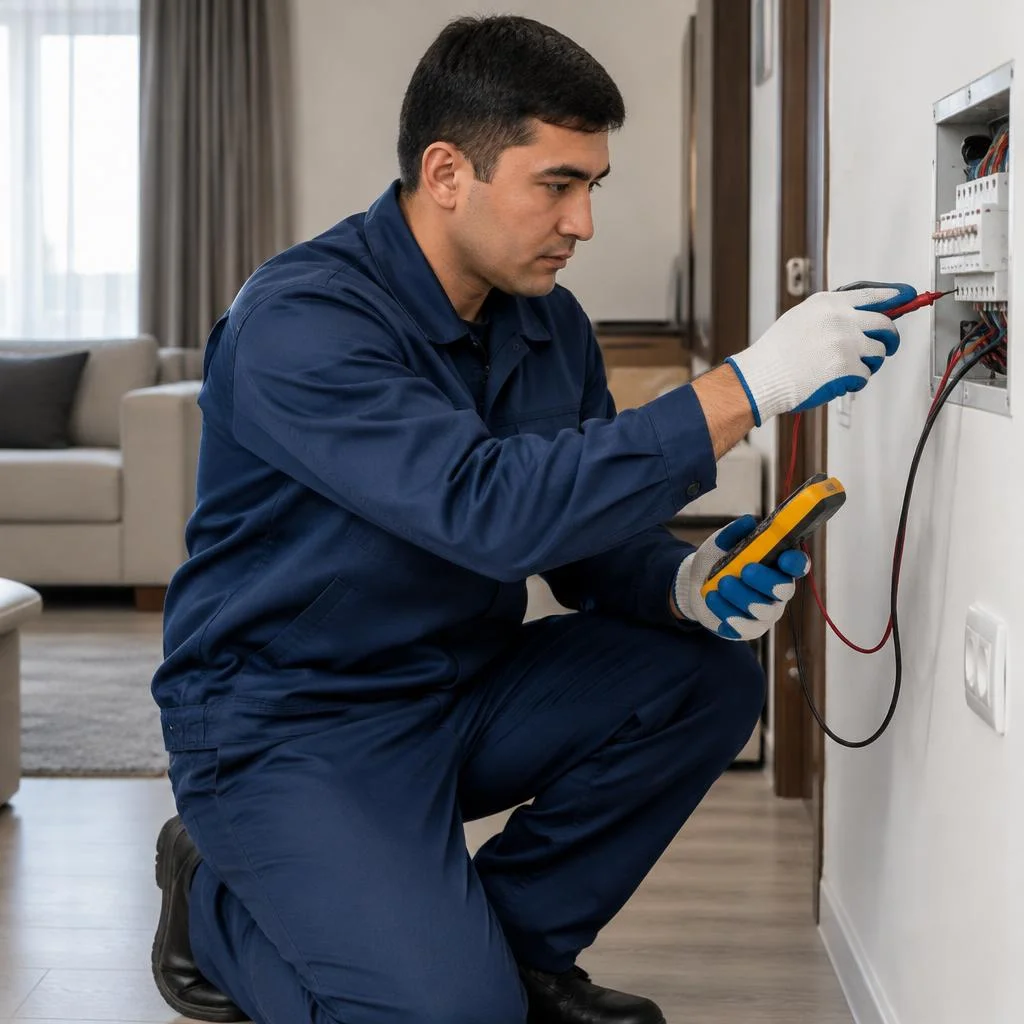
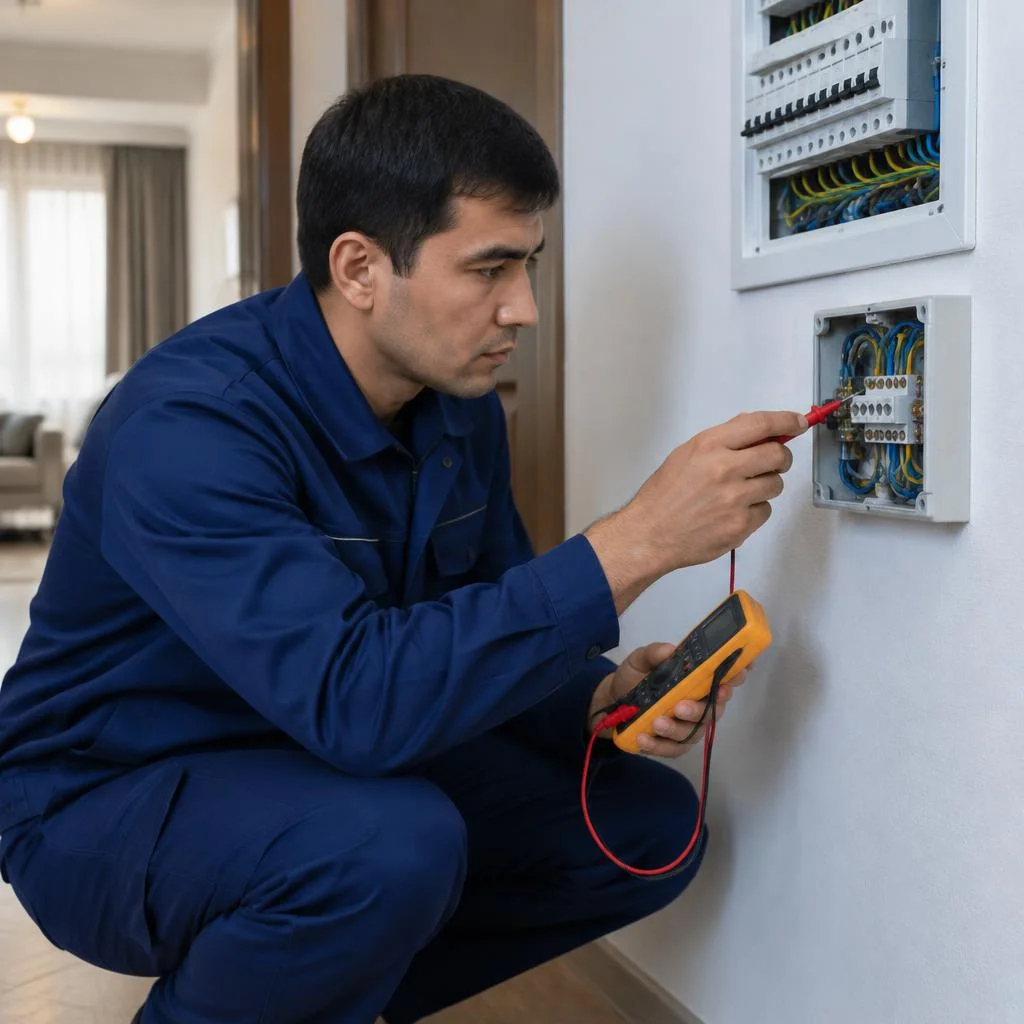
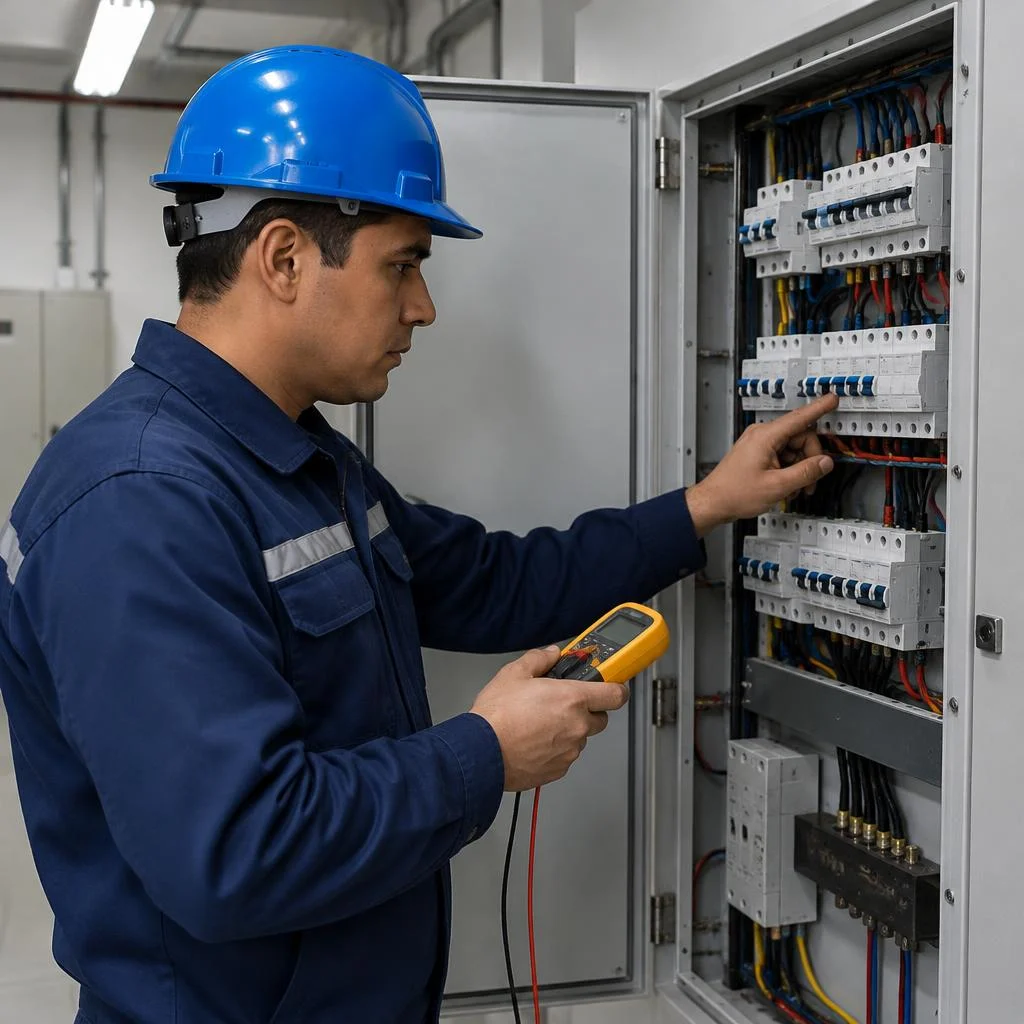
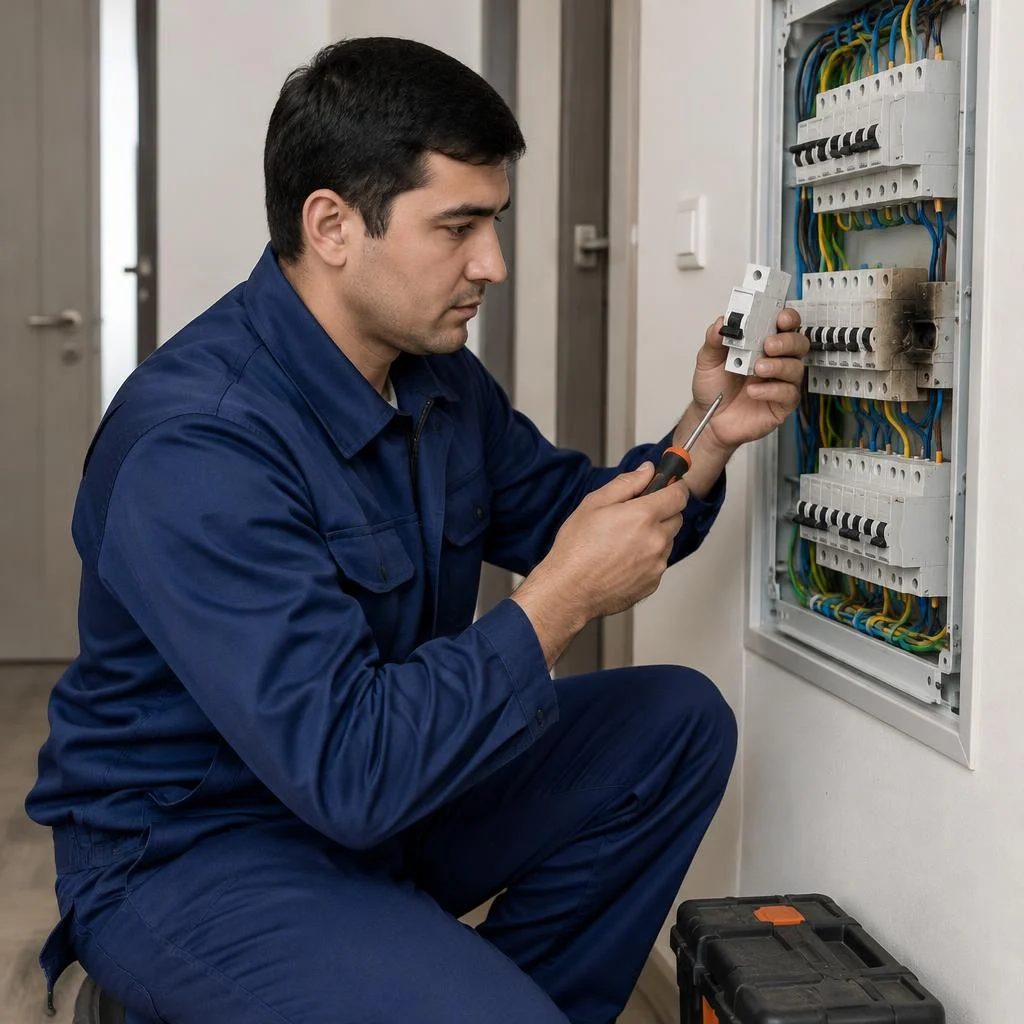
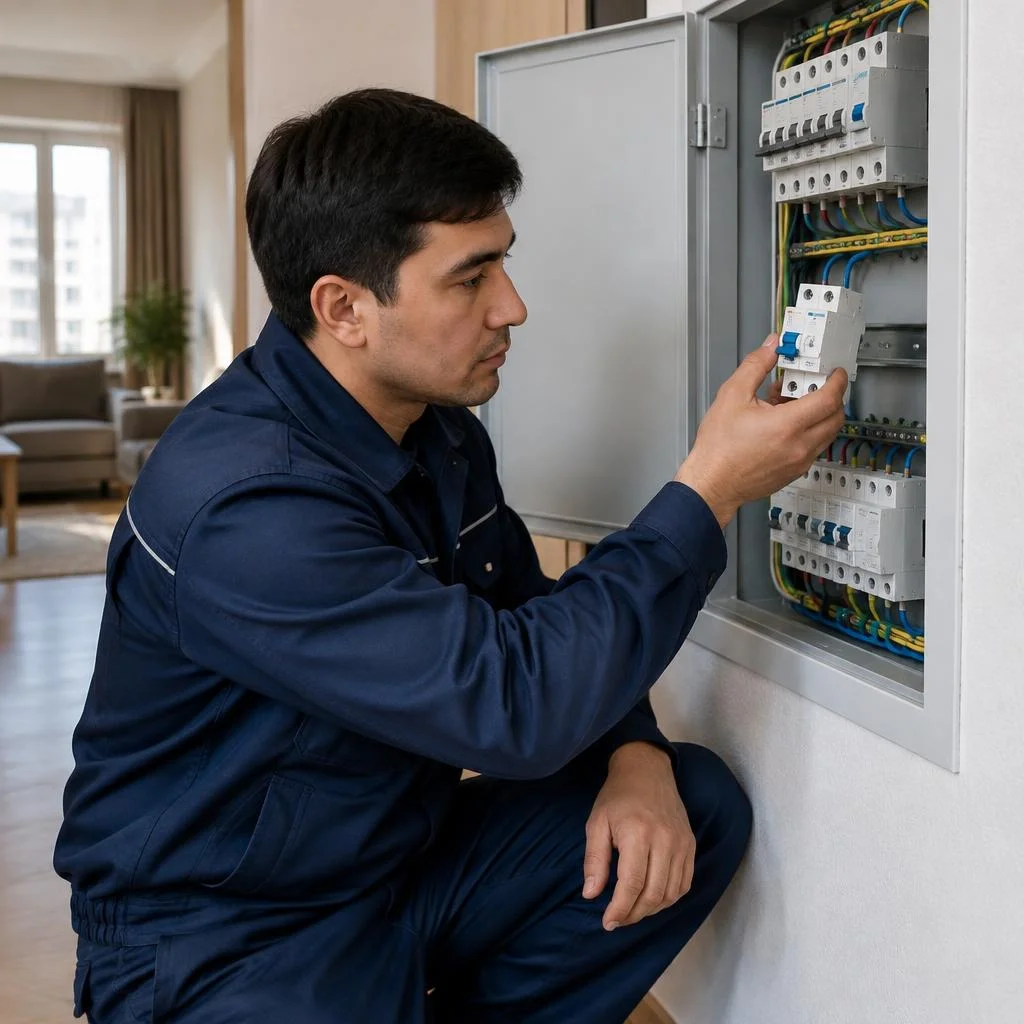
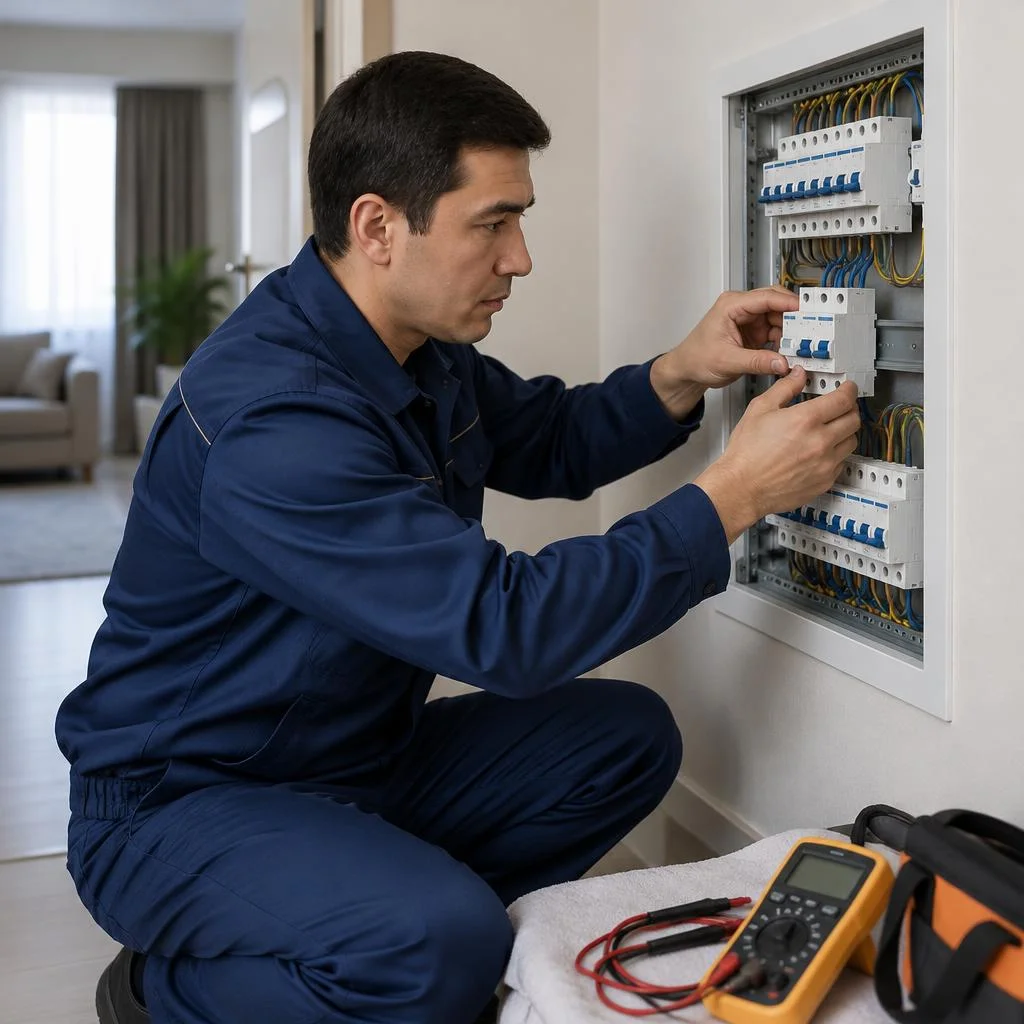
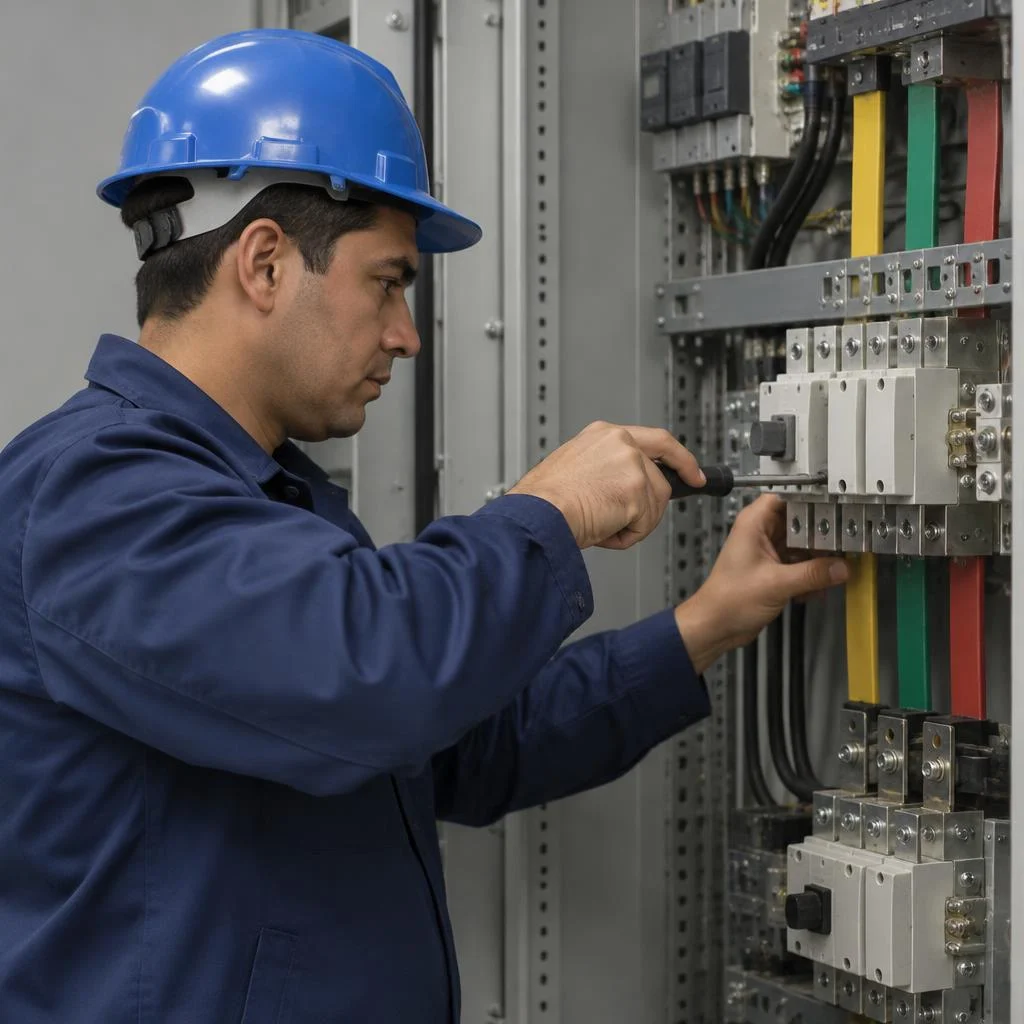







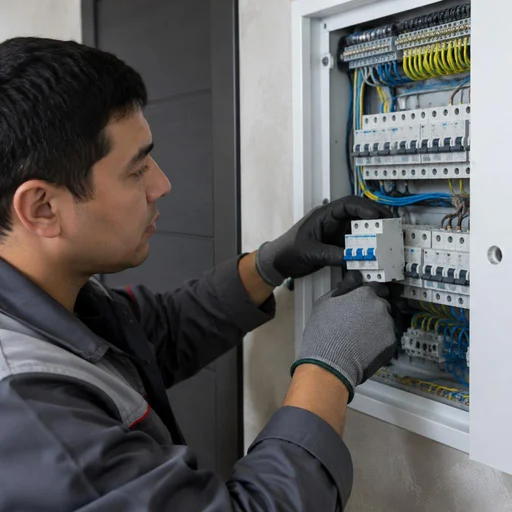
When you need an emergency electrician: signs of an emergency and what to do before arrival
An electrical emergency is not just tripped fuses. We break down the symptoms that call for an urgent electrician, what is safe to do before the technician arrives, and why Tashkent's housing stock produces a distinctive pattern of breakdowns.
Emergency symptoms: when you cannot delay the call
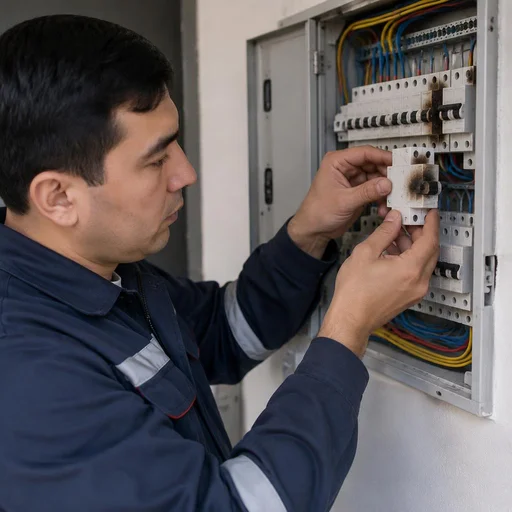
- A burning smell from a socket or panel: indicates an overheated contact or melted insulation — one of the common causes of nighttime fires in apartments.
- Sparkling and crackling in a socket: points to a poor contact or an arc discharge that burns through the mounting box and wall within minutes.
- A circuit breaker trips again after being switched on: a sign of a short circuit or network overload, not a random trip of the protection.
- Partial loss of light in the apartment: a sign of a broken neutral or a burnt-out phase in a 380 V three-phase supply.
- Heating of a plug, extension lead or appliance body: a consequence of line overload, when the combined power of the appliances exceeds the cable's cross-section.
What is safe to do before the technician arrives
- De-energize the main breaker: this removes voltage from the internal wiring and reduces the risk of electric shock when touching appliances.
- Do not touch wet walls and floors near the panel: water conducts current, and a damp surface next to an emergency is a direct path to a shock.
- Do not open the panel or replace breakers yourself: without a device for detecting current leakage you will not see the damaged section and risk shorting the line again.
- Unplug high-power appliances: heaters, boilers and air conditioners remove the residual load from the faulty line.
- Ventilate the room if there is a burning smell: the products of insulation combustion are toxic, and a draught lowers the smoke concentration before the technician arrives.
Typical causes of emergencies in Tashkent's housing stock
In Tashkent's older buildings, emergencies are most often caused by aluminium wiring: it oxidizes at twisted joints, loses contact and heats up under load. In the 1-464 and 1-335 panel series, APPV cable with a 2.5 mm² cross-section was laid under the plaster back in the 70s and 80s, and over the decades the conductor has become covered with an oxide film that increases the resistance of the joint by 2-3 times. On top of that comes network overload: a modern apartment runs an air conditioner, a washing machine and a hob through a single line rated for 16 A. In the brick houses of Chilanzar and Yunusabad there is a second problem — aluminium twists in distribution boxes that have not been serviced for years, which is why an urgent electrician call-out here often involves restoring a contact in the panel. In such houses an emergency electrician call-out frequently has to be repeated: aluminium cannot be connected directly to copper — a galvanic pair forms at the contact point, which accelerates heating, and such joints require terminal blocks or transition sleeves.
Diagnostics: how we locate hidden wiring, breaks, and short circuits
Diagnostics is a separate stage that determines exactly where the fault occurred. Without it, any replacement of a circuit breaker or outlet becomes work done blindly, and the cause of the malfunction remains in the wall.
Locating hidden wiring without unnecessary chasing
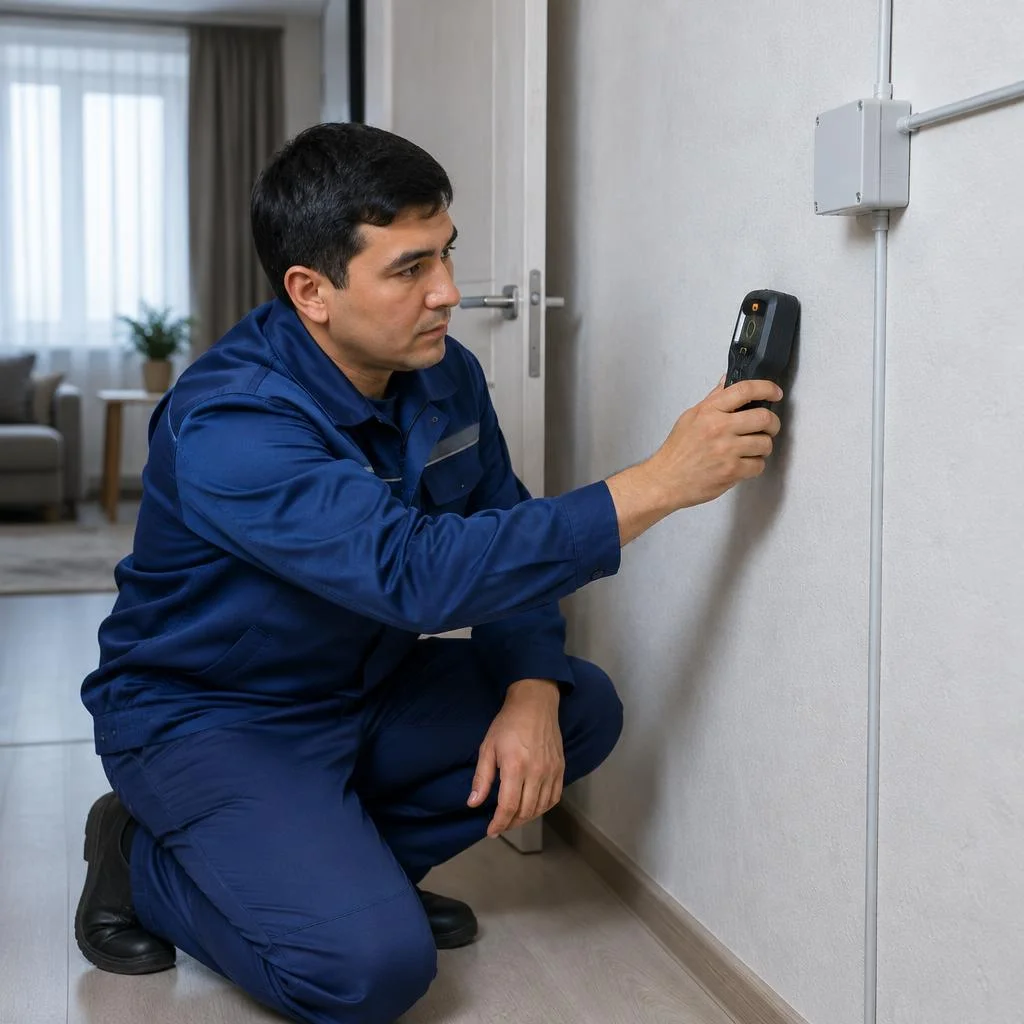
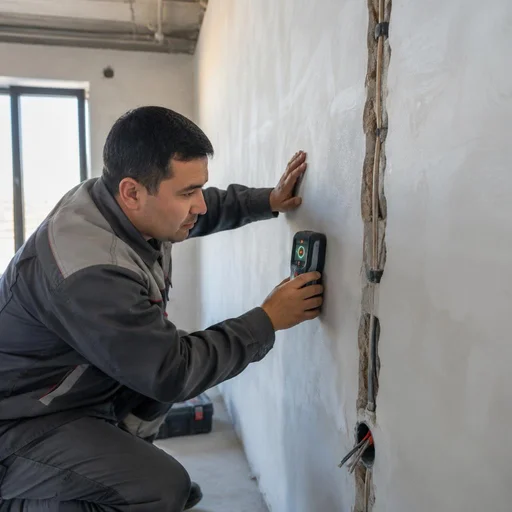
We locate hidden wiring with a device without opening up the walls: the route is determined by the electromagnetic field, and the damage point by the change in signal along the line. On the job we use route locators with a clamp-on sensor and a thermal imager: overheating of the insulation in a section is visible as a local hot spot even before the cable starts smoking. We connect equipment for finding current leakage to the line through a differential clamp — it detects the difference between phase and neutral even with a small leakage current. Expert recommendation: location accuracy drops if there is reinforcing mesh or metal pipes in the wall — in such cases the Eco-Service technician confirms the route with a verification opening at one point, rather than "at random."
Locating the point of a break and a short circuit
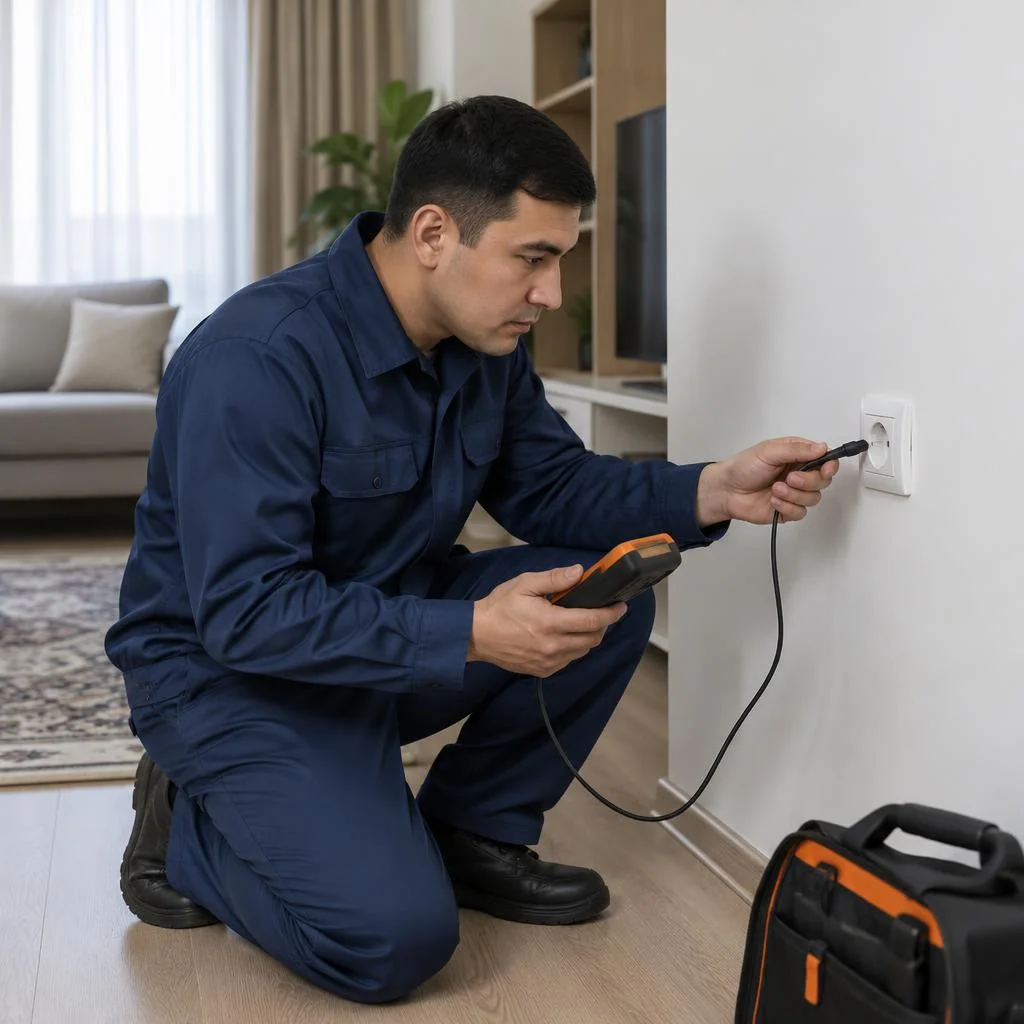
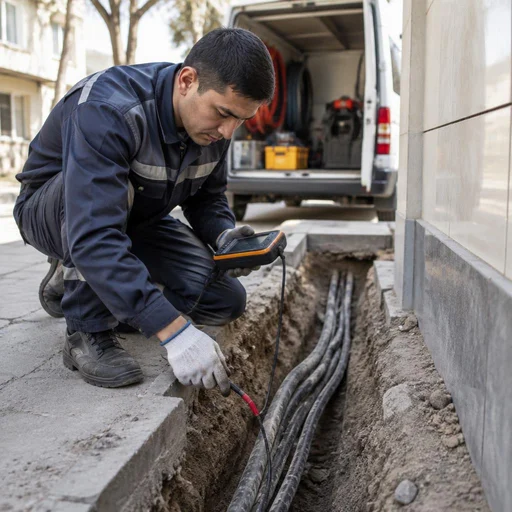
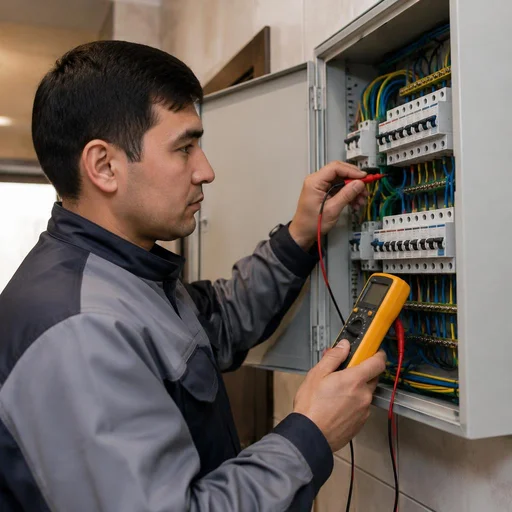
The electrician finds the point of a break and a short circuit section by section: first checks the panel, then rings out the lines and localizes the damage down to a specific segment. When the neutral breaks in a 380 V three-phase network in one of the apartments, the voltage jumps to 300 V and above — a multimeter will show this in seconds, and a reflectometer will indicate the distance to the break in meters. A short circuit in the old aluminum wiring of Tashkent high-rises most often sits in a junction box or at a twist behind a suspended ceiling. In search, clients often type it briefly: Emergency electrician — and for such a request we arrive within an hour, because the entire apartment is left without light. Practical advice: a short circuit and a break often produce the same external symptom — "no light" — but they are fixed differently: for a break, the contact is restored; for a short circuit, the damaged section of cable is replaced.
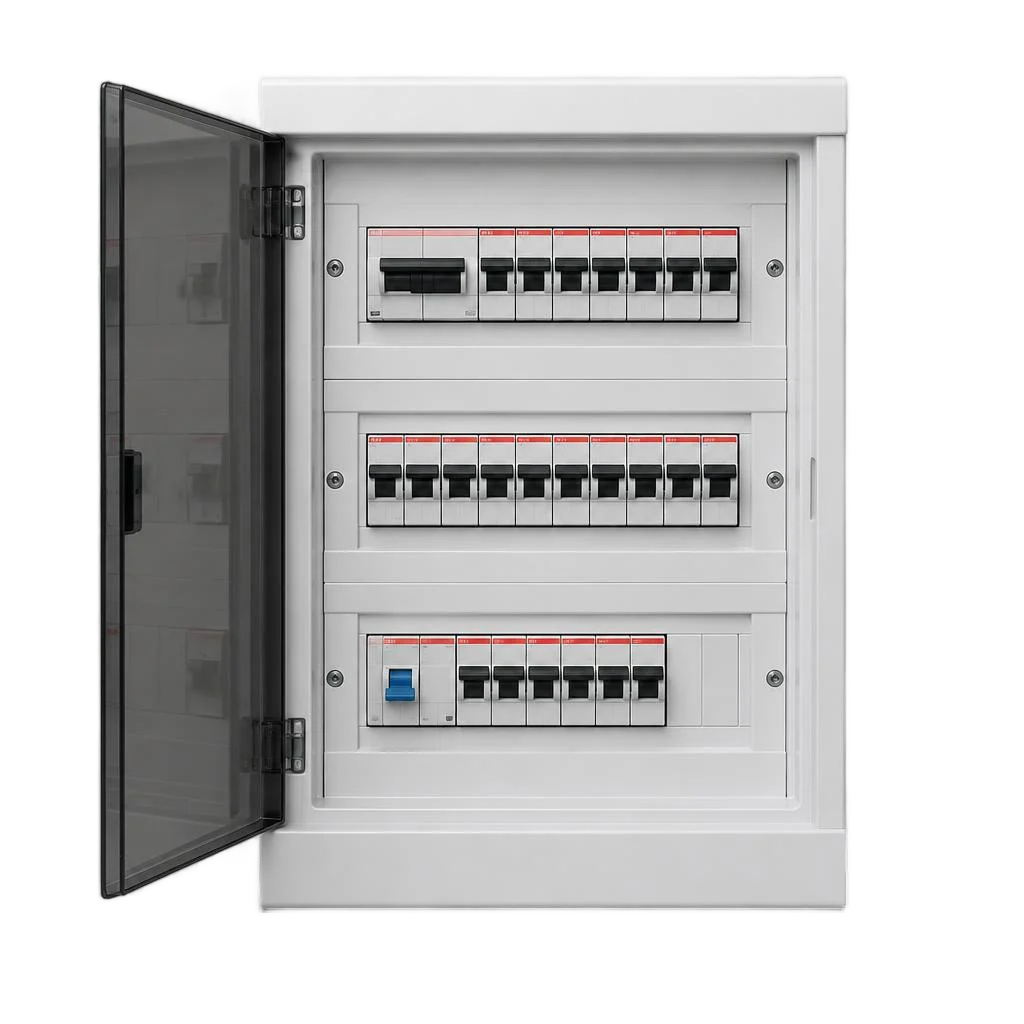
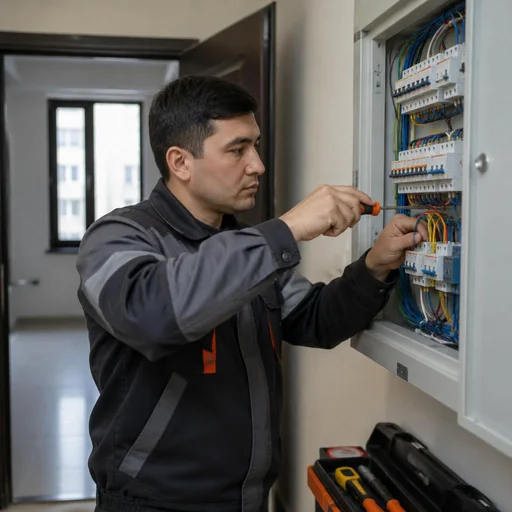
Checking the panel and circuit breakers: what an audit reveals
| What we check | Sign of a problem | What we do |
|---|---|---|
| Breaker terminals | heating, darkening | restore the contact |
| RCD and RCBO | does not trip during test | replace the RCD / RCBO |
| Breaker rating | higher than the cable cross-section | select according to the load |
| Knife switch | sparking, play | replace the knife switch |
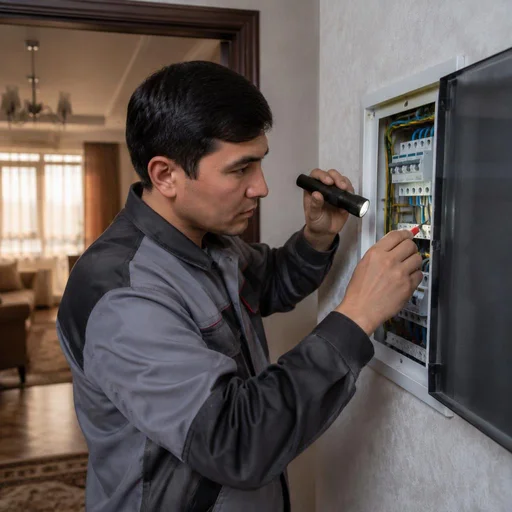
We carry out the check under load: we turn on the kettle, air conditioner, and boiler simultaneously to see the real heating of the terminals and the voltage drop. A breaker with an inflated rating does not protect the line — it "holds" the overload while the cable heats up; during the audit we compare the rating with the cross-section, not just with whether it "trips or not."
Replacement and repair of panel elements: circuit breakers, RCDs, RCBOs
The panel is the node where accidents most often occur. We break down how a circuit breaker, an RCD, and an RCBO differ, what is included in replacing each element, and when a part is replaced versus when a contact is repaired.
How a circuit breaker, RCD, and RCBO differ
| Element | What it protects against | When it is replaced |
|---|---|---|
| Circuit breaker | overload, short circuit | burned out, does not hold the load |
| RCD | current leakage | does not trip during test |
| RCBO | overload and leakage | combined protection, replacement of the pair |
| Knife switch | outdated input | sparking, loose handle |
A circuit breaker protects against overload and short circuit, an RCD protects against current leakage, and an RCBO combines both functions in a single housing. An RCBO takes up less space in the panel, but when it trips it is harder to determine the cause — that is why in old Tashkent panels a pair of "circuit breaker + RCD" is often left for clear diagnostics: you can immediately see whether the line tripped due to overload or due to leakage to the enclosure.
Replacing a burned-out circuit breaker and restoring the contact
We replace a burned-out circuit breaker with a check of the cause: if the rating was too high or the terminal loosened, the new part will burn out the same way — that is why replacement goes together with restoring the contact in the panel. First, the technician measures the load current with clamp meters on each line: in a kitchen with a boiler and a microwave, it often approaches the circuit breaker's rating, and then the issue is not the part but the overloaded line. Next, we check the terminal tightness with a torque screwdriver — a loosened contact heats up, melts the housing, and trips neighboring modules. If the line is indeed overloaded, we install a separate circuit breaker for the high-power appliance or move some of the outlets to a free phase. Before replacing a circuit breaker, measure the load current: if it is close to the rating, the problem is not the part but the overloaded line — then load redistribution or a separate circuit breaker is needed.
Replacing an RCD, RCBO, and knife switch
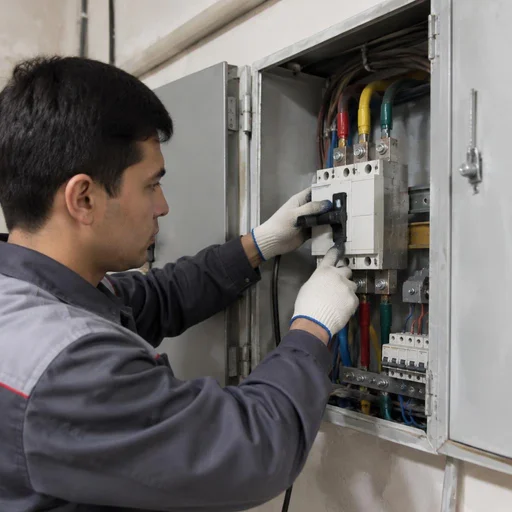
Eco-Service replaces RCDs, RCBOs, and knife switches with a check of the circuit: after replacement, we test tripping with the "Test" button and under load. We select the RCD by rating and leakage current — for wet areas (bathroom, kitchen) we install 10 mA, for other lines 30 mA, otherwise the protection will either not trip in time or will falsely disconnect due to household appliances. An RCBO is convenient where there is no space in the panel for a pair of modules: it occupies one slot and protects the line as a whole. A knife switch in old panels is often left "just in case" — but it does not protect the line, it only switches; at the first opportunity it is replaced with a circuit breaker of the required rating. Checking the panel and circuit breakers after any replacement takes 15-20 minutes and shows whether any weak points remain in the circuit.
Power points and lighting: sockets, switches, chandeliers, accent lighting
Sockets, switches and light fixtures are the most frequent points of failure after the panel: a heating plug, a sparking switch, a burnt smell from the mounting box. Let's break down what we do in each case and how the work on a power point is carried out.
Socket heating, switch sparking: when to replace
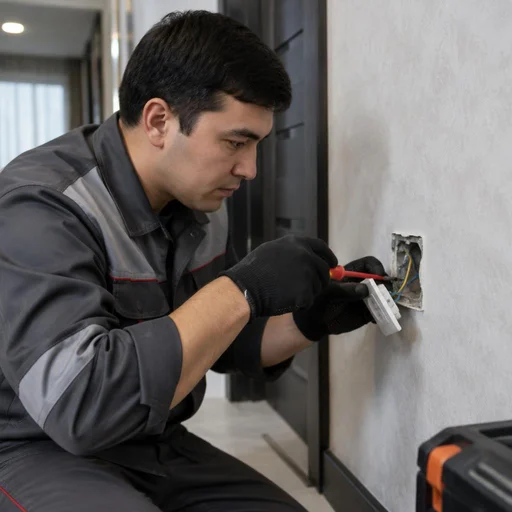
A mobile crew is dispatched for socket heating and switch sparking: we de-energize the line, check the terminals and the mounting box, and replace the point if the contact has already burnt. A heating plug under the load of a washing machine or electric kettle almost always means a loosened screw clamp — the copper beneath it darkens, resistance rises, and the plastic housing melts from the inside. Switch sparking arises for a different reason: the mechanism's contacts burn out after 5-7 years of operation with frequent switching. In search, clients often type in emergency electrician — and end up here, although in fact a scheduled visit for a power point is what's needed. The inspection takes 20-30 minutes: the technician removes the frame, checks the terminal tightness with a torque screwdriver, and uses continuity testing to assess the integrity of the conductor and the cross-section of the supply cable — for a socket group this is 2.5 mm², for a lighting group 1.5 mm². Heating of a point is often related not to the mechanism itself, but to a loosened terminal or a thin cross-section of the supply wire — replacement without checking the line results in repeated heating within a few weeks.
Chandelier repair, installation of spotlights and accent lighting
- Chandelier repair and connection: we work out the circuit for two or three lamp groups, replace E27 and E14 sockets, and restore contact in the terminal block.
- Spotlight installation: we select by the diameter of the mounting hole, 68 or 75 mm, connect via terminals, and check the grounding of the housing.
- Connection of wall sconces and accent lighting: we install surface-mounted and recessed models, run a separate switch, and fit LED strip with a power supply.
- Group check: we test each line under load and verify that the phase goes to the switch, not to the socket.
- Connection diagram: with two lamp groups it is important not to mix up phase and neutral — otherwise, when the light is off, the socket remains energized, and replacing a lamp becomes dangerous.
What is included in work on a power point
- De-energizing the line: we switch off the breaker in the panel, attach a tag, and check for absence of voltage with a tester at the point itself.
- Dismantling the old point: we remove the socket or switch, pull out the mechanism, and assess the condition of the conductors and the mounting box.
- Checking terminals and mounting box: we clean the oxidized copper, check the tightness, and if the mounting box is damaged, replace it with a new one.
- Installing the new point: we fit the mechanism, connect the conductors according to the diagram, secure the frame, and assemble the housing.
- Test under load: we switch on the line and check terminal heating with a thermal imager or by hand after 10-15 minutes of operation of the appliance.
Cable works: laying, wall chasing and route restoration
After fixing an emergency, a damaged or outdated line often remains, and then a new route is needed. We explain how open cable laying differs from laying in a chase and when each option is appropriate.
Open laying or a chase: what to choose
| Method | When it is appropriate | What to consider |
|---|---|---|
| Open cable laying | Concrete, load-bearing walls, temporary lines | Visible cable duct, corrugated conduit or tray |
| Laying cable in a chase | Gypsum partitions, brick, new buildings | Wall chasing plus plastering and final finishing |
| Chasing walls for wiring | A new route or replacement of the entire line | We do not chase load-bearing walls; we run along the ceiling or in the screed |
In panel buildings of Tashkent microdistricts, load-bearing walls must not be chased for wiring — the route is run along the ceiling or in the screed, and this is checked before work begins, otherwise you can receive an order from the State Architectural and Construction Supervision and a fine.
How we chase and lay cable
Eco-Service chases walls for wiring with dust extraction, lays cable in corrugated conduit or pipe and closes the route only after testing the line under load. First we mark out the route according to the apartment plan, bypass load-bearing structures and hidden utilities, then cut a chase to a depth suitable for the wire cross-section — for a socket group usually 3×2.5 mm², for a hob or air conditioner 3×4 mm². We lay the cable in PVC corrugated conduit, secure it with clips at a spacing of 30-40 centimetres, and lead the joints into mounting boxes without twists. After installation we test each conductor for continuity, measure the insulation resistance with a megohmmeter and only then plaster. The wire in the chase is laid with a cross-section reserve for the future load: redoing a hidden route costs more than immediately laying a line for an air conditioner or hob.
How to call an emergency electrician from Eco-Service: callout, contract and 2-year warranty
We explain how the callout works, what is recorded in the contract and why the 2-year warranty is not a formality, but a consequence of the service being provided directly rather than by a random contractor.
How to submit a request and how quickly the technician arrives
- Phone and messengers: you can call an Eco-Service technician by phone or via Telegram and WhatsApp — the dispatcher takes requests around the clock.
- What the dispatcher clarifies: the address, the nature of the symptom (no power, sparking panel, burning smell) and the district — Chilanzar, Yunusabad or Mirzo-Ulugbek.
- What this gives you: the specialist knows the likely fault point in advance and brings the necessary circuit breakers, RCDs and instruments with them, rather than returning for a part after diagnostics.
- Urgency: in case of sparking, the smell of melted insulation or a hot panel, the callout is scheduled first.
The contract and what is recorded before work begins
An emergency electrician works under a contract, and before work begins it records the list of operations, the timeframe and the 2-year warranty — this is what distinguishes a direct service from a private technician with no obligations. The document specifies the legal entity, the property (apartment, office, shop) and the scope of work: tracing hidden wiring, replacing a burnt-out circuit breaker, restoring a contact in the panel. The contract is useful not only in a dispute — it records exactly which lines and fault points have already been checked. On a repeat callout, the technician does not waste time diagnosing the same section, but goes straight to the new point. In our practice there was a case in Yunusabad: six months later the client called a team for a different riser, and using the previous report the technician ruled out the already-checked groups in ten minutes. If a technician offers to work without paperwork — that is a reason to be wary.
2-year warranty and our own service centre in Tashkent
Eco-Service provides a 2-year warranty on its work, and our own service centre in Tashkent allows us to accept requests in person and review a case without intermediaries. The warranty covers the operations performed: replacement of a circuit breaker, RCD, RCBO, restoration of a contact, cable laying. It does not cancel diagnostics on a repeat request: if the cause is a different line or an overloaded network, the technician will demonstrate this with multimeter and thermal imager readings. We keep a log for each address — it shows which groups have already been checked and what was replaced. In March we dealt with a case in Mirzo-Ulugbek: the client came back two weeks later, and the cause turned out to be an overloaded socket in the kitchen, not the new circuit breaker. Such a review takes less than an hour and does not turn into a dispute.
Payment and customer reviews
- Payment methods: you can pay via Click, Payme, Uzcard or Humo — in cash, by card or by phone transfer.
- Documents: the receipt and report are issued on site, and they are also attached to a warranty case.
- Where to find reviews: Eco-Service customer reviews are collected on Google Reviews and Yandex.Maps.
- What to look for in reviews: before-and-after photos of the panel are more useful than an overall rating — they show whether the contact was restored and the terminals replaced, and not just that "the power came back on".
Conclusion
Situations where every minute counts are covered above — from the first signs to the final check of the panel. Below are the main takeaways worth keeping on hand until the next time you call a technician.
Key takeaways
- Warning signs: a burning smell, sparking, a breaker tripping repeatedly, and partial loss of lights are reasons to call a technician immediately, not wait for the weekend.
- Before the technician arrives: it is safe to de-energize the main breaker, but you must not take the panel apart or hold the lever manually — that risks an arc under load.
- Old housing stock: aluminum wiring oxidizes at twists and loses contact under load — that is how most fire-hazard accidents start in buildings of Soviet-era construction.
- Diagnostics matter more than replacement: without locating hidden wiring, a break, and a short circuit, any replacement of parts is working blind with the same fault recurring.
- Contract and 2-year warranty: they record the contractor's obligations and simplify a repeat request if the fault returns in the same area.
- Finding a contractor: in the search bar, users often type emergency electricians — that is how the request reaches the on-duty crew, which arrives within an hour after the call.