









When a riser needs repair: signs, causes and types of risers
A riser is a shared element of the building, and its wear shows up in the same way in a panel nine-storey block and in an old Khrushchyovka. Let's look at the signals that it's time to call a specialist and how cold water, hot water and sewer risers differ.
Signs that the riser needs repairing
- Constant noise in the pipe: humming or whistling with the taps closed indicates a narrowed passage caused by corrosion or deposits on the walls.
- Rusty streaks at the joints: brown marks around couplings and tees in a panel building appear before a pinhole leak does, and serve as the first signal for diagnostics.
- Dampness at the inspection port: a wet patch or drops under the inspection hatch mean the seal is holding poorly and the joint needs repacking.
- Slow drainage in several apartments at once: if water drains slowly both for you and for the neighbours above and below, the shared section is blocked, not the kitchen siphon.
- A warm wall or floor near the riser: heating of the surface near a hot water pipe indicates a microcrack or poor insulation.
- A smell of damp in the bathroom: a persistent sewage smell in a Khrushchyovka with no visible blockage is a sign that a joint below the inspection port has lost its seal.
How cold water, hot water and sewer risers differ
| Riser type | Material | Specifics of the work | What to clarify before the visit |
|---|---|---|---|
| Cold water | Polypropylene, metal-plastic, steel | Requires a building-wide shutdown | Entrance number and floor |
| Hot water | Polypropylene, cross-linked PEX | Account for thermal expansion | Supply temperature |
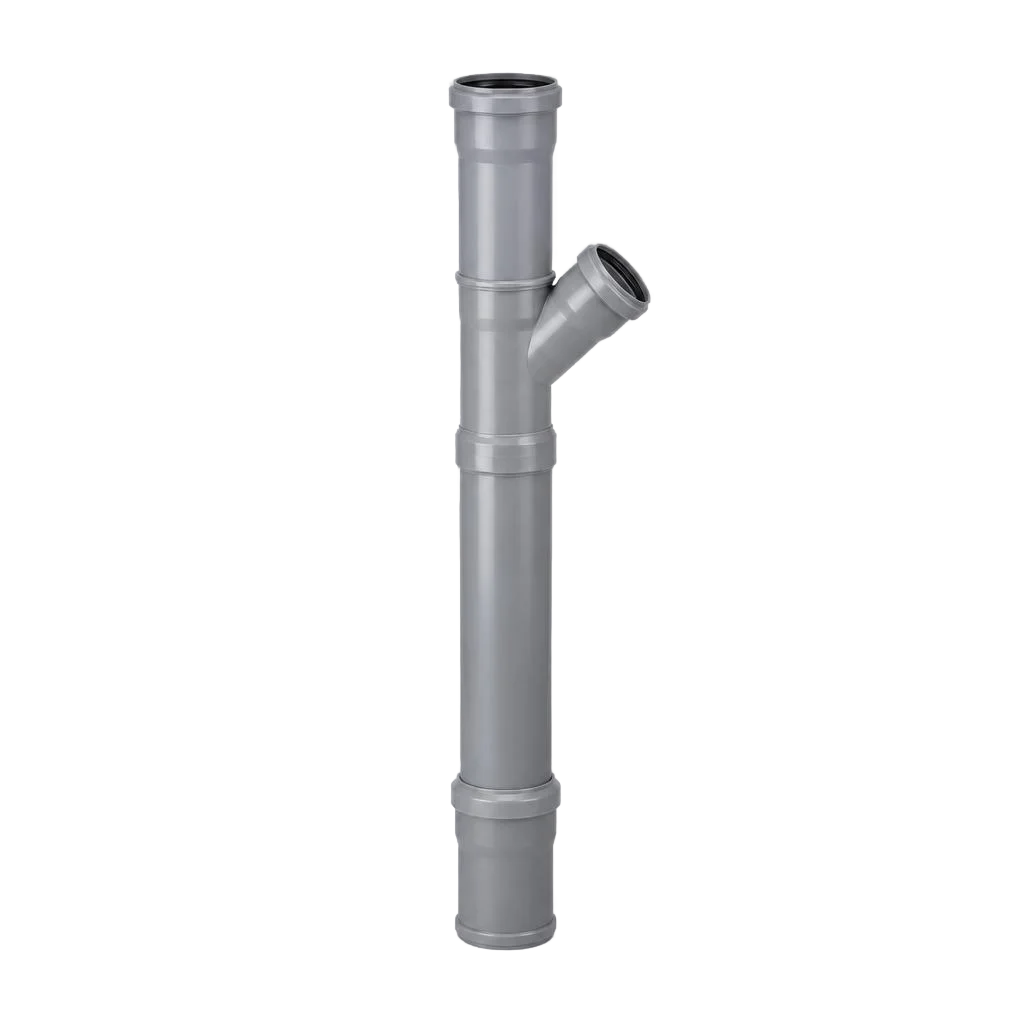
| Sewer | Cast iron, PP 110 mm | Repair without shutting off the water | Presence of an inspection port on the floor |
We carry out work on cold water, hot water and sewer risers in Tashkent, and in practice a pressurised riser cannot be shut off without agreeing a building-wide shutdown, while a sewer riser is serviced without stopping the water supply — which is why the timelines and preparation for these jobs differ.
Why blockages and leaks come back
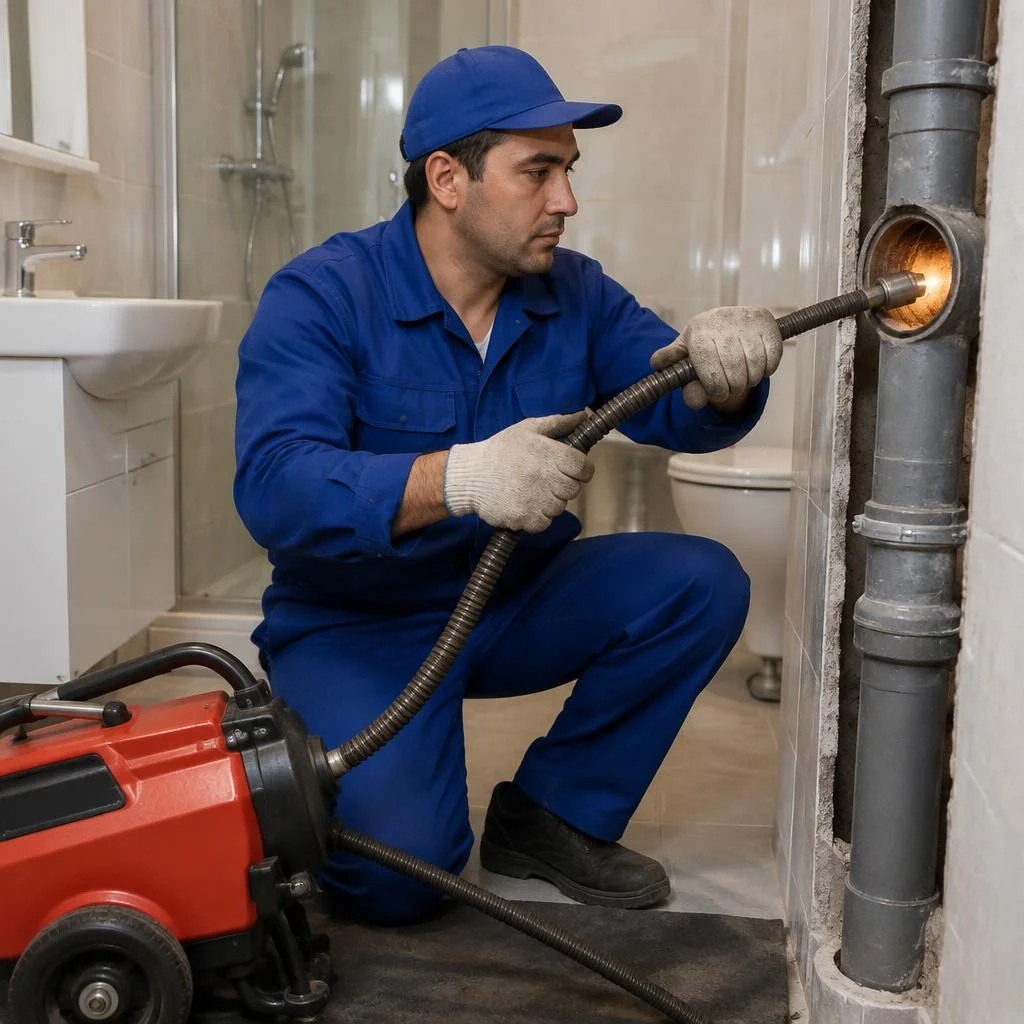
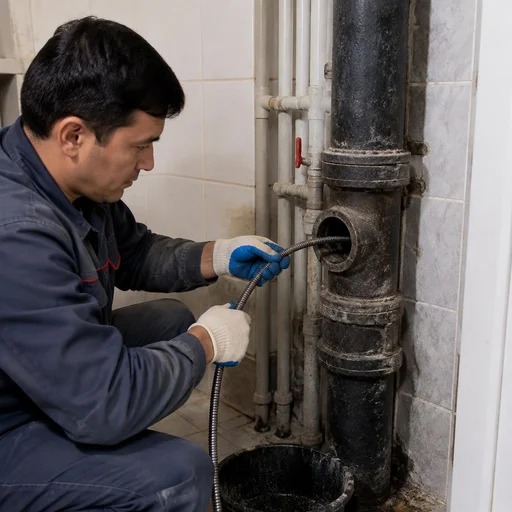
A blockage comes back if only the visible section was cleared rather than the entire riser: grease deposits and corrosion remain on the walls below the inspection port. A specialist with a cable punches through the plug at the nearest drop, but the build-up on the cast-iron walls remains — after 3-4 weeks it blocks the passage again, and the water drains ever more slowly. A leak behaves in a similar way: a tightened clamp holds the joint for a month or two, until pressure and vibration break down the seal again. In their requests, clients often write briefly — "Riser repair" — and from such a request the specialist immediately understands that what's needed is not unclogging but hydrodynamic flushing of the entire riser or replacement of the corroded section. In our experience, on cast-iron risers in Khrushchyovkas after 25-30 years of service, spot measures buy a delay of at most one season, and residents come back to the same problem again.
Repairing the riser in an apartment: what can be done without neighbors and the management company
Some work on the riser is done inside the apartment without approvals, while some requires access to neighbors and notification of the management company. Let's look at where the boundary lies and how not to cross it.
What falls under the resident's responsibility and what is common property
- Common property of the building: the riser up to the first branch into the apartment, the horizontal run in the basement, expansion joints and inspection ports in the attic — the management company is responsible for these.
- Resident's area: the branches, the inspection port inside the apartment, connection of plumbing fixtures, sealing of joints on one's own section.
- Management company emergency service: clears blockages and leaks on the common section, but responds according to the duty schedule.
- Private technician: arrives within an hour and takes on both sections if the resident covers the costs.
- Disputed case: the boundary becomes blurred when the branch and the riser are joined by a single tee — then an inspection is unavoidable.
When approval from the management company and neighbors is needed
We help arrange the work that requires approval: replacing the entire riser, relocating the riser and connecting to the horizontal run affect neighbors and common property. Replacing a section, a tee or an inspection port inside the apartment does not require approval — the technician works within the boundaries of the bathroom and does not enter the common section. Relocation, however, affects the layout and the connection points of the neighbors above and below, so the work is not started without the written consent of the management company and the residents of the adjacent apartments. Connecting to the horizontal run in the basement is also a common section: this requires permission from the management company and notification of everyone on that riser. Approval takes 1-3 days, so scheduled replacement is best started at the beginning of the week — then emergency access to neighbors will not be needed on the weekend.
How the riser shutdown is carried out
We coordinate the riser shutdown with the management company for 2-4 hours — this is enough to replace a section or a tee without a prolonged water shutoff for the whole building. Before the work, the technician warns the neighbors on the riser via a notice at the entrance or in the building chat, so that no one is left without water unexpectedly. Replacing a tee takes 1-2 hours, resoldering a polypropylene section takes up to 3 hours, and connecting to the horizontal run in the basement requires separate permission and another hour. If the riser is cast iron and hidden corrosion is discovered on the adjacent section, the work is stopped and the additional scope is agreed upon — otherwise the new tee will not fit onto the damaged pipe. The shutdown is best scheduled in the morning: if hidden corrosion is discovered, the technician will still have time to buy the components the same day.
Repair of risers in an apartment building: blockages, leaks and unclogging
A riser emergency in an apartment building develops within minutes and affects several apartments. Let's look at what to do before the technician arrives, how the unclogging methods differ, and how an emergency call-out is carried out.
What to do in case of a blockage before the technician arrives
- Shut off the water: close the valve at the apartment inlet so that the wastewater does not reach the neighbors below through the floor slab.
- Do not pour anything into the sink: neither hot water nor boiling water — they soften the sealing rings in the sockets and accelerate depressurization.
- Warn the neighbors above: if the blockage is in a shared section, the wastewater will flow to them — have them shut off the water before the technician arrives.
- Remove water from the floor: collect the spill with a cloth so that moisture does not seep into the slab joints and go downward.
- Photograph the area: a photo of the blockage and the spill will be useful for the report if the damage has to be claimed from the management company.
Hydrodynamic and thermal unclogging: which to choose
| Method | When to use | Riser type |
|---|---|---|
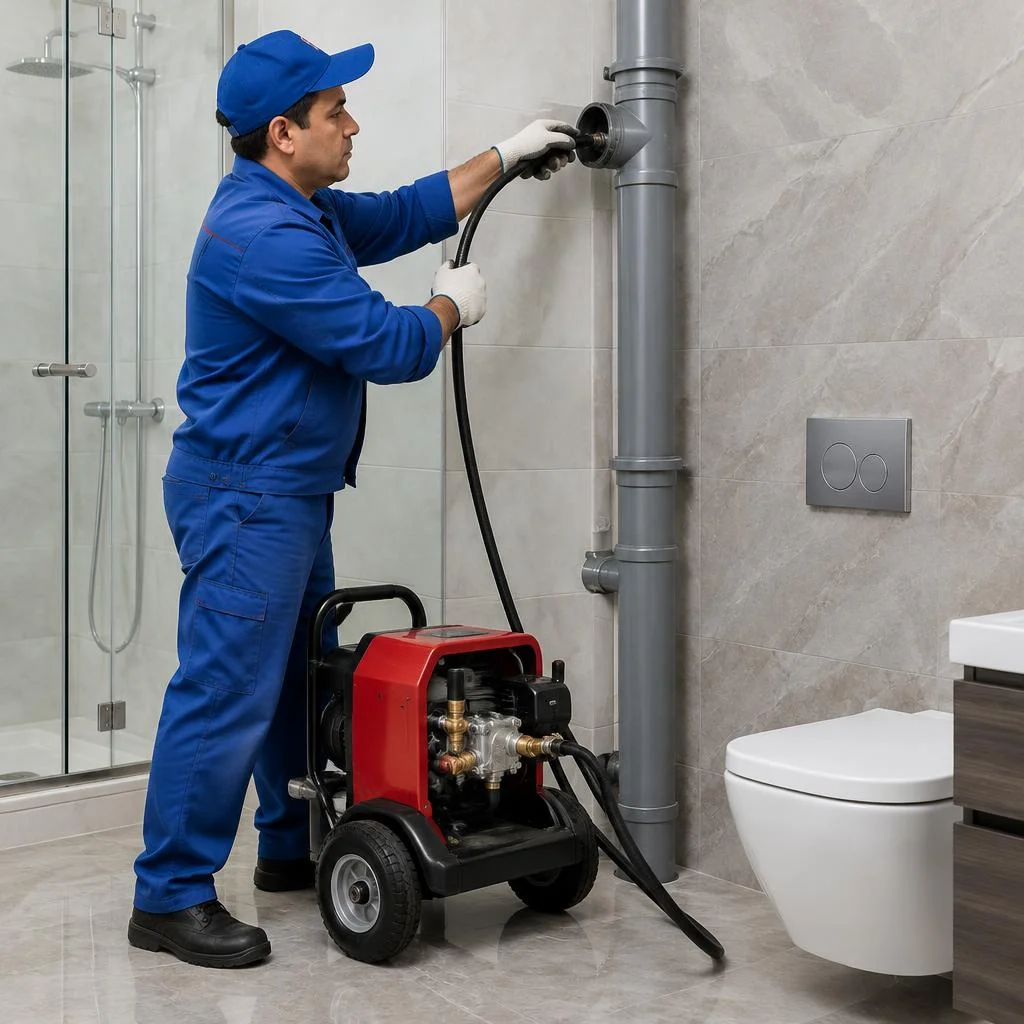
| Hydrodynamic flushing | Grease and mineral deposits | Polypropylene, metal-plastic, steel |
| Thermal unclogging | Dense plugs hardened over years | Cast iron |
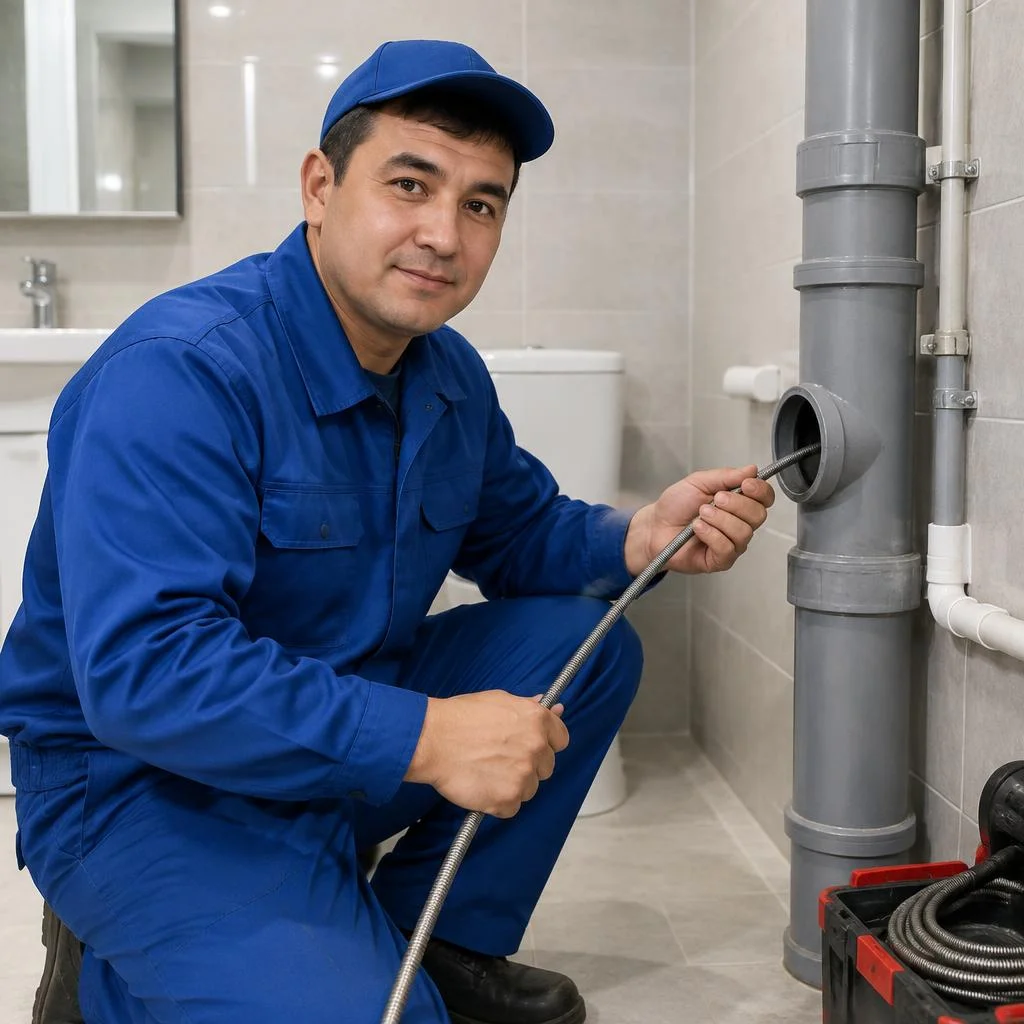
| Mechanical unclogging with a cable | Mixed blockages with solid inclusions | Cast iron, steel |
| Combined method | Old cast iron with thin walls | Cast iron |
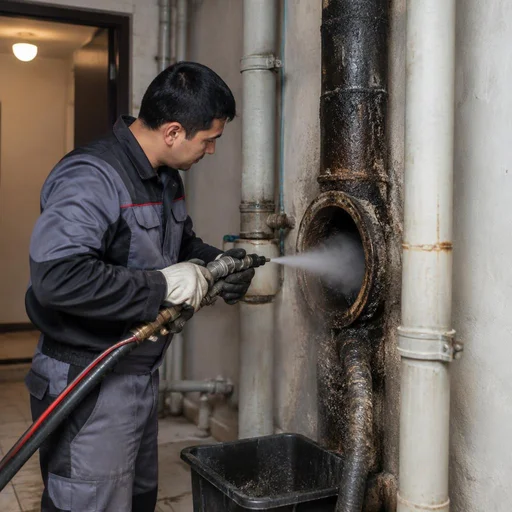
Hydrodynamic cleaning is safer for old cast-iron pipes with thin walls, while thermal cleaning is more effective where deposits have hardened over years. We use both methods on emergency call-outs in Tashkent.
Leak repair and water pumping out
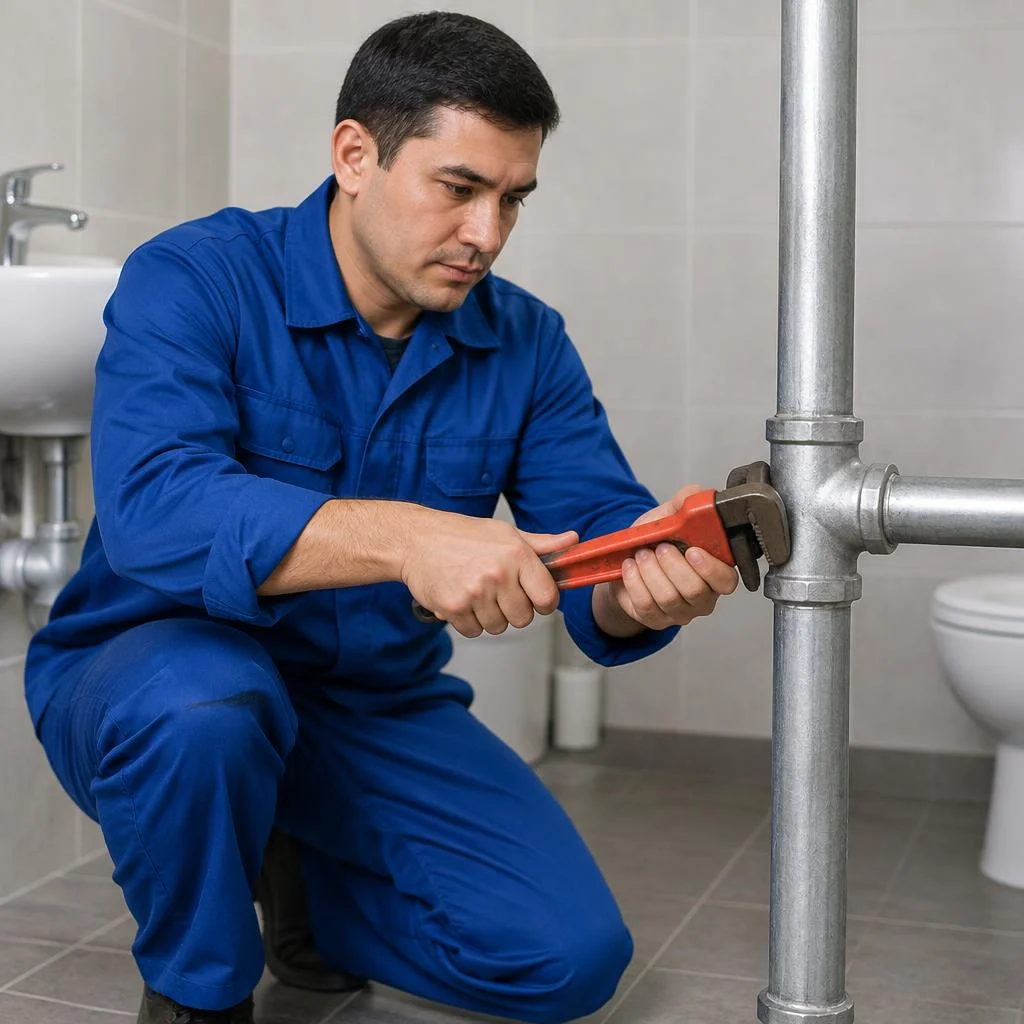
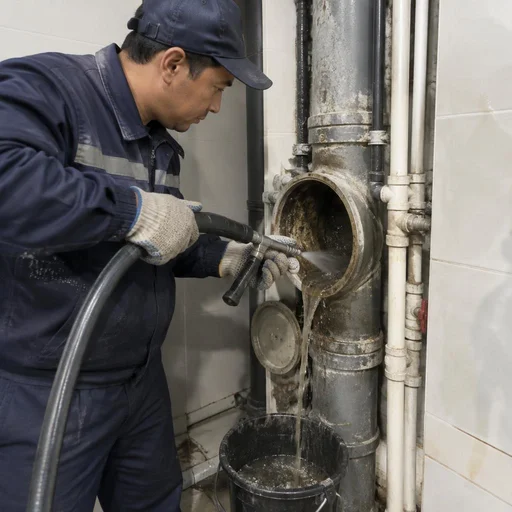
We respond to emergency repair of riser leaks and water pumping out — the technician locates the leak, pumps water out of the basement or technical floor, and restores the tightness of the joint. On the call-out, an electric pump is used for pumping out and an inspection wrench for disassembling the socket. Pumping out is carried out down to the last liter: residual moisture corrodes cast iron from the inside and causes a repeat leak within a month. If the leak comes from the socket joint, it is often enough to replace the sealing ring and seal the joint — a complete replacement of the riser is not needed. Such work fits into a single call-out: the technician removes the socket, replaces the ring, applies sealant and checks the joint under pressure.
Sewer riser repair: replacement of sections, tees, and cleanouts
A sewer riser is assembled from components — tees, cleanouts, expansion joints. Let's break down which component is responsible for what, when it is replaced separately from the pipe, and why replacing a sewer riser rarely means a complete replacement throughout the entire building entrance.
Replacement of a riser section and tee
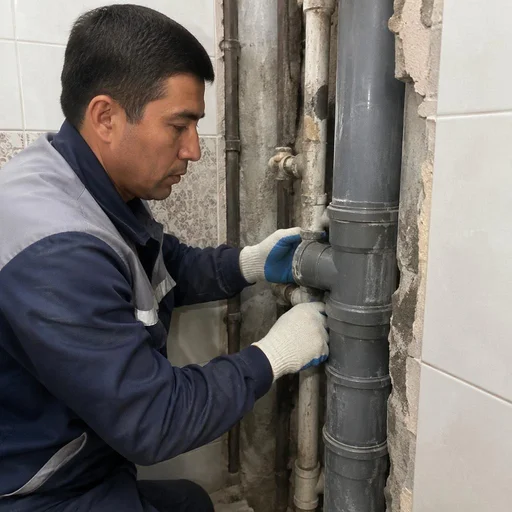
We replace a riser section and tee if a single branch component is damaged — this is cheaper and faster than replacing the entire riser. In older buildings, a cast-iron tee accumulates internal deposits over 25-30 years: the bore narrows to 40-50% of the original, and water drains more slowly. The technician cuts out the defective component with an angle grinder, installs a new tee made of polypropylene or cross-linked polyethylene PEX with adapters, and welds the joint flush with the existing pipe. The tee is replaced together with a section of pipe: attempting to cut out only the tee weakens the joint and leads to leaks within a year.
Cleanout, expansion joint, and access panel
| Component | Function | When to replace |
|---|---|---|
| Cleanout | Access to the riser for snaking with a cable | Seized cover, stripped threads |
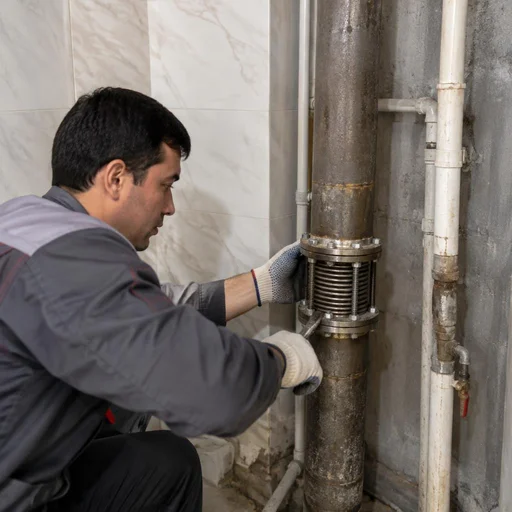
| Expansion joint | Absorbs linear expansion during heating | Cracks, loss of elasticity |
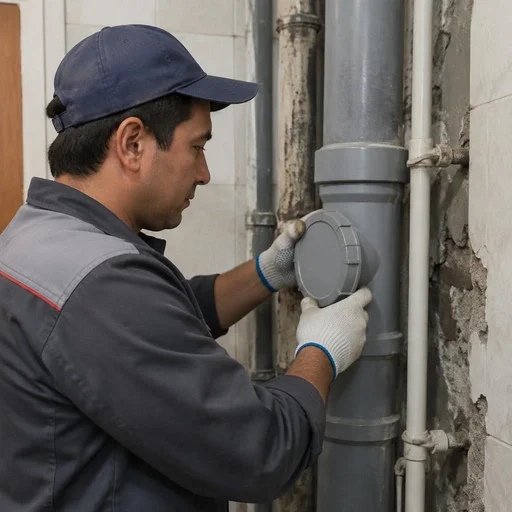
| Access panel | Covers flush access in the wall | Installation of a new component, finish repair |
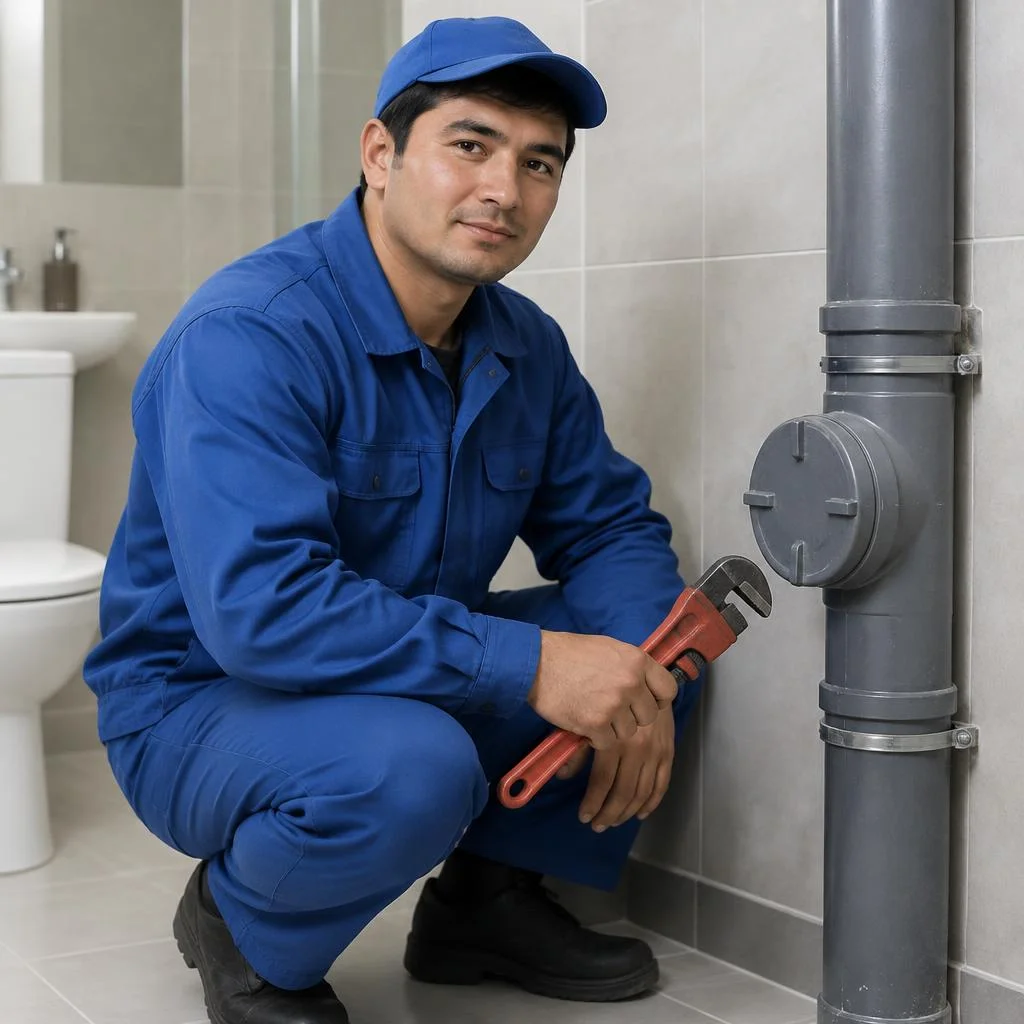
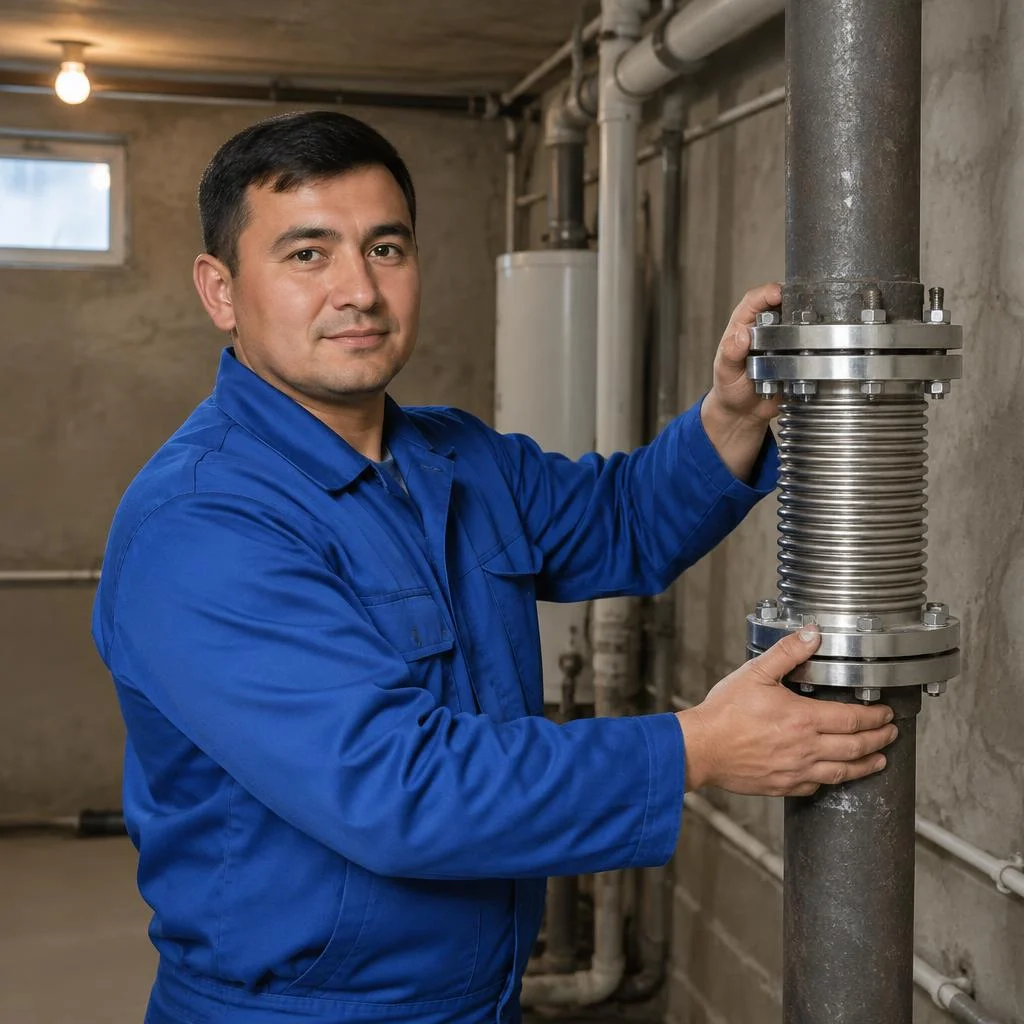
We install the access panel flush with the tile so that the cleanout can be accessed without dismantling the finish — otherwise the next snaking will require opening the wall. The expansion joint in a cast-iron riser is rarely replaced: the component works for decades, but in a polypropylene circuit its condition is checked at every re-soldering, because heating to 95 °C stretches the pipe by 3-5 mm per meter.
Sealing joints and restoring waterproofing
We seal the riser joints and restore waterproofing — this is the final stage, without which even a new pipe will leak at the point where it passes through the floor slab. In Tashkent's panel building series, the riser passes through the slab in a sleeve: the gap between the pipe and concrete is filled with elastic sealant and sealing rings, and a layer of waterproofing is applied on top, extending onto the wall by 15-20 cm. The rings are selected by diameter and profile: for 110 mm cast iron and 110 mm polypropylene they are different, and a universal replacement does not work here. The waterproofing around the riser is checked by pouring water for 30 minutes — if this stage is skipped, the leak will be discovered by the neighbors below, not by the technician.
Repair of risers in an apartment building: replacement of cast iron and polypropylene riser
In Tashkent buildings there are cast iron, polypropylene and metal-plastic risers. Let's look at which material to choose when replacing and how the dismantling of each differs.
Replacement of a cast iron riser
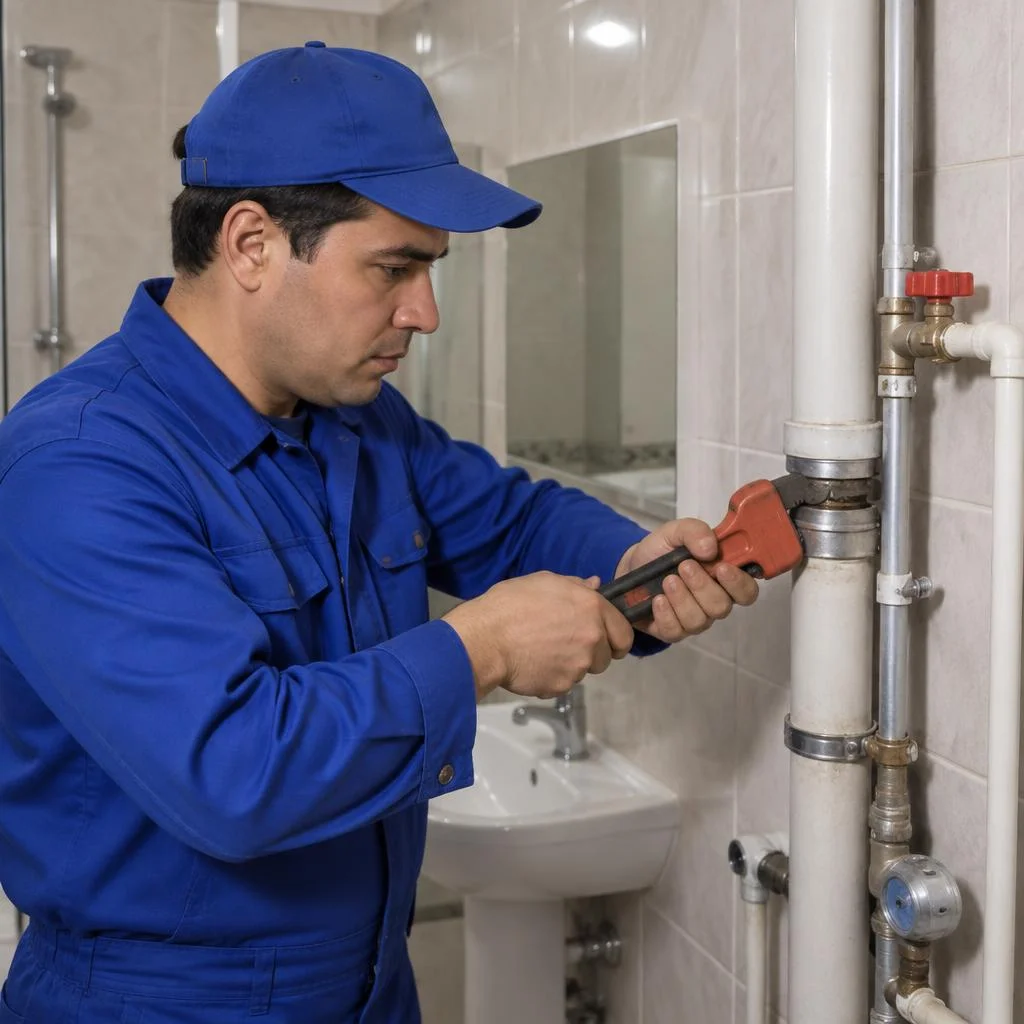
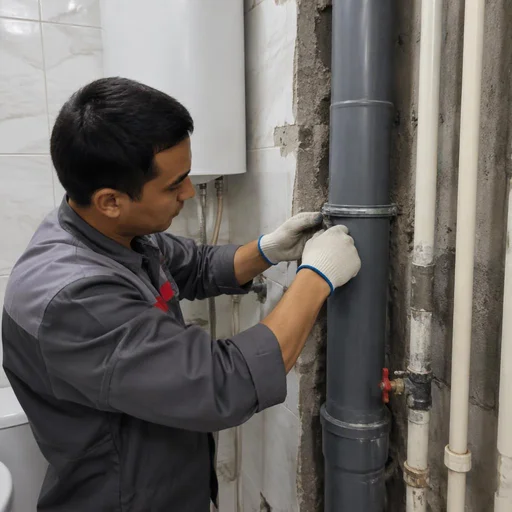
Replacing a cast iron riser in our practice comes down to a complete re-laying with polypropylene: cast iron over time becomes overgrown from the inside and cracks, while PP lasts longer and does not rust. In buildings of series 1-464 and II-49 in Chilanzar and Yunusabad, the cast iron cold water and hot water risers have served 40-50 years, the internal bore has narrowed by 60-70% due to deposits of hardness salts, and fistulas have appeared at the socket joints. This is exactly how people often write to the service: Riser repair — and the technician immediately understands what is meant. Eco-Service carries out dismantling in segments of 30-50 cm: the pipe is secured with a clamp above the cut so that the freed section does not go down under its own weight. A cast iron riser must not be cut with an angle grinder without protection — sparks and graphite dust are dangerous in a bathroom, so they work with a cutting tool and a respirator, and the cut area is moistened. Replacing the riser entirely in a nine-story building takes one working day for two or three entrances with the water supply shut off.
Re-soldering of a polypropylene riser
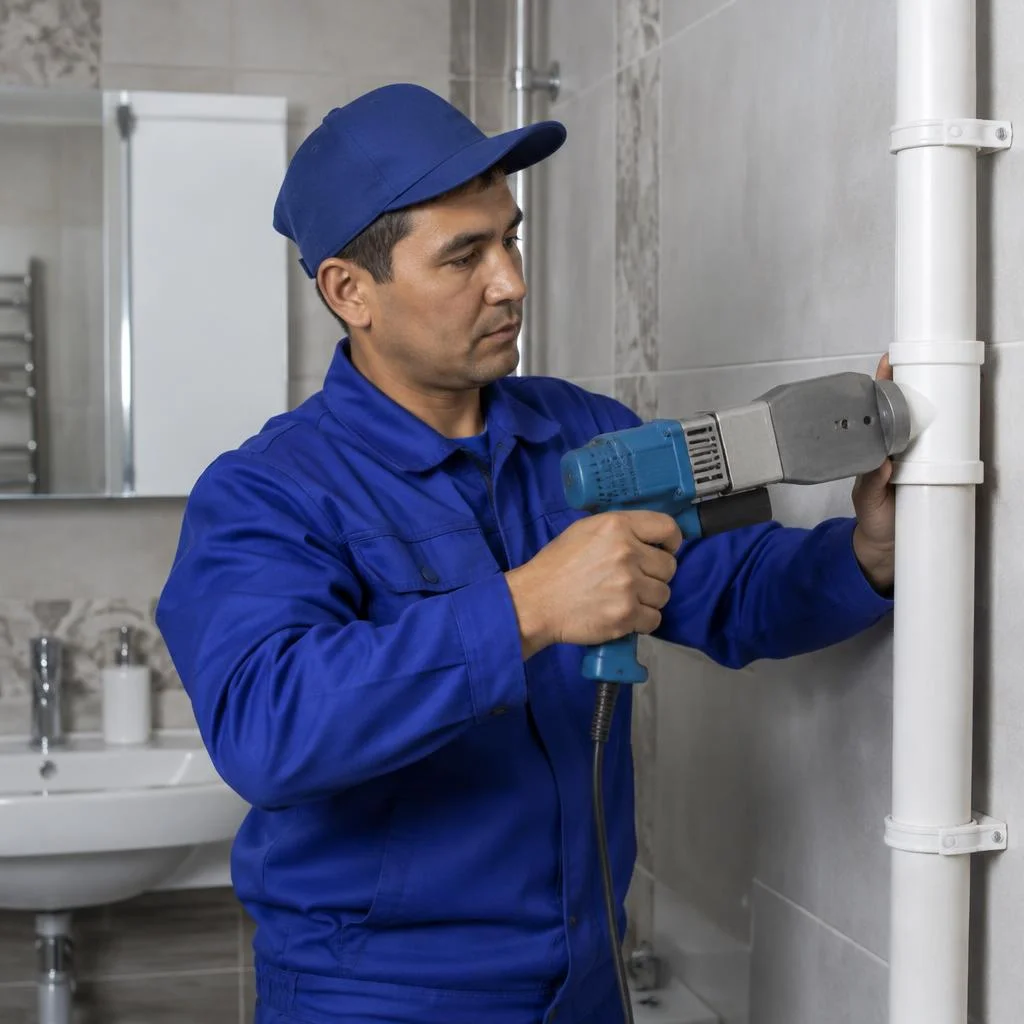
Re-soldering of a polypropylene riser produces a monolithic joint that does not leak during temperature fluctuations. We work with PPR pipe PN20 and PN25 with a diameter of 25 and 32 mm — for cold water we take the fiberglass-reinforced version, for hot water a pipe with an aluminum layer is installed to compensate for thermal expansion. Re-soldering is needed when a tee is replaced on the riser, a branch is cut in for a new bathroom, or an expansion compensator is repositioned after sagging. Re-soldering must not be done on a wet pipe: residual water turns into steam and leaves cavities in the seam, so the section is first drained and dried. We keep the heater at 260 °C, and carry out the soldering for 5-7 seconds without turning — then the joint withstands the working pressure and does not leak in the next season.
Which material to choose: comparison
| Material | Where it is used | Feature |
|---|---|---|
| Polypropylene PN20 | Cold water risers, diameter 25-32 mm | Does not rust, lasts 25-30 years |
| Polypropylene PN25 | Hot water risers, diameter 25-32 mm | Reinforcement withstands temperatures up to 95 °C |
| Polypropylene PP | Sewer riser, diameter 110 mm | Smooth wall, joint with a rubber ring |
| Metal-plastic PEX | Point routing around obstacles | Flexible, but joints are weaker than soldering |
| Cast iron | Old risers before major overhaul | Becomes overgrown, cracks, heavy dismantling |
Metal-plastic is convenient for routing around obstacles, but in a riser it is inferior to polypropylene in service life at the joints. For sewerage in Tashkent high-rise buildings, PP with a diameter of 110 mm with a socket for a rubber ring is used — such a joint can be disassembled without cutting during cleaning.
Full riser replacement, relocation and connection to the building drain
When spot repairs no longer help, the riser is replaced entirely or relocated to suit a new bathroom layout. Let's look at how such work is carried out and what it affects.
When a full riser replacement is needed
We replace the riser entirely if the pipe is affected by corrosion along its entire length or if blockages recur more than twice a year. Signs of irreversible wear are visible during inspection: pinholes along the entire height of a cast-iron stack, rust-colored streaks on the sockets, wall thinning down to 2-3 mm, cracks at the base. On polypropylene, multiple fused joints with streaks and sagging of the pipe between clamps indicate the need for a full replacement. Spot re-soldering in such a situation gives only a temporary effect: within 3-6 months a rupture occurs next to the new joint. In our practice, in a building of series 1-464 in Chilanzar, after the fourth unclogging in a season the owners agreed to a full replacement — the blockages stopped. A full replacement affects all floors: the work is carried out from top to bottom so as not to leave open sockets under water pressure in the lower apartments.
Riser relocation and connection to the building drain
We relocate the riser to suit a new bathroom layout and connect it to the building drain — this is installation work that requires coordination with the management company and access to the neighbors. Typical scenarios: combining a bathroom, moving the wet zone beyond its former boundaries, moving the riser out of the wall into a box, re-piping for new plumbing fixtures. The work includes dismantling the old section, laying a new stack in its design position, tying into the building drain in the basement or on the technical floor, and restoring waterproofing at the points where it passes through the floor slabs. Coordination with the management company records the new route in the technical plan, and without written access to the neighbors above and below, the work cannot begin. When relocating, it is important to maintain the slope of the sewer riser toward the building drain: even a slight deviation leads to constant blockages in the new location.
Warranty, timelines and the Eco-Service service center in Tashkent
Riser work is the kind you come back to if a joint was not sealed properly. Let's break down what period the work is covered for, how in-person intake of requests works, and what to clarify before the technician's visit.
2-year warranty on riser work
We provide a 2-year warranty on all riser work — from clearing a blockage to replacing the entire riser. The period covers hydrodynamic flushing, polypropylene re-soldering, cast-iron riser replacement, and joint sealing: if a leak or blockage reappears in the section through our fault, the technician returns without charge. A warranty case is processed against the work completion certificate and receipt — these documents remain with the resident after the job is handed over. There is one condition: access to the inspection port must be maintained, and any independent tampering with the riser is excluded. That is why we install the inspection hatch during installation itself rather than putting it off: without free access to the inspection port, diagnosing a repeat blockage turns into tearing out the tiles.
Our own service center in Tashkent
We accept requests in person at our own service center — here you can submit a request, agree on a visit time and get advice from a technician. The center works with private apartments, dormitories and management companies: on average, 40-60 riser requests for cold water, hot water and sewerage pass through it each week. The in-person format is convenient for complex cases — the technician assesses the condition of the riser from photos and videos provided by the resident, determines the material (cast iron, steel, polypropylene, cross-linked polyethylene PEX, metal-plastic) and selects the components for the visit in advance: tees, expansion joints, inspection ports, sealing rings. Without advance selection, the crew often goes to the site twice — first for diagnostics, then for the part. If the riser is in an emergency state, bring a video of the leak straight to the center: based on it, the dispatcher will schedule the visit as a priority.
How to submit a request and what to clarify
- Address and floor: street, house number, entrance, floor and location of the riser — this speeds up the visit and the selection of tools.
- Riser type: cold water, hot water or sewerage, material — cast iron, steel, polypropylene, PEX or metal-plastic.
- Nature of the problem: blockage, leak, pinhole, noise in the pipe or a complete replacement of the section — the set of works depends on this.
- Emergency status: if water is flowing right now, say so immediately — emergency requests are scheduled as a priority.
- Access and coordination: whether there is access to the inspection port, whether the management company and neighbors on the riser need to be notified.
Conclusion
We have briefly gathered what determines the outcome of riser work: boundaries of responsibility, the choice of method for repeat blockages, materials and the procedure for approvals. These four points most often decide what replacing a unit will turn into — a quick clearing or a major overhaul.
Key takeaways
- Boundaries of responsibility: the riser is part of the building's common property — up to the first branch it is handled by the management company, while the section inside the apartment and the connections to fixtures remain the resident's responsibility.
- Repeat blockage: if a blockage returns twice within six months, the cause is not a plug but deposits on the walls or a narrowed pipe — here hydrodynamic flushing or replacement of the section helps.
- Materials and assembly: a cast-iron riser is replaced with polypropylene, and a sewer riser is assembled from tees, inspection ports and expansion joints with mandatory slope and joint sealing.
- Approvals: complete replacement, relocation and connection to the main horizontal pipe require written consent from the management company and neighbors — collecting signatures takes from one to three days.
- Warranty and access: the warranty on riser work is 2 years, but it is valid provided access to the inspection port is maintained and there has been no unauthorized rework.