
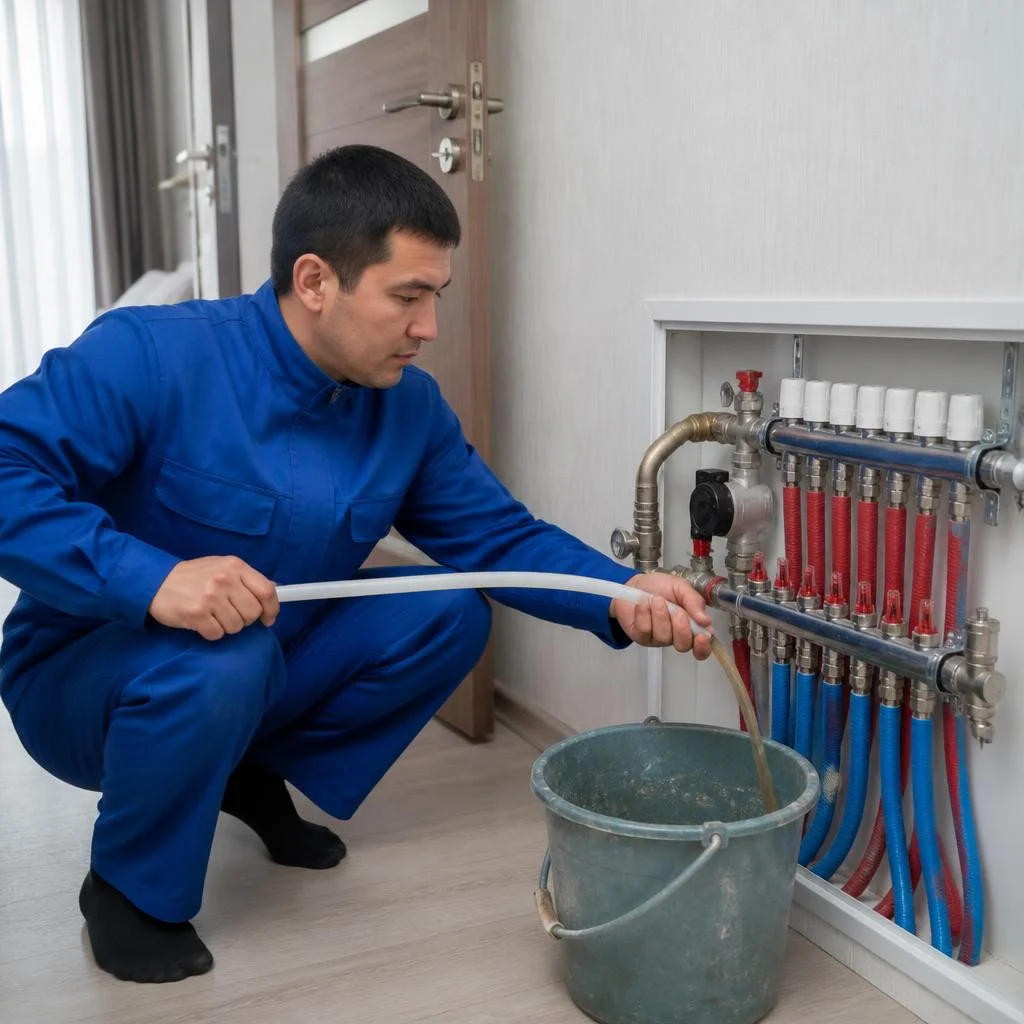
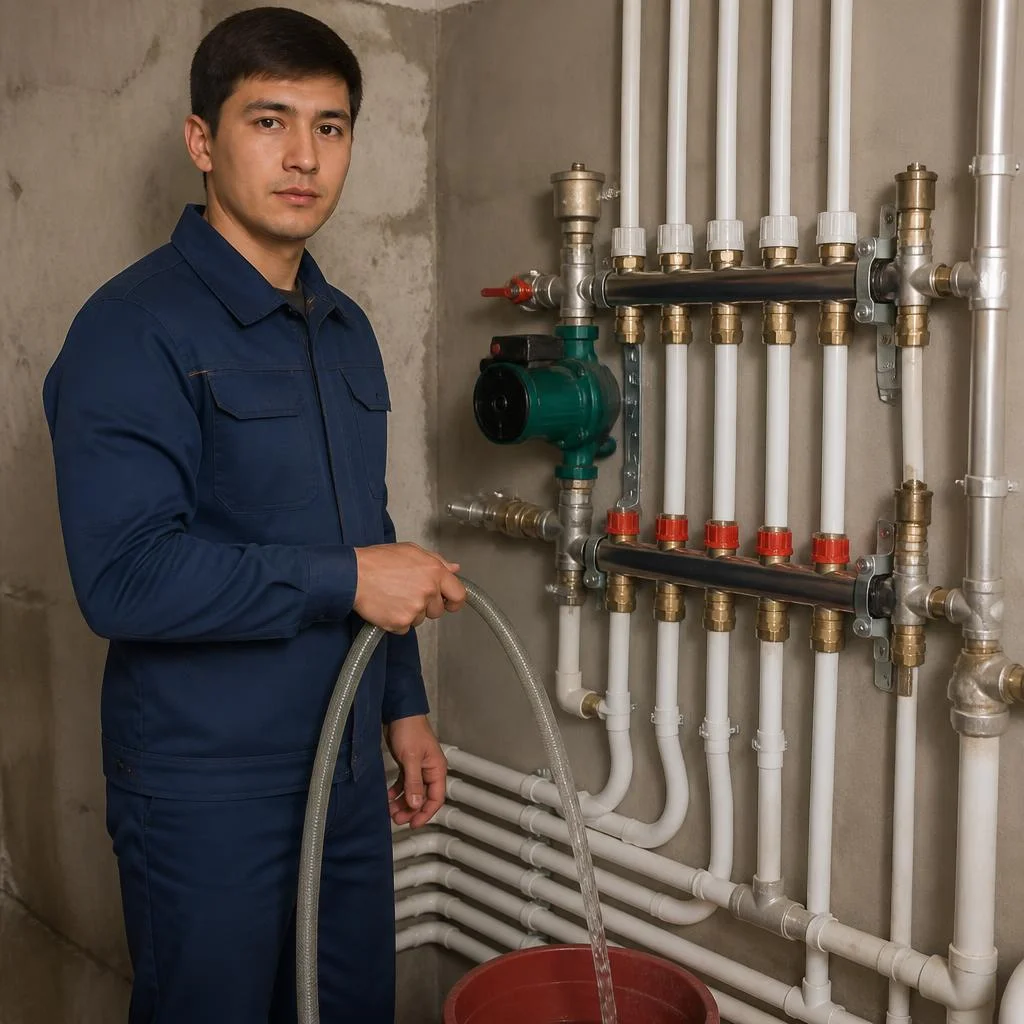
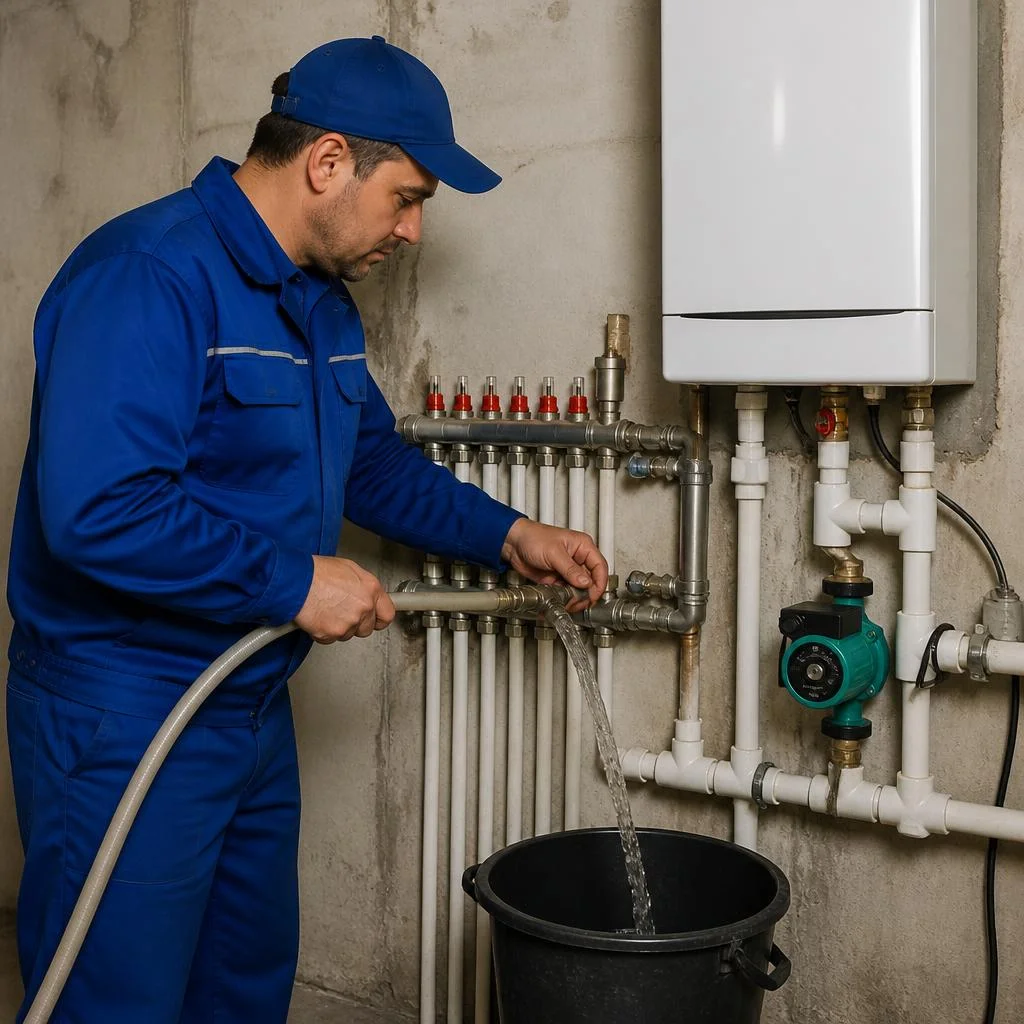
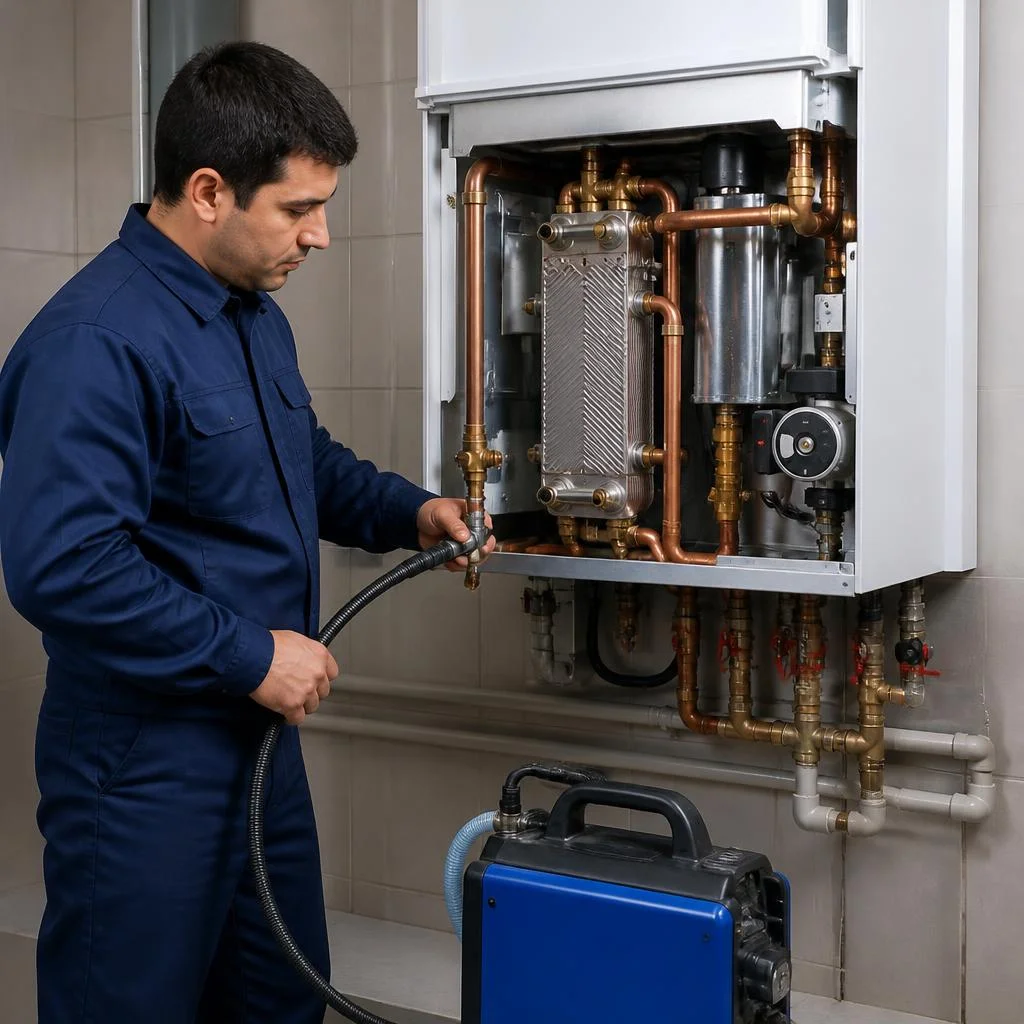
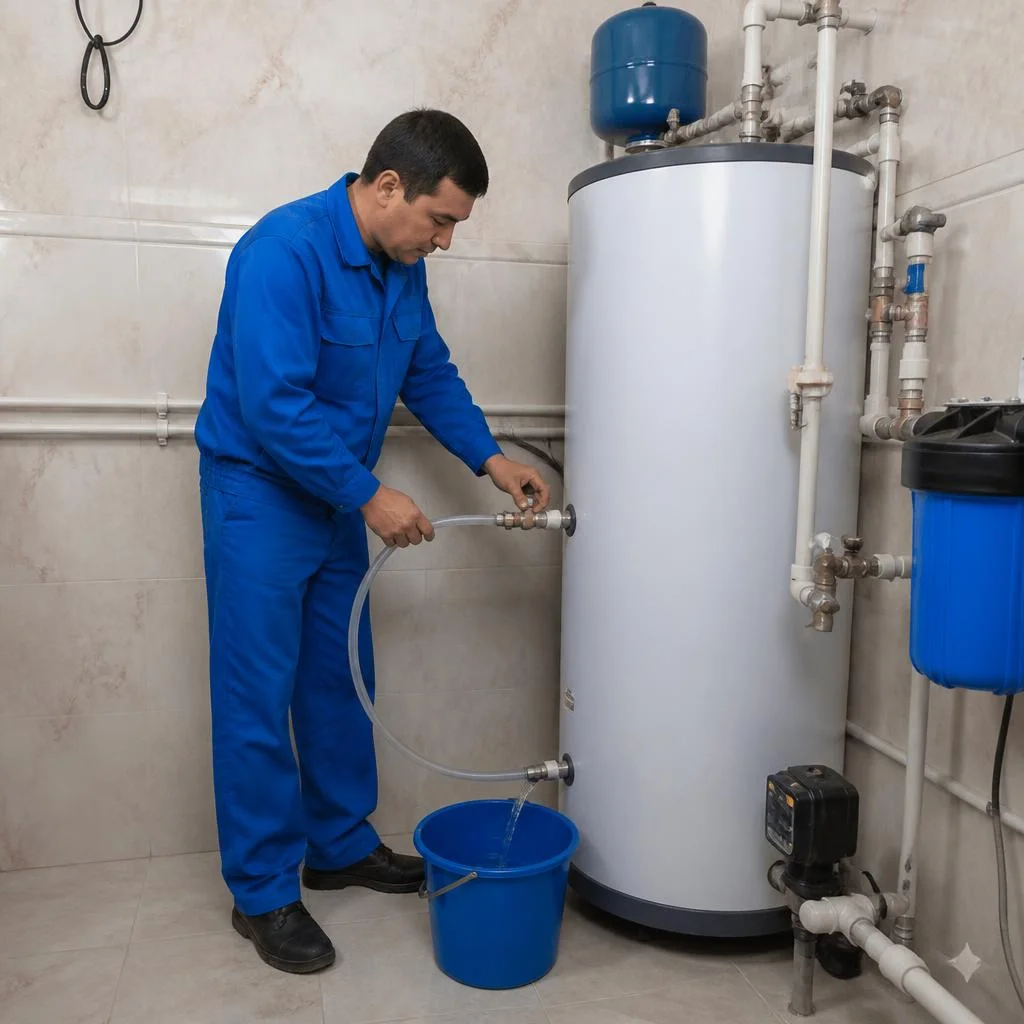
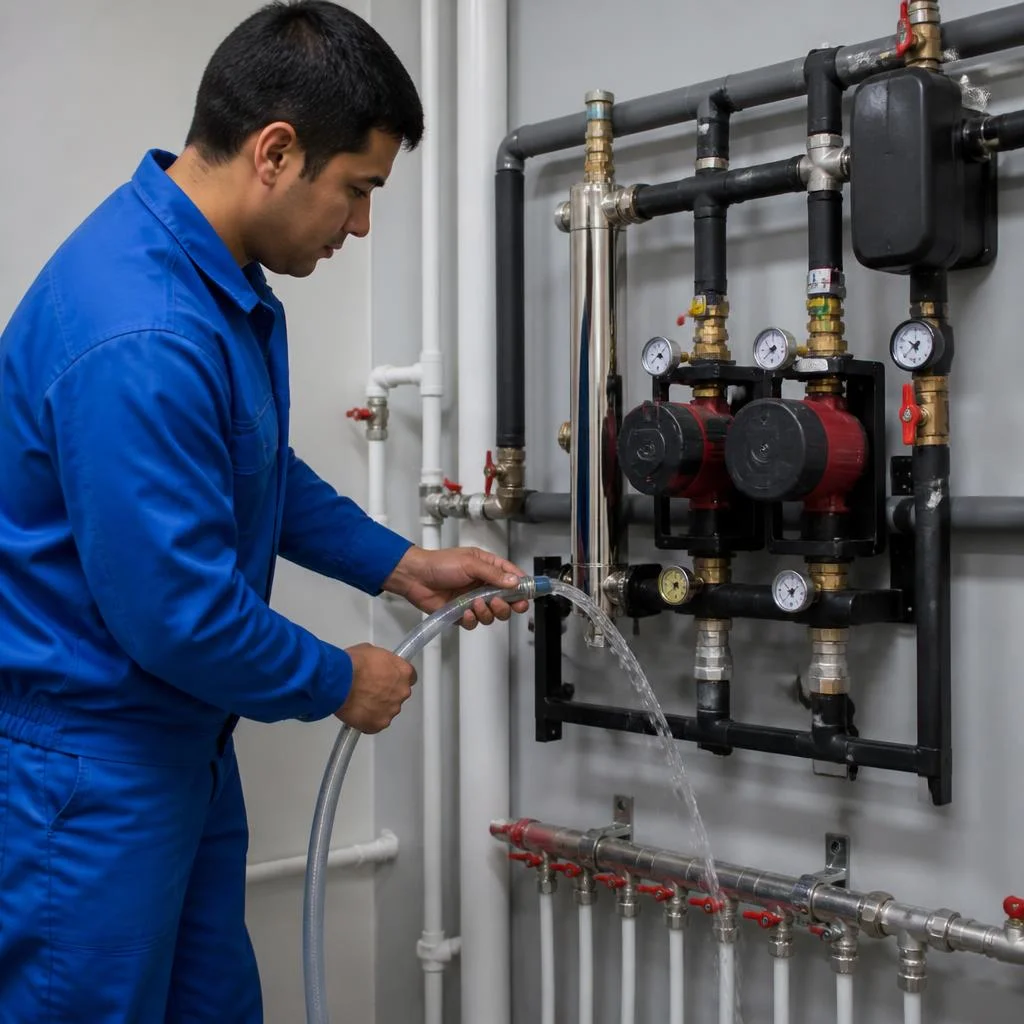








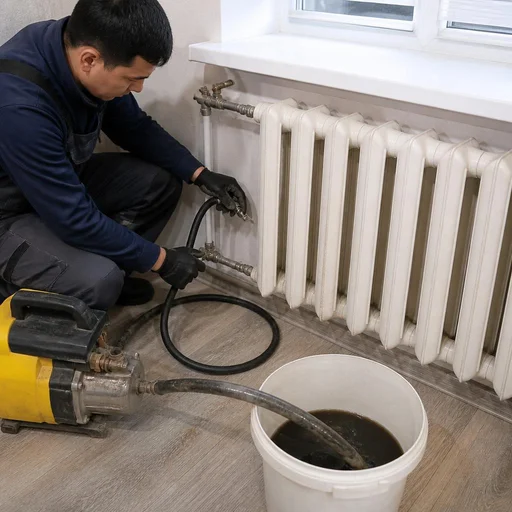
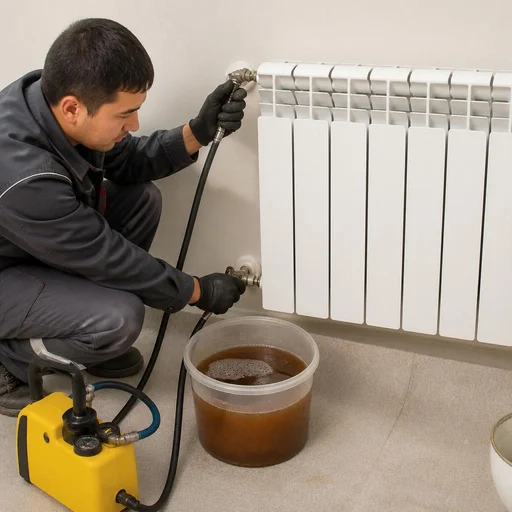
When heating system flushing is really needed: signs of blockage and consequences
Hard water in Tashkent accelerates the formation of scale and sludge — the circuit becomes clogged within just 2-3 heating seasons. Let's look at how to recognize the problem before a breakdown and what happens if you delay cleaning.
How to tell it's time to flush the heating system
- Uneven heating: the radiator is hot at the top and cold at the bottom — sludge has settled in the lower sections and blocked the coolant flow.
- Noise in the circulation pump: humming and vibration appear when the impeller pushes water through channels narrowed by deposits.
- Slow heating: rooms reach operating temperature 30-40 minutes longer than in the first season after startup.
- Temperature difference along the riser: upper floors heat noticeably worse than lower ones at the same water flow rate in the circuit.
- Rusty water when bleeding air: brown suspension comes out of the Mayevsky valve — a clear signal that the heating system needs cleaning from rust.
Why the system clogs faster in Tashkent
The tap water in the capital is hard — with a high content of calcium and magnesium salts, so scale forms on the heat exchanger and in the pipes within 2-3 heating seasons. When heated above 60 °C, the salts precipitate and crystallize on the walls, and the flow rate in narrow channels drops: the pump runs overloaded. Scale just 1 mm thick reduces heat transfer by about 10%, so an "still working" system is already burning gas for nothing, and cleaning the heating system pays for itself right on the heating bill. From our experience in the city, two seasons without water treatment are enough for the lower sections of cast-iron radiators to be half clogged with sludge — before the owner notices the cold in the room. Aluminum sections suffer first: flushing aluminum heating radiators is required after just the second season, because this metal accumulates salt deposits on the internal ribs more actively. In the search bar, owners often type heating radiator flushing price — that's how the request reaches us for diagnostics. Another frequent request sounds like this: battery flushing price — behind it is usually the desire to understand the range of amounts before the technician's visit. And the third variant we see in requests: flush the heating battery — that's how those who have already noticed cold in the lower sections phrase the task.
What happens if flushing is postponed
- Clogging of narrow channels: sludge compacts in the boiler heat exchanger and at pipe narrowings, the passage for the coolant is reduced to a minimum.
- Wear of the circulation pump: operating at increased resistance accelerates wear of the bearings and impeller, and replacing the unit costs more than prevention.
- Failure of shut-off valves: deposits jam ball valves and thermostats, they stop shutting off the circuit in an emergency.
- Pipe rupture in frost: the clogged section freezes first, and a frozen circuit in a private house is the most expensive scenario — some pipes have to be opened up from the wall.
How often cleaning is needed under different conditions
| Operating condition | Cleaning interval | Sign that it's needed earlier |
|---|---|---|
| Private house, water from a well | Every 2 seasons | Scale on the boiler heat exchanger |
| Apartment, central circuit | Every 2-3 seasons | Cold in the lower sections of the batteries |
| Commercial facility, high load | Every season | Rising gas consumption without more heat |
| After a major rewiring of the distribution | Before the first startup | Construction debris in the pipes |
Heating system cleaning is not a one-time procedure but part of a maintenance schedule: the interval depends on water hardness and pipe material, not on the calendar. If you neglect flushing the heating radiator, sludge compacts over the season to such an extent that cleaning without pressure no longer produces results — the system needs to be disassembled.
Signs of a blockage by type of deposit
| Type of deposit | Where it accumulates | How it manifests |
|---|---|---|
| Scale (hardness salts) | Heat exchanger, pipe walls | Whistling in the boiler, excess gas consumption |
| Sludge (suspended solids and rust) | Lower sections of radiators | Cold bottom of the battery while the top is hot |
| Biofouling | Risers, horizontal runs in the basement | Odor, dark water when draining |
| Construction debris | Pipework after renovation | Localized cold at one point |
What scheduled flushing of heating systems provides
- Restoration of heat transfer: after scale is removed, the radiator releases into the room heat that was previously lost heating up the deposits.
- Reduced fuel consumption: a clean heat exchanger reaches operating temperature faster, and the boiler runs in its normal mode instead of constantly reheating.
- Extended pump service life: flushing heating pipes reduces hydraulic resistance, and the circulation pump operates without overload.
- Protection of fittings: removed sludge does not jam valves and thermostats, and flushing heating systems reduces the risk of an emergency shutdown in winter.
- A clear maintenance schedule: scheduled flushing of heating batteries is tied to the season, not to a breakdown, so the technician arrives before the cold and works without rushing.
How to check the circuit yourself
- Temperature difference: measure the radiator inlet and outlet with a pyrometer — a difference of more than 10 °C indicates a blockage in the sections.
- Gas consumption: compare the meter readings with last season — an increase of 10-15% in the same weather indicates scale in the heat exchanger.
- Bleeding air: open the Mayevsky valve on the top floor — cloudy water with flakes confirms sludge in the riser.
- Checking the pump: listen to the housing — a growing hum at an unchanged speed means a narrowed flow passage.
Frequently asked questions about signs of a blockage
- How do you know it's time to flush if the batteries are hot? Even with hot radiators, check the lower sections: if the bottom feels cooler than the top, sludge has already settled.
- Can a blockage be identified without opening up the system? Yes, by the temperature difference at the inlet and outlet of the circuit and by gas consumption — cleaning heating batteries, the price of which depends on the material and number of sections, begins with diagnostics.
- What happens if only the radiators are flushed? Without flushing the entire heating circuit, sludge from the pipes will settle in the sections again within a season — the whole system needs to be cleaned.
- When is flushing of the heating system with disassembly needed? If pressure is not restored after cleaning without disassembly, it means the deposits have hardened and require mechanical removal.
- How does cleaning a heating radiator differ from a full flush? Local cleaning of a heating radiator washes sludge out of only one section, and flushing a heating battery without the common circuit does not eliminate the cause — the sediment returns from the pipes.
Flushing Methods: How Hydropneumatics Differs from Chemicals and Hydraulics
Flushing methods are not interchangeable: the choice depends on the radiator material, the nature of the deposits, and the type of circuit. Below we break down how each method works and when it delivers results.
Hydropneumatic flushing of a heating system: how it works
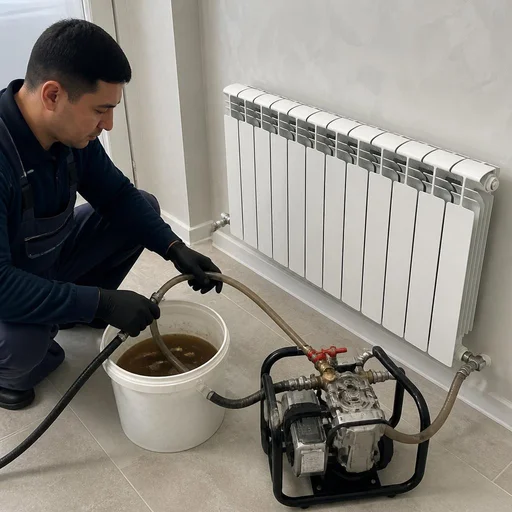
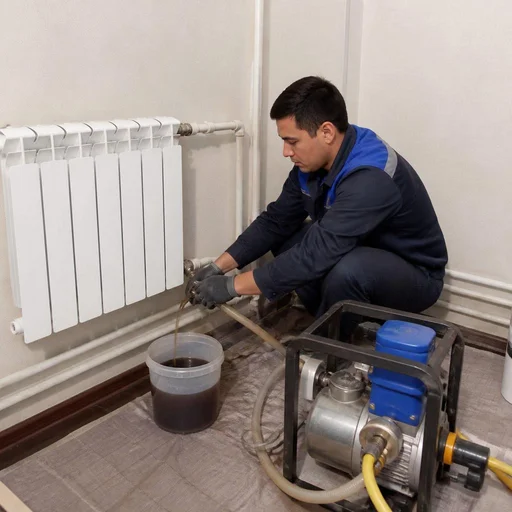
Hydropneumatic heating flushing supplies water under pressure mixed with compressed air — the pulsating mixture tears sludge off the walls of pipes and radiators. A compressor injects air into the circuit in portions, and the flow moves in bursts: in cast-iron sections, where a dense layer has accumulated over the years, this mode works more effectively than a steady pressure. The pulsation knocks deposits out of the lower headers, tees, and bends, where a water jet without air simply cannot reach. The air creates a shock wave that travels where a steady flow is powerless, which is why hydropneumatics is chosen for heavily fouled cast-iron systems. Clients often search for the service using the query hydropneumatic flushing of a heating system in Tashkent — and land on this page. Before startup, the circuit is filled and the pressure is checked: if the shut-off valves hold less than the working pressure, the air will go into a weak point rather than into the deposits. A separate line in the price list is the cost of heating system flushing, and it is calculated after inspecting the circuit. In everyday speech, technicians say it more briefly — hydropneumo flushing of a heating system, and by that word they mean the same circuit method with air pulsation.
Chemical flushing of the circuit: when you can't do without reagents
Chemical flushing of a heating system is needed where scale has already hardened: a reagent with a corrosion inhibitor dissolves the salt layer without damaging the metal. In private homes in Tashkent, the water is often hard, and the carbonate layer builds up on the walls of bimetallic and steel panel radiators over the season. The corrosion inhibitor keeps the acid from reacting with the metal, so the solution takes the scale but does not touch the walls of the sections. An acid compound without an inhibitor eats not only the scale but also the thin walls of aluminum sections, so a separate neutral reagent is selected for aluminum and bimetal. The reagent is pumped into the circuit, held for the time specified in the manufacturer's instructions, and flushed with a neutralizer so that acid residues do not corrode the metal after discharge. If the house has a solid-fuel unit, heating boiler flushing is planned separately: scale on the heat exchanger is removed with the same reagent, but with a different holding time. Owners phrase the task as flushing for a heating system — and the technician immediately understands that a reagent must be selected for the circuit material. A separate service is flushing a heating radiator in an apartment: the reagent is fed into a shut-off section through a fitting, without affecting the entire riser.
Hydraulic and hydrodynamic flushing: what's the difference
Hydraulic flushing of a heating system works with a flow of water under pressure, while hydrodynamic flushing of a heating system works with a high-pressure jet through a special nozzle that mechanically knocks deposits off the walls. Hydraulics is simpler: a flushing station supplies water into the circuit, and the flow carries loose sludge and suspended matter out through the discharge. Hydrodynamics is used in a targeted way: the nozzle is inserted into a pipe or radiator, and the jet knocks the dense layer right off the wall — this is how compacted sludge is removed from risers and horizontal runs. Hydrodynamics is not used on thin-walled aluminum sections: the pressure jet can puncture the wall. For such radiators, hydraulics or mild chemicals remain. On cast-iron and steel circuits with a dense layer, hydrodynamics gives the fastest result, but requires access to the internal cavity of the pipe. In everyday speech, this method is called more briefly — hydro flushing of a heating system, and by that word technicians mean the same circuit method. Clients write hydro flushing of a heating system price when they want to compare this option with chemicals by budget.
Comparison of flushing methods by type of blockage and material
| Method | What it removes | For which radiators | When it is chosen |
|---|---|---|---|
| Hydropneumatics | Loose and compacted sludge | Cast iron, steel, bimetallic | Heavily fouled systems, bends and manifolds |
| Chemicals with inhibitor | Carbonate scale, salt layer | Bimetallic, steel, aluminum (neutral reagent) | Hardened scale, hard water |
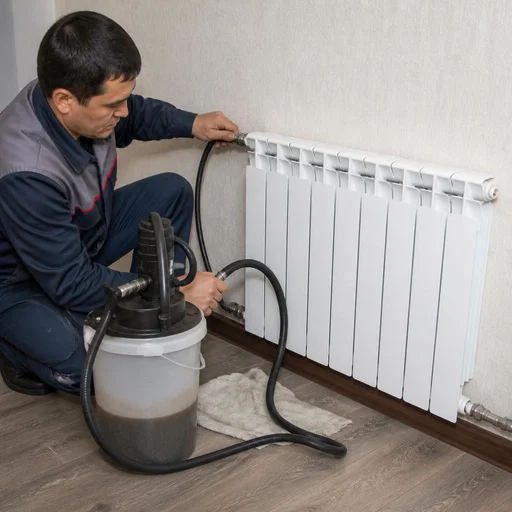
| Hydraulics | Suspended solids, soft sludge | Any, including aluminum | Routine maintenance, light clogging |
| Hydrodynamics | Dense compacted layer | Cast iron, steel | Targeted cleaning of risers and horizontal runs |
There is no universal method: the combination of "chemicals + hydropneumatics" gives the best result on old cast-iron systems, while on new bimetallic ones hydraulics alone is enough. This scheme of hydro-pneumatic flushing of a heating system is confirmed on sites with different service lives. The choice depends not on price, but on what exactly has settled inside: soft sludge is washed away by the flow, while scale requires a reagent. When owners decide to flush the heating system in a private house, the technician first looks at the material of the sections and only then names the method.
Flushing without disassembly and with disassembly of the system
- Flushing without disassembly of the system: it goes through the existing connection points — radiators and pipes stay in place, and the work takes less time.
- Flushing with disassembly of the system: it involves removing the radiators and flushing each one separately, which gives access to the internal cavity of the sections.
- Disassembly is justified when replacing fittings: if the shut-off valves are to be replaced, removing the radiator is combined with flushing and you do not pay twice for one disassembly.
- Disassembly for compacted sludge: when the deposits have hardened so much that flow-through flushing cannot remove them, removing and flushing the sections individually is the only way.
- Removing a cast-iron section: flushing a cast-iron heating radiator with disassembly removes the layer that the flow-through scheme leaves in the lower channels.
Blowing as a complement to flushing
Blowing the heating system with compressed air displaces the remaining water and suspended solids after flushing — without it, some of the sludge remains in the lower points of the circuit. How to blow out a heating system: air is supplied by a compressor through the drain valve, and water with residues exits through the discharge at the other end of the circuit. Blowing a heating radiator is done in a targeted way when the radiator is removed or disconnected from the riser. Blowing the heating batteries shows how completely the suspended solids have come out: if clean water flows from the discharge, the flushing is complete. Blowing the heating pipes helps on long horizontal sections where water stagnates and sludge settles. How to blow out heating batteries correctly is a question of pressure: too weak a flow will not carry out the suspended solids, while too strong a flow will damage the seals. Blowing of the heating goes as the last stage; after it, the system is filled and pressure-tested. Clients often write "flushing and pressure testing of the heating system" in one line — and that is logical: both procedures go one after the other, and flushing the batteries without a control pressure test is not considered complete.
What exactly we flush: radiators, risers, distribution lines, horizontal runs, heat exchangers
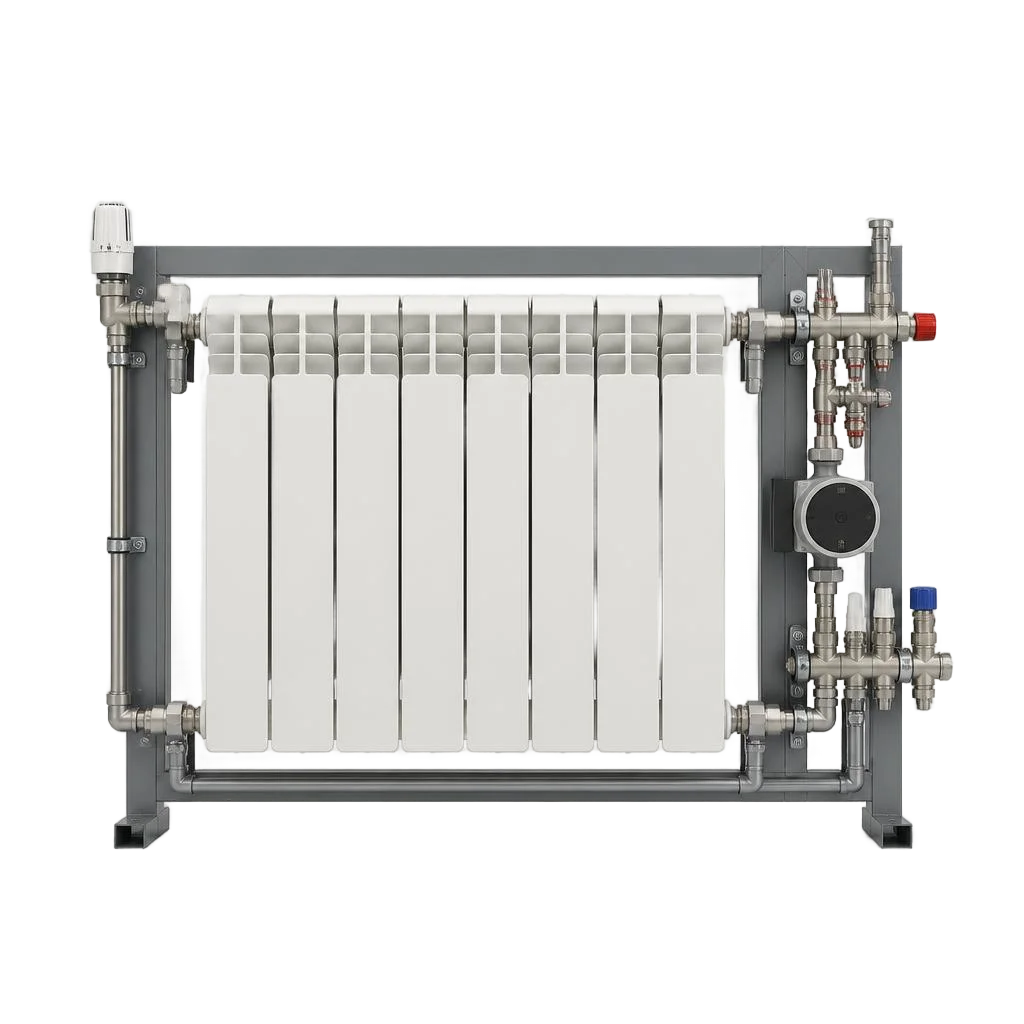
A heating system is not just the radiators in the rooms. We work with each unit separately: a blockage in a riser and scale in a heat exchanger require different equipment, pressure and reagent.
Treatment of radiators by material: cast iron, bimetallic, aluminum, steel
| Material | Method | Specifics | What we remove |
|---|---|---|---|
| Cast iron | Hydro-pneumatic, shock wave | Withstands aggressive reagents, thick wall | Sand, mill scale, bio-sludge |
| Bimetallic | Gentle chemicals, then hydraulic | Steel core, aluminum fins | Scale, suspended solids, silt |
| Aluminum | Weakly acidic compound, neutralization | Sensitive to pH above 8 | Scale, sludge, oxides |
| Steel panel | Combined: chemicals and hydro-pneumatic | Thin channels, risk of pinching | Sludge, rust, suspended solids |
Cleaning risers and horizontal runs in an apartment building
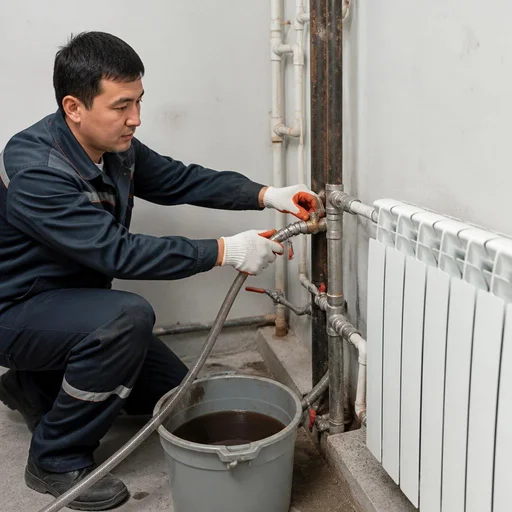
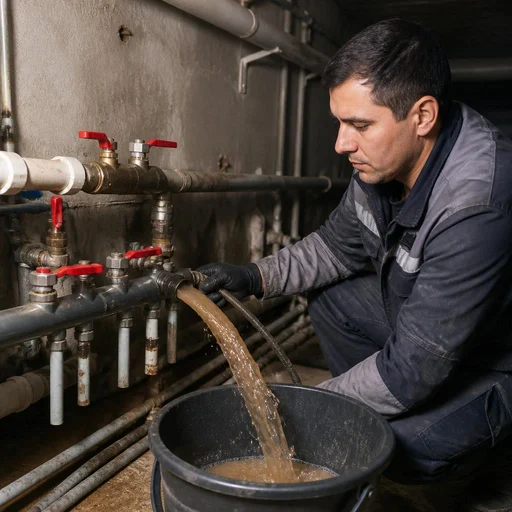
We treat heating risers and horizontal runs in the basement of an apartment building — these are the vertical and horizontal sections where the bulk of the sludge from the central system accumulates. The work is carried out at a pressure of 6–8 bar with compressed air supply: the pulsating flow detaches deposits from the inner walls and carries them into the basement drainage, where the horizontal run collects up to 60% of the solid particles from the upper floors. The riser is treated from top to bottom, otherwise sludge from the upper floors will settle in the lower radiators, which is why apartment-by-apartment treatment without the riser gives only a temporary effect. When the management company approves the work, the price of flushing the heating system in an apartment building depends on the number of risers and the number of floors, and treating radiators in Tashkent in apartments on the upper floors requires a separate stage after the riser. In requests, residents often write briefly: flushing of heating risers — and that is enough for the dispatcher to understand the task and assign a crew with the right equipment.
Treatment of distribution lines in an apartment and piping in a private house
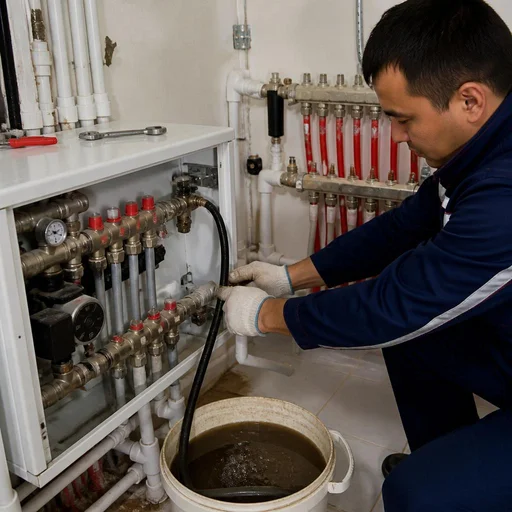
Eco-Service treats the distribution lines in an apartment and the piping in a private house — from the manifold to the last radiator, including hidden sections in the screed and walls. Cleaning heating pipes in an apartment takes 3–5 hours for a two-pipe scheme and 2–3 hours for a single-pipe scheme with bypasses. In a private house the circuit is longer and often has dead-end branches: they are treated one by one, shutting off the valves, otherwise the water will take the short path and the far radiators will remain dirty. The main line from the boiler to the manifold is flushed separately from the branches — this removes the bulk of the sludge without the risk of clogging the thin channels of the radiators. Clients describe the task in different ways, and one of the frequent requests sounds like this: flushing of the heating system in a private house — it usually means a circuit with dead-end branches and hard water. Another popular search variant is heating radiator flushing price: people search this way when they want to first understand how the calculation works, and only then call a crew. The cost of treating a heating radiator as part of comprehensive work on the whole house is calculated not per unit, but by the length of the circuit and the number of branches.
Cleaning the heat exchanger of a boiler and an indirect heating water heater
We treat the boiler heat exchanger and the indirect heating water heater with a separate circuit — scale forms in them fastest, because here the water is heated to the maximum temperature. Cleaning a heating boiler requires a removable circuit with a pump and heating of the reagent to 40–50 °C: at this temperature the salt layer on the walls softens and is removed in 1–2 hours instead of 6–8 hours when cold. Flushing a heating system with a gas boiler has a limitation: the reagent cannot be run through the entire heating circuit — it will get into the radiators and settle there, because the acid concentration in the heat exchanger is higher. Cleaning of heating boilers is included in the maintenance schedule once every 2–3 seasons for gas models and more often for solid-fuel ones, where the water is harder. In search, clients simply type: flushing of heating pipes — and via this query they land on our page, although more often it is actually about the heat exchanger. Another frequent input is flushing of heating radiators price: behind it usually stands the desire to compare estimates for different units before the technician arrives. A heating radiator and batteries can be treated after such a procedure with the same reagent, if it has been neutralized.
Cleaning of a plate heat exchanger and pump group
Eco-Service treats a plate heat exchanger and pump group on site or with removal — the gap between the plates is narrow, and ordinary flow-through treatment does not penetrate it. The heat exchanger flushing system here is built on a closed cycle: the reagent is run through the dismountable plate pack at a speed of 1.5–2 m/s, which breaks up scale in channels 2–3 mm deep. The pump group is treated without removing the housing — only the impeller is removed and the chamber is flushed of suspended solids. After the chemicals, the plate heat exchanger must be neutralized and rinsed with clean water under pressure — residues of the reagent corrode the gaskets and lead to leaks between the plates. A leak test after assembly is a mandatory stage; without it the unit cannot be installed in the circuit.
Cleaning of a heated towel rail
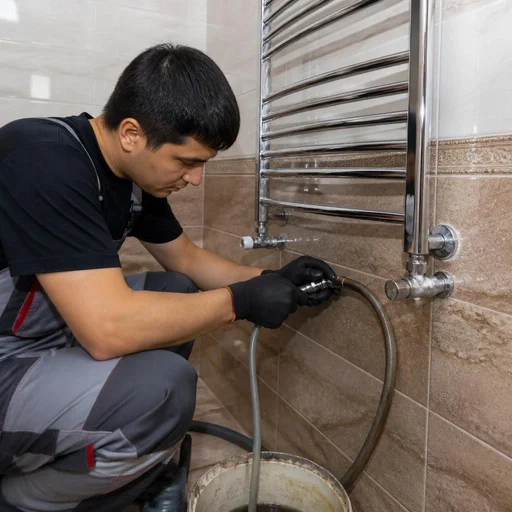
A heated towel rail is treated as part of the hot water supply circuit — the same sludge accumulates in it as in radiators, but because of the thin tubes it clogs faster. The diameter of the channels in a standard model is 15–20 mm, while radiators have a minimum of 25–30 mm, so deposits build up 1.5–2 times faster. Treatment of a heating battery of this type takes 30–40 minutes: running water under a pressure of 4–5 bar with the flow direction reversed. A heating battery can also be treated without removal — through the standard Mayevsky valves, if the threaded connections are not seized. If a heated towel rail has stopped heating evenly, cleaning is often cheaper than replacement: a new model requires welding or repacking of the threaded connections. Requests also contain this wording: flush a heating radiator — using it, the dispatcher clarifies whether it is a heated towel rail or a room battery, and selects a crew with the necessary equipment.
Flushing the heating system in a private house and apartment: how the work differs
The circuit of a private house and the apartment distribution in an apartment building are designed differently — this determines the choice of method, access to the pipes and the scope of work. We break down three scenarios: an autonomous system, apartment-by-apartment distribution and a central circuit.
Flushing the heating system in a private house
The price of flushing a heating system in a private house depends on the length of the circuit, the number of radiators and the pipe material — the work goes from the boiler to the last appliance, including underfloor heating and an indirect water heater. Clients often phrase the request as cleaning the heating system of a private house — and the technician immediately understands that the full circuit is needed, not individual appliances. Cleaning the heating system covers the supply and return lines at the same time: at Tashkent sites with open distribution made of steel pipes, sludge accumulates at the low points and near the boiler. Hydro-pneumatic cleaning of the circuit takes from 3 to 6 hours for a length of up to 120 meters, while treating a private house with copper pipes and aluminum radiators is done only with neutral reagents — alkali corrodes thin-walled metal. In the search bar, owners often type in heating flushing in a private house — and for this query we travel to the site with a full set of equipment. Service through Eco-Service includes pressure testing after the work: the pressure is held for a 2-year warranty, and if the circuit fails the test, the repeat visit is not charged. If you need to flush the heating system in a private house with several branches and underfloor heating, we arrive with a high-pressure machine and a separate set for each circuit.
Flushing the heating system in an apartment and an apartment building
Flushing the heating system in an apartment is limited to the radiators and the distribution up to the riser, while work in an apartment building on the risers and horizontal runs in the basement is performed with the approval of the management company. Owners of suburban properties search differently: flushing the heating system in a private house — that is how the query sounds when it concerns a circuit with its own boiler and distribution across all floors. Servicing a radiator in an apartment of a bimetallic or aluminum model takes 40-60 minutes per appliance, a cast-iron sectional one — up to two hours because of the internal ribs. An autonomous circuit and apartment-by-apartment distribution in an apartment building differ in access to the pipes: in Tashkent buildings of series 1-464 and 1-447, the risers clog faster, and cast-iron horizontal runs in the basement accumulate up to 30% sludge by the fifth season. Apartment-by-apartment cleaning without the riser gives a temporary result: while the riser is clogged, sludge will again descend into the radiators within 1-2 seasons. A separate line in the statistics is heating battery flushing Tashkent: this query is most often made by residents of the upper floors, where air and sludge accumulate more. In requests for individual appliances, technicians see the wording flushing of heating radiators — behind it is usually the task of removing scale from each section and restoring even heating throughout the apartment. When a client asks to flush the entire heating system along the riser, we first coordinate access with the management company and only then start the machine.
Flushing the central heating and heat supply system
Flushing of the central heating system is carried out at the building inlet and along the risers — this is the responsibility of the management company or the homeowners' association, but the Eco-Service service also works on requests from the owner. Owners of autonomous facilities describe the task as follows: flushing the heating system of a house — and specify the number of floors, the boiler, and the pipe material. Treatment of the heat supply system at facilities in Tashkent with an elevator unit requires separate cleaning of the mud trap and the nozzle: scale on the nozzle changes the mixing coefficient and reduces the temperature in the risers by 3-5 degrees. Servicing the circuit of a building with 60-80 apartments with two inlets takes from two days, while an autonomous system with one boiler and six appliances can be done in one shift. In requests for country properties, technicians also see this wording: flushing the heating system of a private house — it usually refers to a circuit with several branches and underfloor heating. Another frequent request from owners is cleaning the heating system in a private house, when radiators heat unevenly across floors. Separately, in building maintenance contracts, flushing of the heat supply system is specified — this is work at the inlet, the mud trap, and the elevator unit before the start of the season. The central circuit is flushed in the off-season: during the heating season, draining the coolant is prohibited, otherwise the entire entrance will be left without heat.
How the work is done: stages, equipment, and what's included in the service
This isn't "connect a hose and turn on the water." We work according to a procedure where every stage is verified: from diagnosing the circuit to the control pressure test after the work.
Stages of work: from diagnostics to pressure testing
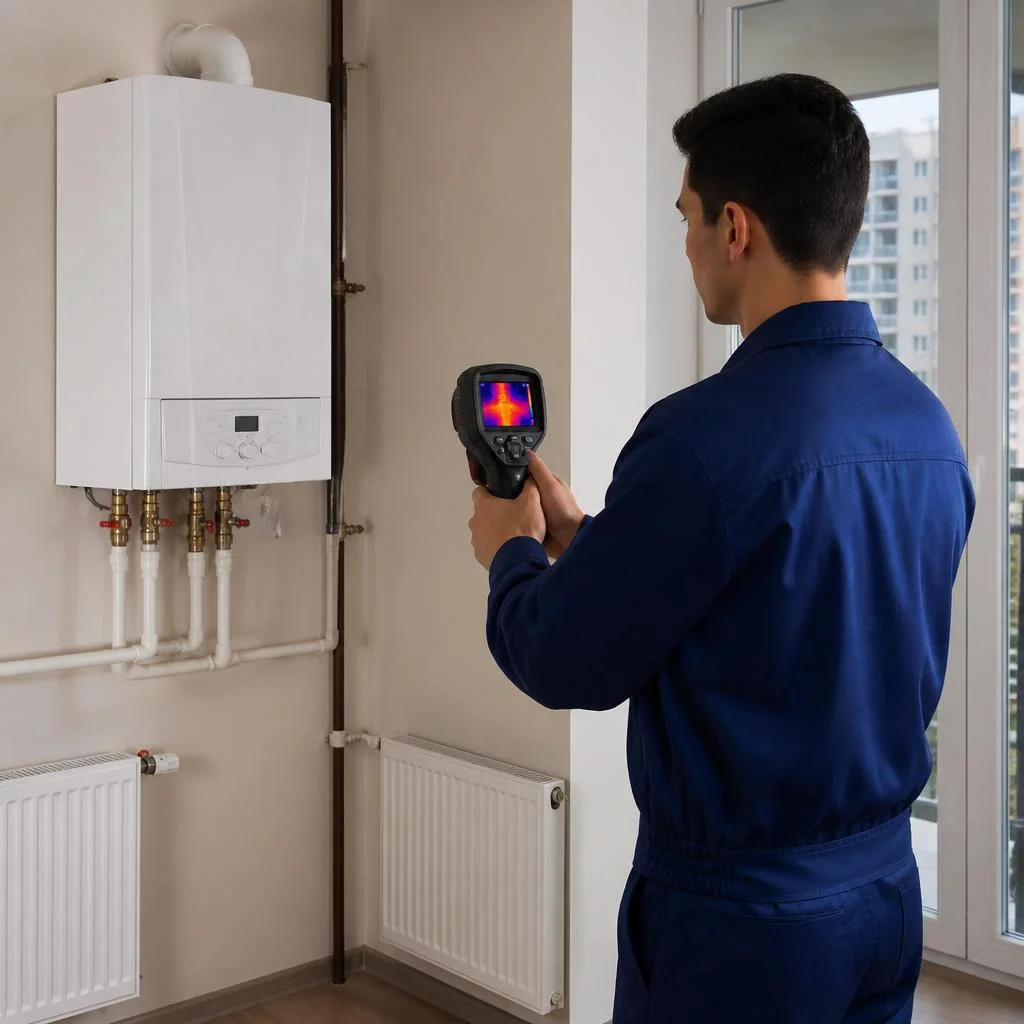
- Diagnostics: a thermal imaging survey shows the blockage zones and temperature differences across risers, radiators, and basement runs.
- Draining the coolant: we discharge the old coolant to the drain and record the volume and degree of water contamination by color and sediment.
- Flushing the circuit: at Eco-Service we use the chosen method — hydro-pneumatic, chemical, or hydraulic, depending on the pipe material and type of blockage.
- Control check: after flushing, we run the water through again and compare the supply and return temperatures with a thermal imager.
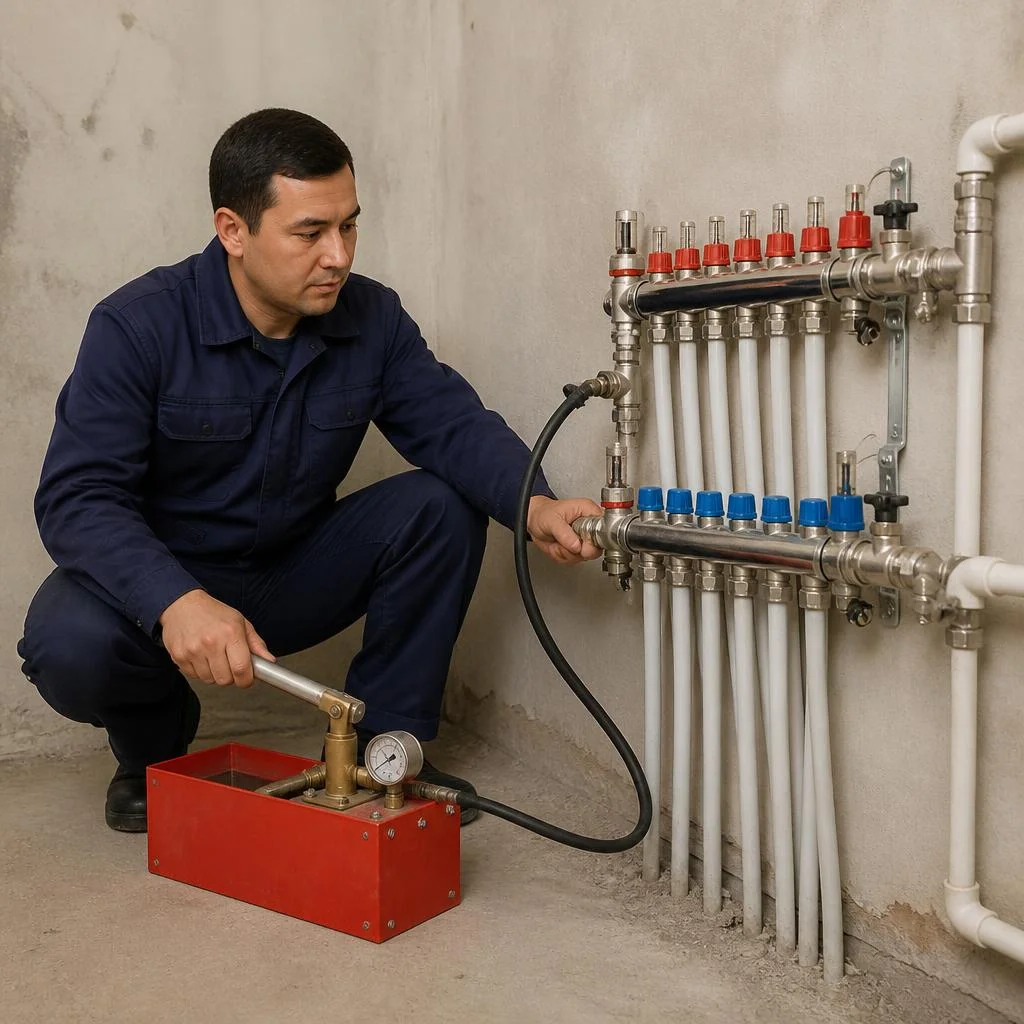
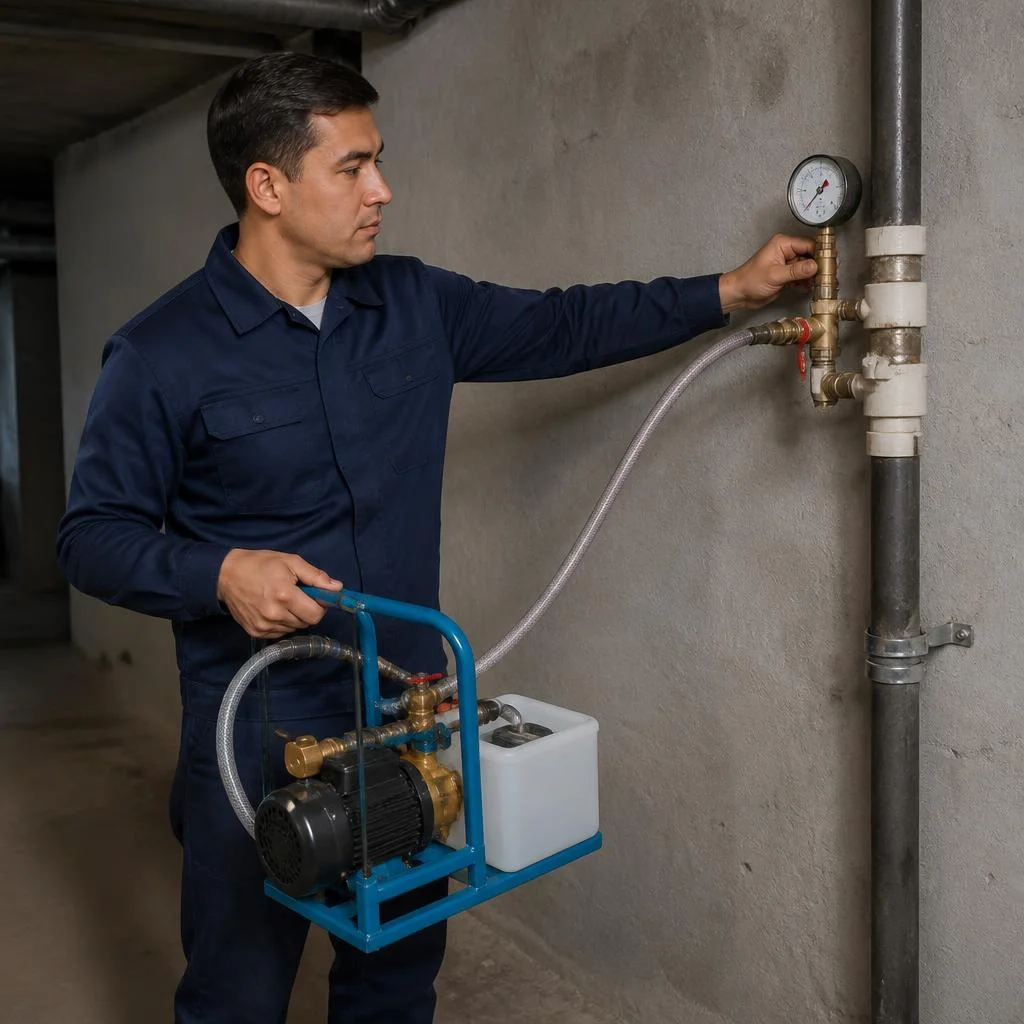
- Pressure testing: flushing and pressure testing of the heating system go together as one block; hydraulic pressure testing confirms the tightness of all connections and threaded joints.
Equipment: flushing station, compressor, high-pressure hoses
- Flushing station: a pump with adjustable pressure and a pressure gauge; we select the mode based on the pipe material and wall thickness.
- Compressor: supplies air for hydro-pneumatic flushing and creates a pulse that knocks sludge and scale off the walls of cast-iron sections.
- High-pressure hoses: reinforced hoses with quick-release fittings, suitable for circuits of any length in private homes and commercial properties.
- Thermal imager: records the temperature distribution before and after the work; the difference is visible on screen immediately and goes into the report.
What's included in the service and what's paid separately
- Included: diagnostics, flushing by the chosen method, draining and refilling the coolant, control pressure testing of the circuit.
- Included: hydro-pneumatic flushing as a separate method, if the technician chooses it based on the condition of the circuit and the degree of blockage.
- Separately: replacement of shut-off valves, repair of identified defects, replacement of pipe sections and heated towel rails.
- Separately: a repeat visit if, after flushing, a hidden pinhole leak is found at a threaded joint or a coupling has loosened.
- Calculation: the cost of pressure testing the heating system is calculated by the number of circuits and connection points, not by the footage of pipes.
Acceptance of work and documents
Heating flushing is closed out with a report stating the method, the pressure test pressure, and the results of thermal imaging control before and after. Heating system maintenance is built on this same report: the technician notes the units worth checking before the next season — usually the shut-off valves at the inlet and the upper points of the distribution. The report is signed by both parties, and one copy stays with the owner of the house or apartment. Without it, a repeat request starts from scratch: the technician doesn't see the work history and can't compare last season's readings with the current ones. Clients often write things like: flush the heating radiators — and ask us to also assess the condition of the sections, so we include that column in the report as well. Another frequent request is flushing a heating radiator: it shows that the person wants targeted work on a single radiator, not the whole riser. In the search bar, many type it briefly: heating flushing price — and with that query the technician immediately understands that the owner needs a budget reference even before the visit. Request the report right after the visit — it saves on diagnostics during the next service.
2-Year Warranty, Safety, and Why a Direct Provider Is More Profitable Than an Intermediary
Flushing is a job where it's important not only to perform it with quality, but also to stand behind the result: a 2-year warranty, our own service center, and direct contractors with no chain of intermediaries.
2-Year Warranty on Flushing and Pressure Testing
Eco-Service provides a 2-year warranty on heating system flushing and pressure testing — if within this period the radiators start heating unevenly again, we will come back and sort it out. A warranty case is processed based on the work completion certificate and receipt: the technician records the parameters before and after the work, including the temperature differential at the radiator inlet and outlet, the pressure in the circuit, and the condition of the shut-off valves. For cast-iron sections, bimetallic, aluminum, and steel panels, the protocols differ in flow rate standards, so the certificate specifies the exact model and material of the sections. The warranty covers the work, not pipe wear: if the system is assembled from rusty pipes, the procedure will give a temporary effect, and we will honestly warn you about this before starting work. Clients often find us through the query "heating radiator flushing" — and land on this page. Before ordering, ask the technician to measure the temperature differential at the supply and return — if the difference is less than 10 °C, the service is urgently needed.
Our Own Service Center in Tashkent and Technician Visits
Eco-Service has its own service center in Tashkent — the technician travels to the site with equipment rather than looking for a subcontractor on site. Work on the heating system is performed by our staff specialists: the vehicle carries a flushing station, an 8-10 bar compressor, high-pressure hoses, and chemical reagents suited to the specific radiator material. Servicing heating systems in multi-story buildings in Chilanzar, Yunusabad, and Sergeli requires coordination with the management company — the technician helps arrange access permits to the risers and basement distribution pipes. Having our own center means that complaints and repeat visits go through us, not through a chain of intermediaries — the response time for a warranty case is shorter. In search, such requests look like "heating flushing Tashkent" or "heating system flushing Tashkent" — that's what we work on. If the site is in Samarkand, Bukhara, or Namangan, check the visit schedule in advance: the crew is formed based on the route and doesn't depart on the day of the request. A separate line in our requests is heating system flushing in Tashkent price, and from it you can see that the person is already comparing offers and is ready for a quote. Some clients type heating systems flushing Tashkent — and from that wording the technician immediately sees the city and the type of work.
Why a Direct Provider Without Intermediaries Is Cheaper and More Reliable
Eco-Service is a direct provider of heating system flushing services: you pay for the work, not for the dispatcher's markup, and you communicate with the contractor directly. With an intermediary, the cost of the service consists of two parts — the technician's rate and the commission of the dispatch service, which often reaches 30-40% of the bill. Going to a direct contractor means that the estimate is formed on site after diagnostics: hydraulic pressure testing, thermal imaging inspection, and circuit flushing are counted as separate line items without hidden markups. With an intermediary, the technician often works on a percentage and cuts corners on reagent or work time — a direct provider is interested in the result because they stand behind it with a warranty. Compare two estimates for the same site — the difference usually shows up in line items that the intermediary doesn't have in their public price list. Clients often phrase the task as: heating systems flushing — and from that phrase alone it's clear that a full circuit is needed, not just one radiator. Many also specify heating systems flushing price — and here it's important to understand that the total depends on the number of floors, the pipe material, and the degree of blockage. Another frequent query is heating system flushing cost: from it you can see that the person is putting together an estimate for comparison, and it's important for the technician to immediately state what line items it consists of.
What to Clarify Before Signing the Contract
- Warranty period in the act: insist on a 2-year warranty on the work — verbal promises offer no protection if the clog recurs.
- Contractor's ID: verify the service center's name in the contract against the actual address — intermediaries often have a mismatched address.
- Itemized estimate: the cost of the service and its individual stages must be broken down into labor, chemicals, and pressure testing.
- Measurement report: temperature differential and pressure are recorded before and after the work — without these figures, a warranty claim is hard to prove.
- Piping layout: for a private house, request that risers and horizontal runs be marked on the plan — on a repeat visit, the technician won't waste time searching for them.
Conclusion
The breakdown of methods, objects, and stages comes down to a few practical conclusions. Below is what determines the outcome of the procedure and the service life of the circuit after it.
Key takeaways
- Early signs: uneven heating of radiators and noise from the circulation pump are a signal that you can't afford to delay: the consequences cost more than prevention.
- Choosing a method: hydropneumatic flushing removes sludge, chemicals dissolve scale, hydrodynamic flushing tackles the dense layer — the method is selected based on the radiator material and the type of deposits.
- Scope of work: in a private house, the entire circuit is flushed along with the return line; in an apartment building, the risers and horizontal runs are flushed, otherwise per-apartment flushing doesn't last.
- Separate circuits: the boiler heat exchanger and indirect water heater are flushed on their own circuit with a pump so the chemical doesn't get into the radiators.
- Final check: the work is completed with pressure testing — it reveals weakened joints that were held together only by sludge before flushing.