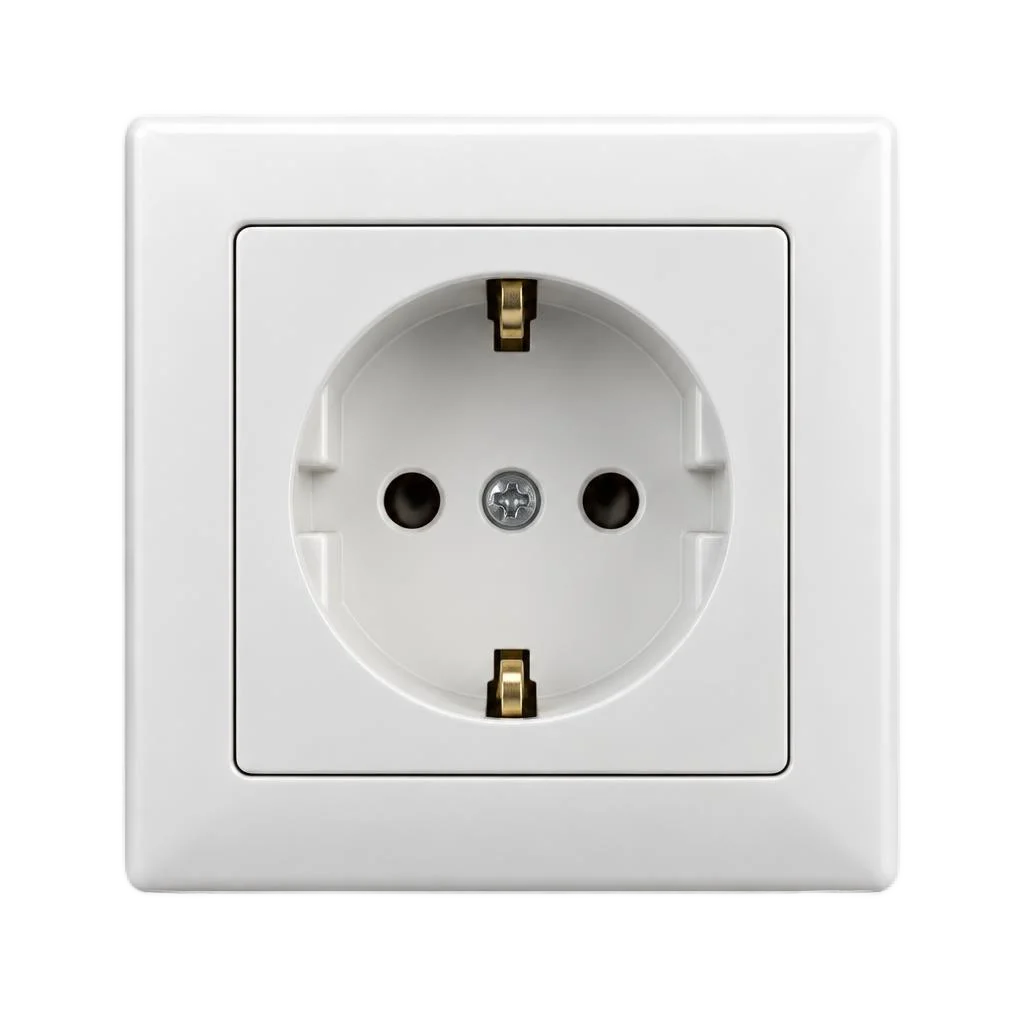

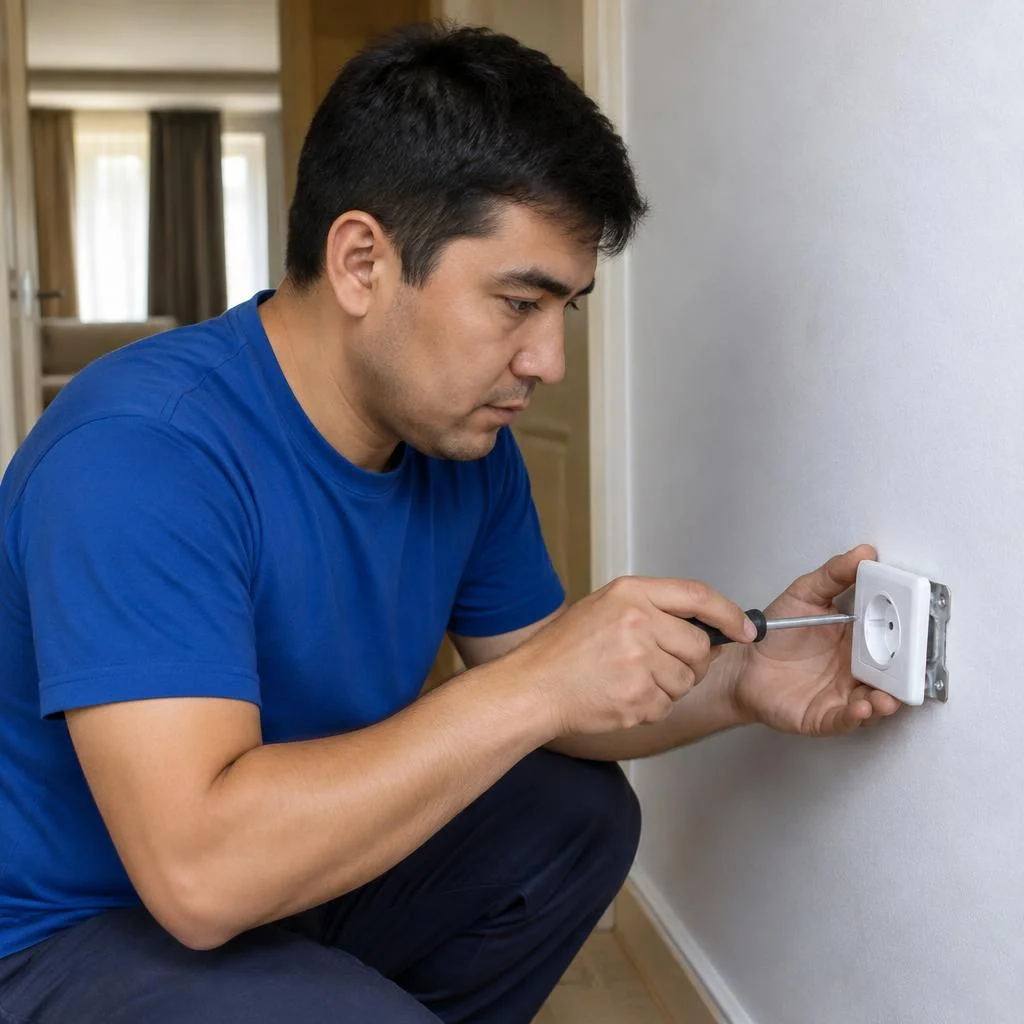
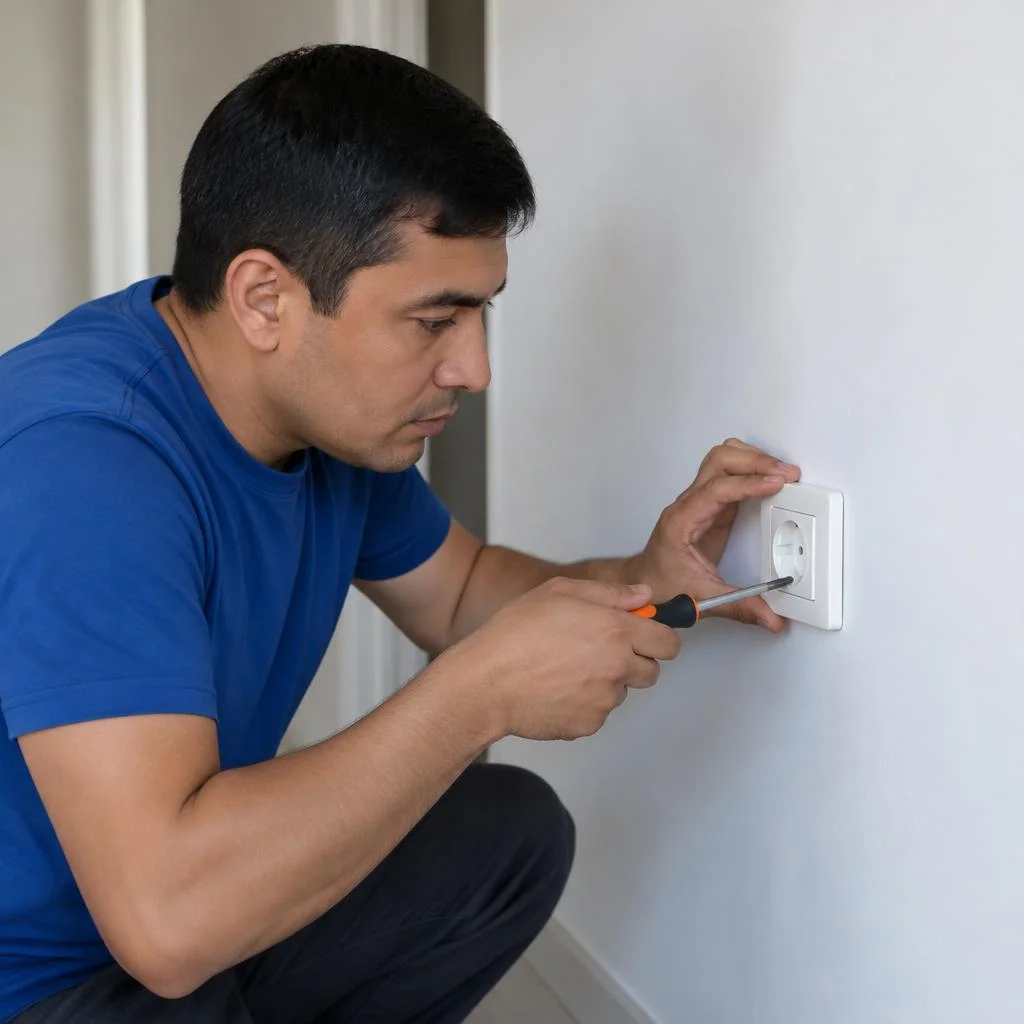
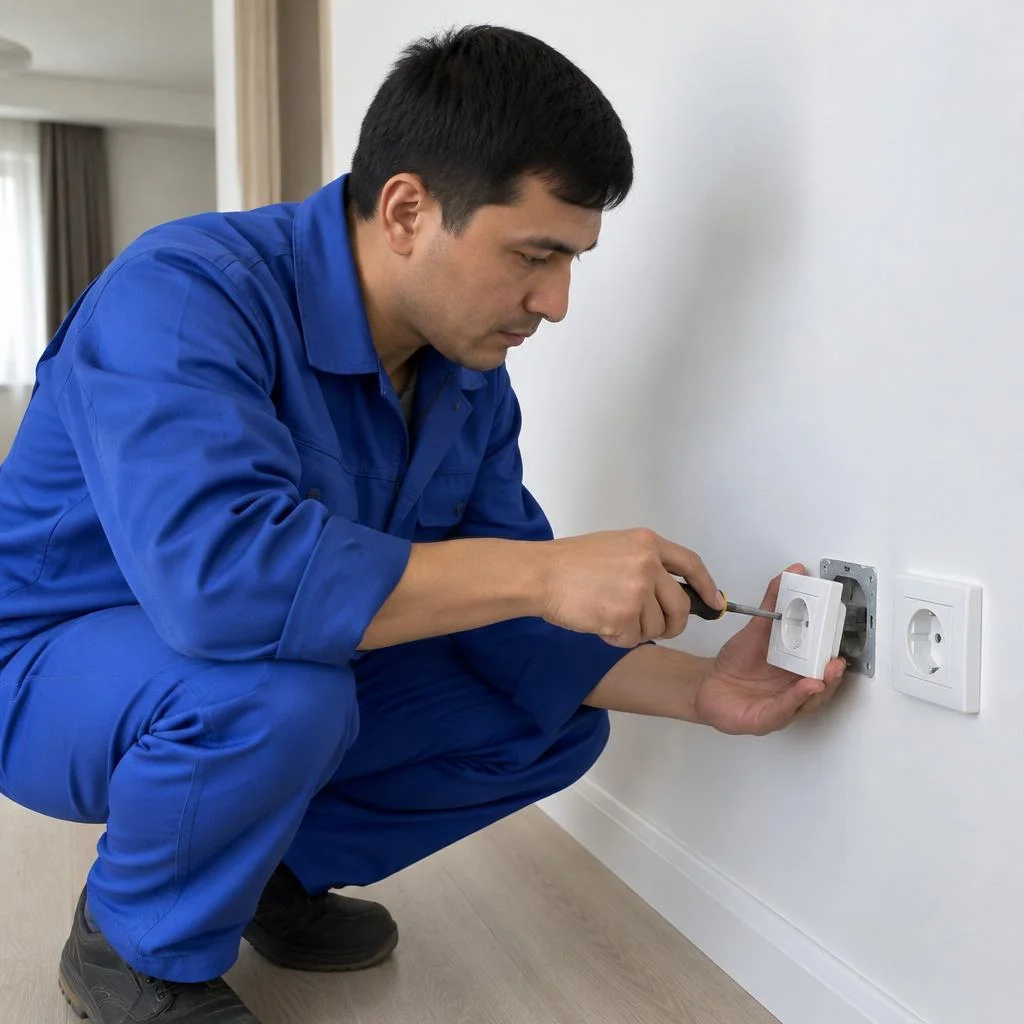

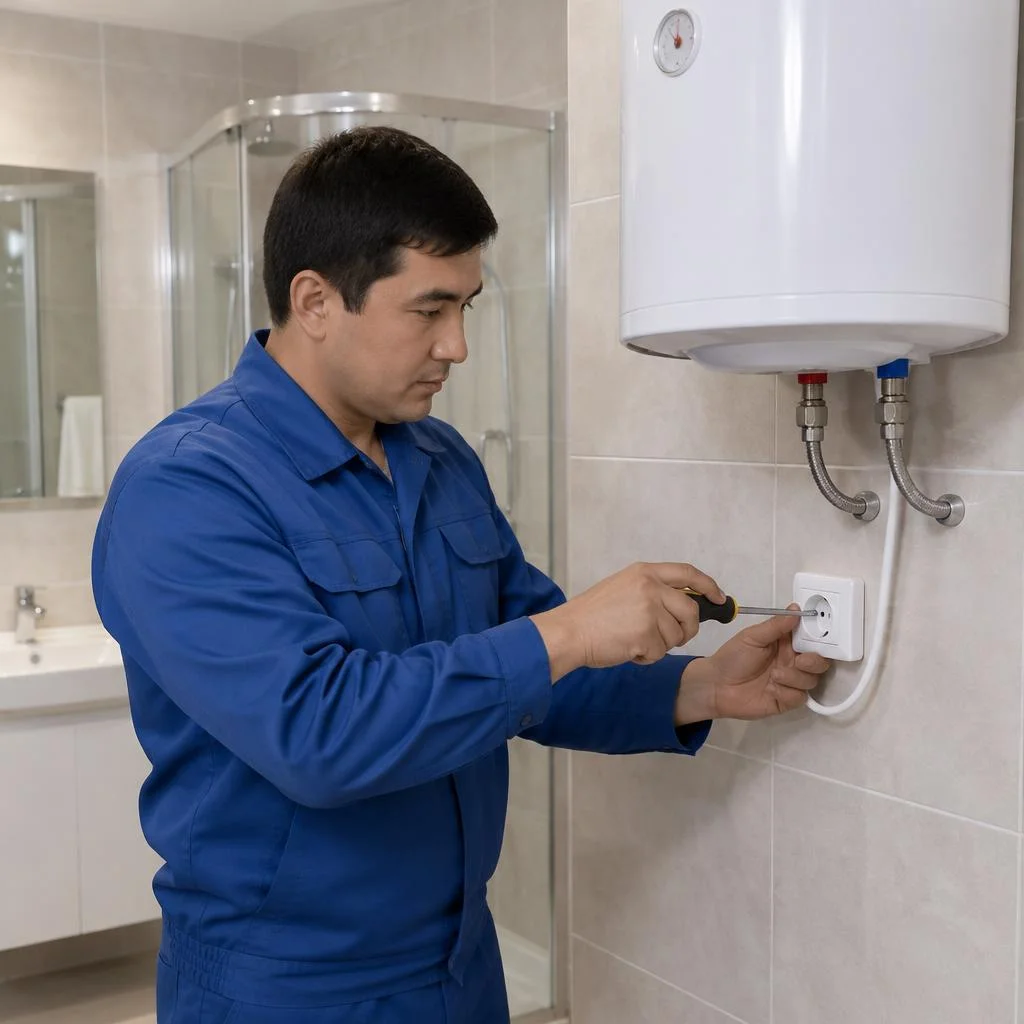








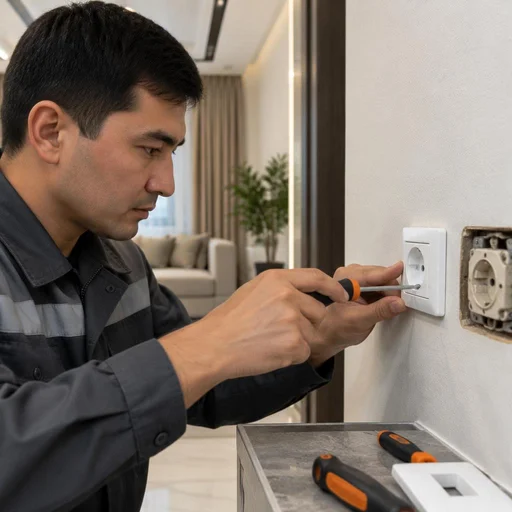
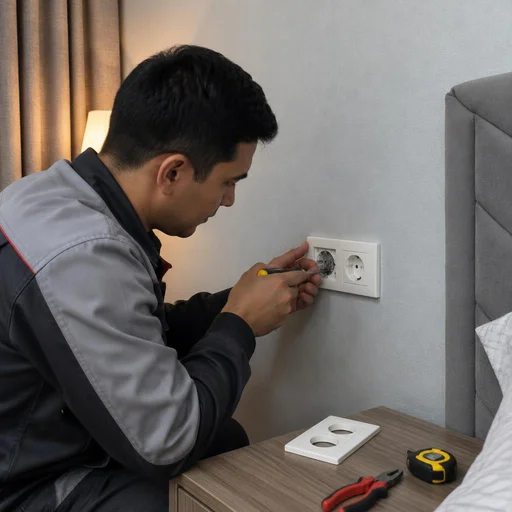
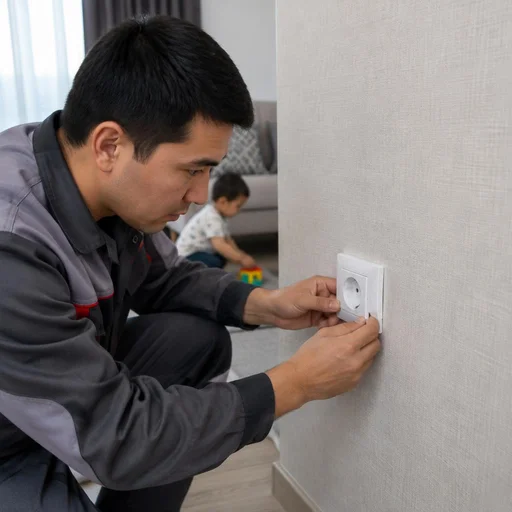
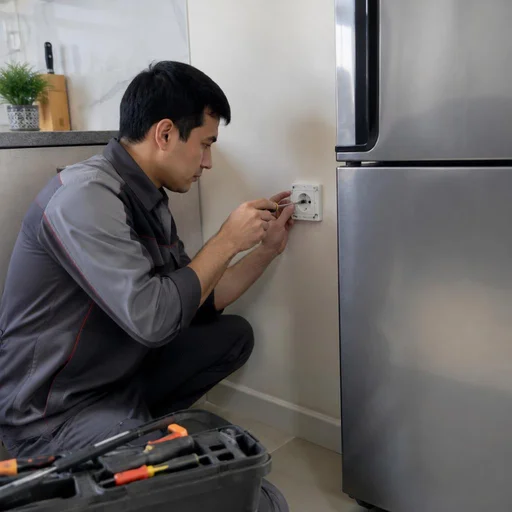
When it's time to replace an outlet: signs of wear and risks
An outlet is a consumable item with a limited service life: spring contacts weaken, plastic ages, terminals oxidize. Let's look at the signs by which Tashkent residents realize that putting off the work is no longer safe.
Sparkling, heating up, loose: 5 signs it's time to replace an outlet
- Sparks and clicking: when the plug is inserted, a blue flash appears or a crackling sound is heard — this is an arc discharge at a loosened contact.
- Heating of the housing: the faceplate is warm or hot to the touch even with a small load — a sure signal of terminal overload.
- Darkening and melting: brown deposits, black spots, the smell of burnt plastic around the sockets — the material has already degraded from heat.
- Loose plug: the plug wobbles, falls out under its own weight, and has to be held in by hand — the spring has lost its elasticity.
- Humming under load: when the kettle or iron is turned on, a background hum is heard — the contact is working unstably, and transition resistance is growing.
Why an old outlet in an apartment is dangerous and why it's not a "small thing"
A worn-out outlet without grounding is one of the common causes of short circuits in Tashkent apartments, especially when high-power appliances are connected through an extension adapter. A loosened contact heats up, the wire insulation melts, and a fire starts inside the mounting box — behind drywall or plaster, where it can't be seen. According to fire statistics, faulty electrical wiring and electrical equipment consistently rank among the top three household causes of fires in residential buildings. A separate problem in old panel and brick buildings is the absence of a grounding conductor in the building's wiring: the neutral and the protective conductor are combined there, or there is no grounding at all. In such a situation, safety is provided by an RCD or RCBO in the panel, not by the outlet itself. Check this before installation — updating the fittings without inspecting the panel covers up the symptom, but not the cause.
What outlet replacement according to PUE standards means
- Wire cross-section for the load: a 16 A line requires 2.5 mm² copper; at 1.5 mm² the outlet heats up even with careful installation.
- Terminal connection: screw clamps are retightened after installation, spring clamps are selected to match the cross-section, otherwise the contact will loosen within a few months.
- Grounding contact: the third wire is connected to the PE bus in the panel, not to the neutral and not to a heating pipe.
- Matching the line's load: a 10 A outlet on the line for a washing machine or stove is a violation that shows up as heating of the housing.
- Frame and mounting box: the depth of the box is selected to match the mechanism, otherwise the housing presses against the wire and deforms the terminals.
Hidden or exposed wiring: which installation suits your home
The installation method determines both the scope of work and the appearance of the wall. Let's look at when hidden installation is appropriate and when exposed is — and how this depends on the type of home, the condition of the wiring, and the task.
Hidden installation: when the socket goes into the wall
We perform socket installation with hidden wiring when the supply cable is already embedded in the wall — the mounting box is recessed into the chase, and the faceplate stays flush with the surface. Chasing for a new line is done only in brick and aerated concrete, where a groove depth of up to 30 mm does not affect the load-bearing structure; in the panel buildings of Tashkent (Chilanzar, Yunusabad, Sergeli), you cannot chase a load-bearing wall for a new line — a hidden socket there is installed only on existing wiring, and a new line is run in an exposed way. The mounting box is selected to match the wall depth: in drywall, 40 mm is enough; in concrete, 45-60 mm with a margin for the frame and mechanism. Work on an existing hidden line is carried out without opening up the wall along its entire length — only the fittings in the old mounting box are replaced. Before drilling, check the wall with a metal detector: rebar in a panel runs at a spacing of 100-150 mm, and hitting it will strip the core bit.
Exposed installation: neat work when you can't chase
Installing a socket with exposed wiring is the solution for panel and old buildings where chasing load-bearing walls is prohibited: the cable runs through a cable duct, and the socket is mounted in a surface-mounted way. Cable ducts are taken at a width of 16×16 or 25×16 mm for three cores with a cross-section of 2.5 mm² — this is enough for a line up to 3.5 kW; for a stove and boiler, a separate 40×25 mm duct is run. In Tashkent's older buildings with aluminum wiring, a new copper line from the panel in a cable duct is installed without opening up the walls and does not require replacing the breakers throughout the whole riser — it is enough to install a separate breaker for the new group. Exposed installation does not mean "ugly": the duct is selected to match the wall color, and the line is run strictly horizontally and vertically — this makes it easier to find later when drilling.
Comparison of installation methods by type of home and task
| Type of home / situation | Installation method | What we do | When it is suitable |
|---|---|---|---|
| New building, cable in the wall | Hidden | Replacement in the existing mounting box | Scheduled replacement of fittings |
| Panel building | Exposed | Cable duct, surface-mounted socket | You cannot chase a load-bearing wall |
| Old building, aluminum | Exposed | New line from the panel | The wiring will not withstand the load |
| A new point is needed | Hidden or exposed | Chase or cable duct | Depends on the wall and the renovation |
The choice between hidden and exposed installation is determined by the type of home, the condition of the wiring, and whether a new line is needed or a replacement on an existing one. If the home already has hidden wiring, but the line is old aluminum, it is cheaper and safer to run a new exposed line from the panel than to open up the wall along its entire length. Through Eco-Service you can order both options — a technician on site will assess the wall and suggest a method for the specific apartment.
Sockets for high-power appliances: stove, air conditioner, boiler, washing machine
High-power appliances require a dedicated line and a socket rated for the specific load. Let's break down how the solutions differ for a stove, air conditioner, boiler, and washing machine.
Socket for an electric stove: dedicated line and grounding
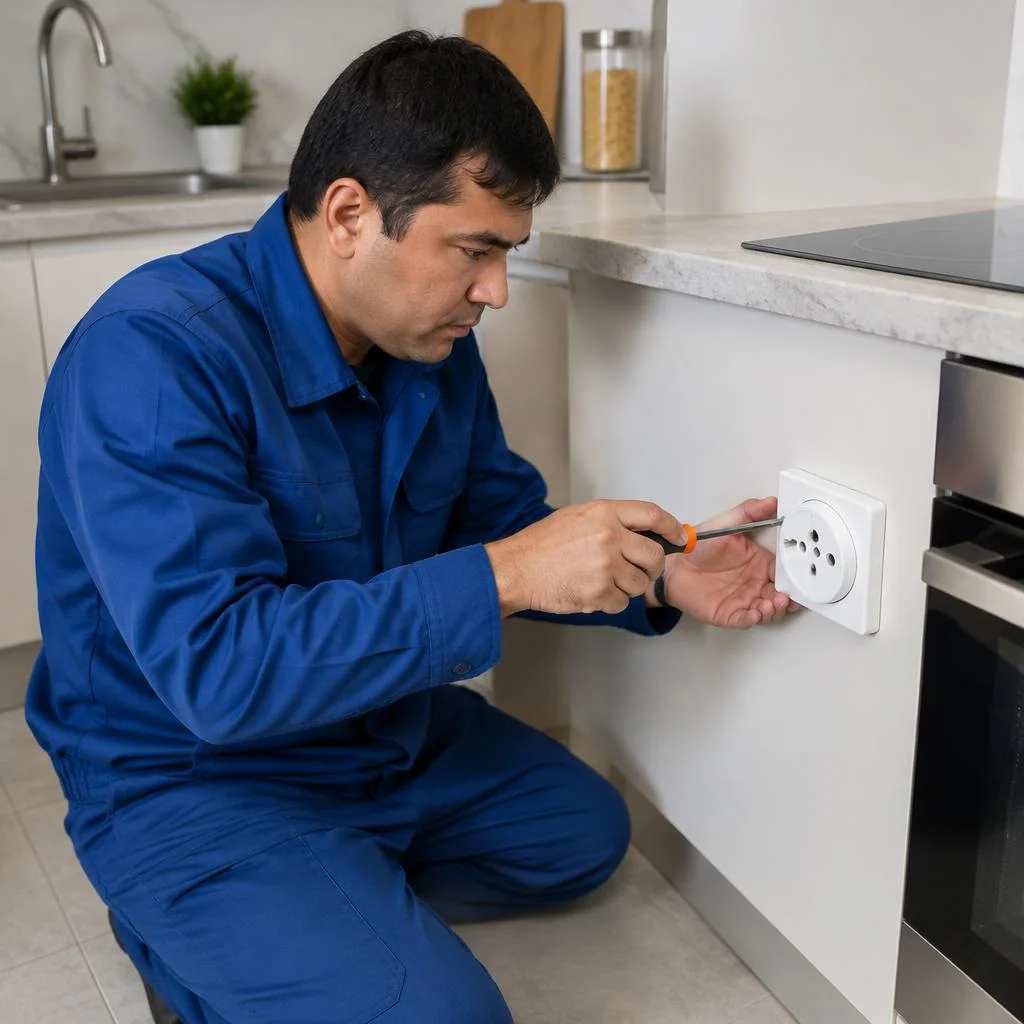
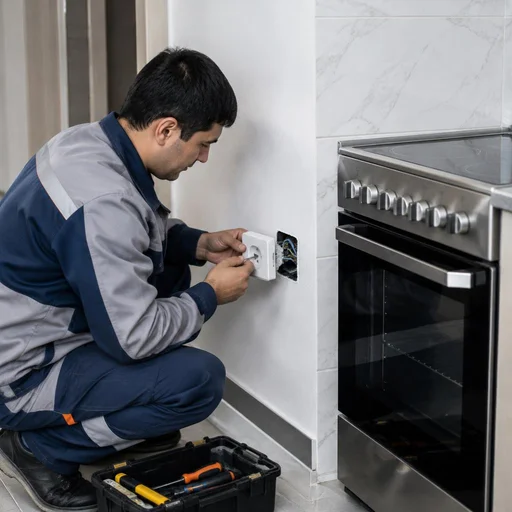
We install the socket for an electric stove on a dedicated line from the panel with a mandatory grounding contact — the stove consumes the most power in the apartment and won't tolerate a shared line with other appliances. For such a line we use copper cable with a cross-section of 4 to 6 mm², and in the panel we install a dedicated breaker rated for the specific model: for compact stoves, 25 A is enough; for full-size ones with four burners and an oven — 32 A. Power sockets from Schneider Electric and Legrand with a ceramic base handle heat better than cheap thermoplastic analogs, and installation of this class involves checking the grounding circuit with a multimeter before connecting the appliance. For a stove, not only the socket matters but also the breaker rated for it in the panel: if the breaker is weaker, it will trip during heating, and upgrading the power point won't fix that.
Air conditioner and boiler: a socket near a source of heat and moisture
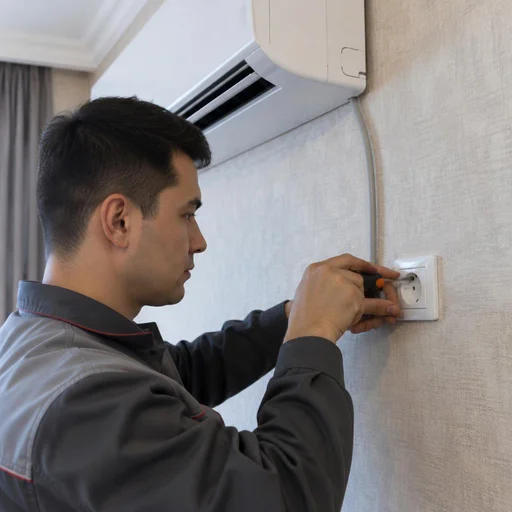
For an air conditioner and boiler, we run the socket on a dedicated line and place it so that condensate and splashes don't reach it — this is a safety requirement, not a convenience one. On the indoor unit of a split system, drainage runs along the wall, so we shift the connection point 30-50 cm away from the route and install a socket with protective shutters. For a 50-80 liter boiler, we run the line with 3×2.5 mm² copper with a 16 A breaker and a 10-30 mA RCD — when the heating element warms up, leakage to the casing is cut off in fractions of a second. Eco-Service electricians most often install ABB or Legrand fittings with IP44 moisture protection at such points. A socket for a boiler is not placed directly beneath it: if it leaks, water runs down the casing, and the connection point should be to the side at a safe distance.
Washing machine and refrigerator: wet room and constant load
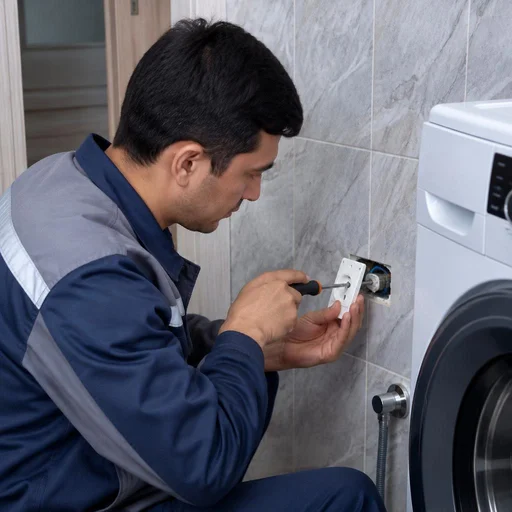
- Socket for a washing machine: IP44 moisture-protected housing, grounding contact, and connection via an RCD — washing happens with water near the power point.
- Socket for a refrigerator: a dedicated line or at least a separate group in the panel, so the breaker doesn't trip from overloading neighboring appliances.
- Voltage stabilizer: during grid voltage drops in Tashkent high-rises, it's installed before the refrigerator — the compressor is sensitive to surges.
- Installation height: for a washing machine, the point is raised 60-90 cm from the floor; for a refrigerator, free access is left without being blocked by the casing.
Comparison of sockets for appliances: line, grounding, placement
| Appliance | Dedicated line | Grounding | Placement |
|---|---|---|---|
| Electric stove | Mandatory | Mandatory | Outside the heating zone |
| Air conditioner | Mandatory | Mandatory | Outside the condensate zone |
| Boiler | Mandatory | Mandatory | To the side, not under the casing |
| Washing machine | Recommended | Mandatory | Outside the splash zone |
| Refrigerator | Recommended | Desirable | Free access |
The table summarizes the requirements that are most often confused during DIY installation: a dedicated line and grounding are considered the same thing, although they are different. The universal rule: the higher the appliance's power, the less sense it makes to save on a dedicated line — overloading a shared line doesn't show up immediately, but when appliances are turned on at the same time.
Functional options: grounding, child protection, USB, timer, dimmer
A socket today is not just two contacts in the wall, but a set of functions for a specific point in the home. Let's break down which options are responsible for safety, which for convenience, and where they are really needed.
Grounding and child protection: basic safety
We install a grounded socket as standard for all lines with appliances: a washing machine, boiler, electric stove and air conditioner are connected only through the third contact connected to the building's grounding loop. In older buildings — Chilanzar, Sergeli, the Karakamysh massif — the loop is often absent, and then we install a separate grounding loop or an equipotential bonding system: without this, leakage current protection does not work. We add child protection in children's rooms and in accessible areas of the hallway — shutters inside the housing cover both contacts and open only when the plug is pressed in simultaneously. For lines under powerful appliances such an option is not mandatory, since the appliance stands stationary and out of a child's reach. Clients often search for the cost of installation in Tashkent — and land on this page. Before choosing a model, check whether there is an RCD in the panel: grounding without residual current protection only partially reduces the risk of electric shock.
USB ports, timer and dimmer: where the options are really useful
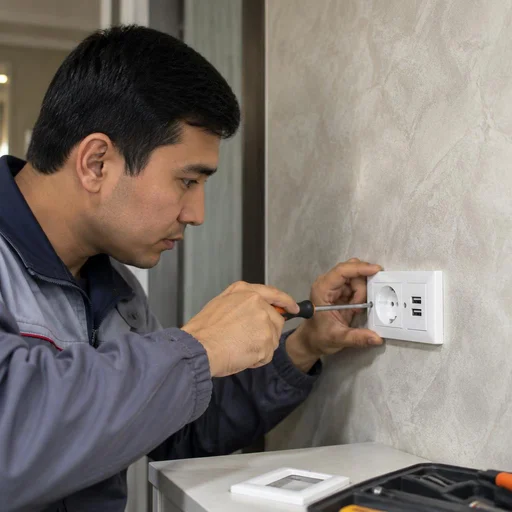
- USB ports: we install them by the bed and at the desk — they charge a phone and tablet without an adapter and free up space by the nightstand.
- Timer: suitable for a boiler and heater — it sets the operating interval and switches the appliance off on schedule, saving electricity.
- Dimmer: controls the brightness of a lamp in the bedroom or living room and connects only to lighting, not to power lines.
- Socket with a switch: convenient in the bedside area and by the TV — it cuts the power without pulling the plug out of the socket.
Comparison of socket options: what each one gives
| Option | Purpose | Where it is appropriate | Mandatory |
|---|---|---|---|
| Grounding | Safety | Everywhere with appliances | Yes |
| Child protection | Safety | Children's room, accessible area | No |
| USB ports | Convenience | Bedroom, desk | No |
| Timer | Convenience | Boiler, heater | No |
| Dimmer | Light control | Lighting only | No |
| With a switch | Combination | Bedside area | No |
You shouldn't pack the maximum of options into one socket: combined models are more expensive and harder to repair. If you are unsure about the set for a specific point, the price of installation in Tashkent depends on the configuration, so first determine the task, and then choose the model.
How we work: visit, diagnostics, installation and a 2-year warranty
We show how socket replacement works from request to warranty card, who exactly will come to your address and what the two-year warranty on the work covers.
Eco-Service's own electricians: who will come and what they will do
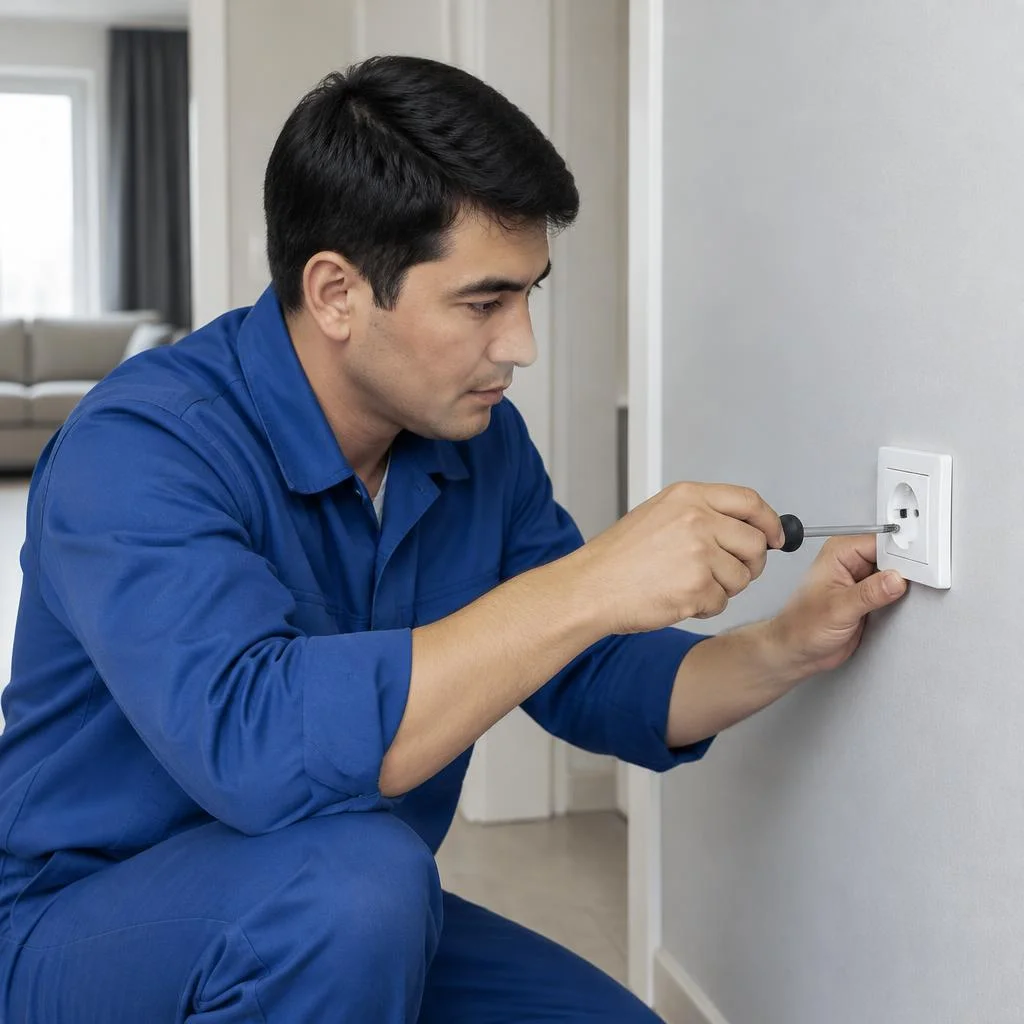
A staff electrician from Eco-Service from our service center in Tashkent comes to you — not a contractor from an ad, but a specialist who works to our standards and under our warranty. The technician arrives with his own tools: a voltage tester screwdriver, a multimeter, a load tester, a set of ferrules and Wago terminals, a hammer drill and a vacuum for the chase. Before installation, he checks the condition of the line: he rings out the conductors, measures the insulation resistance, assesses the cable cross-section and the presence of a grounding conductor in the building's distribution board. If the socket is being replaced in the kitchen or bathroom, he separately checks moisture protection and the connection to the RCD. A staff technician is answerable to the company for the result, so if he has doubts about the condition of the wiring, he will suggest inspecting the line rather than simply installing a new socket and leaving.
How installation proceeds: from the call to testing under load
- Request and coordination: you describe the task by phone or in Telegram, the dispatcher clarifies the address, the type of socket and the approximate scope.
- Technician visit: the electrician arrives within the agreed time window, inspects the installation site and gives an exact estimate before work begins.
- Wiring diagnostics: ringing out the conductors, checking the grounding and the condition of the mounting box, and if necessary, inspecting the section of the line.
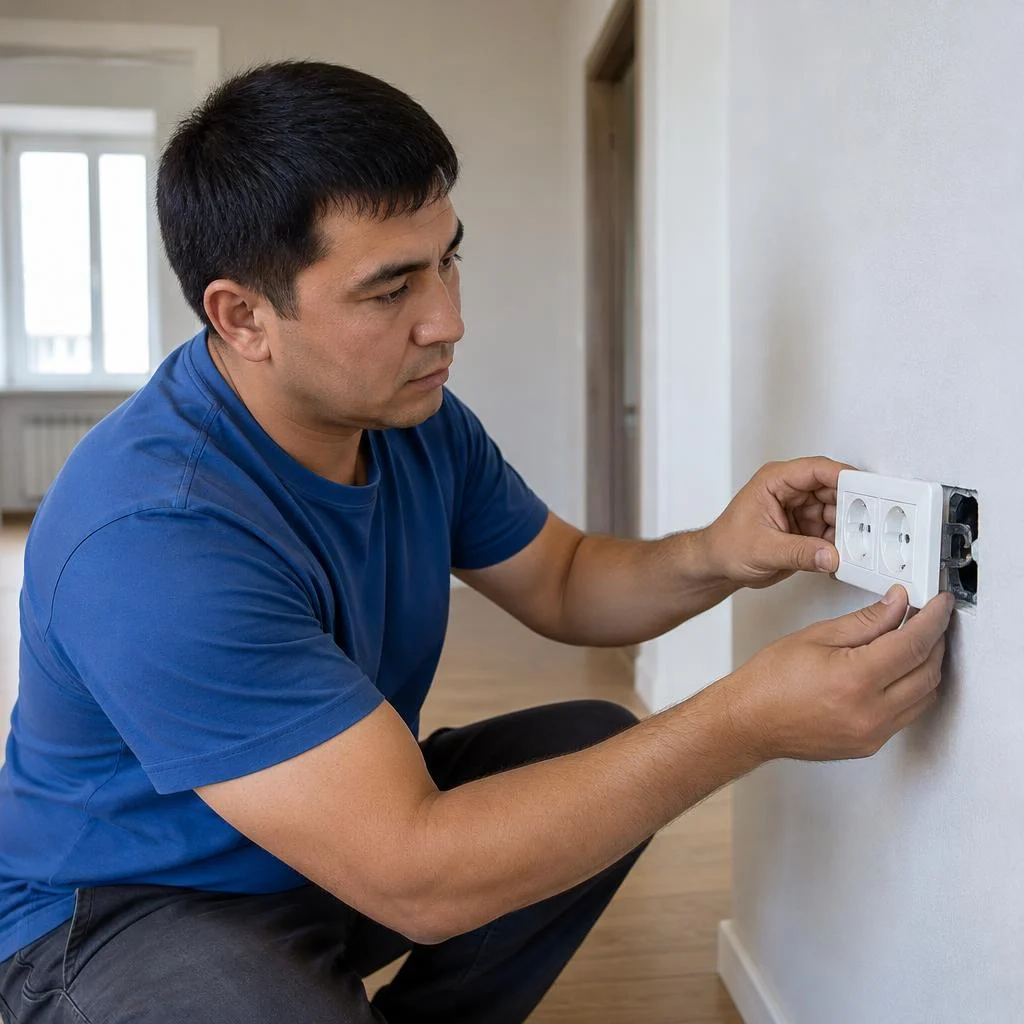
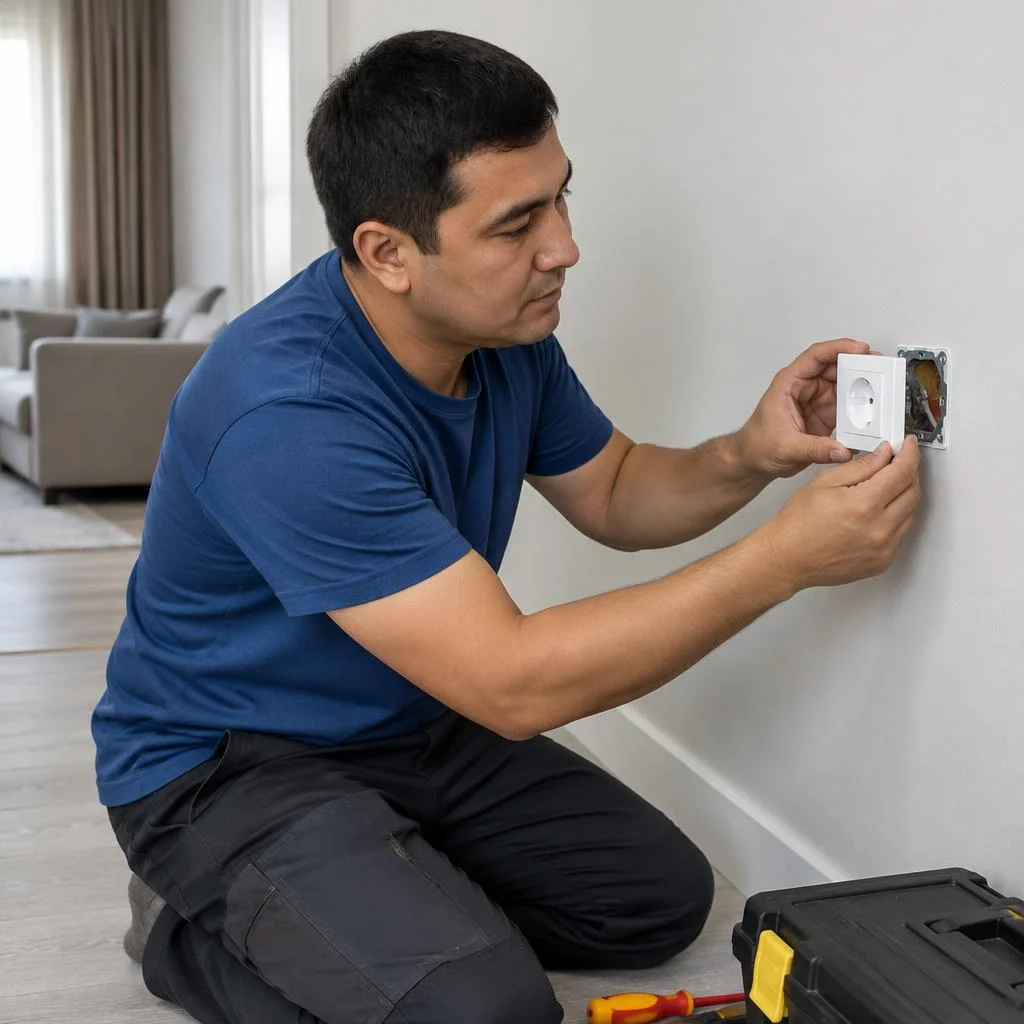
- Installation: removing the old socket, stripping and crimping the conductors, installing the mounting box, connecting and securing the mechanism in the frame.
- Testing under load: the technician connects a device and makes sure the terminals do not heat up and the contact holds the current without voltage drop; a socket that holds voltage without a device may heat up under real current, and this is only revealed by connecting a load.
2-year warranty and what it covers
We give a 2-year warranty on socket replacement: if within this period an installation defect appears — heating of the terminals, loosening of the contact, failure of the mechanism — the technician will come and fix it free of charge. We issue the warranty card on site, along with it — the work completion certificate and the payment receipt; to file a claim, it is enough to give the request number. The coverage applies to the work of our electrician and the installed fittings from Schneider Electric, Legrand and ABB, provided that the mechanism was purchased from us or supplied by the client without signs of having been opened. The warranty covers our work, but not the wear of old wiring: if the line has become unusable, it is more honest to replace the section than to keep reinstalling the socket under warranty every time.
Payment and customer reviews in Tashkent
- Click and Payme: transfer by QR code or phone number directly to the technician after acceptance of the work.
- Uzcard and Humo: card payment via a terminal that the electrician brings with him.
- Cash: accepted after checking the socket under load, before signing the certificate.
- Reviews: accumulate on Google Maps and Yandex.Maps, some clients write in Telegram — they can be seen before ordering.
- Repeat calls: the best indicator of quality — look in the reviews for mentions of addresses and repeat requests.
What affects the final estimate and how not to overpay for it
The amounts for each item are listed in the price block on the page. Here we'll break down which parameters determine the scope of work, why the estimate changes from apartment to apartment, and which questions eliminate disputed surcharges before the start.
What is included in the service and what counts as a separate job
- Disassembly and connection: removing the old socket, stripping the wires, installing the mechanism in the mounting box, and testing under load are included in the base item.
- Frame and mounting box: replacing a broken box is included in the work if it fits into the existing opening without enlarging the hole.
- Chasing and a new line: running cable from the panel, chasing the wall for a new route, and installing a separate outlet are separate estimate items.
- Work in the panel: replacing a circuit breaker, installing an RCD or RCBO for a new line are counted separately from the installation of the socket itself.
What determines the scope of work in a specific apartment
The scope of work is determined by the type of wiring, the core material, the condition of the mounting box, and the number of outlets — the technician assesses these parameters on site before starting installation. In a panel building with concealed wiring, access to the core is through the mounting box, and if the box is set in mortar, it has to be knocked out along with some of the plaster. Open wiring on clips is removed faster but requires careful laying of the new cable in a cable channel. Wiring diagnostics show the core cross-section: copper 2.5 mm² handles a line for a washing machine, while aluminum 2.5 mm² does not. An aluminum core in an old building is a common cost-increasing factor: it breaks when re-tightened, and instead of replacing the socket, you have to extend or replace a section of wire.
How not to overpay: 4 questions for the technician before work begins
- Is chasing included: clarify whether a new route is being run or the work is being done in the existing mounting box — this is the first thing that changes the estimate.
- Is the mounting box being replaced: ask whether the new mechanism fits into the old box or whether the hole will need to be enlarged and the plaster restored.
- Is a new circuit breaker needed: a separate line for high-power appliances almost always requires its own breaker in the panel — clarify this before the start.
- What about the warranty: the 2-year warranty covers installation and connection but does not cover wiring damage discovered after installation.
Fixed price: how the estimate is formed
The installation cost in the Eco-Service price list is tied to a specific item, so the boundaries of the work are visible before the technician arrives. The final cost is fixed before work begins, and the calculation for several outlets is the sum of each price list item — surcharges for volume are agreed separately rather than "added on" at the end.
Conclusion
Updating sockets is a decision about safety, not about interior design. Below are brief takeaways that will help you make a balanced decision without unnecessary expenses and rework.
Key takeaways
- Sparkling and heating: replace the socket if there is sparkling, heating, a loose plug, or darkened plastic — these are signs of a contact problem, not a cosmetic defect.
- Installation method: choose based on the type of building — in panel series, load-bearing walls cannot be chased; open installation in a cable channel is appropriate there.
- High-power appliances: a stove, boiler, and washing machine require a separate line and grounding; one new socket is not enough here.
- Options: USB, timer, and dimmer are a matter of convenience, while grounding and child protection are a matter of basic safety in a home with children.
- Before the start: clarify the scope of work and warranty terms in advance so the estimate doesn't change during installation.
- Wiring matters more than fittings: base your replacement decision on the condition of the line and the load, not the appearance of the faceplate — the neatest socket won't compensate for a weak contact.