














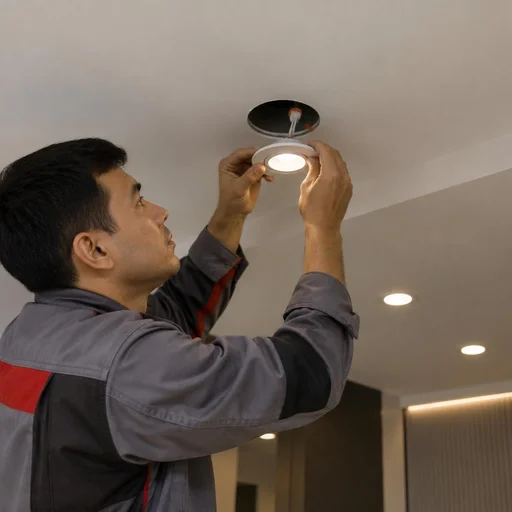
What electrical installation work Eco-Service performs in Tashkent
A full cycle of electrical work in the capital — from a single socket to assembling a panel in a new building. Below is exactly what the work includes and how it differs by the format of the property.
Full list of operations: from a socket to an electrical panel
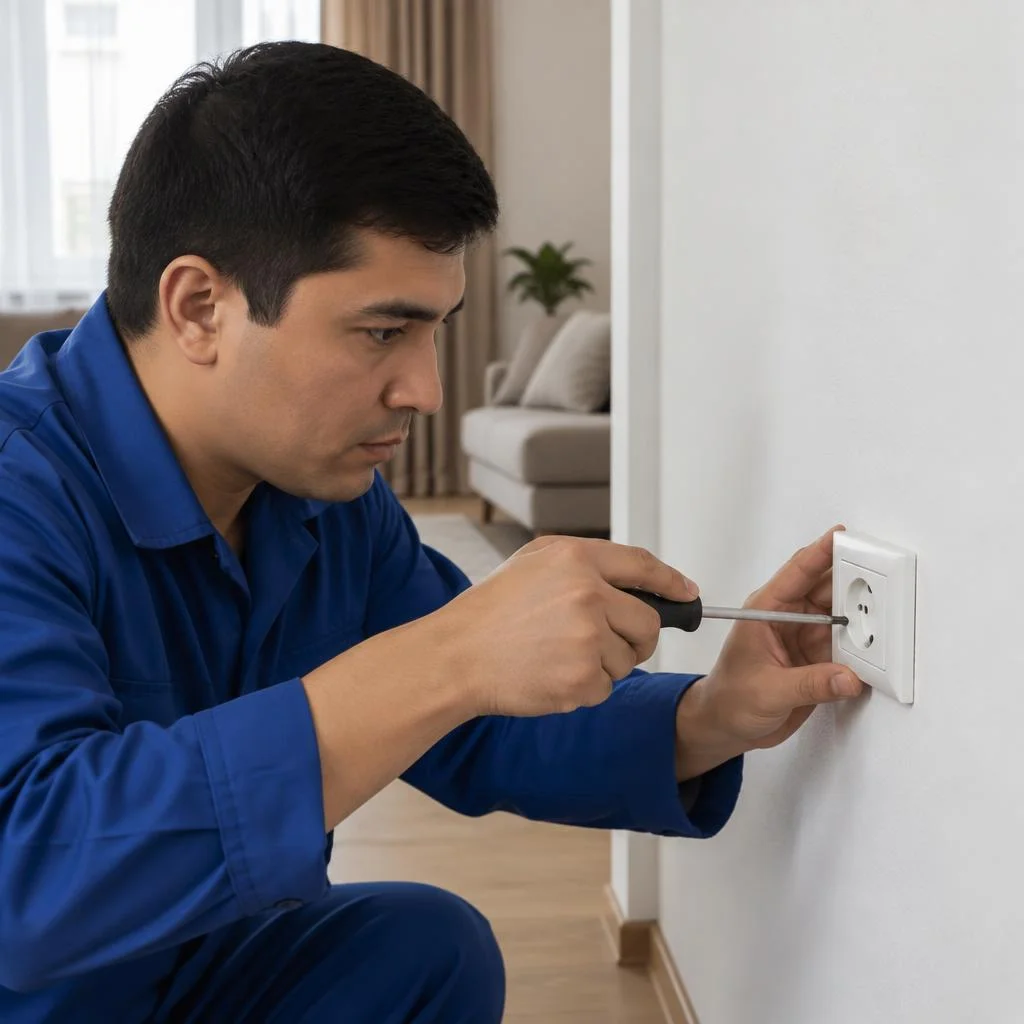
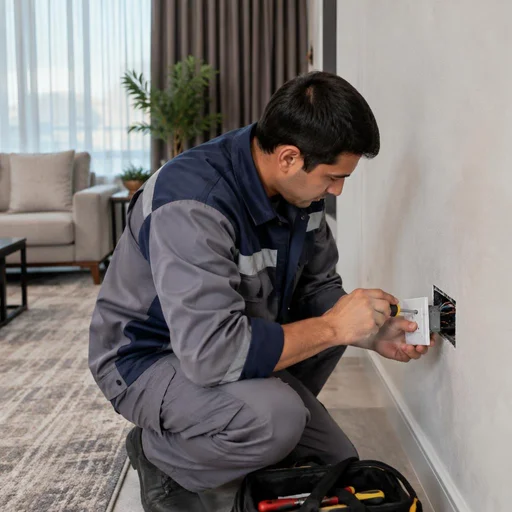
- Socket installation: mounting the back box, connecting to the line, checking with an indicator and a load tester.
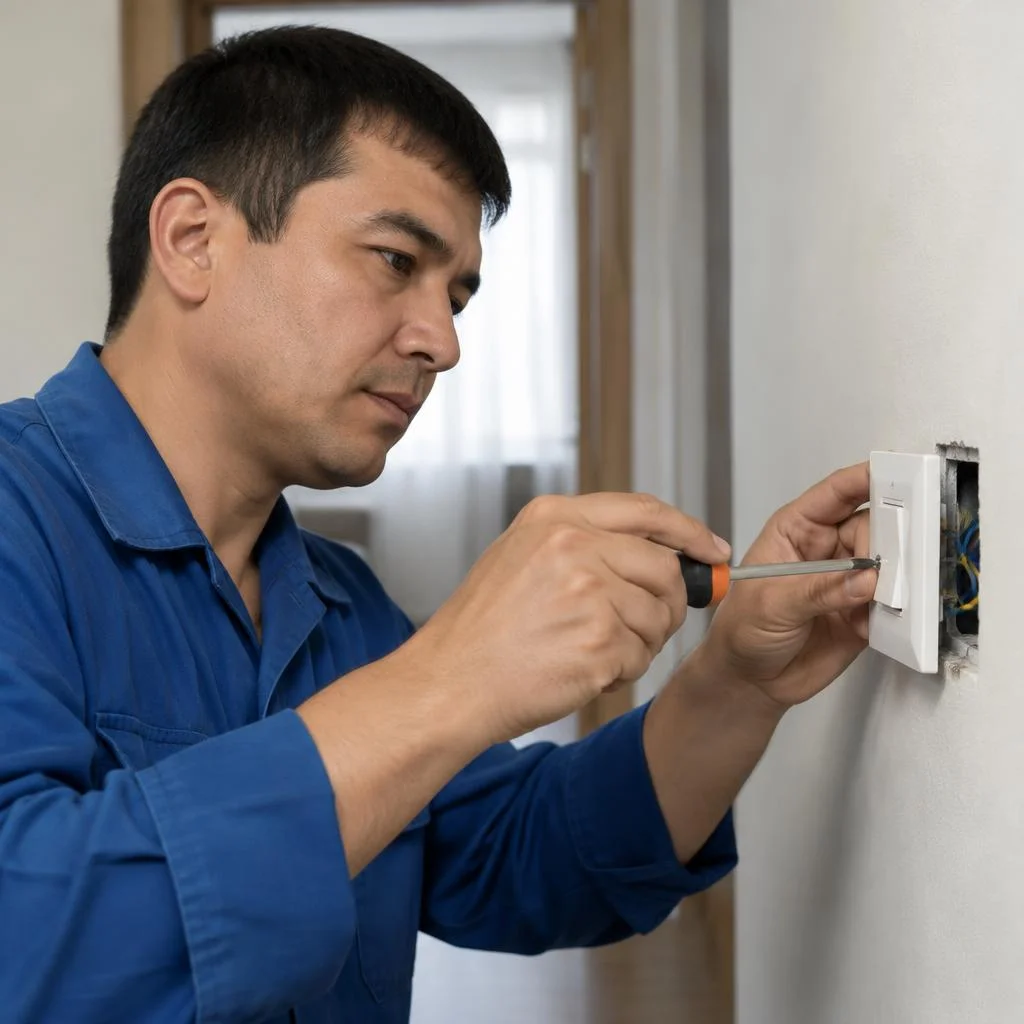
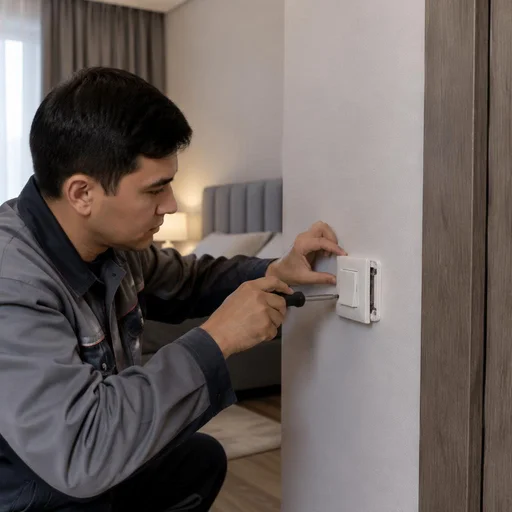
- Switch installation: one-gang, two-gang and two-way circuits, connection with a grounding conductor.
- Socket relocation: dismantling the old point, chasing for the new route, extending the cable.
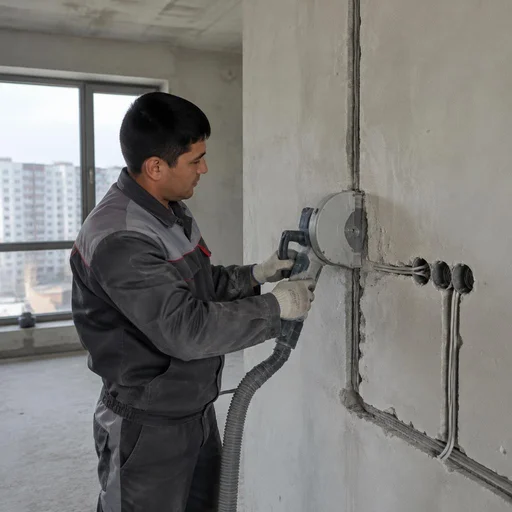
- Wall chasing for cable: cutting concrete and brick with a wall chaser with dust extraction, depth for standard cable.
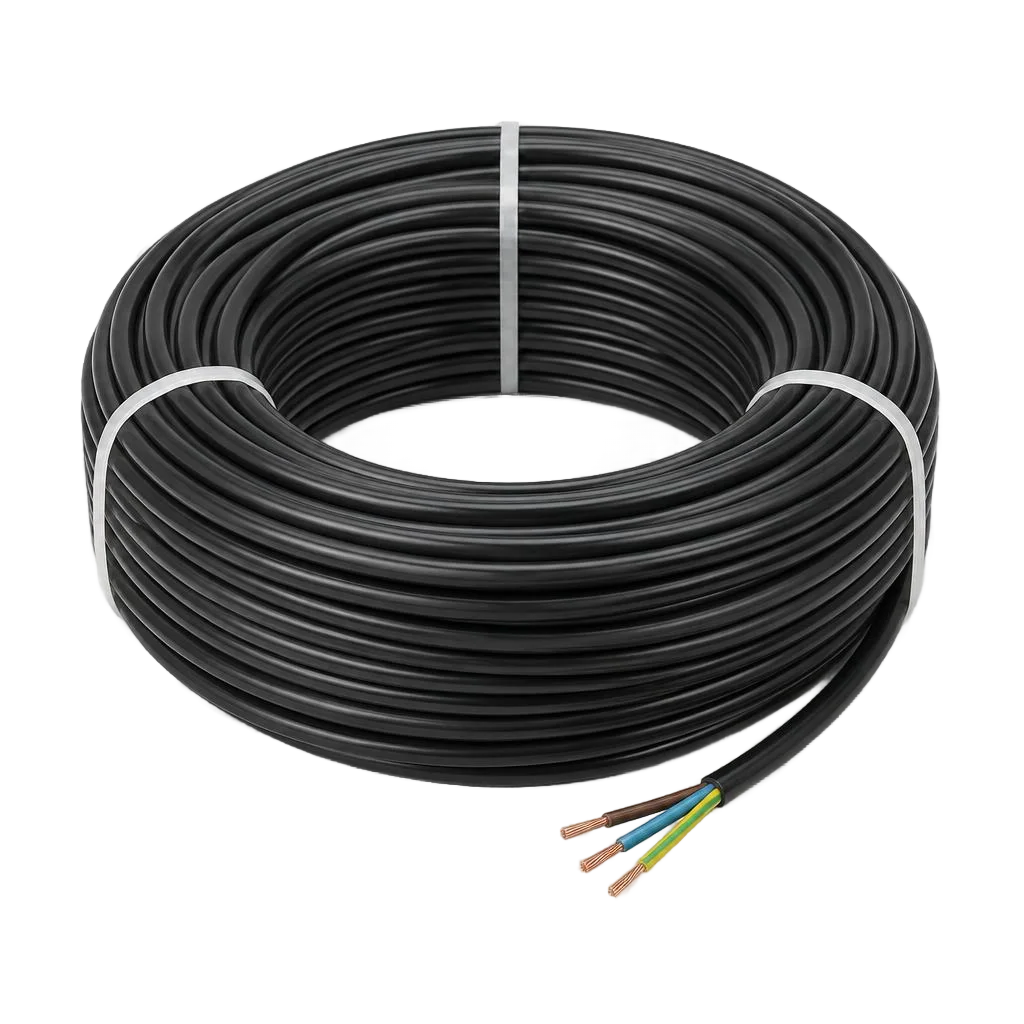
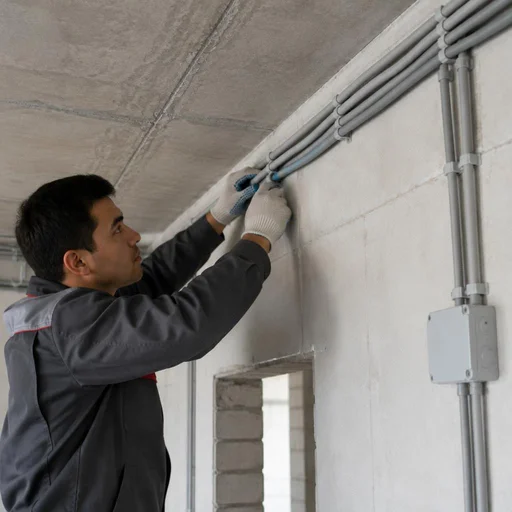
- Open cable routing: installation in a cable duct or corrugated conduit, fastening with clips along the wall.
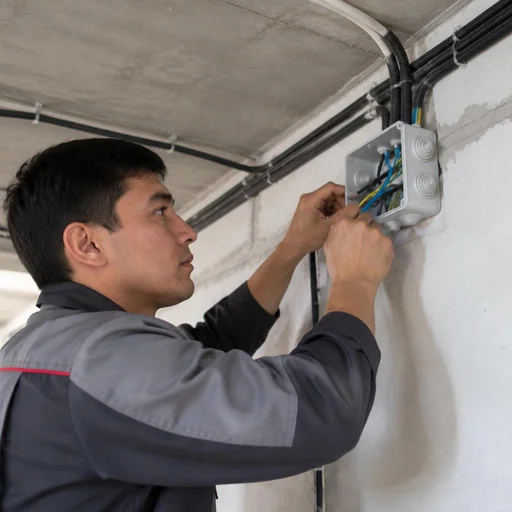
- Junction box installation: wiring out the lines, connecting with terminal blocks or welding, marking the groups.
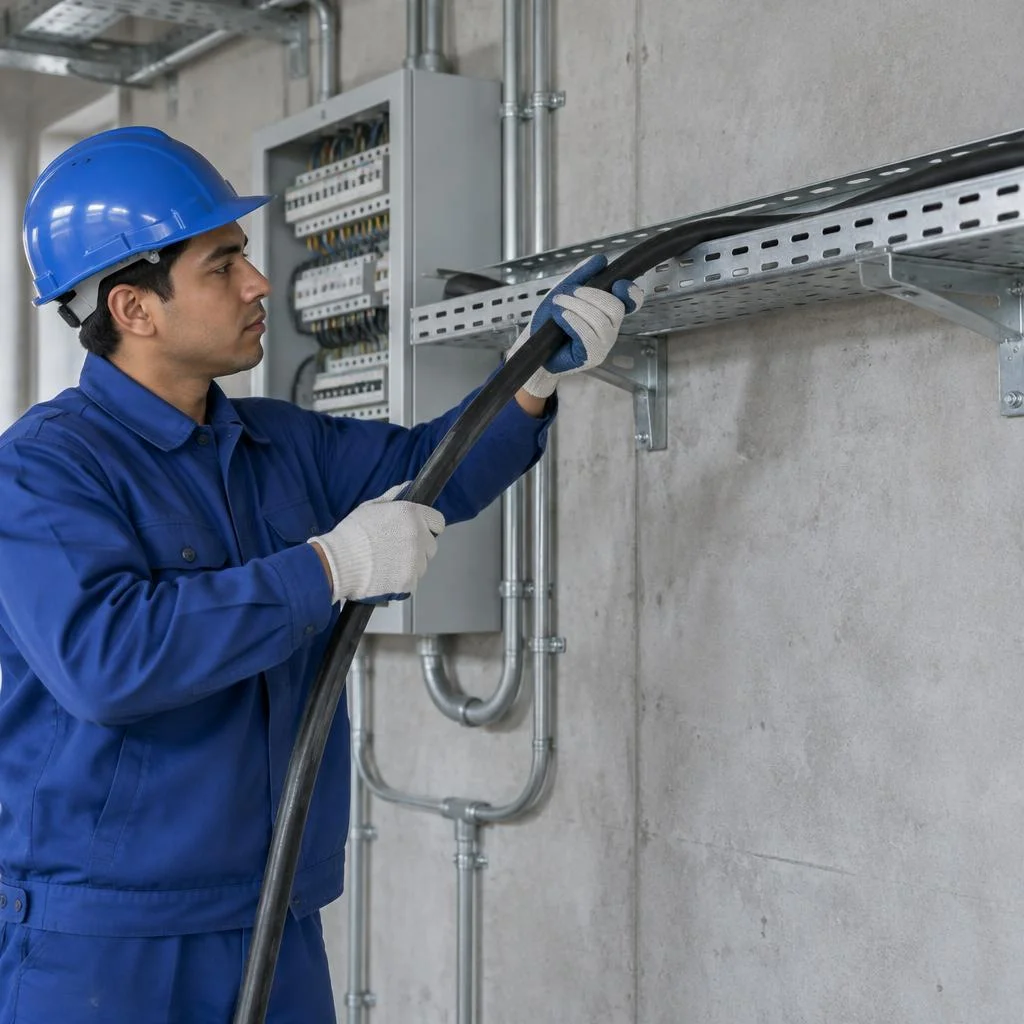
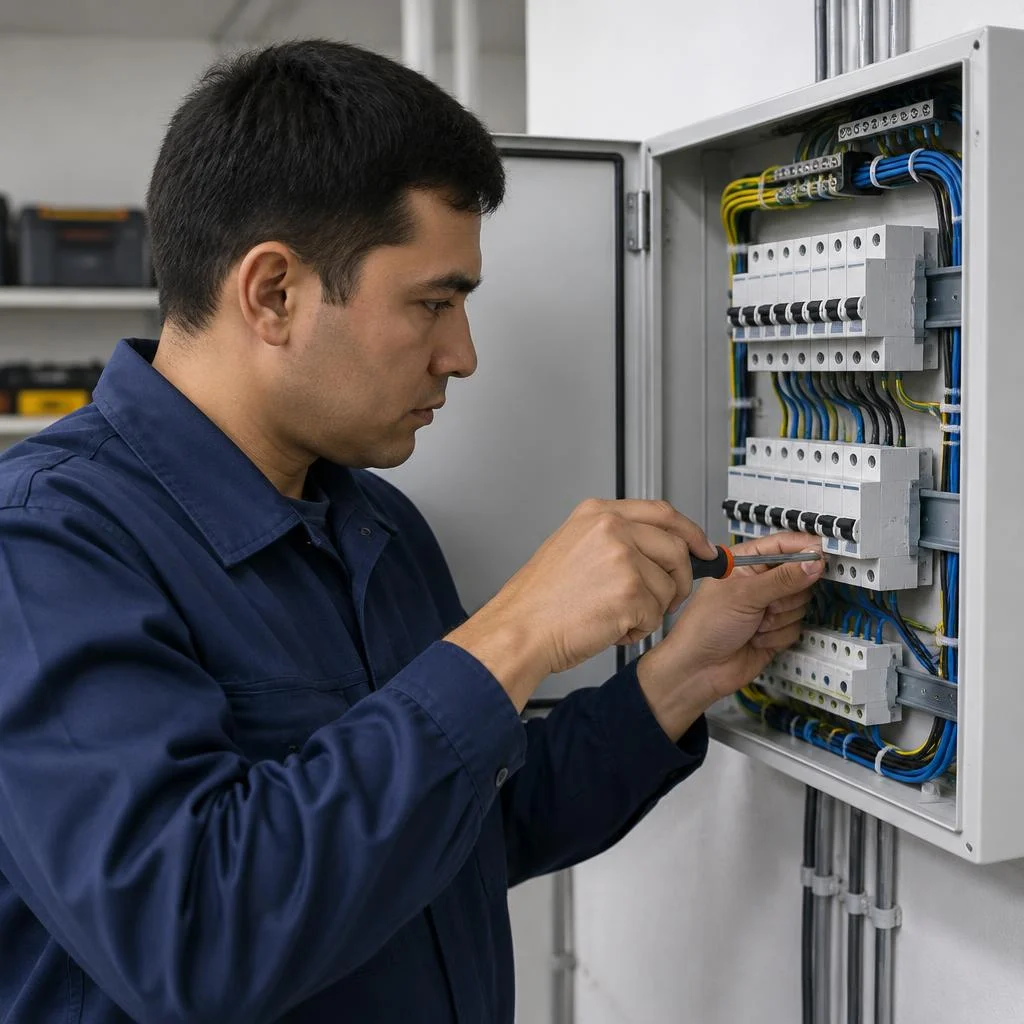
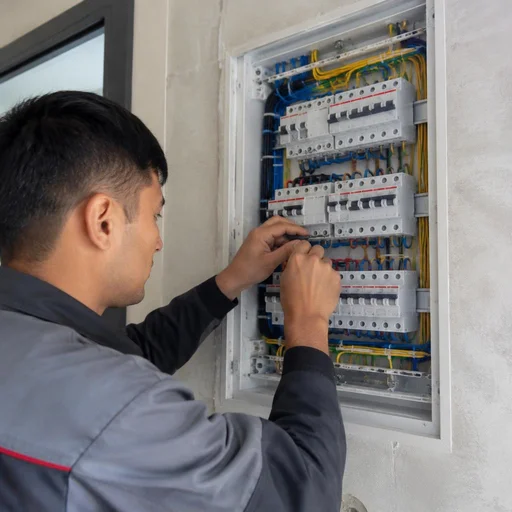
- Electrical panel assembly: arranging circuit breakers, RCDs, voltage relays, busbars and cross-modules according to the project.
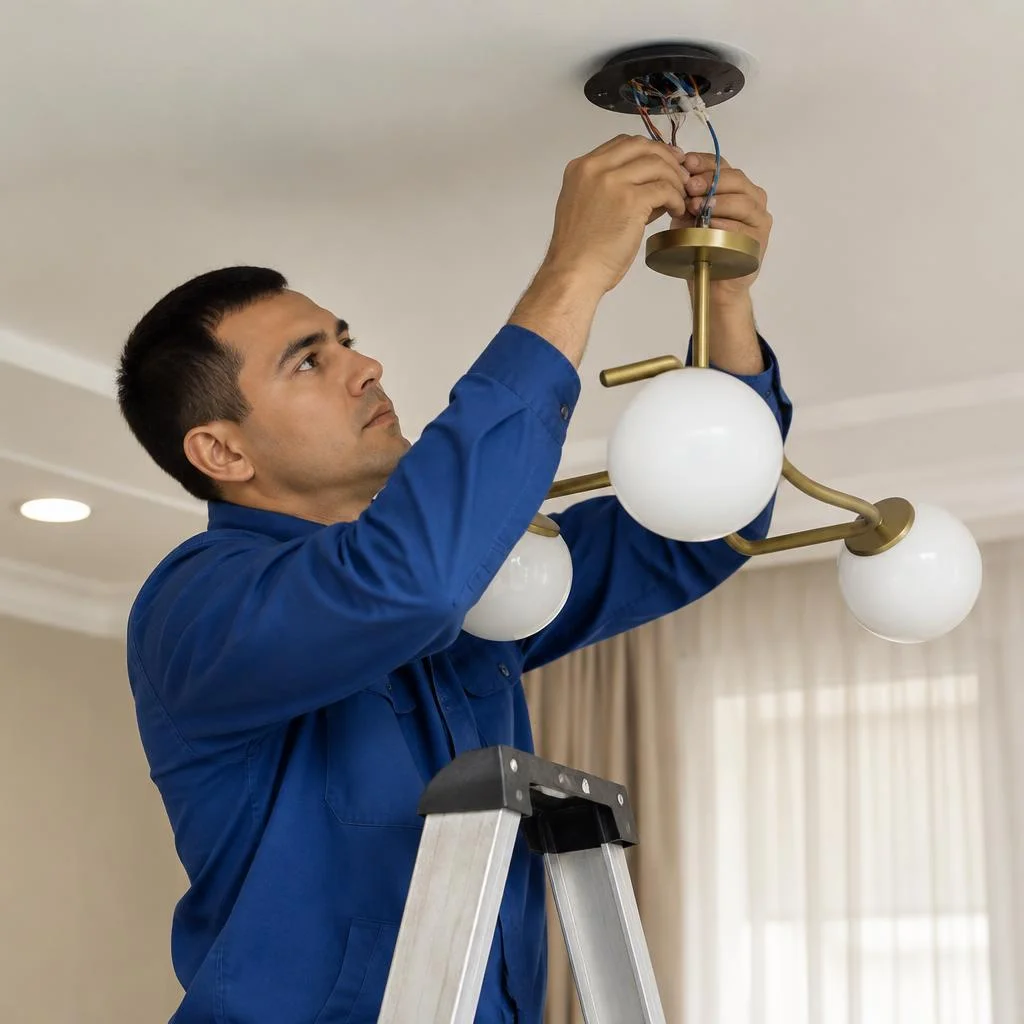
- Chandelier connection: assembling the circuit for several arms, connecting via a terminal block.
- Spotlight installation: installation in drywall or concrete, connection to the lighting group.
- Extractor fan installation: installation in a bathroom or kitchen, connection via a separate breaker.
- Internet socket installation: stripping twisted pair, crimping the connector, checking the signal with a tester.
- Low-voltage cable routing: internet, TV, intercom, video surveillance — in separate routes from the power lines.
How the work differs in a new building, a private house and an office
The difference is in the scope and sequence: in a new building, the project and marking come first; in a private house, the grounding loop and the service entrance; in an office, the separation of power and low-voltage routes. In a new building, we lay out groups for the kitchen, washing machine, air conditioners and boiler, run the cable to the panel in the hallway and leave a reserve on the breakers until the finishing stage. In a private house, lightning protection, outdoor lighting and an entrance from a pole or generator are added. In an office, separate lines go to the server room, water coolers and lighting zones so that interference does not affect the twisted pair. Clients often search for "electrical installation work price" — and land on this page, although the final estimate depends on the format of the property and the length of the routes. Another common request is electrical installation work: this is how those looking for a handyman for a one-time visit, rather than a contract for the entire property, phrase the task. Practice shows: it is cheaper to design a panel with a reserve right away than to redo it after renovation.
Table: types of Eco-Service work and what each includes
| Work | What's included | When it's needed |
|---|---|---|
| Socket installation | Back box, connection, testing | Renovation, replacing an old point |
| Socket relocation | Dismantling, wall chasing, cable extension | Furniture rearrangement |
| Wall chasing | Concrete cutting, dust extraction | Concealed wiring |
| Cable laying | Cable duct, corrugated conduit, fasteners | Exposed route |
| Junction box installation | Wiring connections, terminal blocks, labeling | Distribution to rooms |
| Electrical panel assembly | Circuit breakers, RCDs, busbars, relays | New build, panel replacement |
| Chandelier connection | Socket wiring diagram, terminal block, live wire | After ceiling work |
| Light fixture installation | Drywall or concrete, circuit group | Accent lighting |
| Internet socket | Twisted pair termination, crimping | Office, apartment |
| Low-voltage cable | TV, intercom, video surveillance | Separate route |
How Eco-Service calculates an estimate for electrical installation work
The estimate is drawn up before work begins and does not change during the process — unless the scope is expanded at the client's initiative. Below we break down what the calculation consists of, how to verify it, and why the final total matches the agreed one.
What is included in an estimate for electrical installation work
- List of works: each item is taken from a fixed price list — installing a socket, assembling an electrical panel, chasing walls for cable.
- Number of points: sockets, switches, light fixtures and junction boxes are counted individually based on the actual measurement.
- Meterage of cable and chases: the length of runs from the panel to each group and the total length of chases in the walls.
- Materials: if the contractor handles procurement, cable, circuit breakers, RCDs and mounting boxes appear as a separate line.
- Low-voltage systems: installing an internet socket and laying low-voltage cable are separate items.
- Diagnostics: locating a break in a circuit or a short circuit is included if the cause of the fault is not clear before opening up.
How to calculate the scope of work for an apartment
The scope is calculated by the number of points (sockets, switches, light fixtures), the meterage of runs and the number of groups in the panel — Eco-Service records this during the measurement. When replacing wiring in an apartment of 60-70 sq. m in a new building, the average comes to 35-45 points, 120-160 meters of cable and 8-10 groups in the panel; in a panel building of older construction the meterage is higher due to routing around load-bearing walls, and chasing is partially replaced by laying in cable conduit. Clients often search for an estimate for electrical installation work — and land on this page, where the calculation procedure is broken down step by step. The estimate is made up of these measurements, not the area of the apartment — two properties with the same floor area produce different calculations due to layout. One group per room is an outdated scheme: the kitchen and bathroom need separate lines with RCDs, otherwise when the protection trips the whole apartment goes dark.
Why the estimate does not change after work begins
Eco-Service fixes the estimate before the start: if the scope is not expanded at the client's request, the final sum matches the agreed one. The pricing is tied to an open price list, so the client sees in advance how much each operation costs and checks it against the final invoice. In search, people often type pricing for electrical installation work — that is how those who want to understand the order of figures before calling phrase their query. In practice, the estimate grows in two cases: opening up a wall reveals corroded aluminium wiring instead of copper, or the owner asks during the process to add a socket in a different place. Both changes are formalised with a separate agreement before the additional work begins — the client sees the new item and decides whether it is needed, so there is no "surprise" at the end.
Where to get pricing for electrical installation work in Tashkent
Requests for a calculation are submitted via the website or Telegram — a technician comes to measure, records the points, meterage and condition of the panel, after which the estimate arrives in written form. The measurement visit is free, and the estimate itself is valid for 14 days: during this time you can compare offers and make a decision without rushing. If the property is an office or a private house, the calculation follows the same scheme, but lines are added for the incoming cable, earthing and outdoor lighting. Clients sometimes search for pricing of electrical installation work — and land on this page, where the calculation procedure is described step by step. Before signing, check that works and materials are listed as separate lines — a mixed "turnkey" item does not make it clear where one cost ends and the other begins.
Diagnostics and emergency repair: finding a break, short circuit and sparking
When the lights go out in an apartment or there's a smell of burning — what's needed is not a replacement of the entire panel, but precise diagnostics. First we find the cause, then we calculate what repair is actually needed.
How Eco-Service finds a break in a circuit and a short circuit
We look for a break and a short circuit with a device along the route, without opening up the entire wall — first we localize the section, then we open up only that section. The technician tests the line with a multimeter and a hidden wiring detector, checks the junction boxes, the terminals of sockets and the connections in the panel, marks the location of the damage on the plan and agrees the scope of opening up with the owner. In the panel buildings of Chilanzar and Yunusabad, the route often runs in the joint between slabs, where the cable chafes against metal, and in the old Soviet-era housing stock, the aluminum crumbles right at the twists. Diagnostics take one visit, and the pricing is then calculated based on the section found, not the entire apartment. Clients often find us with the query "electrical installation work Tashkent" — and land on this page. If the breaker trips immediately when switched on — it's a short circuit; if it trips after a while — it's an overload or a bad contact. The difference determines whether to replace the breaker or look for a bad twist.
Sparking socket and restoring power to a room
We de-energize a sparking socket, check the terminals and, if necessary, replace the section of cable — restoring power to a room takes one visit. The technician removes the mechanism, inspects the contact clamps and the conductors: darkened copper, melted insulation and the smell of burning mean that it was the connection point that was heating up, not the device itself. In the Khrushchyovka buildings of Sergeli and in the Kuyluk massif, the wiring is often aluminum, and the brass terminals of new sockets don't get along with it — the contact weakens within a couple of months. If the conductor has burned back by 10-15 cm, we extend the cable through a Wago terminal block, not with a twist. If you simply replace the socket, in a month the contact will weaken again — sparking is almost always from a loosened clamp, not from a "bad socket." Many clients search for "electrical installation work prices" — and that's how they find our section with diagnostics. The price for such work here depends on the length of the damaged section.
Replacing a breaker and RCD in the panel
We replace a breaker or RCD without overhauling the entire panel — provided that the other modules are in working order and the rating is selected correctly. Before replacement, the technician measures the load current with a clamp meter, checks the heating of the busbars and the tightness of the screw terminals: a loosened contact on the incoming line heats up more than a working breaker and causes false tripping. In panels on the stairwell landing, you can't replace a module without disconnecting the riser, so we work in coordination with the management company. Prices in Tashkent also include selecting the rating for the cross-section: for 2.5 mm² copper that's 16-20 A, for 1.5 mm² — 10 A. A breaker that "trips" is often not to blame — it trips because of an overload on the line. Clients search for "electrical installation work prices in Tashkent" — and land on this section, where you can see what the estimate is made up of. Before replacing, it's worth checking the total load on the group, otherwise the new module will trip just the same.
Turnkey electrical installation: how the order and electrician's visit work
You can book a technician for a specific time — the electrician arrives with tools and consumables for typical jobs. Below is how the call-out works, what stages turnkey installation consists of, and how long typical tasks take.
How to call an electrician to your home in Tashkent
- Call or request via Telegram: the dispatcher of the Eco-Service service center records the address, the task and a convenient time for the visit.
- Online booking: in your request, specify the district — Yashnabad, Mirzo-Ulugbek, Chilanzar — and the technician will arrive within the agreed time window.
- Clarifying the task: describe the symptom in advance — "the breaker keeps tripping in the kitchen" is more precise than "a problem with the wiring", and the technician will bring the necessary consumables right away.
- Visit by a staff electrician: only staff electricians work, not contractors from classified ads, so the service center is responsible for the result.
- Payment after the work: prices are quoted before starting, and payment is accepted once the work is done via Click, Payme or Uzcard.
Turnkey stages: from measurement to handover
- Measurement and estimate: the technician walks through the property, counts the points, the length of the runs and selects the cable cross-section for the apartment's load.
- Chasing and laying: wall chasing for the cable and the laying are done according to the markings so as not to damage load-bearing structures and pipes.
- Installing points and the panel: installation of sockets and switches, mounting of junction boxes and assembly of the electrical panel with breakers and RCDs.
- Testing under load: continuity testing of the lines with a multimeter and testing the panel under load — this step should not be skipped, as it reveals weak contacts before you close up the walls and ceiling.
Timeframes for typical work
Point work — installing a socket, connecting a chandelier — we do in a single visit; wiring an apartment takes several days depending on the floor area and the number of points. On a property of up to 60 sq. m, a staff electrician closes up the runs and assembles the panel in 3-5 working days, while in a private house of 150-200 sq. m with grounding and lightning protection the timeframe stretches to 7-10 days. Much depends on access to the walls: if the renovation is starting from scratch, chasing and laying are done in parallel with the rough work. Plan chasing and laying before the finishing work — after the tiles are laid, the run will have to be routed in an exposed way. Clients often search for "price for electrical installation" and "price list for electrical installation" — the dispatcher clarifies the prices during the measurement, and the final estimate is fixed before the start. People also ask separately about the cost of installation — it is quoted after inspecting the property, because the cost depends on the number of points, the length of the runs and the wall material.
Why a direct contractor is more advantageous than a private handyman from an ad
On marketplaces and in Telegram, the price is named by the contractor, but no one is responsible for the result. Let's break down what a properly registered staff, a contract, and a 2-year warranty change when it comes to an apartment or office.
Staff electricians versus private crews
At Eco-Service, the electricians on staff have verified qualifications — their work is accepted by the service center, not by the handyman himself. Each specialist is authorized to work in Tashkent after verification of their grade classification and a practical task on assembling a panel, not based on a photo of a diploma in a profile. A private crew from an ad usually consists of two or three people without any formal registration: one negotiates, the second chases walls, the third connects. Such a team has neither a tool base nor a stock of circuit breakers and RCDs for a specific rating — they go to Texnomart or Mediapark for a part in the middle of a shift. Clients often search for prices on electrical installation and land on the service's page — that way it's easier to compare a staff specialist's rate with the prices of a crew from an ad. A private crew's warranty rests on one person's reputation; if he leaves or disappears, there's no one to file a claim against.
What working without intermediaries gives you
We don't hand the order over to a subcontractor: the estimate, deadlines, and warranty are arranged directly, without an intermediary's markup. When a dispatcher from an aggregator takes the request, he adds his own commission to the handyman's rate — usually 15-25% — and that amount goes into the final price of the work, even though the dispatcher himself doesn't come to the site and doesn't pull cable. In a direct scheme, you pay for wall chasing, cable laying, and panel assembly, not for a dispatcher's markup. Clients type the query for electrical installation prices into the search bar before approving the estimate — and from it you can see how much the work itself costs without markups. Often people also search like this: electrical installation work price — and land on the service's page, where you can see a staff specialist's rate without commission. An intermediary adds his margin to the work but isn't responsible for quality — if it has to be redone, you pay a second time. In our practice, there was a case where a client, after using an aggregator, had to redo the twists in a junction box: the handyman from the ad had assembled them without ferrules, and after a month the connection started to heat up.
Reviews and how to check the quality of work
Reviews of Eco-Service can be viewed on Google Maps and Yandex.Maps, and the quality of work is checked at handover — under load and visually. During acceptance, we apply maximum load to the line: a kettle, a heater, and an iron at the same time, then use a thermometer to check the heating of the circuit breakers in the panel and the connection points. We separately inspect the wall chases and junction boxes — access to the connections must remain open, not plastered over solid. Look not at the average score, but at reviews with photos and a description of specific work — they show how the contractor behaves when problems arise. One detailed review with a photo of an assembled panel is more informative than ten short "everything's great" ones: from it you can see whether the wires are laid out by groups and whether the circuit breakers are labeled.
2-Year Warranty and Safety of Electrical Installation Work
The warranty on completed work is 2 years. During this time, weak contacts, errors in selecting ratings, and defects in connections that are not visible when the project is handed over will manifest. Below is what exactly the warranty covers and how safety systems are set up in a private house.
What the 2-year warranty covers
- Completed work: if a contact in a terminal loosens or a circuit breaker is selected incorrectly and starts to overheat, the technician will come and fix it free of charge.
- Connections and twists: restoration of twists and connections in junction boxes is covered by warranty obligations if the assembly was disassembled by our hands.
- Selection of ratings: if we made a mistake with the characteristics of a circuit breaker or RCD when assembling the panel, we will replace it at our own expense.
- Installation of sockets and switches: loosening of the mechanism, play in the frame, poor contact of the clamp — a warranty case.
- Not covered: damage from overloading by household appliances, external voltage surges, and unauthorized interference with the panel.
Grounding and lightning protection in a private house
Eco-Service installs grounding loops and lightning protection for private houses in Tashkent and the suburbs — this is a mandatory element if the house has a washing machine, boiler, inverter, or pumping equipment. The loop is assembled from three vertical electrodes 2-3 meters long, welded to a 40×4 mm strip, with a spreading resistance of no higher than 10 Ohms according to the norms for re-grounding. Lightning protection is a separate system: an air terminal on the ridge, a down conductor along the facade, and its own ground electrode not directly connected to the household loop. Without grounding, an RCD may not trip during a leakage: the protection is in the panel, but the leakage current has nowhere to go — it flows through the appliance body or a person.
Connecting a generator as backup power
Eco-Service connects a generator through a changeover switch — power is switched without the risk of feeding current back into the city grid. The scheme includes a two-position switch, a separate line from the generator to the panel, a protective circuit breaker matched to the station's rated power, and grounding of the body. For household generators of 3-8 kW, a 32-40 A switch and a cable with a cross-section of 4-6 mm² from the station to the panel are usually sufficient. Simply plugging a generator into a socket is dangerous: when city voltage returns, the current flows in the opposite direction and can injure a crew at the substation — the changeover switch physically breaks this connection.
How to read a price list for work performed
The price list for electrical installation work is structured by types of operations: a separate line for installing a socket, wall chasing, panel assembly, fault finding. Clients often search for estimates for electrical installation work — and land on this page, although what they need is not a price list but a calculation for the project. When ordering a package of 10-15 operations, the total is calculated not by line items but by the project — in this case the price is fixed before the start and does not change. Estimates for installation in a private house and an office differ in composition: in a house, a grounding loop and an incoming cable are added; in an office, low-voltage lines and distribution into groups. Request a calculation broken down by operations, not a single sum — that way you can see exactly what you are paying for.
Conclusion
Electrical work in an apartment, office, or private house rests on three things: an accurate design, a fixed estimate, and a direct contractor. Below are brief takeaways worth keeping at hand before you start.
Key takeaways
- Full cycle with one contractor: wall chasing, wiring, panel assembly, and light connection in one pair of hands saves 3-5 days on coordination between crews.
- Itemized estimate before starting: demand a breakdown for each point and lock it in before work begins — otherwise the scope will "grow" at the wall-chasing stage.
- An emergency starts with diagnostics: finding a break or short circuit is cheaper than replacing the entire panel, so first ring out the lines, then decide on replacement.
- A 2-year warranty works with a direct contractor: a staff electrician provides a work completion report and a receipt, while a crew from an ad gives you only a phone number that will change in a month.
- Plan before finish finishing: wall chasing and cable routing are done before plastering and tile laying, otherwise the walls get opened up again.